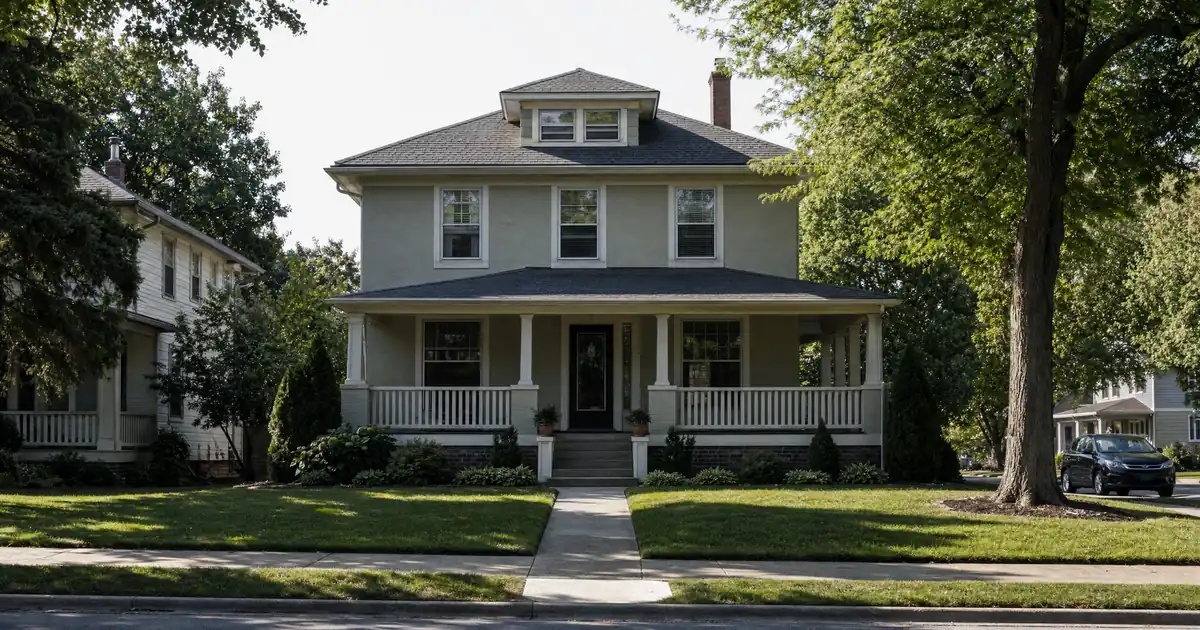
The Quick Read: A rental property home equity loan lets you borrow against the equity in a property you rent out. You can take it as a lump sum or as a revolving line. Your existing first mortgage stays exactly where it is. The property isn’t owner-occupied, so lenders treat the file as business-purpose credit. That means a narrower list of lenders, a higher credit floor, and lower leverage than a HELOC on your own home. Investment-property lines commonly cap near 70% combined loan-to-value. Credit profiles typically need to start around 700. For larger loan amounts or LLC-titled properties, a DSCR cash-out refinance often fits better than a second lien.
Key Takeaways
- A home equity loan (lump sum) and a HELOC (revolving line) both sit as second liens behind your current first mortgage on the rental.
- Investment-property lines typically require a credit profile around 700 or higher and commonly cap near 70% combined loan-to-value on Lendmire’s wholesale-network guidelines.
- Lines above a certain size usually move from an automated valuation to a full appraisal.
- Title has to sit with the individual borrower or a revocable living trust — an LLC-owned rental generally needs a vesting change or a different loan structure entirely.
- A DSCR cash-out refinance often fits better for larger loan amounts, LLC-titled properties, or investors who’d rather replace the first mortgage than stack a second one behind it.
What Is a Rental Property Home Equity Loan?
It’s a loan or line of credit secured by the equity in a property you don’t live in. It sits behind your existing mortgage instead of replacing it. There are two structures. A closed-end home equity loan hands you a lump sum upfront on a fixed repayment schedule. A HELOC works more like a credit line. You draw what you need, when you need it, up to an approved limit.
How large a line the equity supports in your market.
An equity line is sized by combined loan-to-value, occupancy, and credit — not by rental coverage. Switch the occupancy or the credit band and the ceiling moves with it.
Investment-property lines require a 700 minimum credit score. Second-home tiers reach 640; primary-residence tiers reach 600.
A debt-to-income ratio above 45% requires 680+ credit. Profiles under 640 are limited to single-family homes. At least 75% of the approved line is drawn at closing. Ceilings, floors, and caps update from Lendmire’s centralized guideline source.
Line estimate
Illustrative estimate only — not a quote, Loan Estimate, approval, or commitment to lend. The rate is an editable assumption; equity-line pricing is variable through both the draw and repayment periods and never converts to fixed. Occupancy and credit drive the ceiling together: investment property runs to 70% combined LTV with a 700 credit floor and a $500,000 cap; a second home runs to 70% at a 640 floor with a $500,000 cap; a primary residence reaches up to 80% at a 600 floor, and its $750,000 maximum line applies only at 75% combined LTV or below with 720+ credit and a full appraisal. Lines above $500,000 require a full appraisal. Credit, debt-to-income, property type, and full underwriting review all affect the final line.
On an owner-occupied home, this is a familiar product at almost any bank. On a rental, it’s genuinely narrower. Fewer lenders offer it at all. Independent comparison research from Finder.com confirms that many large retail lenders simply don’t extend HELOCs against non-owner-occupied collateral. That gap is exactly why non-QM wholesale channels have stepped in. Lendmire’s own coverage of how home equity loans work on rental property breaks down the baseline mechanics in more detail.
The appeal is simple. Your current first mortgage — rate, term, balance — doesn’t get disturbed. You’re adding a second lien on top of it, not replacing it.
Key Terms Defined
Home equity loan — a one-time lump sum borrowed against a property’s equity, repaid on a fixed schedule.
HELOC (home equity line of credit) — a revolving credit line secured by property equity, drawn from during a set period and repaid afterward.
CLTV (combined loan-to-value) — the first mortgage balance plus the new second lien, measured against the property’s current value. This is the number underwriting actually cares about, not the second lien in isolation.
Lien position — where a loan sits in the payoff order if the property is ever sold or foreclosed on. First liens get paid before second liens.
Business-purpose loan — a loan made for investment or rental purposes rather than personal use, which changes how it’s documented and reviewed.
Seasoning — the length of time you have to own a property before a lender will add new debt against it or refinance it.
DSCR (debt-service coverage ratio) — a way of qualifying a loan primarily on the rent a property produces rather than the owner’s personal income, expressed as a ratio of rent to the monthly obligation.
How Underwriting Actually Treats a Rental Property Home Equity Loan
Underwriting on a rental-property line follows a specific sequence. It looks different from an owner-occupied HELOC file at almost every step.
Credit comes first, and it’s a hard floor, not a soft target. Across Lendmire’s wholesale network, investment-property lines generally start at a 700 credit profile. There’s no lower tier for this product on a rental. That’s meaningfully higher than the 640 floor typically seen on a second home or the 600 floor on a primary residence. If your score sits below 700, this specific line product usually isn’t on the table for a rental at all.
A stronger score buys eligibility more than it buys leverage. Both a 700 and a 720 credit profile commonly reach the same 70% CLTV ceiling on lines up to $500,000. The investment line itself caps at $500,000 — larger-line tiers with a 720 minimum and a full appraisal apply to owner-occupied files. In other words, credit above 700 mostly opens the door to bigger lines. It doesn’t automatically stretch the leverage on a smaller one.
Valuation depends on line size. Lines from roughly $10,000 up to $500,000 are ordinarily valued through an automated model, with no traditional appraisal walk-through. Only above $500,000 does a full appraisal typically become mandatory — though a borrower can request one at any size. Where rental income does factor into the file, the underlying appraisal convention across the industry runs through Fannie Mae’s standardized forms. That means the Single-Family Comparable Rent Schedule (Form 1007) for one-unit properties, and the operating income statement for 2-4 unit buildings. These forms exist to document market rent, not to underwrite a DSCR loan directly. Still, the non-QM industry has broadly adopted the same appraisal convention.
Debt-to-income sits on top of credit. The product typically caps overall DTI around 50%, tightening for weaker credit files. It’s calculated off the interest-only payment at the line’s maximum draw amount, not just what’s currently outstanding. That matters. A lender assumes you’ll eventually tap the whole line, and qualifies you as if you already had.
The draw structure is a hybrid, not a pure lump sum or pure line. Tennessee shortens the runway on both network structures: a 3-year draw with a 12-year repayment on the higher-leverage program, and a 5-year draw with a 10-year repayment on the longer-runway program. Here’s the practitioner detail worth knowing: even investors who conceptually want a “lump sum” typically have to draw at least 75% of the approved line at closing. In practice, the line functions much like a closed-end loan for most borrowers, with a small reserve of undrawn room left over.
Title and vesting are the sharpest structural difference from a DSCR loan. The property has to be titled to the individual borrower or held in an inter vivos revocable living trust. LLCs, corporations, partnerships, and irrevocable, blind, or land trusts can’t hold title on this product — full stop. That single fact reshapes which investors this line even applies to. It’s covered in more depth in Lendmire’s guide to pulling equity out of a rental through a DSCR loan.
Exposure caps limit how far this scales. A borrower can hold up to three lines, with combined exposure to $2,000,000 on the higher-leverage program ($750,000 on the longer-runway program) and a 15-financed-property limit on both. An investor owning more than 15 financed properties typically isn’t eligible for the product at all.
Property type matters as much as the borrower. Single-family homes, 2-4 units, PUDs, townhomes, and condos — including non-warrantable condos — are generally eligible, along with modular factory-built homes. Manufactured homes, co-ops, condotels, timeshares, barndominiums, log homes, commercial and mixed-use property, agricultural-zoned land, and raw land are not eligible on this product.
The Structures and Variations You’ll Run Into
The core choice is lump sum versus revolving line. But a third option belongs in the same conversation: a DSCR cash-out refinance, which replaces the first mortgage entirely instead of stacking a second lien behind it.
| Factor | HELOC / Home Equity Line | DSCR Cash-Out Refinance |
|---|---|---|
| Lien position | Second, behind existing first mortgage | New first mortgage, replaces existing one |
| Reviewed on | Borrower credit and debt-to-income | Property rent covering the payment (coverage ratio) |
| Title | Individual borrower or revocable trust only | Individual or LLC, program-dependent |
| Typical leverage | Up to roughly 70% CLTV, per lender tier | Comparable leverage available, per lender guidelines |
| Existing first mortgage | Stays in place, untouched | Replaced entirely |
A DSCR cash-out refinance qualifies mainly on one thing: whether the property’s rent covers the payment, subject to lender guidelines. It doesn’t run through the borrower’s personal debt-to-income the way a second lien does. That’s the entire appeal for an investor whose personal file is tight but whose rent roll is strong. Across the network, DSCR cash-out refinances typically top out around 75% LTV, with roughly six months of ownership seasoning expected before the refinance closes. Loan sizes generally reach up to $3,000,000 on standard programs, with smaller balances available through select lenders. Above $2,500,000, the network generally holds to 30-year fixed structures rather than shorter or adjustable terms. That said, extended amortization (40-year) and interest-only periods are available through select lenders for investors who want lower scheduled payments, and adjustable-rate structures exist for those who prefer them.
Clearing a 1.00 coverage ratio is a select-program floor on some DSCR products, not a universal standard. It simply means rent covers the payment as calculated. It is not the same thing as positive cash flow. Repairs, vacancy, management fees, utilities, and capital expenditures all sit outside that ratio. Investors weighing this route against a second lien should read Lendmire’s complete DSCR loans guide for the full mechanics, or the DSCR cash-out refinance breakdown specifically.
If the goal is pulling equity from one rental to fund the purchase of another, purchase leverage on the destination property typically runs 75%-80% LTV. Select high-leverage programs reach 85% for borrowers carrying a roughly 700+ credit profile. Lendmire’s article on taking equity out of a rental to buy another property walks through that specific sequencing.
Rental-property home equity lines are also business-purpose loans, not consumer credit. Because they finance non-owner-occupied property, they’re reviewed on a different track than a HELOC on the home you live in, with different documentation and different underwriting emphasis.
Where the General Rule Breaks
LLC-titled properties. This is the single biggest wall investors hit. If your rental is already deeded to an LLC, the standalone home equity line product simply isn’t available. You’d need a vesting change back to the individual borrower or a qualifying trust. That option carries its own tax and liability tradeoffs worth discussing with a professional first. For LLC-titled rentals, a DSCR cash-out refinance is generally the cleaner path, since several programs in the network accept LLC vesting depending on the loan.
Duplexes and triplexes you also live in. House-hackers occupying one unit of a multi-unit property sit in genuinely ambiguous territory. Compliance guidance built on federal business-purpose exemption rules notes something important here. Credit extended to acquire an owner-occupied rental property is generally treated as business-purpose only if the property has more than two units. Credit to improve or maintain it needs more than four units to clear the same bar. That’s a detail worth flagging with a lender early, since it can shift how the file gets classified before it’s even underwritten. See Compliance Alliance’s breakdown of Regulation Z and investment properties for the underlying framework.
A property recently listed for sale. Several state overlays in the network — Indiana, North Carolina, Pennsylvania, Tennessee, Texas, and Washington — treat a property listed within the prior 60 days as ineligible outright. Elsewhere, listing history simply pulls leverage down rather than killing the deal. Some depository lenders elsewhere apply similar listing-history reductions on top of a standard seasoning clock.
Texas. The state’s famous once-a-year cash-out rule, its 12-day waiting period, and its 12-month seasoning clock bind primary residences only. Texas second homes and investment properties are treated as non-homestead transactions and don’t carry those restrictions. That said, Texas properties on this product are limited to 10 acres regardless of use.
New Mexico and Ohio. Both apply a CLTV cap that scales with the borrower’s credit profile rather than a single flat ceiling. That’s worth confirming file-by-file rather than assuming the general 70% figure applies uniformly.
Short-term rentals. The standard rent-schedule appraisal form was built for long-term leases, not nightly-rate properties. That complicates using this specific home equity line on an STR. Investors pulling equity from a short-term rental more often use a DSCR structure instead. There, purchase leverage typically runs up to 75% LTV, with refinance and cash-out closer to 70%. Alongside that, expect a roughly 700+ credit profile, about 12 months of hosting history, and a 1.00 coverage floor commonly expected. Short-term rental rules can also vary by city, county, HOA, and property type. Confirming local rules before relying on projected rental income matters regardless of financing structure.
What the Investor Decision Actually Looks Like
The decision usually comes down to what you’re trying to protect and how the property is titled. It’s not just about what rate sounds better on paper.
A second lien makes sense in a few clear situations. Your existing first mortgage is worth keeping untouched. Your rental is titled to you personally or a revocable trust. The amount you need fits comfortably inside the $500,000 cap this product tops out at on a rental. It also fits investors who want ongoing access to capital — a line they can draw against for repairs or the next opportunity — rather than one large check today.
A DSCR cash-out refinance tends to win in different situations. The property sits in an LLC. The loan amount you need exceeds what a second lien can offer. Or you’d simply rather have one new first-lien loan than two stacked liens with two sets of terms to track. It also wins when your personal debt-to-income is tight but the property’s rent is strong, since the coverage ratio — not your W-2 — carries the file.
Tax treatment can depend on how the funds are used and how the property is held. Investors should keep clear records and speak with a qualified tax professional before relying on any deduction.
If you’re weighing a rental property home equity loan against a DSCR cash-out refinance, Lendmire (NMLS# 2371349) can help compare both paths through its wholesale network of lenders. This works well if you want to see how the numbers line up for your credit profile, leverage target, and property. Lendmire’s own home equity line product is available through select wholesale partners across 16 full-service states, including California, Florida, Texas, and Ohio. Its DSCR investor loan programs reach a broader footprint of 39 states plus Washington, D.C. Investors can request a quote at Lendmire’s quote form or call 828-256-2183 to walk through which structure fits.
None of this is a commitment to lend, and no scenario described here guarantees approval. Every file is subject to lender approval and underwriting. It depends on the borrower’s credit profile, the property, and the specific program guidelines in effect at the time of application. This article is general information, not financial, legal, or tax advice. It shouldn’t be relied on as a substitute for speaking with a qualified professional about your specific situation.
Frequently Asked Questions
Can I get a home equity loan on a rental property I don’t live in?
Yes — but expect a narrower shortlist of lenders than you’d find for a primary residence. The credit floor typically starts around 700, and combined leverage tops out closer to 70% CLTV rather than the 80-85% some owner-occupied HELOCs allow. Many large retail banks skip this product for non-owner-occupied collateral entirely, which is part of why wholesale non-QM channels carry more of this volume.
Does pulling equity out through a second lien affect my existing mortgage?
No, not directly. The first mortgage keeps its own balance, term, and structure exactly as it is. The new second lien simply sits behind it in payoff order. That’s the main reason investors choose a second lien over a full refinance in the first place.
Can an LLC take out a home equity loan on a rental property?
Generally, no. This specific product requires title to sit with the individual borrower or a qualifying revocable living trust. LLCs, corporations, and irrevocable trusts don’t qualify for vesting on it. An LLC-titled rental usually needs either a vesting change or a different structure, such as a DSCR cash-out refinance, which accepts LLC vesting depending on the program.
Is the interest on a rental property home equity loan tax-deductible?
It depends on how the funds are used and how the property is held, so there’s no single answer that applies to every borrower. Investors should keep documentation of what the proceeds were spent on and talk to a qualified tax professional before assuming any deduction applies.
What’s the difference between this and a DSCR cash-out refinance?
A home equity loan or HELOC is a second lien that leaves your existing first mortgage untouched. It qualifies mainly on your personal credit and debt-to-income. A DSCR cash-out refinance replaces the first mortgage entirely and qualifies primarily on the property’s rental income covering the payment, subject to lender guidelines. That’s a meaningfully different underwriting path for the same goal of accessing equity.
This article is for general informational purposes only and does not constitute financial, legal, or tax advice. Loan approval is never guaranteed. All scenarios described are subject to lender approval and underwriting, and depend on borrower credit, property eligibility, and the specific loan program’s guidelines in effect at the time of application. Lendmire is a mortgage broker and arranges financing through select wholesale lending partners; it is not the lender and does not fund, underwrite, or guarantee approval of any loan.
About Lendmire
Lendmire (NMLS# 2371349) is a non-QM mortgage broker serving investors in 40 markets including Washington, D.C. Lendmire helps structure DSCR scenarios commonly evaluated around a property’s rental income rather than personal income paperwork, subject to lender guidelines. A Scotsman Guide Top Mortgage Workplace in 2025 and 2026, Lendmire places loans through wholesale investor lenders and is not a direct lender.
Lendmire’s Top Mortgage Workplace recognition is documented by Scotsman Guide 2025 Top Mortgage Workplace and Scotsman Guide 2026 Top Mortgage Workplace.
Get Started
Ready to find the right loan for you?
In about 30 seconds you can review financing options available for your home or investment property. No commitment required.
Informational only. Not a Loan Estimate, approval, or commitment to lend. Program availability and eligibility are subject to lender guidelines, credit approval, property review, and underwriting.
References
1. Finder.com – Can You Get a HELOC on an Investment Property
2. Fannie Mae Selling Guide – Rental Income (B3-3.8-01)
3. Compliance Alliance – Regulation Z and “Investment” Properties
Brandon Miller
Founder & CEO, Mortgage Loan Originator, Lendmire LLC
- Mortgage Loan Originator · NMLS# 1129696 · Verify on NMLS Consumer Access
- North Carolina Real Estate Broker · License# 343312 · Verify on NCREC
- North Carolina Insurance Producer · License# 19053198 · Property, Casualty, Life, Health · Verify on NAIC SBS
- Lendmire LLC · Firm NMLS# 2371349 · Verify firm licensure
Important disclosures. Lendmire (NMLS# 2371349) is a licensed mortgage brokerage. Lendmire is not a direct lender, depository institution, or financial advisor. All loan inquiries are subject to lender underwriting; this article does not constitute a commitment to lend. Rates, terms, and program guidelines are subject to change without notice and vary by borrower profile, property type, and state. Information in this article is general in nature and is not financial, legal, or tax advice. Equal Housing Opportunity. NMLS Consumer Access: nmlsconsumeraccess.org.