
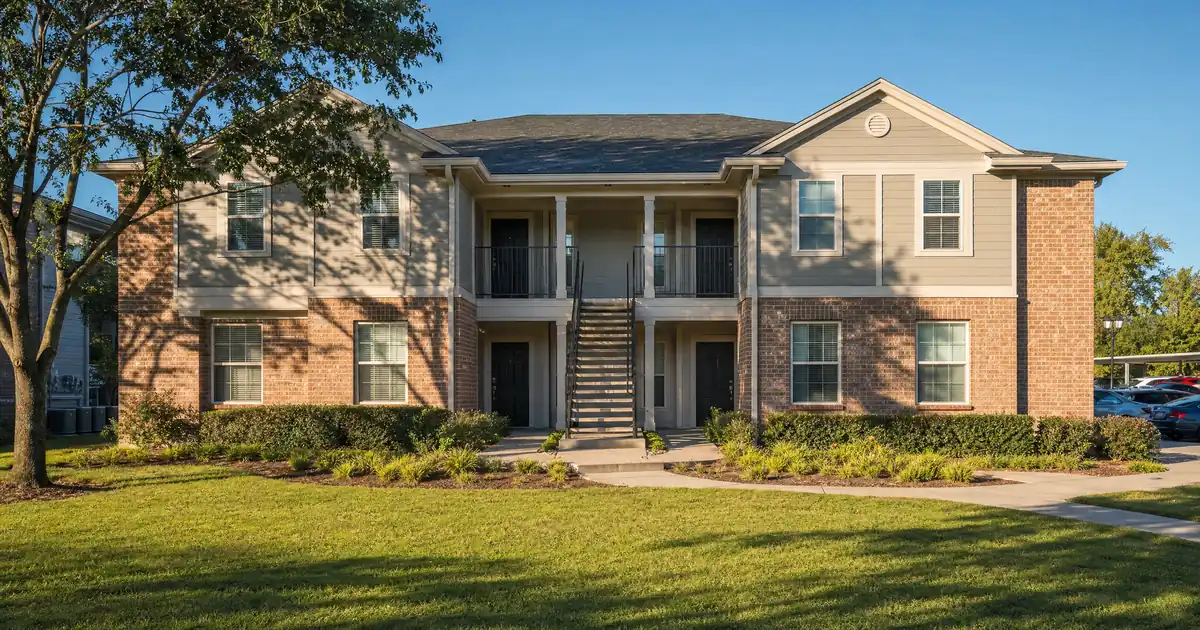
Multifamily Debt Refinance — The Quick Read: Refinancing a rental property works differently depending on how many units it has. A 1-4 unit rental refinances like a residential property. A building with five or more units moves into commercial underwriting, with its own appraisal rules and its own coverage math. Both paths test the same basic thing: does the property’s income cover the new debt? Lenders measure this with a coverage ratio, not the borrower’s personal income. A large chunk of multifamily debt is set to mature over the next couple of years. Knowing which lane your property sits in — and how that lane treats seasoning, leverage, and coverage — makes the difference between a smooth refinance and a last-minute scramble.
Which Lending World Is This Property In?
Unit count is the biggest fork in the road for any multifamily refinance. It decides almost everything that follows. A property with one to four units gets treated as residential real estate for financing. A building with five or more units crosses into commercial territory. That means different appraisal forms, a different type of licensed appraiser, and often a different lending channel altogether, according to AppraiserPoint.
DSCR Calculator
Run the numbers in your market
Rate source: Freddie Mac 30-yr average via FRED® — Federal Reserve Bank of St. Louis · effective Jul 30, 2026
Prefilled with local estimates — enter your own rent or nightly figures, taxes, insurance, and HOA for a more accurate picture.
Program parameters update from Lendmire’s centralized guideline source. Taxes and insurance are editable estimates.
As of Jul 30, 2026 · General Freddie Mac market benchmark, not a Lendmire loan offer. Rent, nightly rate, occupancy, taxes, and insurance are editable estimates. Short-term rental figures are estimates only and vary significantly by season, property type, management approach, and local short-term-rental rules — confirm local regulations before relying on them. Qualifying income for short-term rentals varies by program — some use appraisal market rent, others use documented STR history or projections — and is confirmed in underwriting. Not a Loan Estimate, approval, or commitment to lend. Program availability and eligibility are subject to lender guidelines, credit approval, property review, and underwriting.
That line shows up first in the appraisal. Fannie Mae names two forms for rental income: Form 1007 for a one-unit property and Form 1025 for a two-to-four-unit property, per the Fannie Mae Selling Guide. Once a property hits five units, these forms no longer apply. The appraisal shifts to a narrative commercial report built around income. That report also takes longer and costs more. Residential multi-family appraisals typically run one to three weeks. A 5+ unit commercial appraisal often takes three to six weeks (AppraiserPoint). That timeline gap changes how far ahead of a maturity date you need to start your refinance.
Key Takeaways
- The 1-4 unit versus 5+ unit line sets the appraisal form, the appraiser’s license type, and often the lending channel. It’s a real structural fork, not a minor detail.
- Underwriting on both sides runs off a coverage ratio — rent or NOI measured against debt payments — not personal income paperwork. But the minimum ratio changes by program.
- Government-insured HUD financing uses lower coverage floors, and its own leverage rules, compared with conventional bank or non-QM investor loans.
- A large share of multifamily debt matures soon. Bank-held loans are especially front-loaded over the next couple of years.
- Clearing a 1.00 coverage ratio is just a qualifying line on some programs. It doesn’t prove the property actually makes money after real costs.
How Multifamily Refinance Underwriting Actually Works
Underwriting a multifamily refinance follows the same five steps no matter which lane you’re in. But the details inside each step change sharply above and below the unit-count line.
Step one: classify the property. This decision, covered above, sets the appraisal path and the underwriting rules for everything after it.
Step two: calculate the coverage ratio. On the residential side, this is a debt-service-coverage ratio: monthly rent divided by the full monthly obligation. That obligation includes principal, interest, taxes, insurance, and any HOA dues. On the commercial side, the same idea runs off net operating income — income after operating expenses — against yearly debt payments. DSCR loans are built for non-owner-occupied investment properties. Because they’re business-purpose investor loans, lenders review them differently than a standard owner-occupied mortgage. The property’s income carries the file, not the borrower’s traditional pay stubs and tax returns.
Step three: document the income. For 1-4 unit refinances, that means the Form 1007 or Form 1025 rent schedule mentioned above. Above four units, a full commercial appraisal supports a stabilized rent roll instead. Either way, the appraised rent figure feeds the ratio — not the owner’s optimistic guess.
Step four: classify the transaction. Rate-and-term refinances (which adjust the loan structure without pulling out much cash) get treated differently from cash-out refinances when it comes to leverage. Across Lendmire’s wholesale network, cash-out refinances on investment properties usually need about six months of seasoning before the new appraised value can replace the original purchase price. Rate-and-term refinances often skip that waiting period. Cash-out leverage across most of the network tops out around 75% loan-to-value.
Step five: underwrite the ratio, not the borrower. Whether the file is residential DSCR or commercial multifamily, the lender tests the property — not the person. A borrower with modest personal income but a well-leased, well-documented building can qualify for a refinance that a high-income borrower with weak rent rolls cannot.
Lendmire (NMLS# 2371349) arranges DSCR investor refinances through a wholesale network spanning 39 states plus Washington, D.C. It structures these files around the property’s income, not the borrower’s traditional pay documentation, subject to lender guidelines. For a fuller walkthrough of how that qualification model works, check Lendmire’s complete DSCR loans guide. If you’re looking at a rate-and-term structure specifically, Lendmire’s page on how to refinance a multifamily investment property covers that path too.
What Loan Structures and Programs Exist?
Three broad channels handle multifamily refinances. Each one sets its own rules for coverage, leverage, and who backs the risk.
| Program Type | Who Sets the Rules | Typical Coverage Floor | Best Fit |
|---|---|---|---|
| DSCR / non-QM investor loan | Individual lenders in a wholesale network | 1.00x on select programs | 1-4 unit residential-style rentals |
| HUD Section 223(f) | Federal mortgage insurance program | Roughly 1.11x-1.176x by tier | Stabilized 5+ unit apartment communities |
| Bank or portfolio loan | Individual depository institution | Varies by lender | 5+ unit or complex ownership structures |
HUD’s Section 207/223(f) program is the government-backed path for refinancing an existing, stabilized apartment community, per HUD’s own program description. It’s a separate, federally insured channel with its own leverage rules. Those rules step up across market-rate, affordable, and rental-assisted tiers. They don’t line up with the leverage caps in the private DSCR lane described above. Those tiers pair with coverage floors of roughly 1.176x, 1.15x, or 1.11x, and stretch amortization out to 35 years, according to Regions Bank’s summary of the program. These coverage floors sit well below what non-QM DSCR investor programs typically demand on unsubsidized deals. That gap shows how much federal insurance changes a lender’s risk compared to a private wholesale channel. By contrast, cash-out leverage in Lendmire’s network tops out around 75% loan-to-value, no matter how a government-insured program is structured.
On the DSCR side of the residential lane, structures vary more by lender than by regulation. There’s no single agency selling guide behind these loans. Select lenders in Lendmire’s network offer extended 40-year terms and interest-only periods alongside the standard 30-year fixed option, plus adjustable-rate structures for investors who want them. Credit tiers commonly run from a 620 floor at the low end up to 700+ for the best leverage tiers, with most programs clustering around 660. Loan sizes on standard programs typically run up to $3,000,000. Files above $2,500,000 generally hold to 30-year fixed structures rather than shorter or adjustable terms. Reserve requirements vary by lender, leverage, and loan size. They commonly run around six months of the full monthly obligation, stepping up toward nine months on loans above roughly $1,500,000. Some conservative rate-and-term files at modest leverage skip reserves entirely. For investors weighing a cash-out structure, Lendmire’s pages on multifamily cash-out refinance and multifamily cash-out refinance lenders walk through that path in more detail. Investors pulling equity to pay off higher-cost debt may also find Lendmire’s page on refinancing a rental property to pay off debt useful.
An investment-property HELOC is worth mentioning as an alternative to a full refinance for smaller equity pulls. These lines cap at $500,000 total across the network, with no tier above that number. So larger cash-out needs usually point back toward a full cash-out refinance instead.
Where the General Rule Breaks
The unit-count line is the biggest edge case. But it’s not the only place where the general rule stops applying cleanly.
Occupancy quality outranks occupancy quantity. A rent roll showing full units doesn’t mean that income is actually being collected. Signed leases with unpaid balances, units off-line for repairs, or a recent lease-up still filling vacancies — all of these pull real, usable income below the number on paper. Lenders underwrite to the income they can verify, not the number on the rent roll.
Negative leverage is a real, current edge case. Say a property refinanced years ago when borrowing was cheap, and now needs new financing in a costlier environment. The new debt payment can outrun what the property’s income supports. In that case, available proceeds — not the borrower’s credit or paperwork — become the limiting factor.
Coverage below 1.00 doesn’t automatically kill a refinance, but it does change the terms. Structures below a 1.00 coverage ratio exist through select lenders in Lendmire’s network. Leverage and pricing adjust to make up for the thinner cushion. A no-ratio option is available for DSCR below 1.00 with stronger credit or higher down payment; qualification on that path rests on credit and equity rather than a rent-coverage calculation. A lower ratio always comes with reduced leverage, stronger credit, or extra reserves — never a free pass.
State overlays narrow the leverage ceiling in a handful of markets. Purchase transactions in Connecticut, Florida, Illinois, and New Jersey generally cap near 75% loan-to-value across the network. Overlay-state deals also face a loan-size ceiling around $2,000,000. Both are worth confirming before assuming standard leverage applies.
Certain property types sit outside DSCR programs entirely, no matter the unit count or coverage. Manufactured homes (single- or double-wide), log homes, and barndominiums aren’t offered through the network’s DSCR programs. That’s a hard eligibility line, not a pricing adjustment.
The maturity wave itself isn’t spread evenly. Depositories, CMBS, CLO/ABS, and credit and warehouse lenders account for roughly three-quarters of 2026 commercial real estate maturities. Within multifamily specifically, banks hold about 24% of debt maturing between 2025 and 2033. Of that, 43% is concentrated through 2027, according to Connect CRE. That means bank-financed multifamily owners face a tighter, more front-loaded refinance timeline than owners whose debt sits elsewhere.
Key Terms Defined
DSCR (Debt-Service Coverage Ratio): the ratio of a property’s rental income to its full monthly obligation — principal, interest, taxes, insurance, and any HOA dues.
NOI (Net Operating Income): a commercial property’s income after operating expenses, used in place of a residential rent figure for 5+ unit buildings.
LTV (Loan-to-Value): the percentage of the property’s appraised value that the new loan represents.
Seasoning: the length of time a property typically must be held before its current appraised value, rather than its original purchase price, can be used in a refinance.
Rate-and-Term Refinance: a refinance that changes the loan’s structure or term without pulling significant equity out beyond covering closing costs.
Cash-Out Refinance: a refinance where loan proceeds exceed the existing payoff and closing costs, putting equity into the borrower’s hands.
Stabilized Property: a property with a documented, steady occupancy and income history, as opposed to a lease-up asset still filling vacancies.
What the Investor Decision Looks Like in Practice
Picture an investor who owns a fourplex approaching a scheduled maturity date. At the same time, they’re also underwriting the purchase of a 24-unit apartment community. The fourplex refinance stays in residential-style territory: a Form 1025-supported rent schedule, a coverage ratio tested against the full monthly obligation, and — assuming a rate-and-term structure rather than a large cash-out — no seasoning period to worry about. If the rents comfortably clear coverage in the low-1.2x range at standard leverage, that file moves through a fairly normal DSCR underwriting path.
The 24-unit building is a different animal entirely. It needs a commercial appraisal built on the income approach, a Certified General appraiser, and a longer wait before closing can even get scheduled. If the building qualifies as a stabilized, market-rate HUD 223(f) candidate, its coverage floor could sit much lower than what a private commercial or non-QM lender would demand on the same property. That’s simply because federal insurance lowers the lender’s risk — it doesn’t mean the property is a better deal.
Across files like these, one pattern shows up again and again: investors who start the refinance conversation only a few months before maturity give up options. A 5+ unit commercial appraisal alone can take three to six weeks. Coverage shortfalls that could have been fixed with a partial paydown or extra documentation become much harder to solve against a hard deadline. Starting the process well ahead of the maturity date — not after the lender sends a notice — is one of the more reliable moves an owner actually controls.
If you’re comparing rate-and-term against cash-out on either property type, or weighing a purchase against a refinance timeline, call Lendmire at 828-256-2183 or request a quote. Lendmire can walk through how leverage, coverage, and reserve requirements line up against your specific property. Final terms depend on lender guidelines, property type, leverage, and your full credit picture.
Common Misconceptions
“All multifamily refinances follow the same underwriting rules.” They don’t. The rulebook forks completely at the 4-unit/5-unit line, and again between HUD-insured programs and private DSCR or bank financing. Each has its own coverage floors, leverage caps, and paperwork standards.
“A DSCR of 1.00 means the property cash flows.” It just means rent covers the payment, full stop. Repairs, vacancy, property management, utilities, and capital expenses all sit outside that calculation. A property clearing 1.00x can still run a real cash shortfall once you count actual operating costs.
“HUD leverage tiers apply to a DSCR cash-out refinance.” They don’t. HUD’s rules belong to a federally insured commercial program with its own tiers and coverage floors. Cash-out leverage in Lendmire’s DSCR network tops out around 75% loan-to-value. The two frameworks aren’t interchangeable.
“The maturity wall means multifamily is broadly in trouble.” Stress is concentrated, not spread everywhere. Bank-held and overleveraged assets face the tightest timeline, per Connect CRE’s data above. Well-capitalized, stabilized owners are generally moving through refinances without much friction.
“A bigger down payment fixes any qualification gap.” More equity lowers the payment and can raise the coverage ratio. But it never overrides a leverage cap, a credit floor, a reserve requirement, or a property-type restriction. The strongest files clear both tests — enough equity and enough rental coverage — not one at the expense of the other. These details are subject to lender guidelines and a full review of property, leverage, and credit.
Loan approval is never guaranteed, and nothing here is a commitment to lend. Every scenario described here is subject to lender approval and underwriting based on borrower, property, and program guidelines, which can change. This article is general information only and isn’t financial, legal, or tax advice; investors should confirm current program details directly with a lender or broker and speak with a qualified tax professional about how any refinance affects their specific situation.
Frequently Asked Questions
How do you qualify for a DSCR refinance on a multifamily property? Qualification runs off the property, not the borrower’s personal income. Lenders look at a documented rent schedule or rent roll, a coverage ratio measured against the full monthly obligation, a credit score inside the program’s tier, and reserves sized to the loan amount and leverage. For 1-4 unit properties, that documentation is typically the Form 1007 or Form 1025 rent schedule. Above four units, a commercial appraisal supports the income instead. All of it stays subject to lender guidelines and a full underwriting review.
Can a 5+ unit apartment building use a DSCR loan? Standard DSCR investor programs in Lendmire’s network are typically built for 1-4 unit residential-style properties, since those loans qualify off a residential rent schedule rather than a commercial income approach. Buildings with five or more units generally move into commercial multifamily channels — bank, agency, HUD, or commercial bridge financing — which follow a different appraisal and underwriting path entirely.
Does a multifamily refinance always require six months of seasoning? Not always. Across Lendmire’s network, cash-out refinances commonly need about six months of seasoning before the current appraised value can replace the purchase price in the calculation. Rate-and-term refinances often move without that same waiting period, subject to lender guidelines.
What coverage ratio do lenders want to see on a multifamily refinance? It depends heavily on the program. A 1.00x coverage ratio is a floor on select DSCR programs, not a universal standard, and stronger ratios generally open better leverage terms. Government-insured HUD financing runs its own, typically lower, coverage floors because federal insurance changes the lender’s risk exposure.
What happens if the property’s coverage falls below 1.00? Structures below a 1.00 coverage ratio are available through select lenders in the network. But they come with adjusted leverage and terms rather than standard treatment.
How much cash can an investor pull out in a multifamily cash-out refinance? Cash-out leverage across most of Lendmire’s network tops out around 75% loan-to-value. The exact amount depends on the property’s appraised value, its coverage ratio, and the borrower’s credit tier — all subject to lender program eligibility and underwriting review.
For current guidelines and terms, see Lendmire’s DSCR loan programs page.
About Lendmire
Lendmire is a non-QM DSCR mortgage broker (NMLS# 2371349) working through a wholesale lender network across 40 markets — 39 states plus Washington, D.C. Files are built around the investment property’s rental income, not the borrower’s traditional pay documentation. Program details like coverage floors, leverage caps, credit tiers, and reserve requirements are set by the individual lenders in that network. A 1.00 DSCR is a floor on select programs, not a universal standard. All scenarios are subject to lender approval, underwriting, and guidelines that can change; nothing here is a commitment to lend. Investors can call 828-256-2183 or request a quote to review a specific property. Scotsman Guide named Lendmire a Top Mortgage Workplace in both 2025 and 2026.
Get Started
Ready to find the right loan for you?
In about 30 seconds you can review financing options available for your home or investment property. No commitment required.
Informational only. Not a Loan Estimate, approval, or commitment to lend. Program availability and eligibility are subject to lender guidelines, credit approval, property review, and underwriting.
References
1. AppraiserPoint — Multi-Family Appraisal
2. Fannie Mae Selling Guide — Rental Income
3. HUD.gov — Section 207/223(f) Program Description
4. Regions Bank — HUD 223(f) Program Flyer
5. Connect CRE — Beyond the Maturity Wall
Brandon Miller
Founder & CEO, Mortgage Loan Originator, Lendmire LLC
- Mortgage Loan Originator · NMLS# 1129696 · Verify on NMLS Consumer Access
- North Carolina Real Estate Broker · License# 343312 · Verify on NCREC
- North Carolina Insurance Producer · License# 19053198 · Property, Casualty, Life, Health · Verify on NAIC SBS
- Lendmire LLC · Firm NMLS# 2371349 · Verify firm licensure
Legal disclosures. Lendmire (NMLS# 2371349) is a state-licensed mortgage brokerage that arranges financing through wholesale lender relationships. Lendmire is not a direct lender, depository institution, or registered financial advisor. The discussion above is general informational content about real estate financing — it is not financial, legal, or tax advice, and readers should consult licensed professionals for guidance on their individual circumstances. Loan inquiries are subject to lender underwriting; this article does not represent a commitment to lend. Loan terms, rates, and qualification standards vary by borrower, property, and state, and are subject to change at any time. Equal Housing Opportunity. NMLS Consumer Access: nmlsconsumeraccess.org.


