
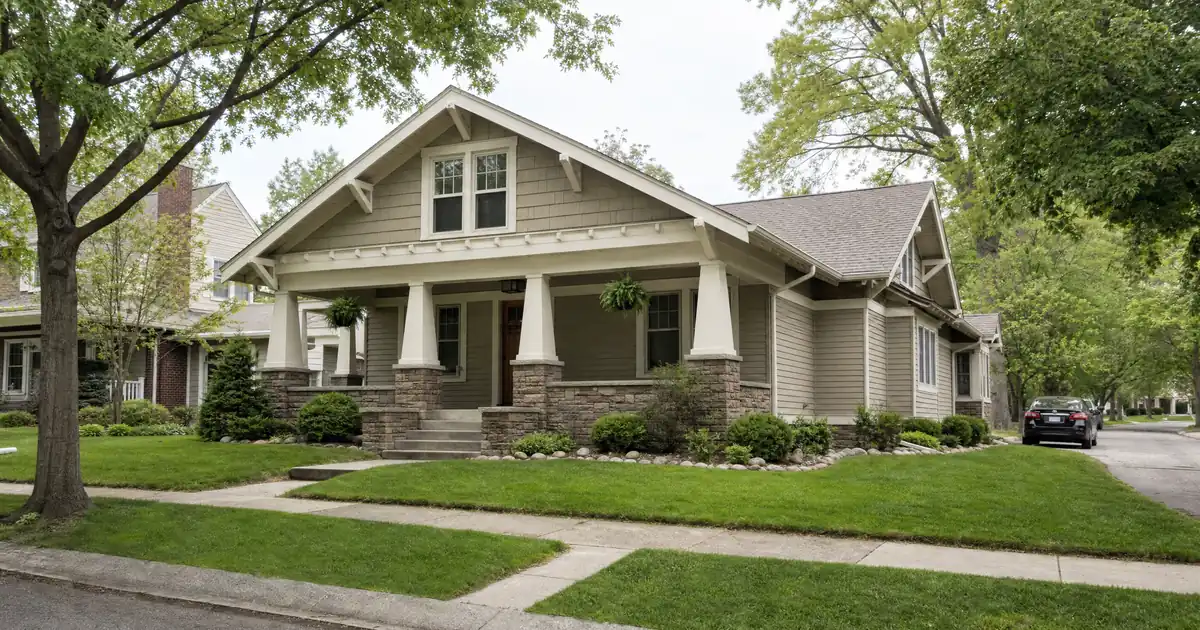
Cash Out One Rental To Buy Another — The Quick Read: Pulling equity from a rental you already own to fund the next purchase is one of the most common ways real estate investors scale a portfolio. The mechanics run through a cash-out refinance: a new, larger loan pays off the old one, and the difference comes back as cash. The catch is that the source property has to still clear its own numbers at the new loan amount, and the new loan amount itself is capped by both equity and rental income — not just one or the other.
How the Cash-Out Refinance Actually Works
A cash-out refinance replaces your existing mortgage on Property A with a new, bigger loan. The new loan pays off the old balance, and whatever’s left over — after closing costs and any required reserves — comes back to you as cash. That cash then becomes the down payment, closing costs, and reserve cushion on Property B.
DSCR Cash-Out Calculator
Run the cash-out numbers in your market
Rate source: Freddie Mac 30-yr average via FRED® — Federal Reserve Bank of St. Louis · effective Aug 13, 2026
Prefilled with local estimates — enter your property’s value, balance, taxes, and insurance for a more accurate picture.
Program parameters update from Lendmire’s centralized guideline source. Taxes and insurance are editable estimates.
As of Aug 13, 2026 · General Freddie Mac market benchmark, not a Lendmire loan offer. Property value, balance, taxes, and insurance are editable estimates. Maximum loan-to-value varies by lender, program, property type, and seasoning. Not a Loan Estimate, approval, or commitment to lend. Program availability and eligibility are subject to lender guidelines, credit approval, property review, and underwriting.
It sounds simple because the concept is simple. The part investors underestimate is that two separate underwriting tests happen here, not one. The source property has to qualify for the new, larger payment. And separately, the new purchase gets its own full underwrite — different property, different rent, different file. A strong equity position in Property A doesn’t automatically clear the way for Property B. Both have to work on their own terms.
On a DSCR loan, that first test runs off the property’s rental income rather than your traditional personal-income documentation or W-2s. DSCR stands for debt-service coverage ratio — it’s the monthly rent divided by the full monthly payment (principal, interest, taxes, insurance, and HOA dues, often shortened to PITIA). If you want the full walkthrough of how that ratio gets built and priced, Lendmire’s complete DSCR loans guide covers it end to end.
Why the Coverage Ratio Changes When You Cash Out
Clearing 1.00 on your current, smaller loan does not mean you’ll clear it on a bigger one — coverage is tested against the new payment, not the old one. This is the single most misunderstood mechanic in the whole strategy, and it’s why a property that cash-flowed comfortably yesterday can suddenly look thin on paper today.
Say a property currently carries a modest loan and the rent covers that payment with real room to spare. Push the loan balance up through a cash-out draw, and the payment rises with it. The same rent now has to stretch further. If the ratio drops toward the coverage floor, the lender caps how much cash can actually come out — regardless of how much paper equity sits in the property. This is where “I have plenty of equity” and “I can access plenty of equity” split into two different questions.
Across the wholesale network Lendmire places files through, cash-out refinances on investment property typically top out around 75% loan-to-value (LTV) — a meaningfully tighter ceiling than purchase leverage, which on most files runs 75-80% and, on select high-leverage programs with stronger credit, up to about 85%. Cash-out gets the tighter cap because money is actually leaving the deal, not just financing a new acquisition.
Minimum qualifying coverage on most sub-1.00-eligible or standard cash-out programs starts around a 1.00 DSCR floor on select programs — never a universal number, and stronger ratios open better pricing and leverage tiers. Credit generally needs to clear somewhere around 660 for the bulk of programs, with a 620 floor existing in parts of the network and 700+ unlocking the strongest leverage. None of this is a guarantee of approval — it’s the range a working DSCR broker sees across comparable files, subject to lender guidelines and full underwriting.
Do the Math: Equity, LTV, and the Funding Gap
Run four numbers before assuming the cash-out alone funds the next deal: current appraised value, the 75% LTV ceiling, the existing loan payoff, and what’s left over as usable cash. That leftover figure — not the property’s total equity — is what actually shows up at closing. Terms vary by lender guidelines, property type, leverage, credit profile, and full file review.
| Step | What It Represents |
|---|---|
| Appraised value today | Set by a licensed appraiser, not the purchase price |
| × 75% LTV ceiling | The cash-out cap across most of the network |
| − existing loan payoff | What’s owed on the current mortgage |
| = cash available (before costs/reserves) | Closing costs and reserves reduce this further |
Notice what’s missing from that table: a dollar figure. That’s intentional — the actual number depends entirely on your specific property’s appraised value and current balance, and it swings the moment either input changes. What doesn’t change is the logic: total equity in the property is almost always bigger than the cash you can actually pull, because the LTV cap and the DSCR test both act as brakes on the draw.
This is the “funding gap” investors run into constantly. Equity on paper says one thing. The cash-out ceiling, the coverage ratio, and required reserves say another. Plenty of BRRRR investors plan a purchase around the full equity figure, then find the actual proceeds land short once LTV and reserves are applied — meaning the next purchase often needs a supplemental funding source, not just the refinance check.
Seasoning: How Long Do You Have to Own It First?
Most lenders in the network want roughly six months of ownership before they’ll size a cash-out refinance against today’s appraised value instead of the original purchase price. That’s the common expectation — it isn’t universal, and it can vary by lender and by how the property was acquired.
There’s a real distinction between owning the property long enough (title seasoning) and being allowed to use the current appraised value rather than the purchase price (value seasoning). The two don’t always move together. An investor who bought a duplex under market value and wants to refinance immediately against the higher appraised number typically has to wait out that seasoning period to capture the appreciation — refinancing sooner usually means the loan gets sized against the lower original purchase price plus documented costs instead.
If you bought the source property in cash, ask specifically how that lender treats seasoning for cash buyers — it’s not standardized the way it is on the agency side, and terms vary by lender in the network. For a deeper look at pulling equity specifically to fund a second acquisition, Lendmire’s write-up on using a cash-out refinance to buy investment property walks through the sequencing in more detail.
Reserves and Loan Size — What Else Gets Checked
Reserves — liquid funds equal to a number of months of PITIA sitting in the bank after closing — commonly run around six months on most files, stepping up toward nine months on loans above roughly $1,500,000. Conservative rate-term deals at modest leverage under that threshold sometimes see reserves waived entirely. There’s no single fixed number here; it scales with loan size, leverage, and transaction type.
Loan amounts across most of the standard program set run up to about $3,000,000, with smaller balances routed through select lenders built for that range. Above roughly $2,500,000, the network generally holds to 30-year fixed structures rather than adjustable terms. A handful of states — Connecticut, Florida, Illinois, and New Jersey among them — carry overlay caps, generally capping purchase LTV near 75% and total loan size around $2,000,000 on cash-out and refinance transactions in those markets.
DSCR files in markets with a heavy mix of long-term and short-term rentals often come in with borderline coverage on conservative long-term rent assumptions, but clear comfortably once trailing rental history or a market rent schedule gets pulled — the stronger files tend to run both numbers before assuming the deal is thin.
The Tradeoff Nobody Skips: Cash Flow on Property A Drops First
Refinancing Property A into a bigger loan raises its payment before Property B produces a dime of income — meaning combined cash flow across both properties can actually go down in the short run, even while your total asset base and long-term equity position grow. That’s the real tradeoff, and it’s worth sizing before committing.
The upside case: two appreciating assets working for you instead of one, with rents likely to grow over time and offset the higher payment on Property A. The downside case: double the maintenance, double the capital expenditure exposure, and a real dip in monthly cash flow until rents catch up. Neither outcome is guaranteed — it depends on the rent trajectory on both properties and how tight the initial coverage ratio runs.
DSCR only measures rent against PITIA. It does not account for vacancy, repairs, property management fees, utilities, or capital expenditures — clearing 1.00 is not the same thing as positive cash flow after real-world costs. Investors who treat a 1.05 or 1.10 ratio as a cash-flow guarantee are usually surprised the first time a furnace needs replacing.
What This Strategy Isn’t (And Where It Doesn’t Fit)
Short-term rentals, manufactured homes, log homes, and barndominiums each carry different — or no — availability through this playbook. Short-term rentals qualify at a 1.00 coverage threshold on purchase and refinance at reduced maximum leverage, and require a 12-month income history or market data report at most lenders. Manufactured homes (single- and double-wide), log homes, and barndominiums simply fall outside DSCR program eligibility across the network — not a matter of stricter terms, just not offered.
Coverage below 1.00 is available through select lenders in the network, but it comes with adjusted leverage and pricing — it’s not a workaround, it’s a different program tier with its own tradeoffs.Select lenders in the network do offer a no-ratio structure — no coverage ratio is calculated — though it generally requires existing primary-residence ownership, and leverage and terms adjust to match, subject to lender guidelines.
Home equity lines of credit on investment property are a separate tool worth mentioning here, since investors often weigh them against a full cash-out refinance. Investment-property HELOC lines cap at $500,000 total across the network — there’s no tier above that for non-owner-occupied lines. A HELOC can make sense as a smaller, more flexible draw; a full cash-out refinance makes more sense when the goal is a larger, one-time capital event tied to a specific next purchase. If you’re weighing the two, Lendmire’s page on pulling equity out of a rental property to buy another home breaks down that comparison further.
DSCR loans are designed for non-owner-occupied investment properties. Because they’re business-purpose loans rather than consumer mortgages, they’re reviewed differently than a standard owner-occupied refinance — and they’re exempt from the consumer disclosure timelines that apply to owner-occupied lending.
Who This Fits — And Who Should Look Elsewhere
This strategy fits an investor with real, seasoned equity in a cash-flowing rental, decent credit, and a clear next property already in mind — someone using the draw as a deliberate down-payment source, not a general-purpose cash grab. It tends to fit less well for an investor whose current rental is already running tight on coverage, since the new, larger payment can push that ratio below what a lender will accept.
It also fits less naturally for someone chasing near-term cash flow above all else. Because the combined monthly numbers across both properties can dip before they recover, this is fundamentally a long-horizon equity play — betting on rent growth and appreciation across two assets rather than optimizing this month’s net income. Lendmire’s guide on using a cash-out refinance to buy rental property and its companion piece on using DSCR loans to pull cash out and buy more deals both walk through the acquisition-focused version of this playbook in more depth.
Tax treatment can depend on how the cash-out funds are used and how the property is titled; investors should keep clear records and speak with a qualified tax professional before relying on any deduction tied to the refinance.
This article is general information, not legal or tax advice — investors should consult a qualified attorney or CPA about their own situation before acting on any of it.
Key Terms Defined
Cash-out refinance — replacing an existing mortgage with a new, larger loan and taking the difference in cash after payoff and costs.
DSCR (debt-service coverage ratio) — monthly rental income divided by the monthly PITIA payment; the core coverage figure on this loan type.
PITIA — principal, interest, taxes, insurance, and any HOA dues combined into the full monthly housing payment.
Seasoning — the length of time a lender expects you to have owned a property before refinancing it against current value rather than original cost.
LTV (loan-to-value) — the loan amount expressed as a percentage of the property’s appraised value; it sets the ceiling on how much can be borrowed.
Business-purpose loan — a loan made to a rental or investment property rather than a primary residence, reviewed under non-QM rather than consumer-mortgage rules.
For deeper background on the mechanics discussed here, see Irs and Fannie Mae Selling Guide — Cash-Out Refinance Transactions (B2-1.3-03).
Frequently Asked Questions
Can I cash out one rental to buy another rental with no personal income documentation? DSCR loans qualify primarily on the property’s rental income covering the payment, subject to lender guidelines — not on traditional personal-income documentation or pay stubs. That doesn’t mean underwriting disappears; the property still has to clear its coverage test, and you’ll still go through credit and asset review.
How much cash can I actually pull from a rental to fund a down payment? It depends on appraised value, the existing loan payoff, the roughly 75% LTV ceiling most cash-out programs use, and whether the resulting payment still clears the property’s coverage requirement. Total equity is almost always larger than usable cash, since both the LTV cap and the DSCR test limit the draw. Exact terms depend on the lender’s guidelines, property type, leverage, and a full review of the borrower’s file.
Does the source property need to season before I can cash it out? Most lenders in the network expect around six months of ownership before sizing a cash-out refinance against today’s value rather than the purchase price. Terms vary by lender and by how the property was originally acquired, so it’s worth confirming on the specific file.
What if the cash-out proceeds aren’t enough to cover the entire next purchase? That’s common, not unusual — the “funding gap” between paper equity and usable cash means many investors bring supplemental funds (savings, a partner, or another source) to close the second property. Planning for that gap before committing to either purchase avoids a stalled deal midstream.
Can I use a cash-out refinance to buy a short-term rental instead of a long-term one? Short-term rental income documentation works differently than a standard long-term lease, so expect a bit more underwriting detail on the rent side.
For how equity extraction works on an investment property, see cash-out refinance on an investment property.
A deeper walk-through of investment-property equity extraction lives in cash-out refinance on an investment property.
About Lendmire
Lendmire, NMLS# 2371349, is a mortgage broker that arranges DSCR financing through select lenders across a wholesale network spanning 41 markets, including Washington, D.C. Loan approval is never guaranteed and nothing here is a commitment to lend — every scenario is subject to lender approval and full borrower, property, and program review. If you’re weighing a cash-out refinance against a rental portfolio purchase, Lendmire can help you compare DSCR loan options based on the property’s income, your credit profile, target leverage, and where you’re trying to take the portfolio next. Scotsman Guide named Lendmire a Top Mortgage Workplace in both 2025 and 2026.
Get Started
Ready to find the right loan for you?
In about 30 seconds you can review financing options available for your home or investment property. No commitment required.
Informational only. Not a Loan Estimate, approval, or commitment to lend. Program availability and eligibility are subject to lender guidelines, credit approval, property review, and underwriting.
References
1. Irs
2. Fannie Mae Selling Guide — Cash-Out Refinance Transactions (B2-1.3-03)
This article is part of Lendmire’s investment property cash-out refinance program — full qualification details, guidelines, and scenarios live on the program page.
Related reading: Can I Take Equity Out Of My Rental Property To Buy Another Home · Can You Refinance A Rental Property Then Buy Another Rental? · Cash Out Refinance to Buy Another Investment Property
Brandon Miller
Founder & CEO, Mortgage Loan Originator, Lendmire LLC
- Mortgage Loan Originator · NMLS# 1129696 · Verify on NMLS Consumer Access
- North Carolina Real Estate Broker · License# 343312 · Verify on NCREC
- North Carolina Insurance Producer · License# 19053198 · Property, Casualty, Life, Health · Verify on NAIC SBS
- Lendmire LLC · Firm NMLS# 2371349 · Verify firm licensure
Disclosure information. Lendmire is a state-licensed mortgage brokerage under NMLS# 2371349. Lendmire is not a depository institution, direct lender, or financial advisor — all loans referenced are placed through wholesale lender partners and are subject to each lender's underwriting standards. This article is provided for general informational purposes and is not a commitment to lend, nor does it constitute financial, legal, or tax advice. Loan programs, terms, rates, and qualification standards change without notice and depend on borrower profile, property type, and the state in which the subject property is located. Equal Housing Opportunity provider. NMLS Consumer Access: nmlsconsumeraccess.org.