
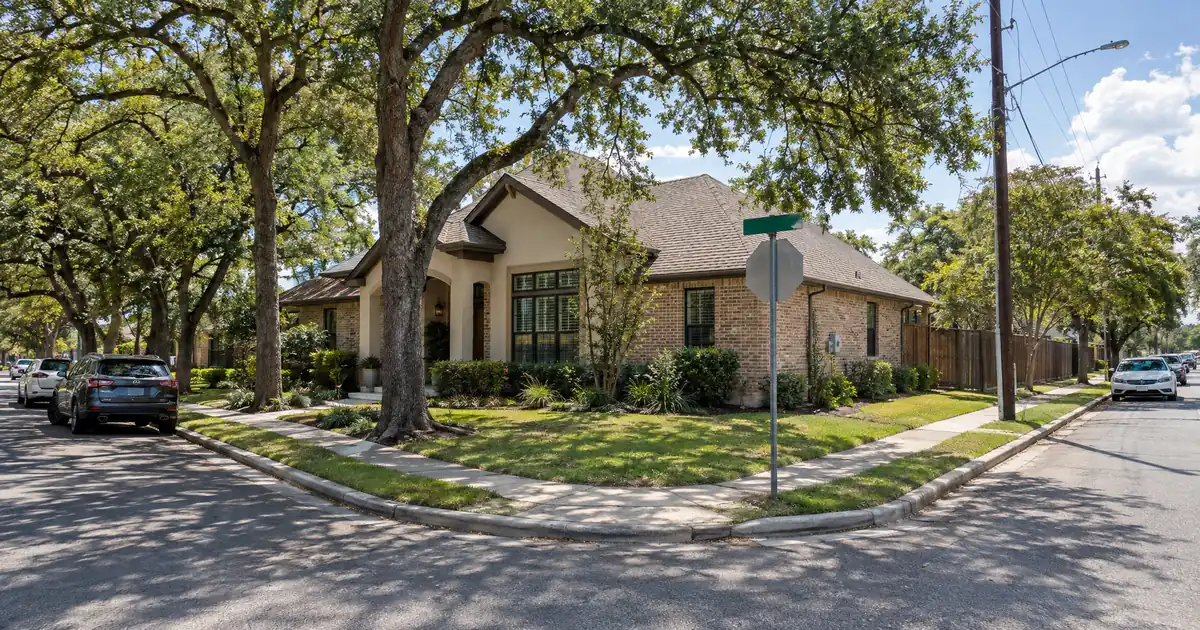
The Quick Read: A Texas homestead HELOC releases the lesser of two numbers: 80% of the home’s market value on closing day minus every lien already recorded against it, or the program’s own tier ceiling and line cap. On most builds the 80% math binds first. Value is measured on the existing homestead as it stands, not on the finished project, so a HELOC often funds part of a build rather than all of it.
- The formula: market value × 80%, minus the first mortgage and any other recorded lien, equals the most the line can be.
- The network ceiling: for a Texas primary residence, Lendmire’s wholesale network tops out at 80% combined loan-to-value (CLTV), and only at stronger credit tiers.
- The draw: at least 75% of the line is drawn at closing, so the line works more like a large initial advance than a pay-as-you-build facility.
- The rental boundary: a completed rental that is not your homestead sits outside these rules, and a DSCR loan on the finished property is a separate decision.
Key Terms Defined
Homestead: the home you live in as your primary residence, which Texas protects with special limits on liens against it.
CLTV (combined loan-to-value): all loans secured by the property, added together and divided by its market value.
Release: here, the amount of credit a line can actually make available after the legal limit and the program limit are both applied.
Draw: an advance of money from the line, which in Texas must be at least $4,000 after closing.
Lien: a recorded legal claim on the property that secures a debt, such as a first mortgage.
Seasoning: the waiting period required between one Texas equity loan and the next.
How large a line the equity supports in Texas.
An equity line is sized by combined loan-to-value, occupancy, and credit — not by rental coverage. Switch the occupancy or the credit band and the ceiling moves with it.
Investment-property lines require a 700 minimum credit score; second-home lines start at a 640 minimum and primary-residence lines at 600, and the combined-LTV ceiling steps down as the credit band drops on primary-residence and second-home lines and holds on investment-property lines; the line cap steps down on primary-residence lines and holds at every tier on investment-property and second-home lines.
A debt-to-income ratio above 45% requires 680+ credit. Profiles under 640 are limited to single-family homes. At least 75% of the approved line is drawn at closing. Ceilings, floors, and caps update from Lendmire’s centralized guideline source.
Line estimate
Illustrative estimate only — not a quote, Loan Estimate, approval, or commitment to lend. The rate is an editable assumption; equity-line pricing is variable through both the draw and repayment periods and never converts to fixed. Occupancy and credit drive the ceiling together: an investment property tops out at 70% combined LTV (minimum credit 700, line cap $500,000); a second home tops out at 90% combined LTV (minimum credit 640, line cap $500,000), with the ceiling stepping down as the credit band drops (the cap holds at every tier); a primary residence tops out at 80% combined LTV (minimum credit 600), and its $750,000 maximum line is available only at 75% combined LTV or below with a 700-or-better credit profile (720 on the longer-runway program) and a full appraisal. Lines above $500,000 require a full appraisal. Credit, debt-to-income, property type, and full underwriting review all affect the final line.
Why Texas Caps the Number at 80%
The cap comes from the Texas Constitution, not from lender preference. Article XVI, Section 50(a)(6)(B) says the equity loan, plus all other debt secured by valid recorded liens on the homestead, cannot exceed 80 percent of the homestead’s fair market value on the date the credit is made.
That has three practical consequences. A strong credit score cannot raise the cap. A lender cannot raise it either. And a program that advertises higher leverage elsewhere is bound by the same 80% line on a Texas primary residence.
Across the wholesale network, equity lines on primary residences carry higher ceilings in other states. In Texas, the primary-residence tier is capped at 80% CLTV, and the calculator on the page applies the same cap. This is one reason Texas homeowners often find a HELOC releases less than they expected.
How the Release Is Calculated, Step by Step
The Texas Legislative Council’s summary describes the maximum line as 80 percent of the home’s market value minus the loans already secured by the home. That document is older, so treat it as a source for the formula only. The steps work like this:
1. Set the value. The value is the home’s fair market value on the date the line is made. On lines of $500,000 or less, the network ordinarily runs an automated valuation rather than a traditional appraisal, though a higher CLTV may require a second valuation. A borrower may request a full appraisal in any case.
2. Apply 80%. Multiply the value by 80%. This is the ceiling for every lien combined.
3. Subtract every existing lien. That means the first mortgage, any prior home-improvement lien, and any construction lien still recorded. All of them count.
4. Compare to the program limits. The network’s lines run from $25,000 up to $750,000. A line above $500,000 is for primary residences only, needs a full appraisal, and caps at 75% CLTV. The credit requirement for that size is 700 or better (720 on the longer-runway program, covered below).
5. Take the lower result. Whichever limit is smaller is the release.
Here are the network’s Texas primary-residence ceilings by credit tier, shown as eligibility guidance and subject to lender guidelines and full file review:
| Credit tier | Max CLTV (Texas primary) | Line size at that CLTV |
|---|---|---|
| 700 and above | 80% | Up to $500,000 |
| 700 and above | 75% | Up to $750,000 |
| 640 to 699 | 80% | Up to $500,000 |
| 620 to 639 | 70% | Up to $400,000 |
| 600 to 619 | 60% | Up to $400,000 |
The 600 floor is the minimum for any primary-residence line. A DTI of 50% is the maximum, with 45% for credit profiles from 600 to 679, and qualification runs on the interest-only payment calculated on the maximum draw.
What the Number Looks Like in Three Build Scenarios
The easiest way to see the release is to express liens and budgets as percentages of the home’s value. These are modeled assumptions, not market data.
| Scenario | Existing liens | Legal room at 80% | What binds | Result against a build |
|---|---|---|---|---|
| Land or home owned free and clear | 0% of value | 80% of value | Program line cap, if value is high | Largest release |
| Home with a first mortgage | 55% of value | 25% of value | The 80% test | Much smaller release |
| Budget larger than the room | 55% of value | 25% of value | The 80% test | Shortfall if budget is 40% of value |
In the third scenario the owner needs 40% of value for the build but has room for only 25%. The 15%-of-value gap has to come from cash, a different lien path, or a smaller scope.
The existing lien balance often moves the answer more than the property does. A homeowner with a large first mortgage and a modest build budget may still hit the ceiling, while an owner with a paid-off home may be limited by the line cap rather than the 80% test.
Lendmire’s piece How Much a HELOC Releases for a Build on Today’s Value covers the same sizing logic outside Texas.
Which Value Counts During Construction?
The as-is value of the existing homestead at closing counts. The legal test measures value on the date the credit is made, which means a finished build that is not yet there cannot be counted. A later appraisal increase after the build does not enlarge a line that has already closed.
For that reason, the safe planning assumption is that the line is sized on what the property is worth before the work starts.
Two edge questions fall to a Texas attorney or title company. One is whether bare land with no residence qualifies as a homestead. The other is how acreage affects homestead status. The network limits Texas properties to 10 acres, and a property listed for sale, or listed within the past 60 days, is ineligible in Texas.
Drawing the Line Against a Build
Contractors bill in stages, while this line pays out mostly up front. On both wholesale programs, at least 75% of the line is drawn at closing. After closing, the minimum subsequent draw in Texas is $4,000, and the Office of Consumer Credit Commissioner confirms that $4,000 minimum draw under Section 50(t)(2).
That structure matters for a build in two ways. First, interest starts on the large initial draw, not on a draw schedule that tracks construction milestones. Second, the cost of the line floats across the draw and repayment periods and never converts to a fixed structure.
Two wholesale programs sit behind these lines. The longer-runway program offers a 5-year interest-only draw followed by a 25-year fully amortizing repayment. The other program offers a 3-year draw with a 17-year repayment. A figure quoted for one program always carries its own structure.
If the build will take a long time, the 5-year draw gives more runway. If the owner plans to repay quickly after the build, the shorter structure may fit just as well.
HELOC, Construction Contract Lien, or DSCR Loan?
A build can be financed under a different part of the same constitutional section. Section 50(a)(5) allows a lien for work and material used to construct new improvements or renovate existing ones, as long as the contract meets set conditions. Sandler Law Group’s construction lending primer explains that those conditions include a written contract signed before work begins, both spouses’ consent, a waiting period after written application, and a right to cancel.
The 80% cap appears in the equity-loan clause, (a)(6)(B). Whether the construction-contract clause carries any comparable limit is a question for a Texas attorney. The network’s lines are standalone equity lines, not construction-contract loans.
| Path | Governing rule | Fits best | Main catch |
|---|---|---|---|
| Homestead HELOC | 80% combined limit on the existing home | Partial funding for an owner-occupied build | Value measured before the build, so it may fall short |
| Construction-contract lien | Separate clause with its own contract conditions | Ground-up or major renovation work | Different timing rules and signing requirements |
| DSCR loan on a finished rental | Property income versus debt payment | A completed non-homestead rental | Not a construction product, and the property must exist first |
Where the General Rule Breaks
The one-lien rule. On a Texas primary residence, the network follows a one-lien-at-a-time rule, a 12-day waiting period, and 12-month seasoning between equity transactions. The 12-day period is a constitutional notice requirement, and FindLaw’s reproduction of Section 50 also describes a 3-day right to cancel and a requirement to close at the office of a lender, attorney, or title company. A homeowner cannot layer a second equity line on top of the first to cover a shortfall.
Second homes and investment properties. The 12-day waiting period, the one-lien rule, and the seasoning rule bind primary residences only. Texas second homes and investment properties are eligible as non-homestead transactions and follow their own standard tables.
Title. The line must be held by the individual borrower or a revocable living trust. LLCs, corporations, partnerships, and irrevocable or land trusts cannot hold title. A property already deeded to an LLC needs a vesting change, or a DSCR cash-out refinance may fit better, subject to program terms.
Property type. The network does not offer these lines on manufactured homes, co-ops, condotels, log homes, commercial, mixed-use, or agricultural-zoned properties. A barndominium also falls outside these programs.
Exposure. A borrower is limited to three lines, and an owner with more than 15 financed properties is not eligible.
The Investor Decision in Practice
A homestead HELOC cannot fund a rental or spec build beyond the 80% combined limit, whatever the credit profile. For an investor, the more practical question is whether the money should come from the homestead at all.
An investment-property equity line on a non-homestead property caps at 70% CLTV, requires a 700 minimum credit profile, runs only the 5-year draw and 25-year repayment structure, and tops out at $500,000. That is a different product from the homestead line, and the numbers above should not be applied to it.
Once the building is complete and rented, the financing question changes. DSCR loans are designed for non-owner-occupied investment properties. Because they are business-purpose investor loans, they are reviewed differently from a standard owner-occupied mortgage. Purchase leverage typically runs 75% to 80% LTV across most of the network, and cash-out refinances top out around 75% LTV with about 6 months of seasoning as a common expectation. Lendmire’s complete DSCR loans guide walks through how those files are structured.
On coverage, 1.00 is where many select programs start. A separate select-lender path takes coverage below 1.00, with leverage and terms adjusted. Clearing 1.00 does not mean positive cash flow, because repairs, vacancy, management, and utilities sit outside the calculation.
Run both tests on any plan that includes a rental. You need enough homestead equity for the HELOC, and later enough rental coverage for the DSCR loan.
Before You Break Ground
- Confirm the lien stack. Pull the payoff on every recorded lien, because each one reduces the room.
- Confirm homestead status and acreage. Check with a Texas title company, especially for land-only sites.
- Match the line to the budget. Use the formula, then compare the result to the build budget with a contingency.
- Plan the shortfall. If room is smaller than the budget, decide where the gap money comes from before closing.
- Check the credit report age. The report can be no more than 90 days old at closing, and there are no rescores.
- Gather income documents. For self-employed borrowers, a file is reviewed on documented income under the applicable program, subject to lender guidelines.
Tax treatment can depend on how the funds are used and how the property is held; investors should keep clear records and speak with a qualified tax professional before relying on any deduction.
Frequently Asked Questions
Can a HELOC cover the whole cost of a build on my Texas homestead?
Only if the build budget fits inside the room left after the 80% test. The line is sized on the home’s value before construction, so a large budget on a home with a big mortgage usually exceeds the release. Many owners combine the line with cash or choose a different lien path for the rest.
Does my credit score change the 80% cap?
No, it only changes which tier you land in. On a Texas primary residence, the cap is 80% combined at the stronger tiers, and lower tiers sit at 70% or 60% with smaller line sizes. Credit cannot lift anything above 80%.
Can I take a second equity line if I run short?
Not on a primary residence in this network, because the one-lien-at-a-time rule applies, along with 12-month seasoning between equity transactions. Plan the gap funding before you close the first line.
What happens if the build runs over budget?
The line does not grow, because value is fixed at closing. The overrun has to come from cash or another source, so a contingency in the original budget matters more here than on most financing.
Does this apply to a rental property I want to build?
No. The homestead limits protect your primary residence, and a rental sits outside them. A non-homestead investment line caps at 70% CLTV, and a finished rental is usually financed through a DSCR loan reviewed on the property’s rent.
Ready to Compare Options?
If you are considering a home equity line and want to see how the numbers work, Lendmire can help you compare HELOC options based on the property, the equity available, credit profile, combined leverage, and your goals. Reach the team at 828-256-2183 or request a quote.
About Lendmire
Lendmire (NMLS# 2371349) is a mortgage broker. Home equity lines of credit — on a primary residence, a second home or an investment property — are arranged through wholesale lenders in Lendmire’s 16 full-service states, and every line is underwritten by the lender under its program guidelines. Scotsman Guide named Lendmire a Top Mortgage Workplace in both 2025 and 2026.
Get Started
Ready to find the right loan for you?
In about 30 seconds you can review financing options available for your home or investment property. No commitment required.
Informational only. Not a Loan Estimate, approval, or commitment to lend. Program availability and eligibility are subject to lender guidelines, credit approval, property review, and underwriting.
References
1. Texas Constitution Art. XVI, Section 50 (Justia reproduction)
2. Texas Legislative Council, Facts at a Glance
3. Office of Consumer Credit Commissioner, home equity guidance
4. Sandler Law Group, Texas residential construction lending primer
5. Texas Constitution Art. XVI, Section 50 (FindLaw reproduction)
This article is part of Lendmire’s home equity line of credit program — full qualification details, guidelines, and scenarios live on the program page.
Related reading: How Much a Bank Statement HELOC Releases on a Texas Homestead · How Much a HELOC Costs Monthly on a Texas Homestead With a Low Mortgage · Texas Refinance Requirements for a First and Second Mortgage
Brandon Miller
Founder & CEO, Mortgage Loan Originator, Lendmire LLC
- Mortgage Loan Originator · NMLS# 1129696 · Verify on NMLS Consumer Access
- North Carolina Real Estate Broker · License# 343312 · Verify on NCREC
- North Carolina Insurance Producer · License# 19053198 · Property, Casualty, Life, Health · Verify on NAIC SBS
- Lendmire LLC · Firm NMLS# 2371349 · Verify firm licensure
Required disclosures. Lendmire (NMLS# 2371349) operates as a licensed mortgage broker, not a direct lender or depository. The discussion in this article is general in nature and should not be relied upon as financial, legal, or tax advice — every investment scenario is unique and should be reviewed by a qualified professional. Any loan inquiry is subject to lender underwriting, and this article is not a commitment to lend or a guarantee of approval. Mortgage rates, loan terms, and program guidelines vary by borrower, property, and state, and may change without notice. Equal Housing Opportunity. Verify licensure at NMLS Consumer Access.