
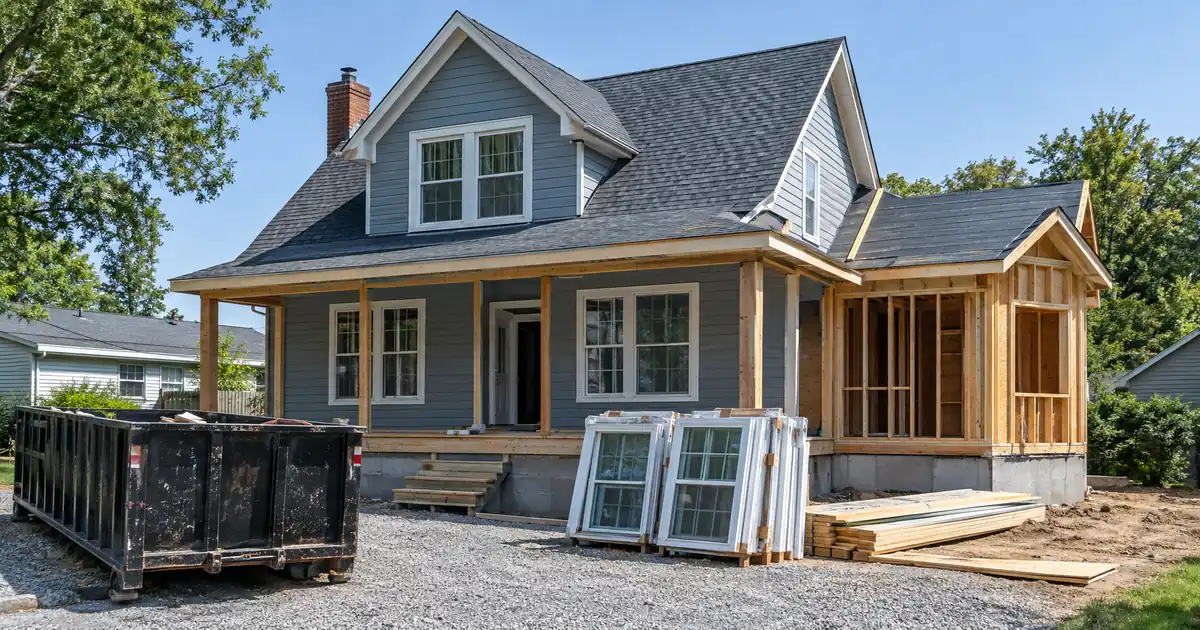
The Quick Read: Yes, a home equity line draw can pay off a hard money note, but it works as a bridge between two loans, because the line becomes new debt that a long-term DSCR loan usually has to retire. The plan only holds when a lender will place the line, the combined balance stays inside the leverage caps, and the rental appraises and covers its payment at the final takeout.
- A HELOC draw is only cash, so the hard money lender releases its lien once it is paid in full.
- Investment-property lines come from a small lender pool, and the network caps them at $500,000 total.
- Lines generally cannot sit on property titled in an LLC, which is how many BRRRR investors hold deals.
- The final exit is typically a DSCR cash-out refinance at up to 75% LTV after about 6 months of ownership.
Hard money does its job in the first months of a BRRRR. It buys and rehabs the property, and then the maturity date starts a countdown. The question is what happens if the long-term loan is not ready when that date arrives. A rental HELOC is one answer. It is rarely the simplest one, and this article explains when it earns its place.
How large a line the equity supports.
An equity line is sized by combined loan-to-value, occupancy, and credit — not by rental coverage. Switch the occupancy or the credit band and the ceiling moves with it.
Investment-property lines require a 700 minimum credit score; second-home lines start at a 640 minimum and primary-residence lines at 600, and the combined-LTV ceiling steps down as the credit band drops on primary-residence and second-home lines and holds on investment-property lines; the line cap steps down on primary-residence lines and holds at every tier on investment-property and second-home lines.
A debt-to-income ratio above 45% requires 680+ credit. Profiles under 640 are limited to single-family homes. At least 75% of the approved line is drawn at closing. Ceilings, floors, and caps update from Lendmire’s centralized guideline source.
Line estimate
Illustrative estimate only — not a quote, Loan Estimate, approval, or commitment to lend. The rate is an editable assumption; equity-line pricing is variable through both the draw and repayment periods and never converts to fixed. Occupancy and credit drive the ceiling together: an investment property tops out at 70% combined LTV (minimum credit 700, line cap $500,000); a second home tops out at 90% combined LTV (minimum credit 640, line cap $500,000), with the ceiling stepping down as the credit band drops (the cap holds at every tier); a primary residence tops out at 90% combined LTV (minimum credit 600), and its $750,000 maximum line is available only at 75% combined LTV or below with a 700-or-better credit profile (720 on the longer-runway program) and a full appraisal. Lines above $500,000 require a full appraisal. Credit, debt-to-income, property type, and full underwriting review all affect the final line.
What Does “Rental HELOC” Actually Mean?
The term covers two different setups with different risk profiles. One is a line secured by a rental, either the BRRRR property or another rental you own. The other is a line secured by a different, equity-rich property, such as a paid-down rental or a primary home.
The first setup is harder to get. NerdWallet reports that the lender pool for investment-property lines is smaller, borrowing limits are lower than against a primary home, and some lenders screen by location or by whether the home is rented year-round. In our wholesale network, investment-property lines cap at $500,000 total, and there is no higher tier for rentals.
The second setup is usually easier to obtain, but it puts the other property at risk. Lenders also treat a line on the subject property differently. A property that still carries a hard money first lien leaves little room for a second lien, so most investors who go this route borrow against a different asset.
Key Terms Defined
BRRRR: Buy, rehab, rent, refinance, repeat, a strategy that recycles capital by refinancing a stabilized rental into long-term debt.
Hard money: A short-term, asset-based business-purpose loan, interest-only, used to buy and renovate before a long-term refinance.
HELOC: A revolving line of credit secured by real estate, with a draw period followed by a repayment period.
CLTV: Combined loan-to-value, the total of all liens on a property divided by its appraised value.
Seasoning: The ownership period a refinance lender requires before it will lend against the current appraised value.
Lien position: The order in which lenders are paid from the property, which determines who must be paid off before another loan can take first place.
How Does the Payoff Work, Step by Step?
The sequence is mechanical. Each step has its own paperwork and its own failure point.
1. Hard money phase. Hard money on our program sheet is interest-only for 6 to 18 months with no prepayment penalty, though terms vary by lender, property, and experience. The investor’s actual note sets the maturity date, and that date is the deadline for everything else.
2. Line approval. The HELOC lender reviews personal credit and debt-to-income, the collateral, and combined leverage. This is a different underwriting path than a rental-income loan, because a line is judged on the borrower first.
3. Draw and payoff. The investor draws on the line and requests a payoff statement from the hard money lender. Title or escrow pays the note, and the first lien is released.
4. Carry period. The line now carries the debt, and the investor pays the line while the rental seasons and the lease is in place.
5. DSCR takeout. A DSCR loan pays off the HELOC and any remaining balance, plus closing costs, in one transaction.
The line is not a permanent home for the debt. The CFPB explains that a HELOC has a draw period, after which borrowing stops, and that payments often rise significantly in the repayment period. It also notes that HELOCs usually carry a variable rate, so payments can change month to month. That is a very different carry from a fixed-payment rental loan, and it matters when the rental’s cash flow is thin.
Documents usually involved include the hard money note and payoff statement, the line agreement and draw history, rehab invoices, the lease, bank statements, and a rental appraisal. Lenders typically use a rent schedule form and a small-income-property appraisal form for the rental valuation.
Which Property Backs the Line?
Collateral is the first decision, because it drives eligibility, title rules, and what you can lose.
| Collateral | Typical access | Main risk |
|---|---|---|
| The subject rental | Often unavailable early | Hard money lien in first position |
| Another rental you own | Smaller lender pool | Second property carries the debt |
| Your primary home | Usually easiest | Home is at risk if unpaid |
Newly acquired property is a common stumbling block. Many HELOC lenders want a recent purchase to be held for some months before they will place a line on it. That varies by lender, so treat it as a screening question to ask early, not a rule. For a BRRRR investor with a short hard money term, it often rules out the subject property. The line then has to sit on something else.
Entity title is the second stumbling block. HELOCs generally cannot be placed on property held in an LLC. DSCR lenders commonly lend to LLCs, subject to lender program eligibility. An investor who bought the BRRRR property in an entity therefore faces an awkward mismatch: the personal-name line and the entity-owned rental do not fit together neatly. The takeout loan can use an entity. The bridge line often cannot.
HELOC, Payoff-Only Refinance, DSCR Cash-Out, or Sale?
A HELOC is one of four ways to deal with a maturing hard money note. The right one depends on how much time is left and how well the numbers cover.
| Option | Best fit | Watch for |
|---|---|---|
| Rental HELOC bridge | Time gap before DSCR seasoning | Variable payments, extra closing |
| Payoff-only DSCR refinance | Equity is enough, no cash back | Needs seasoning and rent coverage |
| DSCR cash-out | Stabilized property, equity to recycle | 75% LTV cap, about 6 months seasoning |
| Sale | Numbers or timing do not work | Gives up the rental |
A payoff-only refinance returns no cash, so it can reach a higher leverage ceiling than a cash-out. On a rate-and-term refinance, the program ceiling is 85% LTV, subject to lender guidelines. A cash-out refinance tops out at 75% LTV across most of the network. Each takes the DSCR lender’s own seasoning and leverage rules, not those of any agency program.
A brief contrast helps here. Some investors ask whether the conventional “delayed financing” exception lets them skip seasoning after a purchase. That is an agency exception for cash purchases, described in the Fannie Mae Selling Guide. It does not govern DSCR files, and it generally does not fit a purchase financed by hard money. The DSCR lender’s own seasoning rule is the one that applies.
For the full picture of how these loans work, see the complete DSCR loans guide.
Worked Example: Base Case and Downside
The numbers below are modeled assumptions, not market data. They use index points instead of dollars, so the logic stays visible.
Base case. Assume the rehabbed rental is expected to appraise at 100 index points. The hard money payoff is 70 points. The HELOC draw covers the payoff. The DSCR cash-out takeout lends up to 75% LTV on a cash-out. The combined debt stack is 70 points against a 100-point value, or 70% of value. That leaves some room under the 75% ceiling for closing costs. Exact terms depend on the lender’s guidelines, property type, leverage, and a full review of the borrower’s file.
Downside case. Suppose the appraisal comes in 10% below expectations, at 90 points. The same 70 points of debt is now about 78% of value. That is above the 75% cash-out ceiling. The takeout cannot retire the whole stack, and the investor must bring cash, negotiate the appraisal, extend the line, or sell. Every figure here varies by lender and program — guidelines, property type, leverage, and credit profile all apply.
The takeaway is simple. A HELOC bridge has almost no slack. A modest appraisal miss can push the debt stack past the cap. Running the downside before drawing the line is the difference between a clean exit and a scramble.
Coverage matters too. A DSCR compares monthly rent to the full monthly obligation of principal, interest, taxes, insurance, and any HOA dues. Many select programs start at a 1.00 floor, and stronger ratios open better pricing and leverage. A separate select-lender path goes below 1.00 with leverage and terms adjusted. Either way, clearing the ratio does not mean the property cash flows. Repairs, vacancy, management, utilities, and capex sit outside the calculation. The takeout loan is also larger than the original hard money payoff, because it must carry the line balance and costs, so the coverage should be tested on the final number.
Why Is the Clock the Real Constraint?
Four timelines run at once, and the plan fails where they disagree.
- Hard money maturity. Terms on the program sheet run 6 to 18 months, and the note sets the deadline.
- Line setup. A HELOC needs its own application, collateral review, and title work before it can fund. Lenders vary on how long that takes, so confirm the lead time before the maturity date approaches.
- Rent seasoning. The lease needs to be in place and, on many files, rent history helps the property show its coverage.
- Ownership seasoning. A DSCR cash-out generally expects about 6 months of ownership, measured from title recording.
If the hard money matures before the ownership clock clears, a bridge becomes tempting. If the clock clears first, the bridge is unnecessary and an investor can move directly to the long-term loan. That is why many investors are better served by choosing a hard money term long enough for the process. Hard money extensions, a payoff-only refinance, or waiting for seasoning are often cheaper than adding a third loan.
For investors who want to see how this sequence works in practice, Lendmire’s piece How to Pay Off BRRRR Hard Money Using a Rental HELOC and DSCR Loan walks through it in more detail.
When Does the Bridge Make Sense?
Layering hard money, a HELOC, and a DSCR loan means three closings and three payoffs. It earns its cost in a narrow set of cases:
- The bridge matures before the ownership clock clears, and an extension is unavailable.
- A low-cost line already exists on other property the investor owns and is comfortable pledging.
- The combined balance stays comfortably under the takeout ceiling, even after an appraisal miss.
- The rental’s coverage still works after the takeout loan absorbs the line balance.
It is the wrong choice when the line sits on a primary residence and the investor cannot afford to lose it, when the property is in an LLC, or when the deal has little equity cushion. In those cases, a payoff-only DSCR refinance, a longer hard money runway, or a sale is usually the cleaner path.
What If the Takeout Does Not Cover the Payoff?
Plan B should exist before the line is drawn. Options typically include:
1. Bringing cash to the closing to close the gap.
2. Asking for a reappraisal or submitting stronger comparable sales.
3. Extending the line or the bridge, if the lender allows it.
4. Taking a payoff-only refinance for a smaller amount and paying the remainder from other funds.
5. Selling the property and keeping the proceeds for the next deal.
Credit also shapes these choices. A 620 floor exists in parts of the network. Most programs want around 660, and 700 or higher unlocks the strongest leverage tiers. Reserves commonly run around 6 months of PITIA, with larger loans stepping up to about 9 months. These figures vary by lender, leverage, and loan size, and nothing here is a commitment to lend.
Common Mistakes
Assuming a rental line is as easy as a home line. The lender pool is smaller and the requirements are stricter, as NerdWallet notes.
Treating the line as permanent. Draw periods end, and payments can reset higher.
Ignoring title. An LLC-held rental often cannot carry a personal HELOC.
Skipping the downside appraisal test. The example above shows how quickly leverage can exceed the cap.
Confusing DSCR with cash flow. A passing coverage ratio says nothing about vacancy or repairs.
Tax treatment can depend on how the funds are used and how the property is held; investors should keep clear records and speak with a qualified tax professional before relying on any deduction.
Where Does the Exit Refinance Fit?
Most investors end up in the same place: a long-term DSCR loan once the property is stabilized. A hard money exit refinance is the usual path there. Lendmire brokers this transition through select lenders in its wholesale network, whether or not a HELOC is used in between. For investors who can wait, going directly from hard money to DSCR often costs less than adding a third loan. For investors who cannot, the HELOC bridge is a legitimate tool, as long as the downside is tested first. Learn more about the hard money exit refinance program, which covers how these payoffs are structured.
Hard money itself has its own limits worth remembering. On the program sheet, fix-and-flip leverage runs up to 93% of project cost for experienced investors with 5 or more completed projects, 90% with 2 or more, and 85% with fewer, with every tier capped at 75% of after-repair value. Those figures vary by lender, property, and experience, and the strongest tiers are reserved for experienced investors. The bridge decision is easier when you know exactly how much of the original debt the final loan must absorb.
Frequently Asked Questions
Can a HELOC pay off a hard money loan on a rental?
Yes, in principle. The draw provides cash, the hard money lender releases its lien when paid, and the line becomes the new debt. The practical limits are lender availability, the collateral, and combined leverage. Because the line must still be repaid, a long-term DSCR loan usually follows.
Can I open a HELOC on a property that still has a hard money lien?
It is often difficult, because the hard money loan holds first position and leaves little equity room. Many lenders also want a newly bought property held for some months first. Investors commonly use a different property as collateral, which puts that property at risk.
Can a HELOC sit on a rental held in an LLC?
Generally no. HELOCs are typically personal-name loans, and entity-titled property is usually excluded. A DSCR takeout loan can be made to an LLC, subject to lender program eligibility. That mismatch is why many BRRRR investors choose payoff-only refinancing instead of a line.
How much can an investment-property HELOC borrow?
In our wholesale network, investment-property lines cap at $500,000 total, and there is no higher tier. Actual limits depend on credit, combined leverage, collateral, and the lender, so many borrowers qualify for less.
What happens if the DSCR appraisal comes in low?
The combined debt may exceed the cash-out ceiling of 75% LTV, so the takeout cannot pay off everything. The investor can bring cash, challenge the appraisal, seek an extension, or sell. Testing a 10% appraisal miss before drawing the line shows how much cushion the plan really has. Final terms depend on lender guidelines, property type, leverage, and the borrower’s complete credit picture.
Who This Fits
A rental HELOC bridge fits investors with a line already in place on other equity, a strong credit profile, a rental that covers its payment comfortably, and a real gap between the note’s maturity and the seasoning clock. It does not fit investors who hold property in an LLC, who have thin equity, or who would be pledging a home they cannot afford to risk.
If you are buying or refinancing a rental property and want to see how the numbers work, Lendmire can help you compare DSCR loan options based on the property income, credit profile, leverage, and investor goals. Lendmire’s earlier piece Rental HELOC vs Hard Money for a BRRRR Investor’s Rehab Budget covers the front end of the same decision.
About Lendmire
Lendmire (NMLS# 2371349) is a mortgage broker that arranges DSCR investor loans and hard money financing through select lenders in its wholesale network, across 41 markets including Washington, D.C. Lenders review eligibility and approve each file, and nothing here is a commitment to lend. Scotsman Guide named Lendmire a Top Mortgage Workplace in both 2025 and 2026.
Get Started
Ready to find the right loan for you?
In about 30 seconds you can review financing options available for your investment property. No commitment required.
Informational only. Not a Loan Estimate, approval, or commitment to lend. Program availability and eligibility are subject to lender guidelines, credit approval, property review, and underwriting.
References
1. NerdWallet – Can You Get a HELOC on an Investment Property?
3. Fannie Mae Selling Guide B2-1.3-03
This article is part of Lendmire’s hard money loan program — full qualification details, guidelines, and scenarios live on the program page.
Related reading: Can a HELOC on Your Home Buy a Rental or Fund a Flip? · How a Family Office Accesses Rental Equity When No DSCR HELOC Exists · HELOC vs Hard Money for Funding a Flip From Primary Home Equity
Brandon Miller
Founder & CEO, Mortgage Loan Originator, Lendmire LLC
- Mortgage Loan Originator · NMLS# 1129696 · Verify on NMLS Consumer Access
- North Carolina Real Estate Broker · License# 343312 · Verify on NCREC
- North Carolina Insurance Producer · License# 19053198 · Property, Casualty, Life, Health · Verify on NAIC SBS
- Lendmire LLC · Firm NMLS# 2371349 · Verify firm licensure
Legal disclosures. Lendmire (NMLS# 2371349) is a state-licensed mortgage brokerage that arranges financing through wholesale lender relationships. Lendmire is not a direct lender, depository institution, or registered financial advisor. The discussion above is general informational content about real estate financing — it is not financial, legal, or tax advice, and readers should consult licensed professionals for guidance on their individual circumstances. Loan inquiries are subject to lender underwriting; this article does not represent a commitment to lend. Loan terms, rates, and qualification standards vary by borrower, property, and state, and are subject to change at any time. Equal Housing Opportunity. NMLS Consumer Access: nmlsconsumeraccess.org.