
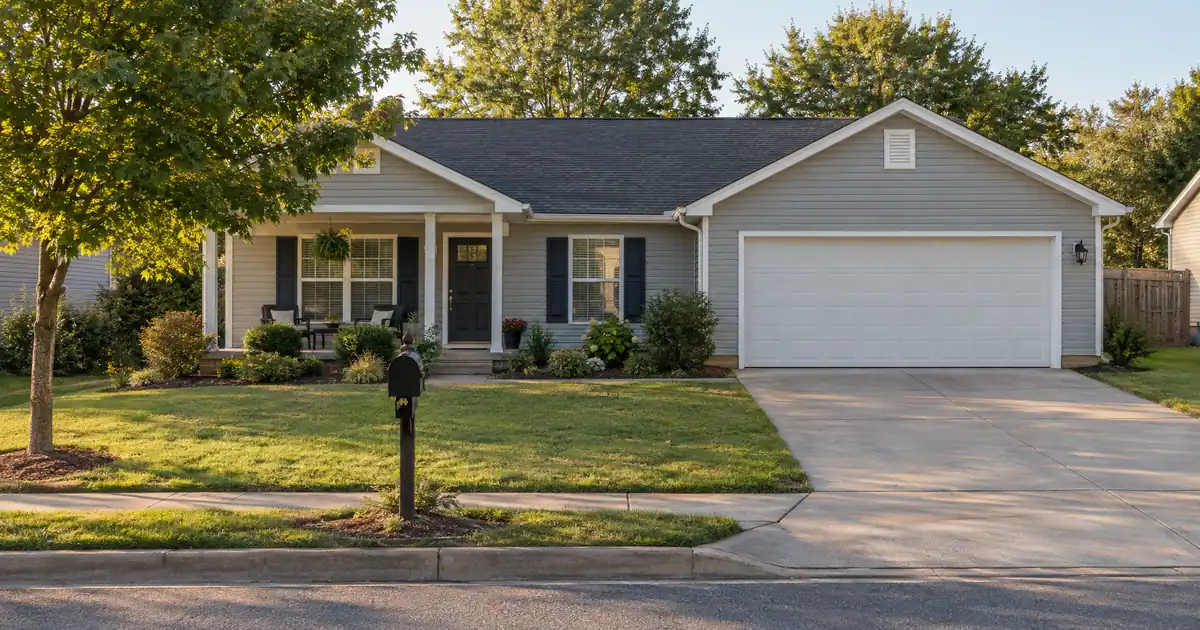
The Quick Read: FHA does not test the wedding date. It tests how long the borrower has owned the home and lived in it as a principal residence. A home bought and occupied before the marriage can meet the 12-month test on its own history, and the FHA cash-out tops out at 80% of the home’s value. Marriage matters in other places: who signs the note, whose debts count in the ratios, and what your state’s law requires at closing.
FHA cash-out estimate
Seeded with an example value, a balance to match, and a round cash request; change any field.
Editable benchmark: 7.40% as of October 15, 2026 · Freddie Mac 30-year average via FRED®. A conventional market reference, not an FHA cash-out refinance quote.
Illustrative starting assumptions: a $350,000 home value, a $193,000 current balance, the FHA cap on a principal residence with the upfront premium financed, a thirty-year term at the current Freddie Mac benchmark, and property taxes and insurance estimated at typical national rates. Every field is editable.
An illustration, not a Loan Estimate, an approval, a quote, or a commitment to lend. The rate shown is the weekly Freddie Mac thirty-year conventional benchmark, used as a market reference; an FHA cash-out is priced by the lender at lock, and this is not an FHA cash-out refinance quote. HUD’s cap limits the base loan; the upfront premium is financed on top of the capped base loan; the monthly premium for the first year follows the snapshot’s schedule. Cash available means the base loan the cap permits less the balances retired, before closing costs, which this calculator leaves out. The line figure applies the line program’s combined loan-to-value ceiling to the same value and balance. Taxes and insurance are estimates you can edit. Licensed in sixteen states for consumer mortgages.
“Bought before the marriage” is not a named HUD category. It is a scenario, and the answer comes from applying the ordinary cash-out rules to your timeline. The sections below walk through those rules, then the places where a spouse changes the file.
What Does an FHA Cash-Out Refinance Actually Do?
An FHA cash-out refinance replaces your current mortgage with a new, larger FHA loan and pays you the difference in cash. The new loan pays off the old one first. What is left after payoff and costs comes to you.
That is different from a home equity loan or a HELOC, which sit behind your first mortgage and leave it alone. The Consumer Financial Protection Bureau draws the same line: a cash-out refinance replaces the original mortgage, while the other products leave it intact.
Lendmire arranges the FHA cash-out refinance program through wholesale lenders in the 16 states where it does consumer lending. Lendmire is a broker, so lenders make the credit decisions. Everything below is subject to lender guidelines and a full file review, and none of it is a commitment to lend.
Key Terms Defined
Seasoning: the length of time you have owned and lived in the home before the loan application gets its case number.
Case number: the FHA identifier assigned to your file. The ownership and occupancy clock runs backward from the day it is assigned, not from closing.
Principal residence: the home where you actually live most of the year. FHA cash-out is limited to this type of property.
Non-borrowing spouse: a spouse who is not on the loan application and does not sign the note.
Community property state: a state where most assets and debts acquired during the marriage belong to both spouses.
Adjusted value: the property value FHA uses when it applies the 80% cap.
Does Marriage Restart the Seasoning Clock?
No. The clock tracks the borrower’s ownership and occupancy of the property. For FHA cash-out, the home must have been owned and lived in by the borrower for 12 months before the case number is assigned. Nothing in that test refers to a marriage date.
So picture a borrower who bought a home, lived in it for two years, and then married. Marriage did not interrupt anything. The ownership and occupancy history is already in place. Now flip it: a borrower who bought the home, lived in it for six months, then married. That borrower is not yet at 12 months, and the wedding neither helps nor hurts. Wait for the clock, then apply.
Here is where practitioners see mix-ups. A spouse who moves in later does not reset the borrower’s clock. What matters is that the borrower’s own occupancy is continuous across the 12 months. If the borrower moved out for part of that period, that is a separate problem from the marriage.
Lenders typically document occupancy with items like utility bills or employment records showing the property address. Gather those before you apply.
What Are the Core FHA Cash-Out Tests?
A file generally has to clear five checks. Across the wholesale programs Lendmire works with, they look like this:
1. Owned and occupied for 12 months. At least one borrower has owned the home and lived in it as a principal residence for the 12 months before the case number.
2. Value and leverage. The new first mortgage, plus any other liens that stay on the home, must fit under 80% of adjusted value.
3. Payment history. Lenders review the prior 12 months on your current mortgage. Late-payment tolerance varies by lender guidelines and handbook rules, so ask before you assume.
4. Credit and ratios. The base housing-to-total ratio pair is 31/43. Documented compensating factors can stretch it to 40/50 at the top tier, and the automated finding governs most files.
5. Full appraisal. Value drives the maximum loan, so a cash-out always needs one.
The wholesale programs Lendmire places FHA loans with start at a 580 decision score. Some lenders set higher floors of their own. FHA also charges mortgage insurance on the new loan: an upfront premium of 1.75% of the base loan, which can be financed, plus an annual premium between 0.15% and 0.75% of the balance depending on term, loan amount and LTV. At 80% LTV on a thirty-year loan, the annual premium ends after eleven years rather than lasting the full term. Your Loan Estimate shows the real numbers.
For the official policy source, FHA’s rules live in HUD’s Single Family Housing Policy Handbook 4000.1, which HUD revises on a regular schedule. County loan limits apply, and they change every year.
Does My Spouse Have to Be on the Loan?
No. The existing owner is the borrower of record, and a new spouse does not have to become a co-borrower. Plenty of homeowners refinance alone after marriage.
Three things can still pull the spouse into the file, even if the spouse is not on the loan:
- Debts in community property states. If you live in a community property state, or the home is in one, the spouse’s debts generally count in your qualifying ratios. Debts that state law excludes are the exception. The spouse’s income cannot be counted, and their credit score is not used, but their liabilities can be.
- Signatures at closing. Some states require a non-borrowing spouse to sign the security instrument, or a relinquishment, so the lender gets a valid first lien. That signature is not a promise to repay the loan.
- Joint applications. If you apply together, lenders typically use the lower credit score. A solo application avoids that.
The practical decision looks like this:
| Choice | Effect on the loan | Effect on income used |
|---|---|---|
| Borrower applies alone | Spouse’s debts may count in community property states | Only the borrower’s income |
| Spouse co-borrows | Both are liable; lower score is used | Both incomes count |
| Spouse signs closing papers only | Not liable on the note | Spouse’s income cannot be used |
If one spouse’s credit is weaker or the household’s debts are heavy, the solo route often keeps the file cleaner. If the borrower’s income alone cannot support the ratios, a co-borrower may be the only way to reach the loan amount. That is a real tradeoff, not a default.
Loan Versus Title: Two Separate Decisions
The mortgage and the deed are different documents. The loan says who owes the money. The title says who owns the home. You can have a loan in one name with a deed in both, or the other way around.
Industry sources quote an older FHA rule that allows people who are not applicants to hold an ownership interest without signing the note. State law may still call for a signature on the security instrument. This language predates the current handbook, so a lender should confirm it against today’s text.
Adding a spouse to title during a refinance is an ownership decision, and it is not required by FHA. It can change how the home is treated in a divorce or an estate. In a state that follows the title-based system, retitling may blur the line between your separate property and shared property. In a community property state, the rules differ again. That is a question for a family-law attorney, not a lender. Ask the attorney before you sign a new deed, not after.
When Does This Rule Break?
The general rule has several edge cases worth knowing.
The home was a rental or second home before the wedding. FHA cash-out is limited to principal residences. Until the borrower has lived there for 12 months as a primary home, it is not eligible. Occupancy decides the leverage, so the date you moved in is the date that counts.
Inherited homes. HUD’s archived guidance recognized an exception to the ownership clock for heirs who have occupied the home since inheriting. That guidance is old, so confirm the current version with a lender before relying on it. Lendmire’s piece Can You Get an FHA Cash-Out on an Inherited Home Before Probate Closes? covers that situation in detail.
A streamline instead of a cash-out. An FHA Streamline refinances an existing FHA loan with no appraisal and a limited credit review. Rules for adding a person to title on a streamline are looser. But a streamline is not a cash-out. It gives essentially no cash back.
Divorce or equity buyouts. If you are buying out a former spouse, lenders typically treat it under special documentation rules and ask for the divorce decree or settlement papers. It is a different path from the standard cash-out, so raise it at the start.
Multi-unit homes. A one-to-four unit home can be eligible if you live in one unit and meet the 12-month test. Confirm unit-count rules with the lender.
A rental you own, bought before the marriage. That is a different loan type with a different underwriting basis. Lendmire’s piece DSCR Cash-Out Spouse Rules for a Rental Bought Before Marriage covers it.
Using the Cash: What Changes in Your Household
A cash-out replaces the whole first mortgage with a bigger one. Your monthly obligation changes, and the equity left in the home shrinks. FHA premiums apply to the new, larger loan. Costs are paid at closing or financed within the 80% cap, and your Loan Estimate and Closing Disclosure show them.
The CFPB’s survey work found that paying off other debts was the most common stated reason for a cash-out refinance, with home repairs next. That shifts unsecured debt into debt secured by the house. The CFPB has noted that this can put the home at risk of foreclosure if payments become unsustainable.
How you spend the cash can matter for ownership too. If marital income repays the new, larger loan, or the cash goes into a joint account or a joint project, some states may treat that as a shared stake in a home you bought alone. Keep proceeds traceable if separate-property status matters to you. Tax treatment can depend on your situation; borrowers should speak with a qualified tax professional before relying on any deduction or credit.
Three Quick Scenarios
Long-time owner, recent wedding. The borrower lived in the home for years before marrying. The 12-month test is met on the borrower’s own history. The question is only whether to apply alone or jointly, and whether the spouse’s debts count in a community property state.
Recent buyer, newlywed. The borrower closed on the home and moved in eight months ago, then married. The seasoning clock has not reached 12 months. Wait until it does. Applying early only wastes a credit pull.
Home was a rental, now lived in together. The borrower rented the home out for years, then moved in at the wedding. The 12 months of principal-residence occupancy start from the move-in date, not the purchase date.
What to Gather Before You Apply
For the lender:
- Proof of when you took title and when you began living there
- Utility bills or similar records tying you to the address
- Twelve months of mortgage payment history
- A payoff statement for the current loan
- Details on any HELOC or second lien staying in place, since those count toward the 80% limit
For your own records, if protecting separate-property status matters:
- The original purchase documents showing the date and your name alone
- Records of who paid the mortgage and from which account
- Receipts for improvements and what funds paid for them
- Any prenuptial or postnuptial agreement
Frequently Asked Questions
Does the date I got married change my FHA cash-out eligibility?
No. Eligibility turns on how long you have owned the home and lived in it as a principal residence, measured back from the case number. A wedding before or after that window does not move it.
Can I refinance without my spouse on the loan?
Yes, in most cases. The owner of record can be the sole borrower. In a community property state, the spouse’s debts generally still count in your ratios, and some states require the spouse’s signature on the security instrument.
Why would a title company ask my spouse to sign if they are not borrowing?
Some state laws require it so the lender’s lien is valid against the spouse’s possible interest in the home. The signature does not make the spouse liable for the loan.
Is the FHA cash-out limit 85% of my home’s value?
No. HUD lowered it to 80% for case numbers assigned on or after September 1, 2019. Older sources, including some archived HUD pages, still show 85%.
Does adding my spouse to the deed hurt my cash-out chances?
Not by itself. It becomes a lending issue only if the spouse becomes a borrower or state law requires a signature. It can matter a great deal to ownership, so talk to an attorney first.
If you are weighing a cash-out refinance against keeping the loan you have, Lendmire can help you compare the programs and the equity each one reaches. Call 828-256-2183 or request a quote through Lendmire’s quote page.
About Lendmire
Lendmire is a mortgage brokerage (NMLS# 2371349) licensed for consumer mortgage lending in 16 states, arranging FHA, VA, conventional and jumbo purchase and refinance loans through a wholesale lending network. Eligibility is determined by the lender on each file. Scotsman Guide named Lendmire a Top Mortgage Workplace in both 2025 and 2026.
Get Started
Ready to find the right loan for you?
In about 30 seconds you can review financing options available for your home or investment property. No commitment required.
Informational only. Not a Loan Estimate, approval, or commitment to lend. Program availability and eligibility are subject to lender guidelines, credit approval, property review, and underwriting.
References
1. CFPB Office of Research blog on cash-out refinances
2. HUD Handbook 4000.1 transmittal (Update 18)
This article is part of Lendmire’s FHA Loan series — every loan program’s qualification details, guidelines, and scenarios live on the loan options page.
Related reading: Can You Get an FHA Cash-Out on a Home in an Irrevocable Trust? · Is an FHA Cash-Out Easier to Get on a 2–4 Unit Primary Home? · FHA Cash-Out Rules for a Texas Second Home That Isn’t a Homestead
Brandon Miller
Founder & CEO, Mortgage Loan Originator, Lendmire LLC
- Mortgage Loan Originator · NMLS# 1129696 · Verify on NMLS Consumer Access
- North Carolina Real Estate Broker · License# 343312 · Verify on NCREC
- North Carolina Insurance Producer · License# 19053198 · Property, Casualty, Life, Health · Verify on NAIC SBS
- Lendmire LLC · Firm NMLS# 2371349 · Verify firm licensure
Compliance and disclosures. Lendmire (NMLS# 2371349) is a licensed mortgage broker and is not a direct lender, depository institution, financial advisor, or tax professional. Content in this article is general market analysis and educational information — not financial, legal, or tax advice for any specific situation. Lendmire does not guarantee loan approval; every transaction is subject to underwriting by the funding lender. Mortgage pricing and loan program guidelines are subject to change at any time without notice and vary by borrower characteristics, property type, and state regulations. Lendmire complies with Equal Housing Opportunity. Licensure verification: NMLS Consumer Access.