
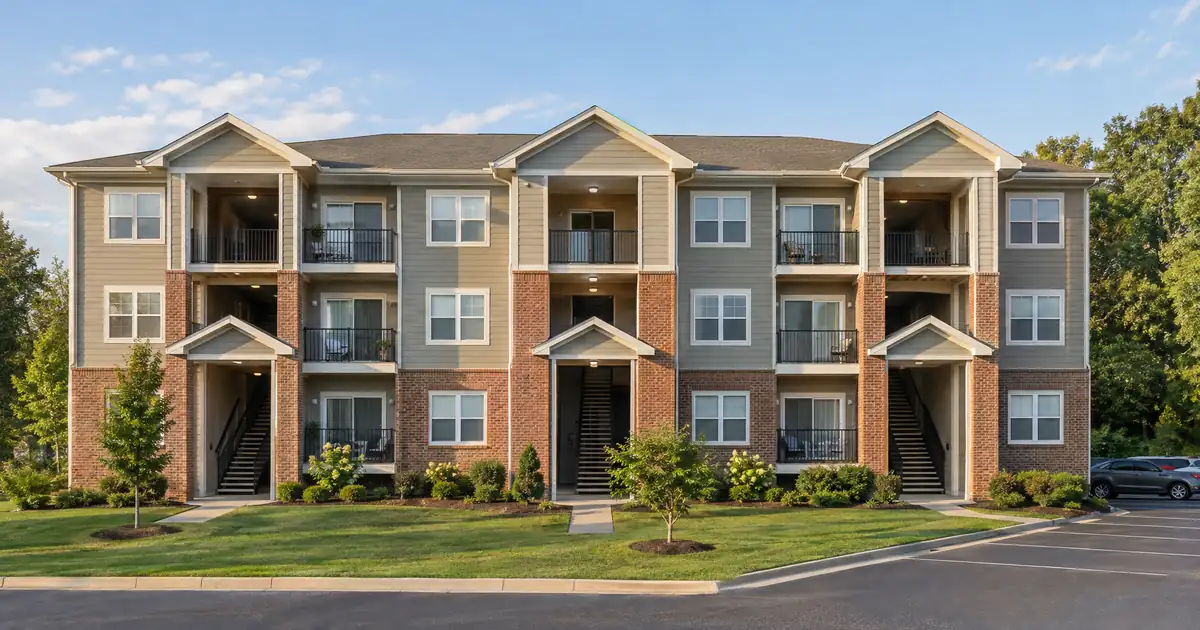
The Quick Read: A cash-out refinance on a building with five or more units replaces your old loan with a larger one and pays you the difference. The lender sizes it on the building’s net operating income and appraised value, not on a simple rent check. Across Lendmire’s wholesale network, cash-out typically tops out around 75% LTV, subject to lender guidelines.
- Five units is where the deal shifts from a residential-style review to a commercial-style one, with a different appraisal and different documents.
- The loan is sized by the lowest of several tests. Appraised value, income coverage, and reserves can each become the limit.
- Cash in hand is always less than your equity, because payoff, closing costs, escrows, and reserves come out first.
- About 6 months of ownership, measured from title recording, is the common seasoning expectation in the network.
- Clearing a coverage ratio of 1.00 does not mean the building cash-flows. Repairs, vacancy, management, and capital spending sit outside that math.
Where Four Units Ends and Commercial Begins
The line sits at five units. One to four units is a residential-style file valued by comparable sales. Five and up is commercial multifamily, valued mostly on income. The loan is usually the same idea in both lanes, but the review behind it is not.
DSCR Cash-Out Calculator
Run the cash-out numbers in your market
Rate source: Freddie Mac 30-yr average via FRED® — Federal Reserve Bank of St. Louis · effective Oct 8, 2026
Prefilled with starting assumptions — enter your property’s value, balance, taxes, and insurance for a more accurate picture.
Program parameters update from Lendmire’s centralized guideline source. Taxes and insurance are editable estimates.
As of Oct 8, 2026 · General Freddie Mac market benchmark, not a Lendmire loan offer. Property value, balance, taxes, and insurance are editable estimates. Maximum loan-to-value varies by lender, program, property type, and seasoning. Not a Loan Estimate, approval, or commitment to lend. Program availability and eligibility are subject to lender guidelines, credit approval, property review, and underwriting.
| Factor | 1-4 Units | 5+ Units |
|---|---|---|
| Income test | Rent vs. PITIA | NOI vs. debt service |
| Appraisal | Sales comparison | Income approach |
| Key documents | Leases, rent schedule | Rent roll, operating statements |
| Value driver | Neighborhood comps | NOI and cap rate |
| Lender pool | Wider | Narrower, more varied |
PITIA is principal, interest, taxes, insurance, and association dues, the full monthly obligation on the loan. For a duplex or fourplex, DSCR (debt service coverage ratio) is typically monthly rent divided by that obligation. Past four units, many lenders switch to net operating income (NOI), which is rent and other income minus operating expenses, divided by annual debt service.
The practical result is that expenses and vacancy matter as much as rent. A building with strong rents and sloppy books can underperform a quieter building with clean numbers.
This is a common mistake investors make at the line. They assume a bigger building is a bigger version of the same loan. It is closer to a different product, with its own paperwork and its own appraiser.
How Underwriting Treats a 5+ Unit Cash-Out, Step by Step
Underwriting a cash-out on a larger building follows a predictable sequence. Knowing it lets you prepare before the file goes to a lender.
1. Classification. The lender confirms the unit count and property type. Mixed-use space, rooming-house layouts, and unusual configurations change the path.
2. Ownership and borrower. Most investors close in an LLC, subject to lender program eligibility. Lenders want entity documents, a clear ownership chart, and guarantor details.
3. Income review. You provide a current rent roll, trailing operating statements, year-to-date income and expenses, and a sample of leases. The lender reconciles what the leases say against what the bank deposits show.
4. NOI calculation. Lenders start from collected income, subtract a vacancy allowance and operating expenses, and arrive at NOI. Financing costs, income taxes, depreciation, and capital spending are not operating expenses.
5. Appraisal. The appraiser values the building mainly through the income approach. NOI divided by a market cap rate gives value, and comparable sales mostly help set that cap rate. The new loan sizes off this appraised value, not your purchase price.
6. Sizing. The lender runs the leverage cap and the coverage test. The lower result controls.
7. Reserves and costs. The lender holds back reserves, escrows, and fees. What remains after paying off the old loan is your cash.
Step five matters for strategy. Because value comes from NOI, a higher-income building may support a higher appraised value, depending on comps and underwriter review. Raising rents, filling vacant units, or trimming real costs can all feed that number. Investors call this forcing appreciation, and it only counts once the improvement shows up in the trailing financials.
How Much Cash Do You Actually Get?
Proceeds are the lowest of several ceilings, minus costs. Most investors anchor on the leverage cap and ignore the other two limits, which is how they end up surprised.
Run it with percentages. Say the appraisal comes back and your existing balance equals 55% of appraised value. A 75% cap leaves a gap of 20% of value before anything else comes out. Closing costs, escrows, and reserves then shrink that gap. The check you receive is smaller than the 20% headline.
Now flip the scenario. Suppose the building’s NOI only supports a loan equal to about 65% of value at the coverage ratio the lender wants. Coverage binds before leverage does. Your gap shrinks to 10% of value, and the appraisal was not the problem. Expenses and vacancy were.
A third limit is reserves. Across the network, reserves commonly run around 6 months of PITIA, and loans above $1,500,000 typically step up to about 9 months. Liquid reserves held back from proceeds, or held elsewhere, reduce what you can spend. Reserves vary by lender, leverage, loan size, and transaction type, so treat those numbers as a guide.
Two strong files can therefore produce very different checks. Equity is only one of the two tests. The building also has to earn enough to carry the new loan.
What the Network’s Programs Look Like at This Size
Here is where the DSCR programs Lendmire places files with generally land. These are typical ranges from select lenders in the network, subject to lender guidelines. Lendmire is a broker and arranges financing; lenders review and approve.
- Cash-out leverage: around 75% LTV on a standard rental, which is the ceiling across most of the network. A larger down payment on a purchase never lifts this cap for a cash-out.
- Seasoning: about 6 months of ownership before cash-out is the common expectation.
- Coverage: 1.00 is where many select programs start. A separate select-lender path takes coverage below 1.00, with leverage and terms adjusted. Stronger ratios open better pricing and leverage.
- Credit: a 620 floor exists in parts of the network. Most programs want around 660, and 700+ unlocks the strongest leverage tiers.
- Loan size: up to $3,000,000 on standard programs. Above $2,500,000, the network generally holds to 30-year fixed structures.
- Structure: the 30-year fixed is the spine. Extended terms, such as 40-year, and interest-only periods are available through select lenders. ARM structures exist for investors who want them.
- Not offered: manufactured homes (single- and double-wide), log homes, and barndominiums fall outside these programs.
Putting more money into a deal can lower the payment and lift coverage. It does not erase credit floors, reserve rules, leverage caps, or property eligibility. The strongest files have enough equity and enough income coverage.
Other channels exist at this size, including bank portfolio loans, agency and government-insured execution, and securitized loans. They differ on recourse, prepayment cost, documentation, and how they treat cash-out. A broker who sees many lenders can compare them side by side. A single bank usually shows you one.
Where the General Rule Breaks
The five-unit line is a good rule of thumb. These are the places it stops working.
Owner-occupied small buildings. If you live in one unit of a five-unit building, the loan is not a pure investor file. Under the CFPB’s rule text for exempt transactions, an owner-occupied rental is treated as business purpose to acquire above two units and to improve or maintain above four. Below those thresholds, the lender weighs the actual purpose of the loan. Occupancy changes the program, the leverage, and the paperwork, so raise it at the start.
Non-owner-occupied rentals at any size. The business-purpose picture is simpler when you do not live in the building. The official interpretations on eCFR say credit to acquire, improve, or maintain a non-owner-occupied rental is deemed business purpose regardless of unit count. DSCR loans are designed for non-owner-occupied investment properties. Because they are business-purpose investor loans, they are reviewed differently from a standard owner-occupied mortgage, and consumer mortgage disclosure forms generally do not apply.
The commercial label alone. Calling a loan commercial does not make it so. As practitioner commentary from Compliance Cohort points out, the borrower’s actual primary purpose decides. That is why lenders typically collect a business-purpose statement on cash-out files.
Mixed-use buildings. Ground-floor retail or office space changes how income is underwritten. Some programs limit how much commercial space a building can have, and some price it differently. Residential-only coverage math may not carry over.
Buildings that are not stabilized. A building with heavy vacancy or major rehab pending usually does not fit a cash-out program yet. Lenders want a track record of occupancy and collections first. Bridge financing often comes first, with a refinance after the building stabilizes.
Five to eight units. Small buildings just past the line sit awkwardly between worlds. They are too big for residential-style forms and too small for many large commercial lenders. Expect fewer lender options and more variation in terms.
Old loan terms. A prepayment penalty or yield-maintenance clause on your current loan can wipe out the benefit of pulling cash. Read the payoff terms before you order an appraisal.
Is a Multifamily Investment Property Cash-Out Refinance Worth It?
The refinance makes sense when the cash earns more than the new debt costs, and when the building can carry the larger loan with room to spare. It makes less sense when the cash plugs a hole.
Strong uses of cash-out include a down payment on the next building, a funded renovation that raises NOI, and consolidating higher-cost debt. If you are buying another rental with the proceeds, Lendmire’s piece Using Cash Out Refinance To Buy Investment Property covers the mechanics. Another post explains taxed on cash out refinance to purchase investment property. Tax treatment can depend on how the funds are used and how the property is held; investors should keep clear records and speak with a qualified tax professional before relying on any deduction.
Weak uses include covering operating losses, funding a lifestyle, or pulling cash from a building that barely clears coverage. A thin coverage ratio leaves no margin for one bad quarter.
A practical decision checklist:
- Stress the appraisal. If value comes in lower, does the deal still work?
- Stress the income. Run collections and concessions worse than your rent roll suggests.
- Check the old loan. Add up any prepayment penalty before you commit.
- Price the exit. Ask how the new loan treats a sale or refinance later.
- Compare against selling. If the building has run its course, a sale might beat a refinance.
Remember what coverage does and does not tell you. A 1.00 DSCR means income covers the loan obligation. It does not mean positive cash flow, because operating costs and capital repairs sit outside it.
DSCR files in this category tend to move more smoothly when the investor treats the rent roll and operating statements as the main product, not an afterthought. In Lendmire’s broker experience, the gap between a clean file and a messy one is usually the books, not the building. Reconcile bank deposits to the rent roll before anyone asks.
For the full picture of how these loans work across property types, see Lendmire’s complete DSCR loans guide.
Key Terms Defined
Net operating income (NOI): the building’s income after vacancy and operating expenses, before debt service, taxes on income, depreciation, and capital spending.
Debt service coverage ratio (DSCR): income divided by the loan obligation. On small buildings it is rent over PITIA, and on larger ones it is typically NOI over annual debt service.
LTV (loan-to-value): the loan amount as a percentage of the appraised value.
Cash-out refinance: a new loan larger than the one it replaces, with the difference paid to you.
Seasoning: the ownership period a lender wants before it will refinance for cash.
Reserves: liquid funds a lender wants you to hold after closing, usually counted in months of PITIA.
Prepayment penalty: a fee for paying a loan off early, which can apply to your current loan or a new one.
Rent roll: a unit-by-unit schedule showing tenants, rents, lease dates, and occupancy.
Frequently Asked Questions
Can I use a residential DSCR loan on a building with five or more units?
Usually not in the same simple form. Past four units, the review typically moves to NOI, a rent roll, operating statements, and an income-based appraisal. Select lenders in the network place DSCR programs on larger buildings, subject to lender guidelines, so the answer depends on the building and the file.
Does a fourplex count as commercial?
No. One to four units is residential-style, valued by comparable sales. Commercial treatment starts at five units. A fourplex sits in the residential lane, which often means a wider lender pool and a simpler appraisal.
How much equity can I pull out of a five-unit building?
It depends on appraised value, your payoff, and the NOI the lender recognizes. The network’s cash-out ceiling is around 75% LTV on a standard rental, but coverage or reserves can bind first. Proceeds are always lower than headline equity because costs, escrows, and reserves come out. Terms depend on the lender’s guidelines, the property type, the leverage, and a full review of the credit profile.
How long do I need to own the building before a cash-out?
About 6 months of ownership, measured from title recording, is the common expectation across the network. Some lenders ask for more. Seasoning rules vary, so confirm them before you plan around a timeline.
Does the property need to be fully occupied?
Lenders generally want a stabilized building with a track record of occupancy and collections. A building with heavy vacancy or major renovations underway may need bridge financing first. The underwriter looks at trailing results, not just what the building could earn.
Running Your Own Numbers
If you are buying or refinancing a rental property and want to see how the numbers work, Lendmire can help you compare DSCR loan options based on the property income, credit profile, leverage, and investor goals. The brokerage arranges DSCR financing through select lenders in its wholesale network across 41 markets, including Washington, D.C. Call 828-256-2183 to talk through a larger building. Any calculator estimate is illustrative and not a quote or a commitment to lend.
For how equity extraction works on an investment property, see Lendmire’s guide to cash-out refinance on an investment property.
About Lendmire
As a DSCR and non-QM mortgage broker, Lendmire — NMLS# 2371349 — connects investors with wholesale lending channels across 41 markets, including Washington, D.C. The property’s rental income, not the borrower’s tax returns, is central to lender review, which works for self-employed operators and portfolios beyond four financed properties. Scotsman Guide named Lendmire a Top Mortgage Workplace in both 2025 and 2026.
Get Started
Ready to find the right loan for you?
In about 30 seconds you can review financing options available for your investment property. No commitment required.
Informational only. Not a Loan Estimate, approval, or commitment to lend. Program availability and eligibility are subject to lender guidelines, credit approval, property review, and underwriting.
References
1. CFPB, Regulation Z §1026.3 (Exempt transactions)
2. eCFR, Supplement I to Part 1026
3. Compliance Cohort, excluding a Reg Z loan as commercial
This article is part of Lendmire’s investment property cash-out refinance program — full qualification details, guidelines, and scenarios live on the program page.
Related reading: Cash-Out Refinance vs HELOC on a Non-Warrantable Condo · Cash-Out Refinance vs HELOC for Investment Property Owners: What Decides · VA Cash-Out vs Investment Property HELOC With a Low Home Mortgage
Brandon Miller
Founder & CEO, Mortgage Loan Originator, Lendmire LLC
- Mortgage Loan Originator · NMLS# 1129696 · Verify on NMLS Consumer Access
- North Carolina Real Estate Broker · License# 343312 · Verify on NCREC
- North Carolina Insurance Producer · License# 19053198 · Property, Casualty, Life, Health · Verify on NAIC SBS
- Lendmire LLC · Firm NMLS# 2371349 · Verify firm licensure
Disclosure information. Lendmire is a state-licensed mortgage brokerage under NMLS# 2371349. Lendmire is not a depository institution, direct lender, or financial advisor — all loans referenced are placed through wholesale lender partners and are subject to each lender's underwriting standards. This article is provided for general informational purposes and is not a commitment to lend, nor does it constitute financial, legal, or tax advice. Loan programs, terms, rates, and qualification standards change without notice and depend on borrower profile, property type, and the state in which the subject property is located. Equal Housing Opportunity provider. NMLS Consumer Access: nmlsconsumeraccess.org.