
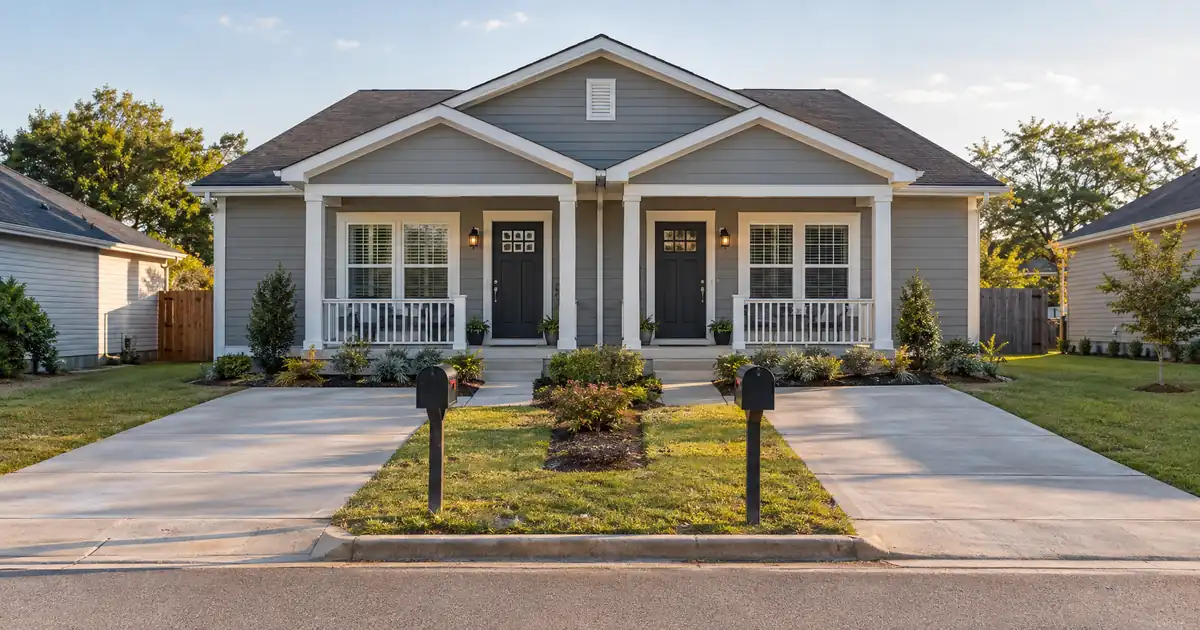
The Quick Read: A non-owner-occupied condo or duplex can be refinanced for cash, and a DSCR structure judges the deal mainly on the property’s rent against its new payment, not on the borrower’s traditional employment income or DTI. The new loan replaces the old one, and the borrower receives the difference at closing.
- Cash-out leverage on an investment property tops out around 75% LTV across most of the network.
- About 6 months of ownership (measured from title recording) is the common seasoning expectation.
- 1.00 coverage is where select programs start, and a bigger balance lowers coverage.
- A condo adds a building review on top of the unit review, and HOA dues sit inside the payment.
- A duplex is tested on combined unit rents, and it must be a true non-owner-occupied rental. The exact numbers vary by lender and program and follow a full review of property, leverage, and credit.
Most borrowers asking this question hold one of two assets: a condo unit rented to a tenant, or a two-unit building. They look similar on a balance sheet, but underwriting treats them differently. This article walks through the mechanics step by step, then the structures, the edge cases, and the decision itself. For the wider picture, Lendmire’s complete DSCR loans guide covers the program family.
DSCR Cash-Out Calculator
Run the cash-out numbers in your market
Rate source: Freddie Mac 30-yr average via FRED® — Federal Reserve Bank of St. Louis · effective Oct 8, 2026
Prefilled with starting assumptions — enter your property’s value, balance, taxes, and insurance for a more accurate picture.
Program parameters update from Lendmire’s centralized guideline source. Taxes and insurance are editable estimates.
As of Oct 8, 2026 · General Freddie Mac market benchmark, not a Lendmire loan offer. Property value, balance, taxes, and insurance are editable estimates. Maximum loan-to-value varies by lender, program, property type, and seasoning. Not a Loan Estimate, approval, or commitment to lend. Program availability and eligibility are subject to lender guidelines, credit approval, property review, and underwriting.
Key Terms Defined
Cash-out refinance: a new, larger loan that pays off the old mortgage and puts the difference in the borrower’s hands.
Seasoning: how long the borrower has owned the property before a lender will lend on its appraised value instead of its cost.
LTV (loan-to-value): the new loan balance divided by the property’s appraised value.
DSCR (debt service coverage ratio): monthly rent divided by the monthly principal, interest, taxes, insurance and HOA dues (PITIA).
PITIA: principal, interest, taxes, insurance and association dues, the full monthly obligation the rent must cover.
Non-warrantable condo: a project that fails agency eligibility rules. It does not mean the property is bad.
What Does a Cash-Out Refinance Actually Do on a Rental?
It swaps your existing mortgage for a bigger one and hands you the gap as cash. The structure matches a primary-residence cash-out. The difference lies in how the file is judged.
On a DSCR file, the loan is reviewed primarily on property-level rental income covering the payment, subject to lender guidelines. Traditional personal-income documentation and DTI are not the center of the file. DSCR loans are designed for non-owner-occupied investment properties, so they are reviewed differently from a standard owner-occupied mortgage.
That matters most for self-employed investors, entity-held portfolios, and anyone whose personal income doesn’t tell the story of the rental.
How Underwriting Treats It, Step by Step
Underwriting runs in a fixed order, and each step can stop the file.
1. Classification. The lender sorts the deal as cash-out or rate-and-term. On most files in the network, cash-out tops out around 75% LTV on an investment property. Rate-and-term refinances, which return no cash at closing, can carry a higher ceiling of up to 85% LTV. A refinance that hands back meaningful cash is cash-out, whatever you call it.
2. Ownership and seasoning. About 6 months of ownership, counted from title recording, is the common expectation. Before that, many lenders lend on the lower of cost basis or appraisal. Lender policy, not federal rule, sets this, so it varies across programs.
3. Appraisal and rent evidence. The appraiser supplies the value and a market rent opinion. Fannie Mae’s learning center lists the standard forms by name: Form 1025 for small residential income properties, Form 1007 for the single-family comparable rent schedule, and Form 1073 for an individual condominium unit. A duplex typically uses 1025, which reports rent unit by unit. A condo typically pairs the 1073 value report with a 1007 rent schedule. The pairing is common practice, not a rule.
4. Size the loan. The new loan is the lesser of two limits: the leverage ceiling applied to appraised value, and the amount the rent can support at the required coverage. Cash to you equals the new loan, minus the payoff, minus closing costs and prepaids.
5. Test coverage on the new payment. This is where cash-out files get tight. A bigger balance raises PITIA and lowers the ratio. A property that covered comfortably before can land near 1.00 after the pull.
6. Borrower and entity file. Expect the appraisal and rent schedule, lease evidence, title and payoff statement, proof of reserves, and entity documents (operating agreement, good standing) if an LLC holds title. LLC vesting is typically accepted, subject to program terms.
7. Condo project review, covered next, since it applies only to condos.
The Condo Path: Two Tests, Not One
A condo file has to pass the unit test and the building test. A strong unit in a troubled building can still stall.
Lenders look at HOA financials and delinquencies, the share of units that are investor-owned, pending litigation, and any commercial space. Most DSCR programs write their own project rules rather than borrowing agency rules, so an issue that blocks a conventional loan doesn’t always block a DSCR file. Not every issue clears, though. Heavy HOA delinquency or serious project problems can end it.
HOA dues are the other condo-specific drag. They sit inside PITIA, so higher dues cut coverage dollar for dollar. Special assessments can do the same. Two condos with identical rent and identical balances can land at very different ratios because of dues alone.
If the project fails review at one lender, the answer is rarely to give up. Programs differ on investor concentration, delinquency tolerance and leverage adjustments, which is where a broker comparing several lenders earns its keep. Expect tighter leverage, higher reserves or pricing adjustments on non-warrantable buildings.
The Duplex Path: Unit-by-Unit Rent
A duplex is a 2-4 unit property, so it goes through the small-income-property lane. The appraiser reports rent for each unit, and the combined figure feeds the coverage test.
Two cautions apply. First, the property must be non-owner-occupied. If you live in one unit, you are in owner-occupied territory, and pulling cash runs through owner-occupied refinance rules instead. DSCR programs are for investment property only. Second, a 2-4 unit building held as condos can muddy form selection between 1073 and 1025. A New Jersey appraisal practice’s guide to Form 1025 notes that 1025 includes condos and PUDs in the 2-4 unit category. Treat that as a secondary, practitioner view, and expect the lender to tell you which form it wants.
Appraisers on small multifamily tend to lean on sale comparables, not on rent. Higher rent doesn’t automatically mean a higher appraisal.
Condo vs. Duplex at a Glance
| Factor | Condo unit | Duplex |
|---|---|---|
| Value form | 1073 | 1025 |
| Rent evidence | 1007 schedule | Unit-by-unit on 1025 |
| Extra review | Building and HOA | Unit count, occupancy |
| Payment drag | HOA dues in PITIA | Taxes and insurance only |
| Common stall | Project problems | Owner-occupied unit |
Structures and Variations
The spine is the 30-year fixed. Extended terms (40-year) and interest-only periods are available through select lenders in the network, and ARM structures exist for investors who want them. Interest-only and longer amortization can lift coverage on a thin file, at the cost of slower principal paydown.
Key program ranges, all subject to lender guidelines and varying by borrower, property and loan scenario:
- Coverage: 1.00 is where many select programs start. A separate select-lender path takes coverage below 1.00 with leverage and terms adjusted. Stronger ratios open better pricing and leverage.
- Credit: a 620 floor exists in parts of the network, most programs want around 660, and 700+ unlocks the strongest tiers.
- Reserves: commonly around 6 months of PITIA, stepping up to about 9 months above $1,500,000. Whether cash-out proceeds can count toward reserves is program-specific, so don’t assume it.
- Loan size: up to $3,000,000 on standard programs, with smaller balances routed through select lenders.
Short-term-rental condos follow different rules. Cash-out on STR collateral runs around 70% LTV, versus 75% on standard long-term rentals, with a 640+ score and about 12 months of hosting history typical. Short-term rental rules can vary by city, county, HOA, and property type, so investors should confirm local rules before relying on projected rental income. Final terms depend on the lender’s guidelines, the property type, and the borrower’s complete credit picture.
Not offered in the network: DSCR on manufactured homes (single- and double-wide), log homes and barndominiums. Condotels and rental-pool buildings are usually treated as a separate property class with lower cash-out caps, not as a normal condo.
Where the General Rule Breaks
Recently bought or renovated property. Inside the seasoning window, value is typically the lower of cost and appraisal. After it, appraised value applies. An investor who renovated and wants to pull cash out right after the work is the classic case. Wait for the window, or expect the lender to ask about improvements if value jumped well above the prior price.
Refinancing an existing DSCR loan. The new loan is underwritten fresh. Value, rent and coverage are all rechecked.
Owner-occupied duplex. Covered above. Different product, different rules.
Entity title versus personal title. HELOCs and some conventional alternatives often need personal or trust title. An LLC-held rental points back toward DSCR.
HELOC as an alternative. Investment-property HELOC lines cap at $500,000 total. It can be cheaper capital for a smaller need, but it won’t scale for a large pull.
Conventional or DSCR for These Two Property Types?
| Factor | Conventional | DSCR |
|---|---|---|
| Reviewed on | Personal income, DTI | Property rent vs PITIA |
| Fits | W-2 borrower, few loans | Self-employed, LLC, many loans |
| Title | Usually personal | Personal or LLC |
| Cost | Typically lower | Typically higher |
Conventional can be the better call for a salaried investor with one or two financed properties and clean traditional personal-income documentation. DSCR becomes the practical path when personal income is hard to document, when title sits in an LLC, or when the number of financed properties has outgrown agency limits. The tradeoff is cost: DSCR loans generally cost more and often carry prepayment penalties. What they buy is capacity. Lendmire’s DSCR vs conventional comparison goes deeper on how the two paths differ.
A Worked Example, Without the Dollar Figures
Take a rented condo and a rented duplex, each appraising at the same value. Apply 75% LTV. Subtract the existing payoff, then closing costs and prepaids. What remains is net cash. It is almost always smaller than the equity number suggests. Each figure is subject to lender guidelines and a complete review of property type, leverage, and credit.
Now test coverage. The duplex adds up two unit rents against a payment made of principal, interest, taxes and insurance. The condo has one rent against that same stack plus HOA dues. At the same price and rent, the condo usually lands at the lower ratio. Say the duplex clears about 1.25x on the new balance while the condo with healthy dues clears roughly 1.10x. Both pass the 1.00 floor, but the condo has less room to absorb a lender’s reserve or leverage adjustment. A max pull could push either one toward 1.00.
Here is the catch. DSCR compares rent to PITIA only. Clearing 1.00 is not positive cash flow. Repairs, vacancy, management, utilities and capex all sit outside the ratio. A property can pass and still lose money in a bad month.
Is It Worth Pulling the Cash?
It depends on where the money goes and how thin the post-refinance margin is.
- Go: reinvesting into another rental with its own strong coverage, or paying for a renovation that may support a higher appraised value, depending on comps and underwriter review.
- Caution: a max pull that leaves the property near 1.00 with a fat HOA bill. Size the loan to a cash flow you’d accept, not to the lender’s ceiling.
- No-go: funding purchases where the numbers don’t work at the next property either. That signals a submarket problem, not a financing problem.
Tax treatment can depend on how the funds are used and how the property is held; investors should keep clear records and speak with a qualified tax professional before relying on any deduction.
One more tradeoff. Waiting to clear seasoning decides whether you borrow on appraised value or cost. If an appreciation story justifies the wait, patience can add real borrowing capacity.
What Usually Stalls a File
- Condo project issues: delinquent dues, heavy investor ownership, litigation.
- Coverage that looks fine on old debt but thin on the new balance.
- An owner-occupied unit in a duplex.
- Appraisal that comes in below expectations on small multifamily.
- Reserves short, especially if the borrower assumed proceeds would count.
- Title and entity paperwork out of order.
Frequently Asked Questions
Can I use an FHA or VA loan to cash out on a rental?
No. Government-backed programs are built for owner-occupants, so a pure rental doesn’t fit them. Investors typically choose between conventional and DSCR, with HELOCs as a smaller alternative.
How long do I have to own the property first?
About 6 months from title recording is the common expectation on most files in the network. Inside that window, lenders often use the lower of cost or appraised value. Policies vary by program.
Can an LLC-owned condo or duplex be refinanced?
Yes, typically, subject to program terms. Expect entity documents such as the operating agreement and a good standing certificate.
What if I live in one unit of my duplex?
Then it is an owner-occupied property, and DSCR doesn’t apply. The cash-out would run through owner-occupied refinance rules instead.
Does a non-warrantable condo rule out a DSCR loan?
Not automatically. Non-warrantable means the project misses agency rules, and DSCR programs set their own. Leverage may tighten and reserves may rise, and serious HOA problems can still block the file.
If you are buying or refinancing a rental property and want to see how the numbers work, Lendmire can help you compare DSCR loan options based on the property income, credit profile, leverage, and investor goals, through select lenders in its wholesale network across 41 markets, including Washington, D.C. Call 828-256-2183 or request a quote. Qualification is subject to lender guidelines and is not a commitment to lend.
A deeper walk-through of investment-property equity extraction lives in Lendmire’s guide to cash-out refinance on an investment property.
About Lendmire
Lendmire is a non-QM mortgage brokerage (NMLS# 2371349) arranging DSCR investor loans in 41 markets, including Washington, D.C., through wholesale and investor-lending channels. DSCR loans are evaluated by the lender on rental income rather than personal income, subject to lender guidelines — a fit for LLC-owned portfolios, self-employed investors, and operators scaling beyond conventional loan caps. Recognized as a Scotsman Guide Top Mortgage Workplace in 2025 and 2026.
Get Started
Ready to find the right loan for you?
In about 30 seconds you can review financing options available for your investment property. No commitment required.
Informational only. Not a Loan Estimate, approval, or commitment to lend. Program availability and eligibility are subject to lender guidelines, credit approval, property review, and underwriting.
References
1. Fannie Mae Learning Center: Appraisers & Property Underwriting
2. NJ Real Estate Appraisal blog: Form 1025 guide
This article is part of Lendmire’s investment property cash-out refinance program — full qualification details, guidelines, and scenarios live on the program page.
Related reading: Hard Money vs Investment Property Cash-Out Refinance for Equity Access · Investment Property HELOC vs Fix-and-Flip Loan for Cash-Out · Investment Property HELOC vs Cash-Out Refinance to Pull Cash Out
Brandon Miller
Founder & CEO, Mortgage Loan Originator, Lendmire LLC
- Mortgage Loan Originator · NMLS# 1129696 · Verify on NMLS Consumer Access
- North Carolina Real Estate Broker · License# 343312 · Verify on NCREC
- North Carolina Insurance Producer · License# 19053198 · Property, Casualty, Life, Health · Verify on NAIC SBS
- Lendmire LLC · Firm NMLS# 2371349 · Verify firm licensure
Compliance and disclosures. Lendmire (NMLS# 2371349) is a licensed mortgage broker and is not a direct lender, depository institution, financial advisor, or tax professional. Content in this article is general market analysis and educational information — not financial, legal, or tax advice for any specific situation. Lendmire does not guarantee loan approval; every transaction is subject to underwriting by the funding lender. Mortgage pricing and loan program guidelines are subject to change at any time without notice and vary by borrower characteristics, property type, and state regulations. Lendmire complies with Equal Housing Opportunity. Licensure verification: NMLS Consumer Access.