
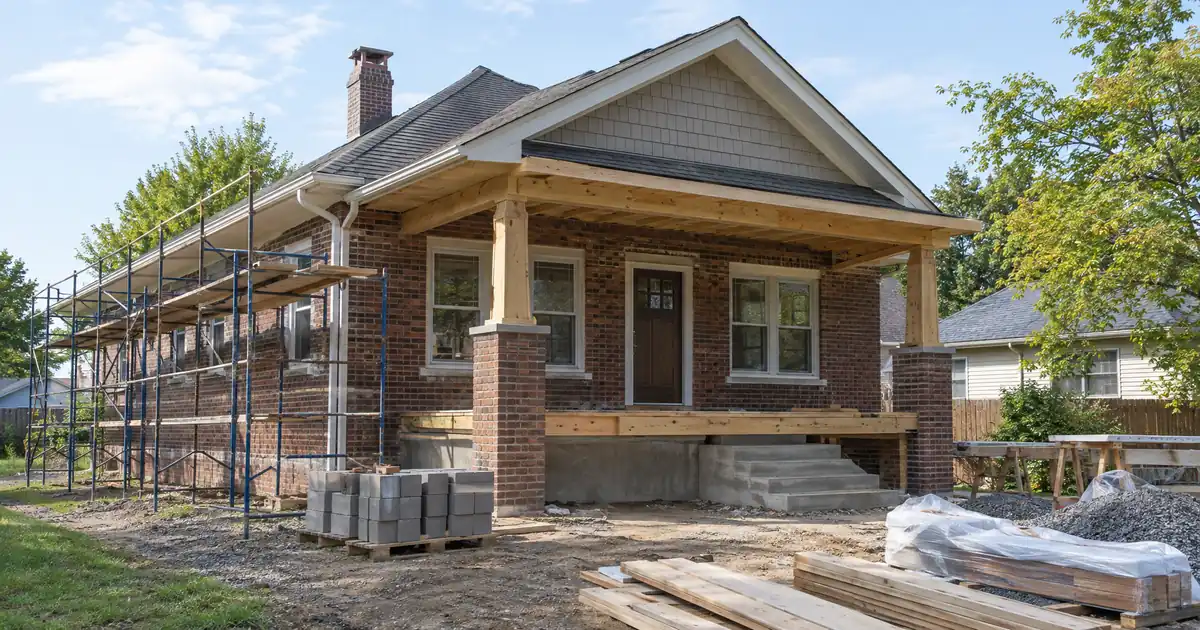
The Quick Read: A conventional cash-out refinance underwrites you, using the net income on your traditional personal-income documentation, while a fix-and-flip loan underwrites the deal, using the property’s after-repair value and your plan to exit the project, so each one asks a different question about the same borrower. One pulls equity out of a property you already own. The other funds a purchase and a rehab. For a 1099 earner whose write-offs shrink taxable income, that difference often decides the choice.
- A conventional loan is not truly “1099-only.” It leans on returns, so net income after deductions is what counts.
- A flip loan looks at the project first and your personal income second.
- They are not substitutes. One fits a property you hold, the other a property you are buying and renovating.
- Programs that qualify on 1099 forms alone are non-QM products, a separate track from conventional.
- Many investors use both in sequence: a flip loan to buy and rehab, then long-term financing to hold.
Key Terms Defined
After-repair value (ARV): what the property is expected to be worth once the renovation is finished.
Draw: a release of held-back rehab money after a lender confirms that a stage of work is done.
Loan-to-cost: the share of your total project cost (purchase plus rehab) that the lender funds.
Schedule C: the tax form where a sole proprietor subtracts business expenses from 1099 income to reach net profit.
Non-QM: a loan outside the standard conventional box, often built for borrowers whose income does not show well on traditional personal-income documentation.
Seasoning: the waiting period a lender wants between buying a property and refinancing it.
Side-by-Side
The conventional column reflects published industry norms. The flip column reflects typical guidelines across the wholesale lender network Lendmire works with. Both vary by lender, property, and borrower.
| Factor | Conventional cash-out | Fix-and-flip loan |
|---|---|---|
| Review basis | Personal income, debts, credit | The deal: ARV, scope, exit, experience |
| Documentation | Traditional personal-income documentation, net income | Contract, rehab budget, ARV comps |
| Property types | Primary home or personal rental | Non-owner-occupied 1-4 units |
| Entity vesting | Generally an individual borrower | LLC common, per program terms |
| Loan term | Long-term, fully amortizing | 6-18 months, interest-only |
| Reserves | Set by each lender | Vary by lender, property, experience |
One note on property types: ground-up construction on the flip side can reach 10 units, but that is a different project than a standard flip.
What “1099-Only” Really Means on a Conventional Loan
Conventional underwriting wants returns, not a stack of 1099s. That is the first thing to understand.
Here is why. The IRS Form 1099-NEC instructions say that self-employment income reported in Box 1 generally goes on Schedule C for a sole proprietor. Business deductions then come off that amount. As TurboTax’s explainer on 1099 filing notes, the net profit, not the gross total, flows to the personal return.
Conventional lenders then read that net figure. The Fannie Mae Selling Guide is the benchmark here. It lets a lender verify self-employed income with signed federal returns or IRS transcripts. Agency rules are only contrast on this page. They do not govern the investor programs discussed below.
The practical result is blunt. A contractor who grosses a lot and writes off a lot can look like a modest earner on paper. Great for the tax bill. Not great for qualifying.
Some borrowers in this spot look at non-QM alternatives that qualify on documented income under the applicable program, subject to lender guidelines. That is a separate track from conventional.
When a Conventional Cash-Out Refinance Is the Better Fit
A conventional cash-out refinance fits when your traditional income documentation tells a strong story and the equity sits in a property you already own.
It works best for a particular borrower. Think of someone with two or more years of self-employment history, steady or rising net income, and room under their debt-to-income limit. They own a stabilized property in their own name. They want long-term, fully amortizing debt and no pressure to sell or refinance on a clock.
It also fits when the property has been held long enough to clear a lender’s seasoning rules. A house you bought last month for resale generally does not fit a conventional refinance. That is one reason the two loans are not true substitutes.
There are honest downsides:
- Write-offs hurt. The same deductions that lower your tax bill lower your qualifying income.
- Debt-to-income fills up. A new payment on your return-based income can crowd out the next application.
- Entity friction. Conventional files generally assume an individual borrower, which is awkward if your properties sit in an LLC.
- Pledged collateral. If the equity comes from your primary home, you are putting your residence behind an investment project. Weigh that risk carefully.
When a Fix-and-Flip Loan Is the Better Fit
A fix-and-flip loan fits when the opportunity is the project itself: a property that needs work, a credible resale or refinance plan, and income that does not photograph well on a tax return.
Across Lendmire’s wholesale network, hard money programs for flips look at the property, the plan, and the exit. They are asset-based. Credit still matters, though. A 620 minimum score is typical, with additional conditions below 660, and first-time investors generally land in the lower leverage tiers.
Leverage is tiered by documented completed projects and measured against project cost:
- Fewer than 2 completed projects: up to 85% of project cost.
- 2 or more: up to 90% of project cost.
- 5 or more: up to 93% of project cost.
- Every tier is capped at 75% of after-repair value.
Rehab money works differently from purchase money. Up to 100% of the rehab budget funds in draws against completed work. You front the work, and the lender releases money as stages are finished. It is a rehab-budget figure, not a purchase loan-to-value. There is no true 100% purchase program.
Terms run 6 to 18 months, interest-only, with no prepayment penalty. That means no fee for paying the loan off early. Loan amounts generally go up to $5,000,000, with larger balances by exception. Every figure varies by lender, property, and experience, and nothing here is a commitment to lend.
The core risk is time. A flip loan is short by design, so the exit must work before maturity. If the house does not sell or the refinance does not line up, you are under pressure. Plan the exit before you buy.
A Modeled Example: Where the ARV Cap Bites
Run the numbers this way. These are modeled assumptions, not market data.
Say a flipper has completed two projects, which puts them in the 90% of project cost tier. The deal’s total cost is 80% of its after-repair value. Ninety percent of that cost works out to 72% of ARV. That is under the 75% cap, so the cost-based tier governs.
Now change one input. Total project cost is 85% of ARV, a thinner deal. Ninety percent of cost would be 76.5% of ARV. The ARV cap binds, and the loan comes in lower than the tier suggests. You would cover the difference with cash.
The lesson is plain. Thin margins cost you leverage. And the loan never asks how much you made from your 1099 clients last year as its main test.
Now the conventional side of the same borrower. Picture a contractor with strong gross receipts and heavy deductions. The refinance underwriter works from net profit and may land well below what that contractor actually earns. The cash is real. The qualifying income is not.
A Quick Word on Business-Purpose Loans
DSCR and flip loans are designed for non-owner-occupied investment properties. Because they are business-purpose investor loans, they are reviewed differently from a standard owner-occupied mortgage. That is one reason they can be written to a property’s economics, and why they often close in an LLC, subject to lender program eligibility.
Conventional files on personal residences follow the standard consumer path.
The Exit and the Middle Paths
Many investors pair these tools instead of choosing one. They use a flip loan to buy and rehab, then refinance once the property is stabilized and rented. Lendmire is a broker that arranges the move into long-term DSCR investor loans. Use that step only when it fits your plan.
On DSCR loans, a few network figures help you plan the second step:
- Cash-out refinance: tops out around 75% LTV on a standard rental, with roughly 6 months of seasoning as a common expectation.
- Credit: a 620 floor exists in parts of the network. Most programs want around 660, and 700 or higher unlocks the strongest leverage tiers.
- Coverage: 1.00 is where many select programs start. A separate select-lender path takes coverage below 1.00, with leverage and terms adjusted.
- Reserves: they vary by lender, leverage, and loan size, commonly around 6 months of PITIA, which is principal, interest, taxes, insurance, and association dues.
A DSCR loan is reviewed primarily on property-level rental income covering the payment, subject to lender guidelines. The measure used is the debt service coverage ratio: rent divided by PITIA. Clearing 1.00 is not the same as positive cash flow. Repairs, vacancy, management, and utilities sit outside that calculation.
Other tools exist, including HELOC lines, bank-statement programs, and portfolio loans.
For the full picture of how these programs fit together, see Lendmire’s complete DSCR loans guide.
The Verdict
Choose the conventional cash-out refinance if your net income is strong, the equity sits in a property you own and have held, and you want stable, long-term debt. Accept that your write-offs work against you.
Choose the fix-and-flip loan if you are buying a property that needs work, the margin supports it, and you have a credible exit. Accept the short clock.
If your conventional personal-income paperwork understates your real cash flow, the flip loan will not penalize that. But it will not solve a long-term holding need either.
This article is general information, not legal or tax advice. Tax treatment can depend on how the funds are used and how the property is held; investors should keep clear records and speak with a qualified tax professional before relying on any deduction. Talk with a qualified attorney or CPA about your own situation.
Frequently Asked Questions
Can I use a conventional cash-out refinance to fund a flip on 1099 income?
Possibly, but it is awkward. The lender will underwrite your net income from standard personal-income documentation, and the equity must come from a property you already own and have held long enough. A flip loan funds the purchase and rehab directly and looks at the project.
Does a flip loan check my income?
Mostly it checks the deal: the scope, the after-repair value, the exit, and your experience. Credit still matters. A 620 minimum score is typical in the network, with additional conditions below 660. Qualification is asset-based, not driven by tax-return income.
Is a flip loan the same as hard money?
They overlap. Hard money is the broad category of short-term, asset-based loans. A fix-and-flip loan is a structured version built around a purchase and rehab, with leverage tied to project cost and after-repair value.
What happens if the flip does not sell?
The loan is short-term, so you need a backup. Options include a sale at a lower price, an extension where the lender allows it, or refinancing into long-term rental financing once the property is stabilized. Terms vary by lender and program, so plan the exit before closing on the purchase.
How long must I own a property before a cash-out refinance?
It depends on the lender and program. On DSCR cash-out refinances, roughly 6 months of seasoning is a common expectation across the network. Conventional lenders set their own waiting periods, so ask before you count on that equity.
Next Step
If you are buying, rehabbing, or refinancing an investment property on a short timeline and want to see how the numbers work, Lendmire can help you compare hard money options based on the project, the exit plan, leverage, and your goals. Lendmire is a broker arranging financing through select lenders in its wholesale network, across 41 markets, including Washington, D.C.
About Lendmire
Lendmire, NMLS# 2371349, is a mortgage brokerage focused on investor financing, arranging DSCR loans in 40 states plus Washington, D.C. — 41 markets total. Qualification is based on the property’s income rather than personal income documentation, subject to lender guidelines, making it a fit for LLC-held rentals and scaling portfolios. Scotsman Guide named Lendmire a Top Mortgage Workplace in both 2025 and 2026.
Get Started
Ready to find the right loan for you?
In about 30 seconds you can review financing options available for your investment property. No commitment required.
Informational only. Not a Loan Estimate, approval, or commitment to lend. Program availability and eligibility are subject to lender guidelines, credit approval, property review, and underwriting.
References
2. TurboTax: How to File Taxes with Form 1099
This article is part of Lendmire’s hard money loan program — full qualification details, guidelines, and scenarios live on the program page.
Related reading: How to Pair a VA Cash-Out With a DSCR Loan on an Existing VA Loan · Conventional Loan Cash-Out Refinance for Investment Property Owners · Should a Homeowner Choose a Cash-Out Refinance or a Home Equity Loan?
Brandon Miller
Founder & CEO, Mortgage Loan Originator, Lendmire LLC
- Mortgage Loan Originator · NMLS# 1129696 · Verify on NMLS Consumer Access
- North Carolina Real Estate Broker · License# 343312 · Verify on NCREC
- North Carolina Insurance Producer · License# 19053198 · Property, Casualty, Life, Health · Verify on NAIC SBS
- Lendmire LLC · Firm NMLS# 2371349 · Verify firm licensure
Required disclosures. Lendmire (NMLS# 2371349) operates as a licensed mortgage broker, not a direct lender or depository. The discussion in this article is general in nature and should not be relied upon as financial, legal, or tax advice — every investment scenario is unique and should be reviewed by a qualified professional. Any loan inquiry is subject to lender underwriting, and this article is not a commitment to lend or a guarantee of approval. Mortgage rates, loan terms, and program guidelines vary by borrower, property, and state, and may change without notice. Equal Housing Opportunity. Verify licensure at NMLS Consumer Access.