
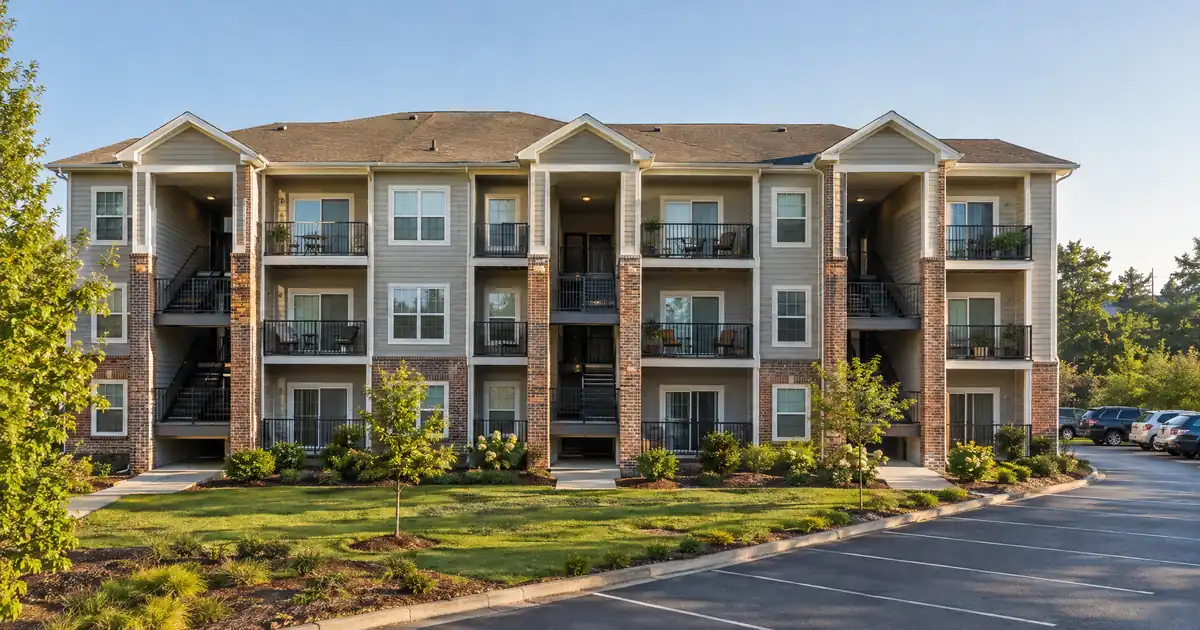
The Quick Read: A cash-out refinance on a building with five or more units replaces your current loan with a larger one and returns the difference as cash, sized by the building’s net operating income, not by a simple rent-to-payment ratio. Across Lendmire’s wholesale network, the loan is capped by leverage and by coverage, and whichever limit binds first sets your proceeds.
- Cash-out leverage tops out around 75% LTV on standard rental collateral, with about 6 months of seasoning from title recording.
- Five-plus unit files are read on stabilized NOI, not on the gross rent you collect today.
- Equity is not cash. Payoff, closing costs, reserves, and any prepayment charge on the old loan come out first.
- Reserves commonly run about 6 months of PITIA, stepping up to about 9 months above $1,500,000.
- Program availability for 5+ units varies by lender, so the file is matched to a lender case by case, subject to lender guidelines.
Owners of larger apartment buildings tend to ask the same thing: how much cash can come out, and what will it cost? The answer depends on three limits working at once. This piece walks through each one, the places where the usual rule breaks, and the decisions that follow. Lendmire is a DSCR-focused mortgage broker that arranges these loans through select lenders in its wholesale network, across 41 markets including Washington, D.C.
DSCR Cash-Out Calculator
Run the cash-out numbers in your market
Rate source: Freddie Mac 30-yr average via FRED® — Federal Reserve Bank of St. Louis · effective Oct 8, 2026
Prefilled with starting assumptions — enter your property’s value, balance, taxes, and insurance for a more accurate picture.
Program parameters update from Lendmire’s centralized guideline source. Taxes and insurance are editable estimates.
As of Oct 8, 2026 · General Freddie Mac market benchmark, not a Lendmire loan offer. Property value, balance, taxes, and insurance are editable estimates. Maximum loan-to-value varies by lender, program, property type, and seasoning. Not a Loan Estimate, approval, or commitment to lend. Program availability and eligibility are subject to lender guidelines, credit approval, property review, and underwriting.
What a 5+ Unit Cash-Out Refinance Actually Is
A cash-out refinance pays off the existing mortgage with a new, larger one. The difference, after costs, lands in your account. A rate-and-term refinance does the opposite. It changes the loan terms and returns no cash at closing. Across the network, rate-and-term files can reach about 85% LTV, while cash-out files stop around 75% LTV. If a refinance returns cash, it is underwritten as cash-out. Every figure here varies by lender and program — guidelines, property type, leverage, and credit profile all apply.
The 5+ unit line matters because the file changes lanes there. A one-to-four unit rental is commonly sized on rent against the full monthly obligation. A building with five or more units is a commercial-style file. The lender is buying the income stream, so it builds its own picture of what the building earns.
Business-purpose rental loans are reviewed differently from an owner-occupied mortgage. That is true at any unit count, but it is most visible here, because the building’s numbers carry the whole file.
How Underwriting Treats a 5+ Unit Building, Step by Step
The federal bank regulators describe the same logic in their exam materials. The OCC/OTS Exam Handbook on income property lending defines net operating income as property income net of operating expenses, and says total debt service covers principal and interest on all outstanding or proposed loans on the property. That is the framework a 5+ file runs on.
On a working file, it plays out in this order:
1. Classify the property. Five or more units moves the file to NOI-based review. The one-to-four unit shortcut of rent divided by PITIA does not apply.
2. Assemble the package. Expect a current rent roll, trailing twelve-month operating statements, leases, and expense detail. Entity and guarantor documents come with it. Unexplained gaps between the rent roll and the trailing statements are a common reason a package stalls.
3. Normalize the NOI. The underwriter replaces your reported figures with stabilized ones. That usually means a vacancy allowance, a management fee, and replacement reserves, even when your actual numbers are better. Expenses get checked against comparable buildings. Traditional personal-income documentation often does not show capital spending, so underwriters cross-check.
4. Value the building. The appraiser applies a market cap rate to the NOI and tests the result against comparable sales. Cap rate is NOI divided by value. Your building’s cap rate is set by the market, not by you.
5. Size the loan. Three limits apply. The leverage cap, the coverage test, and, on some structures, a debt-yield floor. The lowest of them wins.
6. Net out proceeds. The new loan minus the payoff, closing costs, escrows, reserves, and prepayment charges is what you actually receive.
7. Clear conditions. Title, insurance, property condition, and entity documents all have to be in order before funding.
The coverage test and debt yield are different measures. The OCC’s earlier Commercial Real Estate Lending handbook defines debt yield as NOI divided by the loan amount. It also says the appropriate coverage level should reflect the amortization period and how volatile the cash flow is. A shorter amortization may justify a lower ratio. Volatile income may warrant a higher one.
Why the Lowest Limit Wins
Think of the three limits as three doors. You can only leave through the narrowest one.
A building with strong NOI and a high appraised value may hit the 75% leverage cap first. Equity is plentiful, but the cap stops the loan. A building with thin NOI relative to its value hits the coverage test first. The equity is there on paper, but the income cannot carry a bigger loan. Final terms depend on lender guidelines, property type, leverage, and the borrower’s complete credit picture.
This is why more cash-out means less coverage. A larger loan raises the obligation against the same NOI. The same OCC handbook illustrates the effect with a sensitivity case where a higher payment drops a 1.31 coverage ratio to roughly 0.90. Treat it as an illustration of direction, not a program figure.
On the network side, 1.00 is where select programs start for standard rental collateral, and stronger ratios open better pricing and leverage. A separate select-lender path takes coverage below 1.00, with leverage and terms adjusted. For 5+ unit buildings, lenders layer their own NOI treatment on top, so the number your file is judged on is the lender’s stabilized figure, not yours.
Clearing a coverage ratio is also not the same as positive cash flow. Repairs, vacancy, management, utilities, and capital spending sit outside the calculation.
Worked Example: From Equity to Net Cash
Run the numbers on a modeled building. This is a hypothetical, with no dollar amounts, built to show how the pieces interact.
- The appraiser values the building from stabilized NOI at a market cap rate.
- Apply the 75% leverage cap to that value. That is your maximum loan by leverage.
- Test the NOI against the debt service on that loan. If coverage clears the program floor, leverage is the binding limit. If it does not, the loan shrinks until it does.
- Subtract the existing payoff.
- Subtract closing costs, escrows, and reserves. Reserves commonly run about 6 months of PITIA, and about 9 months above $1,500,000.
- Subtract any prepayment charge on the old note.
- What remains is net proceeds.
| Line item | Effect on cash |
|---|---|
| New loan (lower of leverage or coverage limit) | Starting point |
| Existing loan payoff | Reduces |
| Closing costs and escrows | Reduces |
| Reserves | Reduces or ties up cash |
| Prepayment charge on old loan | Reduces |
| Net proceeds | What you receive |
Equity on paper and cash in hand are different numbers. Files that assume otherwise are the ones that get re-traded late.
Key Terms Defined
NOI (net operating income): Property income minus operating expenses, before any debt service.
Stabilized NOI: The lender’s normalized estimate of income and expenses, not last year’s reported figures.
Coverage ratio: NOI divided by annual debt service, or for smaller rentals, rent divided by PITIA.
Debt yield: NOI divided by the loan amount, a second sizing test some lenders use.
Cap rate: NOI divided by value, set by the market and used to turn income into a value.
Seasoning: The ownership period required before cash-out is available, measured from title recording.
Where the General Rule Breaks
The rules above hold for most files. These are the places they bend.
Prepayment on the existing loan. This is the biggest hidden cost. Catalyst Equity Partners notes that commercial multifamily loans nearly always carry prepayment penalties, with terms typically running 3 to 10 years. Yield maintenance floats with Treasury yields. A step-down schedule is set at closing. Pull the old note before you price anything. A payoff that looks routine can remove a large part of your proceeds.
Unit-count boundary. Four units and five units are different lanes. If your building sits at the line, the classification decides everything.
Growth that exists only on paper. New rents not yet in place may not count at the stabilized level. Many lenders underwrite in-place income, not pro forma. Seasoning of the income, not just the ownership, is what the underwriter wants to see.
Vacancy or deferred maintenance. Both reduce the NOI and value used for sizing. They can also trigger repair escrows or holdbacks.
The government-insured lane. The Section 223(f) program from the Department of Housing and Urban Development is a refinance and purchase program for multifamily, delivered through FHA-approved lenders. Cash-out is permitted only under specific conditions. Confirm the rules with an approved lender, because they are a separate framework from DSCR programs.
Recourse. Bank loans are generally recourse. Agency and HUD loans are generally non-recourse, with carve-outs. Which one you are signing matters if you plan to hold the building for the long term.
Property types the network does not offer. Manufactured homes, log homes, and barndominiums fall outside these DSCR programs.
What the Network Looks Like for Larger Files
On the network side, 5+ unit cash-out is handled through select lenders. Standard programs run up to $3,000,000, and smaller balances route through select lenders. Above $2,500,000 the network generally holds to 30-year fixed structures. Extended terms and interest-only periods are available through select lenders, and ARM structures exist for investors who want them.
On credit, a 620 floor exists in parts of the network, most programs want about 660, and 700 or higher opens the strongest leverage tiers. These are typical ranges, not promises. Each file is underwritten individually, subject to lender guidelines.
A larger equity position helps. It lowers the loan relative to value and can lift coverage. It never removes the leverage cap, credit floors, reserve rules, or property eligibility. The strongest files clear both tests: enough equity and enough income. Lendmire’s complete DSCR loans guide covers how those tests fit together across property types.
LLC-titled borrowers are common on larger buildings, subject to lender program eligibility. Entity documents, operating agreements, and guarantor details need to be complete before the file goes in.
Choosing a Path by Goal
The decision is not “can I pull cash.” It is “which structure fits what I plan to do next.”
| If your goal is | Lean toward | Watch for |
|---|---|---|
| Maximum proceeds | Highest leverage the NOI supports | Coverage tightens as the loan grows |
| Keeping the next sale open | Structure with flexible exit terms | Prepayment on the new note |
| Long-term hold, lower exposure | Non-recourse or longer fixed term | Carve-outs and term tradeoffs |
| Smaller, faster-to-document file | Select lender with simpler package | Leverage and terms adjust |
A few operating habits keep these files clean. Reconcile the rent roll to the trailing statements before the file goes in. Get the old note’s prepayment terms in writing. Hold reserves in documented, seasoned accounts. And size the new payment on the lender’s NOI, not yours.
Pulling cash now and selling soon is a classic trap. A new prepayment schedule can lock the building up right when you want to exit. Match the term and prepayment structure to your hold period.
Alternatives Worth Comparing
Cash-out is not the only way to reach equity. A sale converts equity to cash but ends ownership. A second lien or supplemental loan leaves the first mortgage in place, which matters when the existing note has a low obligation or a heavy prepayment charge. Investment-property HELOC lines in the network cap at $500,000 total.
Proceeds are loan funds, not sale proceeds. Tax treatment can depend on how the funds are used and how the property is held; investors should keep clear records and speak with a qualified tax professional before relying on any deduction.
Using the Proceeds
Money that raises NOI is the cleanest use. Capital improvements may support a higher appraised value, depending on comps and underwriter review. Because value is NOI divided by cap rate, income gains move value, but the appraiser decides how much.
Using proceeds for another acquisition re-leverages you. Run the post-closing obligation on the existing building and the new one together. A larger loan means less cushion if vacancy rises or expenses jump. Size for the downside, not the base case.
If you are buying or refinancing a rental property and want to see how the numbers work, Lendmire can help you compare DSCR loan options based on the property income, credit profile, leverage, and investor goals. Call 828-256-2183 or request a quote.
Frequently Asked Questions
Can I pull cash out of a 5+ unit building?
Yes, when the building clears leverage, coverage, and reserve tests. On the network, cash-out tops out around 75% LTV, and the lower of the leverage and coverage limits sets the loan. Eligibility is subject to lender guidelines, and approval is never assured.
How long do I need to own the building first?
About 6 months of seasoning is the common expectation, measured from title recording. Settlement statements document it. Files that assume seasoning away are the ones that get sent back.
What happens to the prepayment penalty on my current loan?
It comes out of your proceeds. Commercial multifamily notes often carry yield maintenance, step-down, or defeasance structures. Pull the note and price the payoff before you decide whether the refinance makes sense.
Do I need personal income documents?
Programs in the network qualify primarily on property-level income covering the payment, subject to lender guidelines. Credit, reserves, and entity documents still apply. Select lenders may ask for more on larger or more complex files.
Does HUD allow cash-out?
HUD’s 223(f) program is a refinance program for FHA-approved multifamily lenders, and cash-out is allowed only under specific conditions. It runs under separate rules from DSCR programs, so confirm details with an approved HUD lender.
Where the next dollar of equity comes from matters less than what the old note charges to leave it, and in a 5+ file that line is usually the one worth reading first.
For the mechanics of pulling equity out of a rental property, see Lendmire’s guide to cash-out refinance on an investment property.
For current guidelines and terms, see Lendmire’s DSCR loan programs page.
About Lendmire
Lendmire, NMLS# 2371349, is a non-QM mortgage broker serving real estate investors in 41 markets, including Washington, D.C., through DSCR investor loan programs. Qualification is generally reviewed around the subject property’s rental income, not the borrower’s W-2 history — a practical fit for LLC-titled portfolios and self-employed investors. All scenarios remain subject to lender review and program guidelines. Two consecutive Scotsman Guide Top Mortgage Workplace recognitions (2025, 2026).
Get Started
Ready to find the right loan for you?
In about 30 seconds you can review financing options available for your investment property. No commitment required.
Informational only. Not a Loan Estimate, approval, or commitment to lend. Program availability and eligibility are subject to lender guidelines, credit approval, property review, and underwriting.
References
1. OCC/OTS Exam Handbook 210, Income Property Lending
2. OCC Comptroller’s Handbook, Commercial Real Estate Lending (previous version)
This article is part of Lendmire’s investment property cash-out refinance program — full qualification details, guidelines, and scenarios live on the program page.
Related reading: Cash-Out Refinance Above Conforming vs Conforming Cash-Out Plus HELOC · Bridge Loan vs Investment Property Cash-Out Refinance to Pull Cash · Home Equity Loan vs Cash-Out Refinance for a Rental Owner
Brandon Miller
Founder & CEO, Mortgage Loan Originator, Lendmire LLC
- Mortgage Loan Originator · NMLS# 1129696 · Verify on NMLS Consumer Access
- North Carolina Real Estate Broker · License# 343312 · Verify on NCREC
- North Carolina Insurance Producer · License# 19053198 · Property, Casualty, Life, Health · Verify on NAIC SBS
- Lendmire LLC · Firm NMLS# 2371349 · Verify firm licensure
Compliance and disclosures. Lendmire (NMLS# 2371349) is a licensed mortgage broker and is not a direct lender, depository institution, financial advisor, or tax professional. Content in this article is general market analysis and educational information — not financial, legal, or tax advice for any specific situation. Lendmire does not guarantee loan approval; every transaction is subject to underwriting by the funding lender. Mortgage pricing and loan program guidelines are subject to change at any time without notice and vary by borrower characteristics, property type, and state regulations. Lendmire complies with Equal Housing Opportunity. Licensure verification: NMLS Consumer Access.