
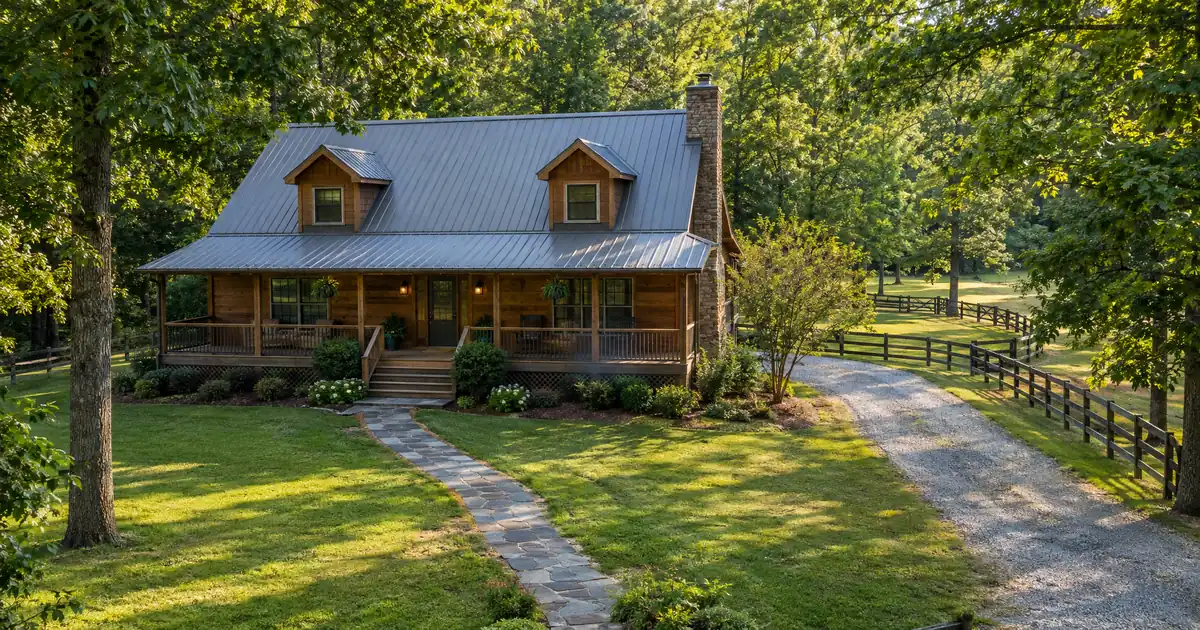
The Quick Read: Start by asking the lender which income source it accepts, then order a short-term-rental revenue estimate for the cabin or let the lender order the appraiser’s rent schedule. The report is an estimate that stands in for a lease or booking history on a new purchase. Lenders review it, adjust it, and decide how much of it counts.
- Ask the lender which income source it accepts before you pay for any report.
- Enter exact bedrooms, bathrooms, and guest capacity, because they drive the comp set.
- Rural comp sets are thin, so treat the headline number as a ceiling.
- The lender, not the vendor, decides how much of the projection counts toward coverage.
- Clearing 1.00 on a short-term-rental file does not mean the cabin cash flows.
Rural cabins are the hard case for projections. Few nearby listings means the estimate leans on a handful of comps, and the appraiser faces the same scarcity on the long-term rent side. This explainer walks through what the report is, how to order it, how underwriting treats it, and where it breaks. Lendmire is a broker that arranges DSCR loans through select lenders in its wholesale network, across 41 markets including Washington, D.C. Program details below come from that network’s typical guidelines, subject to lender review.
DSCR Calculator
Run the numbers in your market
Rate source: Freddie Mac 30-yr average via FRED® — Federal Reserve Bank of St. Louis · effective Oct 15, 2026
Prefilled with starting assumptions — enter your own rent or nightly figures, taxes, insurance, and HOA for a more accurate picture.
Program parameters update from Lendmire’s centralized guideline source. Taxes and insurance are editable estimates.
As of Oct 15, 2026 · General Freddie Mac market benchmark, not a Lendmire loan offer. Rent, nightly rate, occupancy, taxes, and insurance are editable estimates. Short-term rental figures are estimates only and vary significantly by season, property type, management approach, and local short-term-rental rules — confirm local regulations before relying on them. Qualifying income for short-term rentals varies by program — some use appraisal market rent, others use documented STR history or projections — and is confirmed in underwriting. Not a Loan Estimate, approval, or commitment to lend. Program availability and eligibility are subject to lender guidelines, credit approval, property review, and underwriting.
What Is a DSCR Projection Report?
There is no single official document by that name. No regulator owns it. In practice the phrase means one of two things, and which one applies depends on the lender.
The first is a third-party short-term-rental revenue estimate. The best-known tool builds a list of nearby comparable listings, weights them by relevance, and layers on seasonality. Per RentalRecon’s guide to the AirDNA Rentalizer, the quality of the estimate depends on the property details you enter. It outputs projected annual revenue, average daily rate, and occupancy, with a monthly breakdown on paid plans.
The second is the appraiser’s long-term rent opinion. The appraiser documents market rent on the Single-Family Comparable Rent Schedule, Form 1007. That is a form name only. DSCR loans are not agency products, and the form simply gives the lender a standard way to see rent.
| Income method | What it is | Best for |
|---|---|---|
| Documented history | Platform or bank records of past bookings | Cabins already operating as rentals |
| Third-party projection | Vendor estimate from comparable listings | New purchase, no booking history |
| Appraiser rent schedule | Long-term market rent opinion | Cabins with a real year-round lease market |
Programs differ on which of these they accept. Some want history. Some accept a projection on a first purchase. Some use only long-term rent. Across the wholesale network, all three exist, so the first move is asking, not ordering.
How Do You Get One, Step by Step?
Ask the lender first, then order. Lenders often pull the report themselves. Other times the borrower runs it and the lender reviews it. Paying for a report the lender will not use is the most common wasted step on cabin files.
1. Ask which source the lender accepts. Request the income method in writing: history, projection, long-term rent, or a mix. Projected revenue from a listing, a seller, or the borrower is not automatically qualifying income.
2. Confirm the cabin can legally operate as a short-term rental. Short-term rental rules can vary by city, county, HOA, and property type, so investors should confirm local rules before relying on projected rental income. A projection means nothing on a cabin that cannot legally host guests.
3. Enter exact property specs. Use true bedroom count, bathrooms, and guest capacity. A den with a sleeper sofa is not a bedroom. The tool filters comps on these inputs.
4. Read the comp set and the confidence score. The vendor’s free calculator reports a Comp Set Strength of Low, Medium, or High. RentalRecon notes that a low confidence score signals few comps, which is common in rural areas.
5. Pull the outputs. Save annual revenue, average daily rate, occupancy, and the monthly seasonality view. Gross revenue is the daily rate times occupancy times 365, per Hostfully.
6. Submit it with the file. The lender-ready version goes in with the purchase contract, entity documents, credit authorization, and bank statements for reserves and down payment.
7. Expect the appraisal to run alongside. The appraiser delivers a value opinion and a rent opinion. Nightly rate times 30 is not a valid substitute for the rent schedule.
For more on the underlying report type, Lendmire’s explainer What Is A Market Data Report For Rental Income? covers the basics. Entity and reserves documentation still matters. The complete DSCR loans guide lays out the full file.
How Do You Read the Report?
Not every line matters to underwriting. Annual revenue, occupancy, and daily rate feed the income figure. The rest is useful to you, less so to the lender.
| Report field | What it means | Does underwriting use it? |
|---|---|---|
| Projected annual revenue | Estimated gross bookings | Yes, before the lender’s adjustment |
| Average daily rate | Typical nightly price | Supports the revenue figure |
| Occupancy | Share of nights booked | Supports the revenue figure |
| Monthly seasonality | Revenue by month | Often reviewed for weak months |
| Comp set and strength | Listings used and consistency | Yes, as a credibility check |
| Market score or rank | Vendor’s market rating | Varies by lender |
The comp count and similarity are the credibility test. Per the vendor’s own framing, accuracy comes down to two questions: did the data capture what happened, and were the right comps chosen. On a cabin, the second question is where files get shaky.
Why Are Rural Cabins the Hard Case?
Thin data is the core problem. BNBCalc’s AirDNA review says that in small markets the projection becomes extrapolation, because too few comparable listings exist to model from. The same reviewer advises treating a single estimate as a midpoint and discounting it before underwriting. That is one reviewer’s opinion, not a tested statistic, but it matches how cabin files behave.
Three other gaps show up on cabin files:
- Comps ignore physical reality. Haus, an STR analytics firm, says these tools match mostly on bedroom count and location. They miss hot tubs, views, lake or mountain access, and private road conditions.
- Appraiser comps are scarce. McKissock’s appraisal education notes that rural areas have fewer transactions, so appraisers may reach into neighboring towns. That piece covers sale comps, but rent comps have the same problem. Where no real long-term rental market exists, the rent opinion can come in low or hard to support.
- Seasonality. A cabin with a few strong months and long dead stretches can show a good annual number and still strain on a monthly basis.
Here is a practical credibility check. Count the comps. Look at how far away they sit. Check whether they have the same bedroom count and amenities. If the comp set is small and far-flung, the number is soft.
From Projection to Coverage: How the Math Runs
The lender takes the raw projection, applies its own adjustment, then divides by the full monthly obligation. DSCR compares qualifying income to PITIA, which is principal, interest, taxes, insurance, and any HOA dues. Haircuts vary by lender, and the network’s select programs set their own.
Run the numbers this way. Say a vendor projection comes back strong on the cabin. The lender trims it for vacancy, platform fees, and uncertainty. The trimmed figure becomes qualifying income. If that figure covers the monthly obligation about 1.2 times, the file clears the 1.00 floor that many select programs use with room to spare. If it covers about 0.9 times, the file sits below 1.00.
Sub-1.00 files are a separate path. Select lenders in the network offer programs below 1.00, with leverage and terms adjusted. Interest-only structures and extended terms are also available through select lenders, and those can lift coverage by lowering the monthly obligation.
Now stress it. A vendor number that lands 15 to 30 percent off, a range BNBCalc’s reviewer describes as opinion, can swing a file from comfortable to short. Run the cabin at a projection 10, 20, and 30 percent lower. If coverage falls under 1.00 at the first cut, the file has no cushion.
| Projection stress | Coverage read |
|---|---|
| Vendor number as shown | Strongest case, rarely what underwriting uses |
| Lender-adjusted figure | The working case |
| Adjusted figure down 10-20% | Shows how thin the cushion is |
| Adjusted figure down 30% | The downside case |
A larger down payment lowers the monthly obligation and can lift coverage. It does not erase leverage caps, credit floors, reserve rules, or property eligibility. Purchase files on most programs land at 75% to 80% LTV on an investment property, and a short-term-rental purchase tops out at 75%. A strong file clears both tests: enough equity and enough rental coverage.
Does Clearing 1.00 Mean the Cabin Makes Money?
No. DSCR compares rent to PITIA only. Repairs, vacancy, cleaning, utilities, management, and capex sit outside the calculation. Cabins carry extra operating costs: heating fuel, firewood, septic and well service, snow removal, and road maintenance. Occupancy swings hit hard. A cabin that books 70 percent of nights can look very different at 50 percent, and the gap lands almost entirely on owner cash flow, not on the lender’s ratio.
The projection also does not guarantee anything. Projected income may not hold up after closing. Model owner cash flow separately from the lender’s ratio, and keep a cash cushion beyond the required reserves.
What If the Report Comes Back Weak?
A weak report is information, not a dead end. Match the fix to the weakness.
| Problem | Option to consider |
|---|---|
| Few or distant comps | Widen the comp set, or try a second data provider |
| Low confidence score | Add custom comps if the plan allows |
| Coverage under 1.00 | Larger down payment, lower price, or a sub-1.00 path through select lenders |
| No lender accepts projections | Use long-term rent, or build documented booking history first |
| Cabin cannot legally host guests | Walk, or underwrite on long-term rent only |
Free tiers are limited. RentalRecon’s AirDNA review notes the free plan gives limited market insights and basic estimator access, while custom comp sets sit on paid plans. A free report and a lender-grade report are not the same thing.
Use the report twice. Run an informal version before making an offer, to screen the cabin. Run the lender-grade version after the contract is signed.
DSCR vs. conventional financing
There are two common ways to finance an investment property, and they qualify you differently — here’s how investors weigh them.
Why investors choose it
- Qualifies on the property’s rental income — no personal tax returns, W-2s, or pay stubs needed to document income.
- No personal debt-to-income ceiling to clear, so existing mortgages and obligations don’t cap your borrowing the same way.
- Can be closed in an LLC, keeping the property inside a business entity.
- Built for scaling — not held to the limit on number of financed properties that conventional financing applies.
- Underwriting centers on the deal: generally qualifies when the rent covers the payment, a 1.00x coverage ratio being a common baseline (confirmed in underwriting).
- Designed specifically for investment property, including long-term and, where the program allows, short-term rentals.
Where it’s strong
- Often the lowest ongoing financing cost for a buyer who fully qualifies on personal income — a fit for a first property or a cost-first purchase.
Trade-offs for investors
- Requires full personal income documentation and must fit within a debt-to-income limit — salary, existing debts, and other mortgages all count.
- Typically held in your personal name rather than a business entity.
- Caps how many financed properties you can carry, which can become a ceiling as a portfolio grows.
- Evaluates you as a borrower as much as the property, which usually means more paperwork.
How investors usually choose: a first or single property often optimizes for the lowest financing cost; portfolio builders often optimize for leverage, vesting in an LLC, and scaling past conventional caps. The right answer depends on your goals, the property, and current guidelines — both paths run through select lenders in Lendmire’s wholesale network, with eligibility and terms confirmed in underwriting.
Purchase vs. Refinance, First-Timer vs. Experienced Host
On a first purchase with no history, a projection or long-term rent is typically the path. On a refinance, lenders more often want documented performance. Short-term-rental refinance leverage runs around 70%, and cash-out tops out at 70% on short-term-rental collateral, versus 75% on standard rentals. Programs generally expect about 12 months of hosting history on those files and a 640 or higher credit score. Purchase files use a 1.00 coverage floor, and refinances use 1.00 as well.
An experienced host with booking records has the stronger file.
Property type matters too. Log homes, manufactured homes, and barndominiums are not offered in the network’s DSCR programs, and many rural cabins are log construction. Confirm construction type before spending money on a report. Ground-up builds typically need construction financing first, then a refinance.
Document Checklist
- Entity documents, if the cabin is held in an LLC (subject to lender program eligibility)
- Credit authorization
- Purchase contract
- Bank statements for down payment and reserves, commonly around 6 months of PITIA, varying by lender, leverage, and loan size
- Insurance binder with complete coverage detail
- The projection report with comp set and confidence score
- Evidence of local short-term-rental permit or registration status
- Appraisal and rent schedule, ordered through the lender
Key Terms Defined
DSCR: The ratio of qualifying income to the full monthly housing obligation.
PITIA: Principal, interest, taxes, insurance, and any association dues.
Projection report: A third-party estimate of a property’s likely rental revenue.
Comp set: The group of comparable listings the estimate is built from.
Qualifying income: The portion of projected or documented income the lender actually counts.
Form 1007: The appraiser’s single-family rent schedule, used to document long-term market rent.
Frequently Asked Questions
Can I qualify a rural cabin with no rental history?
Sometimes. Some programs accept a third-party projection on a first purchase, others rely on long-term market rent, and some want documented history. Acceptance varies by lender, so ask before ordering anything.
Does every DSCR lender accept a projection report?
No. Some lenders do not lend on short-term rentals at all. Others require long-term rent or 12 months of history. Across the network, only select programs use projections, and those apply their own adjustment.
How is the projection different from the appraiser’s rent schedule?
The projection estimates nightly-booking revenue from comparable listings. The rent schedule is the appraiser’s long-term lease opinion. Multiplying a nightly rate by 30 does not convert one into the other.
What does a weak report mean for my loan?
It means less qualifying income, and that may mean a lower coverage ratio. Options include a larger down payment, a lower price, a sub-1.00 path through select lenders with leverage and terms adjusted, or building booking history first.
Does a 1.00 coverage ratio mean the cabin is profitable?
No. The ratio counts rent against PITIA only. Operating costs, vacancy, and repairs are outside it, so cabin owners should model cash flow separately.
If you are buying or refinancing a rental property and want to see how the numbers work, Lendmire can help you compare DSCR loan options based on the property income, credit profile, leverage, and investor goals. Tax treatment varies; consult a qualified professional.
About Lendmire
Lendmire (NMLS# 2371349) is a mortgage brokerage focused on DSCR investor financing, helping arrange programs through wholesale and investor-lending channels in 41 markets, including Washington, D.C. DSCR loans are evaluated by the lender on property cash flow rather than personal income, subject to lender guidelines, supporting LLC closings and accommodating investors with four or more financed properties. Scotsman Guide Top Mortgage Workplace in both 2025 and 2026.
Get Started
Ready to find the right loan for you?
In about 30 seconds you can review financing options available for your investment property. No commitment required.
Informational only. Not a Loan Estimate, approval, or commitment to lend. Program availability and eligibility are subject to lender guidelines, credit approval, property review, and underwriting.
References
1. RentalRecon – AirDNA Rentalizer guide
2. Fannie Mae – Single-Family Comparable Rent Schedule (Form 1007)
3. AirDNA – Free Airbnb Calculator
4. Hostfully – Is an Airbnb profitable
6. Haus – Are predictive short-term rental revenue tools accurate
7. McKissock – Appraising Rural Properties
8. RentalRecon – AirDNA review
This article is part of Lendmire’s DSCR loan program — full qualification details, guidelines, and scenarios live on the program page.
Related reading: DSCR Refinance Requirements for Better Terms on a Short-Term Rental · How to Get an STR Projection Report a DSCR Underwriter Accepts · Conventional vs DSCR Short-Term Rental Loan for a Condotel
Brandon Miller
Founder & CEO, Mortgage Loan Originator, Lendmire LLC
- Mortgage Loan Originator · NMLS# 1129696 · Verify on NMLS Consumer Access
- North Carolina Real Estate Broker · License# 343312 · Verify on NCREC
- North Carolina Insurance Producer · License# 19053198 · Property, Casualty, Life, Health · Verify on NAIC SBS
- Lendmire LLC · Firm NMLS# 2371349 · Verify firm licensure
Disclosure information. Lendmire is a state-licensed mortgage brokerage under NMLS# 2371349. Lendmire is not a depository institution, direct lender, or financial advisor — all loans referenced are placed through wholesale lender partners and are subject to each lender's underwriting standards. This article is provided for general informational purposes and is not a commitment to lend, nor does it constitute financial, legal, or tax advice. Loan programs, terms, rates, and qualification standards change without notice and depend on borrower profile, property type, and the state in which the subject property is located. Equal Housing Opportunity provider. NMLS Consumer Access: nmlsconsumeraccess.org.