
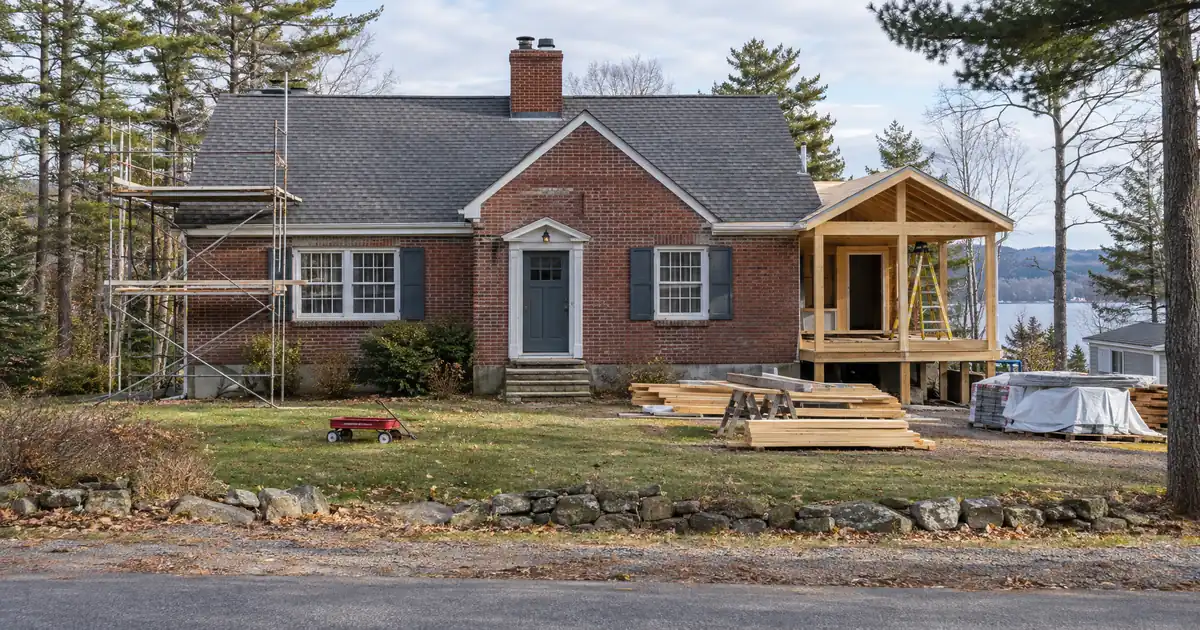
The Quick Read: You pay off the short-term loan with a new long-term DSCR loan secured by the same rental property. A DSCR loan is reviewed primarily on property-level rental income covering the payment, subject to lender guidelines, so your own paycheck is not the center of the file.
- Three tests decide the outcome: how long you have owned the property, the new lender’s own appraised value, and whether the rent covers the new payment.
- On a DSCR cash-out refinance of a standard rental, the ceiling is 75% LTV, with about 6 months of seasoning measured from title recording. LTV means loan-to-value, the loan as a share of the property’s value.
- A DSCR rate-and-term refinance on an investment property can reach up to 85% LTV, but it returns no cash at closing.
- New Hampshire lenders foreclose through power of sale, so a maturing bridge loan is not a loan to ignore.
- Start the exit while the rehab is still underway, not when the maturity date arrives. Exact terms depend on the lender’s guidelines, property type, leverage, and a full review of the borrower’s file.
What Does Exiting Hard Money Actually Mean?
It means a new mortgage pays off an old one. That is all. Nothing special happens legally. The hard money loan is a short-term lien, and the DSCR loan‘s proceeds retire it.
DSCR Cash-Out Calculator
Run the cash-out numbers in New Hampshire
Rate source: Freddie Mac 30-yr average via FRED® — Federal Reserve Bank of St. Louis · effective Oct 15, 2026
Prefilled with starting assumptions — enter your property’s value, balance, taxes, and insurance for a more accurate picture.
Program parameters update from Lendmire’s centralized guideline source. Taxes and insurance are editable estimates.
As of Oct 15, 2026 · General Freddie Mac market benchmark, not a Lendmire loan offer. Property value, balance, taxes, and insurance are editable estimates. Maximum loan-to-value varies by lender, program, property type, and seasoning. Not a Loan Estimate, approval, or commitment to lend. Program availability and eligibility are subject to lender guidelines, credit approval, property review, and underwriting.
Hard money terms typically run 6 to 18 months, interest-only, with no prepayment penalty, though terms vary by lender, property, and experience. The shape of that loan tells you the plan. It was never meant to be your long-term debt. It was built to buy or rehab the property and hold it until you can replace it.
Nothing federal sets the rules for this exit. Seasoning, leverage caps, coverage ratios, and reserves are the new lender’s policy, not regulations. That is good news and bad news. Programs differ, so the answer on your file depends on which lender reviews it.
Lendmire is a mortgage broker (not a lender) that arranges DSCR investor loans through select lenders in its wholesale network, across 41 markets including Washington, D.C. It sees many lenders’ guidelines side by side. Many investors move out of hard money into long-term DSCR financing once the property is stabilized, and Lendmire brokers that path through its hard money exit refinance program. If you need background on the loan itself, the complete DSCR loans guide covers it from the start.
DSCR loans are designed for non-owner-occupied investment properties. Because they are business-purpose investor loans, they are reviewed differently from a standard owner-occupied mortgage.
How Does the New Lender Decide How Much You Can Borrow?
The new lender sizes the loan from five inputs: time owned, its own appraisal, rent coverage, the leverage cap, and the size of your payoff. Your after-repair value (ARV), the number you projected when you bought, is a plan. The appraisal is the verdict.
Here is the sequence, step by step.
1. Time owned. Seasoning is the waiting period before a lender sizes a cash-out loan on appraised value instead of cost. Across the network, about 6 months from title recording is the common expectation for a DSCR cash-out refinance. Inside that window, a lender may limit the loan to what you paid plus documented improvements. Programs differ on whether they will even look at a file inside the window.
2. Refinance type. A rate-and-term refinance covers the payoff and costs. You get no cash back. A cash-out refinance is larger than the payoff, and the difference comes to you. On a DSCR loan for an investment property, cash-out tops out at 75% LTV. Rate-and-term can go to 85% LTV. Both are subject to lender guidelines, credit, and property review.
3. Appraisal. The new lender orders its own. For a one-unit rental, that usually includes a rent schedule (form 1007) alongside the value appraisal. For two to four units, the operating income form is the 1025. No matter what you paid or what the rehab cost, the appraisal and the LTV cap decide how much the loan can be.
4. The rent test. DSCR is the debt service coverage ratio. You divide monthly rent by the monthly PITIA, which is principal, interest, taxes, insurance, and any association dues. A ratio of 1.00 means rent just covers the payment. Select DSCR programs start at 1.00, and stronger ratios open better terms and leverage. A separate select-lender path goes below 1.00, with leverage and terms adjusted. A bigger loan means a bigger payment. A cash-out can therefore fail on rent even when the equity is plentiful.
5. Credit and reserves. A DSCR loan has a 620 credit floor in parts of the network. Most programs want around 660, and 680 and 700 unlock the stronger leverage tiers. Reserves are cash left after closing. They commonly run about 6 months of PITIA, stepping up to about 9 months above $1,500,000. Expect those to be verified.
6. Payoff and title. The payoff is principal drawn, accrued interest, and any extension or other fees the loan documents allow. It grows with time. The title company confirms the old lien is released and records the new mortgage in its place.
Clearing 1.00 is not the same as making money. Coverage compares rent to PITIA only. Repairs, vacancy, management, utilities, and capital expenses sit outside the number. A property can clear the ratio and still cost you cash every month.
Which Exit Fits Your Situation?
The DSCR loan fits most stabilized rentals held for the long term. The other exits earn their place when timing or the property says no. Compare them by what each one is reviewed on and what it costs you.
| Exit | Reviewed on | Best fit | Main drawback |
|---|---|---|---|
| DSCR loan | Property rent vs. PITIA | Leased rental, held long term | Needs seasoning and rent proof |
| Conventional or bank loan | Your personal income | Strong W-2 or tax-return borrower | Heavy income paperwork |
| Extension from your lender | Existing relationship | Rehab finished late | Added cost, same maturity risk |
| Second bridge loan | Property and plan | Property not yet leasable | More short-term carry |
| Sale | Market buyer | Thin equity or a flip plan | Gives up the rental |
Two questions sort most files. Is the property leased, or can it be? And do you want to qualify on property income or on your own traditional personal-income documentation? If the property is not rent-ready, a DSCR loan has nothing to measure. Finish the work first.
Hard money lenders also offer a refinance of their own at up to 65% of value on cash-out and rate-and-term refinances. That keeps you in short-term debt. Think of it as buying time, not an exit.
Run the Break-Even First
Your break-even appraisal is the payoff plus your exit costs, divided by the LTV cap. This is plain arithmetic, not a sourced statistic. It tells you whether the exit works before you apply.
At a 75% cap, the appraised value must be at least about 1.33 times your payoff plus costs. Put another way, payoff plus costs must be 75% of value or less for a DSCR cash-out to cover itself.
Run the numbers on three modeled scenarios. These are assumptions, not market data.
- Scenario one. Payoff plus costs equal 70% of the appraised value, and rent covers the new payment at roughly 1.25x. A DSCR cash-out at up to 75% LTV covers the payoff and leaves a modest slice of value as cash back. Tight, but it works.
- Scenario two. Payoff plus costs equal 78% of appraised value. The 75% cash-out cap falls short, so you would bring cash to closing. A DSCR rate-and-term loan at up to 85% LTV could cover the payoff, but you get no cash back. It also adds loan size, so check that coverage stays at or above 1.00.
- Scenario three. You borrowed on a fix-and-flip tier. Those are sized on project cost, up to 93% at the top tier for experienced investors, and every tier is capped at 75% of after-repair value. If you borrowed near that cap, the exit appraisal may need to come in above your original ARV just to break even. Interest and costs sit on top of the loan. Every figure here varies by lender and program — guidelines, property type, leverage, and credit profile all apply.
Hard money leverage varies by lender, property, and experience. The point is that the bridge and the exit both look at value, and the exit lender does not owe you your projected number.
Where the General Rule Breaks
The six-month, 75%, and 1.00 numbers describe the middle of the road. These are the places files leave it.
Entity versus personal name. Many hard money lenders want the loan in an LLC. Some refinance programs want personal name, and others accept entities, subject to lender program eligibility. Moving title can create a new recorded deed, and that can restart the seasoning conversation. Settle vesting before you apply, not the week of closing.
Delayed financing. This is a cash-purchase exception in agency lending that lets a buyer pull money back out soon after buying with cash. It does not rescue a financed hard money purchase. It is also not DSCR policy. If someone tells you it applies, ask which program they mean.
Tenants and the appraisal. A tenant moving in can change how a property shows. Where possible, schedule the appraisal before the tenant takes occupancy. A signed lease still helps your rent proof. Plan the two events so they do not collide.
A declining market. Values drift. A property that would have appraised at your ARV six months ago may not now. The lower your cost basis relative to value, the more cushion you carry.
The six-month window. Seasoning counts from the recorded deed, not from when the rehab ends. A 6-month hard money term can leave you at the edge of eligibility on the day it matures. That is why term length and seasoning belong in the same conversation.
Ineligible property types. Manufactured homes, log homes, and barndominiums are not offered through the network’s DSCR programs. A bridge loan on one of these does not have this exit.
What the New Hampshire Lien Changes
New Hampshire is a power-of-sale state. A lender does not need a court case to foreclose. It conducts a sale instead. RSA 479:25 sets the notice rules. Notice must be served at least 25 days before the sale, or 45 days for a residential mortgage. Whether your investor loan counts as residential is a legal question. Ask a New Hampshire real estate attorney instead of guessing.
The practical lesson is simple. A bridge lender’s remedies run through that process. Do not rely on a long court timeline to buy you room. If the exit looks shaky, call the lender about an extension before the maturity date, not after.
Licensing is a separate matter. The NH Banking Department is the regulator for mortgage bankers, brokers, servicers, and loan originators under the state licensing statute. If you are unsure how the rules treat a specific loan, ask counsel.
Expect your closing to involve title work and recording of the new mortgage, with the old one discharged. New Hampshire refinance costs and transfer-related charges vary by property and transaction, so ask your title company for an itemized estimate early. This article gives no figure for them, because none can be stated honestly in general.
Property type matters too. A small multifamily, a condo with association rules, and a seasonal property each change the file. Condo dues enter PITIA. A seasonal property may need a rent story that holds up over a full year. The rent schedule on the appraisal carries a lot of weight.
Runway: What to Do and When
Work backward from maturity. The tasks are the same on every file. Only the order shifts.
- Before the first draw. Read your hard money loan. Note the maturity date, extension options, default terms, and payoff process.
- During the rehab. Keep invoices and draw history. Decide the entity question. Price out your break-even.
- When work finishes. Get the property rent-ready. Schedule the appraisal around any tenant move-in.
- Once leased. Gather lease and deposit proof. Confirm reserves. Ask for a payoff letter.
- Before maturity. Submit the file with margin to spare. Do not apply the week the loan is due.
These are the documents most files need.
| Document | Why it matters |
|---|---|
| Settlement statement | Shows your cost basis |
| Rehab invoices and draw history | Proves the work behind your value |
| Recorded deed | Starts the seasoning clock |
| Payoff letter | Shows the exact amount owed |
| Lease or rent evidence | Feeds the coverage ratio |
| Insurance | Part of PITIA |
| Entity documents | Confirms who holds title |
| Reserve statements | Confirms cash after closing |
Read the payoff letter line by line. It should itemize principal, interest, and fees, and show how the figure changes by day. A payoff that grows while you wait is a cost of delay, which is why the file should be ready before the date, not after.
If It Doesn’t Work
A refinance that comes up short leaves four paths: bring cash to close, ask for an extension, take a second bridge loan, or sell. Each costs something. Extensions and second bridges add carry on top of a loan that is already expensive. Hard money is much costlier to hold than long-term financing, so each month of delay compounds.
A common reason a file stalls is appraisal risk. If the property does not appraise near your ARV, the deal is hard to repeat. If that is where you land, rate-and-term sizing at up to 85% on a DSCR loan, or a modest cash infusion, may close the gap. Selling can beat refinancing when the equity is thin.
Five Beliefs That Cost Investors Money
The lender will use my ARV. It uses its own appraisal.
Seasoning starts when the rehab ends. It generally counts from the recorded deed, and it is lender policy rather than law.
There is a federal waiting period. There is not. Agency rules are a template, not a DSCR rule.
All the equity I created is borrowable. The LTV cap limits it. Borrowable equity is roughly the cap times value, minus what you owe.
A 1.00 coverage ratio means I make money. It means rent equals PITIA. Profit is a different question.
Tax treatment can depend on how the funds are used and how the property is held. Investors should keep clear records and speak with a qualified tax professional before relying on any deduction.
Key Terms Defined
- Seasoning: the waiting period before a lender sizes a cash-out loan on appraised value instead of cost.
- After-repair value (ARV): your estimate of what the property will be worth once the work is finished.
- Payoff letter: the lender’s written statement of exactly what it takes to retire the loan on a given day.
- Power of sale: a foreclosure method where the lender sells the property without going to court.
- Rate-and-term refinance: a new loan that covers the payoff and costs and returns no cash.
- Cash-out refinance: a new loan larger than the payoff, with the difference returned to you.
Next Step
If you are buying or refinancing a rental property and want to see how the numbers work, Lendmire can help you compare DSCR loan options based on the property income, credit profile, leverage, and investor goals. Call 828-256-2183 or request a quote at Lendmire’s quote page before your maturity date narrows your choices. Qualification is subject to lender guidelines, and nothing here is a commitment to lend.
Frequently Asked Questions
Can I refinance out of hard money before six months of ownership?
It depends on the lender. Programs differ on whether they review a file inside the seasoning window. Where one does, it may size the loan to cost instead of appraised value. About 6 months from title recording is the common expectation for a DSCR cash-out refinance across the network.
Will a DSCR loan give me cash back when I leave hard money?
Sometimes. A DSCR cash-out on a standard rental tops out at 75% LTV, so your payoff and costs must fit under that cap with room left. Rent used for lender review, reserves, and credit also limit the amount. A rate-and-term DSCR refinance returns no cash. Final terms depend on lender guidelines, property type, leverage, and the borrower’s complete credit picture.
What credit score do I need for the DSCR exit?
The DSCR floor is 620 in parts of the network. Most programs want around 660, and 680 and 700 open the stronger leverage tiers. Hard money has its own 620 minimum, with added conditions below 660. Scores alone do not decide anything, because the property and reserves still have to qualify.
What if my rent doesn’t cover the new payment?
Select DSCR programs start at 1.00. A larger down payment or lower leverage can lift the ratio. It does not erase credit floors, reserve rules, or property eligibility.
Does New Hampshire law change how I refinance?
Not the underwriting. The lender’s policy sets that. The state matters for the lien. Foreclosure runs through power of sale rather than a court case, with notice rules in the statute. Confirm any classification question about your specific loan with a New Hampshire attorney.
About Lendmire
Lendmire is a DSCR-focused mortgage brokerage, NMLS# 2371349, placing investor loans across 41 markets, including Washington, D.C. DSCR eligibility is generally reviewed by the lender around a property’s rental income rather than personal income documentation, which fits LLC-held rentals, self-employed investors, and portfolios scaling past conventional financed-property limits. Scotsman Guide named Lendmire a Top Mortgage Workplace in both 2025 and 2026.
Get Started
Ready to find the right loan for you?
In about 30 seconds you can review financing options available for your investment property. No commitment required.
Informational only. Not a Loan Estimate, approval, or commitment to lend. Program availability and eligibility are subject to lender guidelines, credit approval, property review, and underwriting.
References
1. Justia, New Hampshire RSA 479:25
2. NH Banking Department, Consumer Credit Licensees FAQ
This article is part of Lendmire’s hard money loan program — full qualification details, guidelines, and scenarios live on the program page.
Related reading: How a 40-Year DSCR Loan Works as an Out-of-State Investor · How an Interest-Only DSCR Loan Works for Out-of-State Investors · How CLTV Works on a Rental Loan
Guides: Hard Money Loans in New Hampshire
Brandon Miller
Founder & CEO, Mortgage Loan Originator, Lendmire LLC
- Mortgage Loan Originator · NMLS# 1129696 · Verify on NMLS Consumer Access
- North Carolina Real Estate Broker · License# 343312 · Verify on NCREC
- North Carolina Insurance Producer · License# 19053198 · Property, Casualty, Life, Health · Verify on NAIC SBS
- Lendmire LLC · Firm NMLS# 2371349 · Verify firm licensure
Disclosure information. Lendmire is a state-licensed mortgage brokerage under NMLS# 2371349. Lendmire is not a depository institution, direct lender, or financial advisor — all loans referenced are placed through wholesale lender partners and are subject to each lender's underwriting standards. This article is provided for general informational purposes and is not a commitment to lend, nor does it constitute financial, legal, or tax advice. Loan programs, terms, rates, and qualification standards change without notice and depend on borrower profile, property type, and the state in which the subject property is located. Equal Housing Opportunity provider. NMLS Consumer Access: nmlsconsumeraccess.org.