
The Quick Read: Choose DSCR when the cabin is a true rental whose income comfortably covers its full monthly obligation. Choose bank statement qualifying when your deposits are strong, the cabin’s income is unproven, or you expect to use the place yourself for more than a couple of weeks a year. A DSCR loan tests the property. A bank statement loan tests you, and the cabin’s own rent matters much less.
- DSCR (debt service coverage ratio) qualifies primarily on property-level rental income covering the payment, subject to lender guidelines.
- Bank statement qualifying converts 12 to 24 months of deposits into income, so the cabin’s own rent matters less.
- Across our wholesale network, large DSCR loans on rental property run from $150,000 to $10,000,000, with leverage stepping down as the balance climbs.
- Cabin collateral gets extra scrutiny: construction type, remote comps, and how the income is documented.
- Personal use of the cabin can move the file out of investment-loan territory altogether.
Key Terms Defined
DSCR: The property’s qualifying monthly income divided by its full monthly housing obligation (principal, interest, taxes, insurance, and any association dues).
Bank statement loan: A loan that reviews 12 to 24 months of personal or business deposits to estimate the borrower’s income, instead of using traditional personal-income documentation.
Expense factor: A discount applied to gross rental income before the ratio is figured. On short-term rentals, most programs in our network count 80% of gross.
Reserves: Liquid cash left after closing, measured in months of the property’s housing obligation.
Business-purpose loan: A loan made to acquire or hold property as an investment rather than as a place to live.
Short-term rental (STR): A property rented by the night or week, usually through a booking platform.
DSCR Calculator
Run the numbers in your market
Rate source: Freddie Mac 30-yr average via FRED® — Federal Reserve Bank of St. Louis · effective Oct 15, 2026
Prefilled with starting assumptions — enter your own rent or nightly figures, taxes, insurance, and HOA for a more accurate picture.
Program parameters update from Lendmire’s centralized guideline source. Taxes and insurance are editable estimates.
As of Oct 15, 2026 · General Freddie Mac market benchmark, not a Lendmire loan offer. Rent, nightly rate, occupancy, taxes, and insurance are editable estimates. Short-term rental figures are estimates only and vary significantly by season, property type, management approach, and local short-term-rental rules — confirm local regulations before relying on them. Qualifying income for short-term rentals varies by program — some use appraisal market rent, others use documented STR history or projections — and is confirmed in underwriting. Not a Loan Estimate, approval, or commitment to lend. Program availability and eligibility are subject to lender guidelines, credit approval, property review, and underwriting.
How Does Underwriting Treat the Cabin Under Each Path?
DSCR underwriting asks one question about the cabin: does its income cover its cost? Bank statement underwriting asks a different question about you: do your deposits support the new obligation? The same cabin can pass one test and fail the other.
On the DSCR path, the lender builds qualifying income for the cabin from one of a few sources. On a purchase with no history, the appraisal’s short-term-rent analysis is the usual source. On a refinance, twelve months of actual operating history is the usual source. A manager’s trailing statement or booking records can serve as that history.
The lender then counts 80% of gross on a short-term rental and divides by the full monthly obligation. A result of 1.00 or higher earns the strongest leverage in a program. Short-term rental files on this path run to $2,000,000 and are for experienced investors only (twelve months owning income property in the last thirty-six). Municipal permission to operate must be documented for the specific property, and it is never assumed for a town, county, or state.
Some select programs in the network accept coverage from 0.75 to 0.99, with LTV and terms adjusted, subject to underwriting. Interest-only terms of up to 120 months can also help thin coverage, up to 75% leverage and qualifying on interest, taxes, and insurance alone. One more path exists for long-term-rented cabins: through select wholesale programs, no-ratio files reach $2,000,000 within a defined envelope of LTV, credit, and reserves, subject to underwriting. Short-term rentals are not eligible for that path. These specifics are subject to lender guidelines and a full review of property, leverage, and credit.
On the bank statement path, the lender reviews deposits over 12 to 24 months. Business accounts get an expense factor. The new payment is then stacked on your other obligations. That makes the product a fit for self-employed borrowers whose traditional personal-income documentation understates their cash flow. Reporting on the two products notes that DSCR scales across properties while bank statement loans eventually hit a personal-income ceiling.
If you want to test the cabin’s rental coverage, the calculator on this page gives an illustrative estimate only. It is not a quote or a commitment to lend. Your deposit-based income is reviewed separately with your broker.
Side by Side: What Each Path Reviews
| Factor | DSCR | Bank statement |
|---|---|---|
| What is tested | The cabin’s income | Your deposits |
| Personal DTI | Not the deciding test | Central to the file |
| New cabin, no history | Appraisal STR analysis | Deposits carry the file |
| Thin cabin coverage | Reduced-leverage paths exist | Matters less |
| Entity title | Welcome, subject to program terms | Varies by program |
| Fit for heavy personal use | Poor | Better |
| Portfolio growth | Each property judged alone | Stacks on your income |
Which Path Fits Which Cabin Owner?
Run four checks in order. Each one narrows the choice.
1. Personal use. If you will stay in the cabin more than about two weeks a year, treat it as a second home, not a pure rental. Business-purpose DSCR financing assumes the property is held as an investment.
2. Property income. If the cabin has a clean trailing history, or an appraisal analysis that supports coverage near or above 1.00, DSCR is usually the simpler file.
3. Deposit strength. If your personal or business deposits are large and steady, a bank statement file can carry a cabin whose income is thin or seasonal.
4. Portfolio goals. If you plan to add several properties, DSCR keeps your personal income out of each new file. Our network allows up to 20 financed properties.
If the checks point mostly the same way, that usually settles it. A split result is worth comparing on both paths before you commit.
Is the Cabin Itself Eligible?
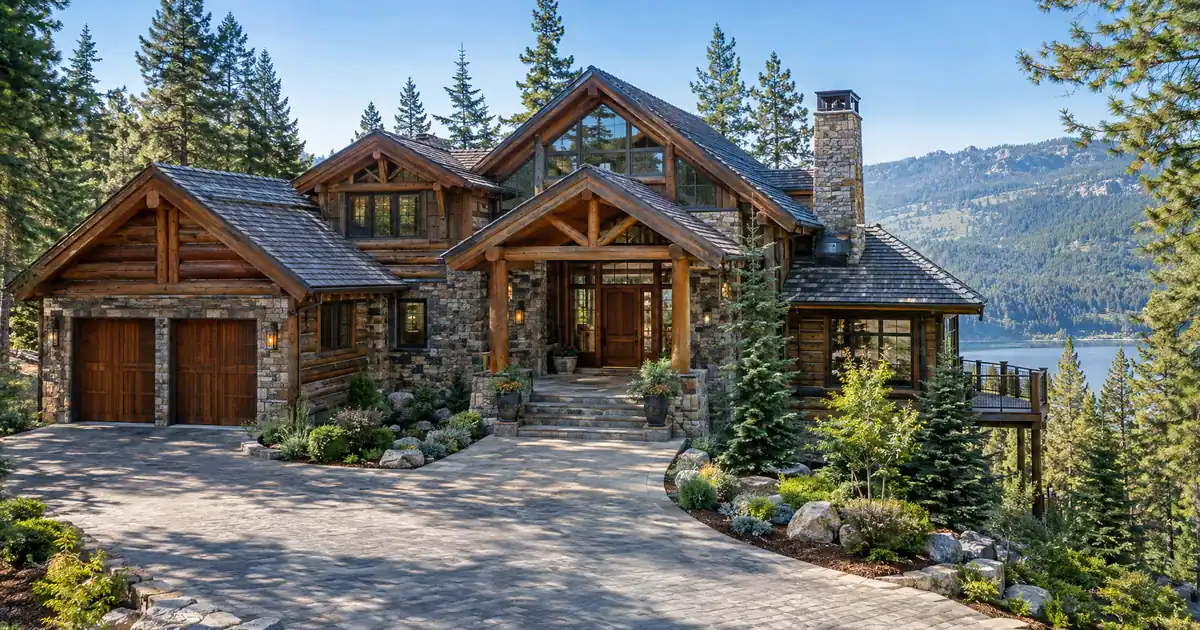
Many luxury cabins qualify, but cabin collateral draws more questions than a suburban house does. Lenders look at construction type, whether the home is livable year-round, and whether comparable sales exist nearby.
True log construction is the usual sticking point. Some programs in the network treat it cautiously because comps are scarce and resale is narrow. A cabin-style home with log siding or timber accents over conventional framing is a different story and is often treated like any other single-family house. Tell your broker which one you own before the file goes anywhere.
Location matters as well. Rural properties on five acres or less can reach 75% leverage in the network. Larger acreage brings tighter limits. Above $3,000,000, rural property is off the table and ten acres is the maximum. Terms depend on the lender’s guidelines, the property type, the leverage, and a full review of the credit profile.
Appraisal is the other hurdle. One-of-a-kind cabins in thin markets produce wide comp ranges, so above $2,000,000 two appraisals are required. Booking calendars, manager reports, and local rental data help the appraiser support your income number.
What Changes at Luxury Loan Sizes?
Leverage steps down as the balance rises, and credit expectations climb. These figures are ceilings on investment property through select wholesale programs, subject to underwriting:
- $150,000 to $1,000,000: up to 80% on a purchase and rate-and-term refinance, and 75% on a cash-out. The credit floor is 660.
- $1,000,000 to $3,000,000: 75% on a purchase and rate-and-term, with higher credit scores required. Cash-out leverage is lower at these sizes.
- $3,000,000 to $4,000,000: 65% on a purchase or rate-and-term. No cash-out.
- $4,000,000 to $10,000,000: 60% on a purchase or rate-and-term, reviewed case by case before submission. No cash-out.
Reserves are typically six months on the subject property, and twelve months for first-time investors. Cash-out proceeds cannot satisfy reserves. Short-term-rental files stop at $2,000,000, so a cabin priced above that generally needs to qualify on long-term rent.
Business-purpose financing is arranged in 41 markets, including Washington, D.C. Entity vesting is welcome, with no layered entities, subject to program terms.
DSCR vs. conventional financing
There are two common ways to finance an investment property, and they qualify you differently — here’s how investors weigh them.
Why investors choose it
- Qualifies on the property’s rental income — no personal tax returns, W-2s, or pay stubs needed to document income.
- No personal debt-to-income ceiling to clear, so existing mortgages and obligations don’t cap your borrowing the same way.
- Can be closed in an LLC, keeping the property inside a business entity.
- Built for scaling — not held to the limit on number of financed properties that conventional financing applies.
- Underwriting centers on the deal: generally qualifies when the rent covers the payment, a 1.00x coverage ratio being a common baseline (confirmed in underwriting).
- Designed specifically for investment property, including long-term and, where the program allows, short-term rentals.
Where it’s strong
- Often the lowest ongoing financing cost for a buyer who fully qualifies on personal income — a fit for a first property or a cost-first purchase.
Trade-offs for investors
- Requires full personal income documentation and must fit within a debt-to-income limit — salary, existing debts, and other mortgages all count.
- Typically held in your personal name rather than a business entity.
- Caps how many financed properties you can carry, which can become a ceiling as a portfolio grows.
- Evaluates you as a borrower as much as the property, which usually means more paperwork.
How investors usually choose: a first or single property often optimizes for the lowest financing cost; portfolio builders often optimize for leverage, vesting in an LLC, and scaling past conventional caps. The right answer depends on your goals, the property, and current guidelines — both paths run through select lenders in Lendmire’s wholesale network, with eligibility and terms confirmed in underwriting.
When Personal Use Breaks the Rule
DSCR loans are designed for non-owner-occupied investment properties. Because they are business-purpose investor loans, they are reviewed differently from a standard owner-occupied mortgage.
The line is sharper than most cabin owners expect. Under Regulation Z, credit for non-owner-occupied rental property is deemed business purpose. The same rule says a property is not non-owner-occupied if you expect to use it for more than 14 days in the coming year. A law-firm primer from Doss Law adds that the consumer-protection rules attach to natural-person, consumer-purpose, one-to-four-unit loans secured by real estate.
The practical result is simple. A cabin held as a business can go the DSCR route. A cabin you plan to enjoy most summers is a second home, and the deposit-based route is the natural alternative.
Two other edge cases deserve attention. Seasonal income looks fine on an annual average but hides slow months, so underwrite on the net figure, not the booking-platform dashboard. And a long-term rent schedule often sits well below what a cabin earns by the night, which is why the income method a program accepts can decide the file.
Three Hypothetical Scenarios
These are illustrations, not market data, and each uses coverage ratios instead of dollar amounts.
The established rental. An investor refinances a cabin with a full year of booking history. After the 80% discount to gross, coverage lands near 1.25x. The investor holds the property in an LLC, subject to program terms. Verdict: DSCR. Personal income never enters the file.
The new purchase. A buyer is acquiring a cabin with no operating history. The appraisal’s STR analysis supports coverage a little above 1.00x. The buyer is an experienced investor and the price is under $2,000,000. Verdict: DSCR, with a close look at the reserves, because the margin is thin and the income is projected, not proven.
The self-employed owner who also vacations there. A business owner with strong deposits and modest tax-return income plans to stay at the cabin for a month each year. Coverage on rental income alone sits below 1.00x. Verdict: bank statement. The planned personal use would push this file out of pure investment-loan territory anyway. A sub-1.00 DSCR program might exist if the owner dropped the personal use, with LTV and terms adjusted, subject to underwriting.
Mistakes That Stall Luxury-Cabin Files
- Assuming a vacation home is automatically an investment property. The purpose of the loan governs, not the label.
- Quoting platform revenue as qualifying income. Lenders discount it.
- Skipping local-rule documentation. Short-term rental rules can vary by city, county, HOA, and property type, so investors should confirm local rules before relying on projected rental income.
- Treating a strong ratio as the whole file. Credit, reserves, experience, and property condition count alongside it.
- Forgetting that clearing 1.00x does not make a cabin profitable. Repairs, vacancy, management, and cleaning on a remote property all sit outside the ratio.
- Mixing up deposits. One large, one-time deposit may not count the way steady monthly deposits do.
Tax treatment can depend on how the funds are used and how the property is held; investors should keep clear records and speak with a qualified tax professional before relying on any deduction.
For the full picture of how these loans work, see Lendmire’s complete DSCR loans guide.
Frequently Asked Questions
Can I use my cabin’s rental income if I also stay there?
Only in limited amounts. If you expect to occupy the cabin more than 14 days in the coming year, it is no longer treated as a non-owner-occupied rental. Light, documented personal use is a conversation to have with your broker early, because programs differ on how they treat it.
Can I buy a cabin with no rental history?
Often yes, on the DSCR path. On a purchase, income typically comes from the appraisal’s short-term-rent analysis at 80% of gross, with coverage of 1.00 or higher, subject to underwriting. Refinances usually need twelve months of actual operating history.
Does DSCR require traditional personal-income documentation?
DSCR qualifies primarily on property-level rental income covering the payment, subject to lender guidelines, so traditional income documentation is not the deciding test. You still provide credit, reserves, an appraisal, and income evidence for the cabin.
What if my cabin has log construction?
Some programs treat true log construction cautiously, while cabin-style homes with conventional framing are usually reviewed like other houses. Share the construction details and recent comps up front so your broker can match the file to the right lender.
Which path is better for a self-employed owner?
It depends on the cabin’s income and your use of it. A self-employed owner with strong deposits and an unproven cabin often fits bank statement qualifying. An owner who rents the cabin full-time and wants to keep personal income out of the file usually fits DSCR.
If you are buying or refinancing a high-balance rental cabin and want to see how the numbers work, Lendmire can help you compare super jumbo DSCR and bank statement options based on the property income, the loan balance, credit profile, leverage, and investor goals.
For current guidelines and terms, see Lendmire’s super jumbo DSCR loan programs page.
Self-employed borrowers can compare both super jumbo programs on Lendmire’s self-employed mortgages page.
About Lendmire
Lendmire is a non-QM mortgage brokerage (NMLS# 2371349) arranging DSCR investor loans in 41 markets, including Washington, D.C., through wholesale and investor-lending channels. DSCR loans are evaluated by the lender on rental income rather than personal income, subject to lender guidelines — a fit for LLC-owned portfolios, self-employed investors, and operators scaling beyond conventional loan caps. Recognized as a Scotsman Guide Top Mortgage Workplace in 2025 and 2026.
Get Started
Ready to find the right loan for you?
In about 30 seconds you can review financing options available for your investment property. No commitment required.
Informational only. Not a Loan Estimate, approval, or commitment to lend. Program availability and eligibility are subject to lender guidelines, credit approval, property review, and underwriting.
References
1. Home Business Magazine, DSCR Loans and Bank Statement Loans
3. Doss Law, Business Purpose Exemption Simplified
This article is part of Lendmire’s super jumbo DSCR loan program — full qualification details, guidelines, and scenarios live on the program page.
Related reading: How a Luxury Rental DSCR Loan Works in Seattle · How Luxury Airbnb DSCR Loan Sizes Work From Jumbo to Super Jumbo · DSCR vs Bank Statement Loan for a Portfolio Operator With LLC Doors
Brandon Miller
Founder & CEO, Mortgage Loan Originator, Lendmire LLC
- Mortgage Loan Originator · NMLS# 1129696 · Verify on NMLS Consumer Access
- North Carolina Real Estate Broker · License# 343312 · Verify on NCREC
- North Carolina Insurance Producer · License# 19053198 · Property, Casualty, Life, Health · Verify on NAIC SBS
- Lendmire LLC · Firm NMLS# 2371349 · Verify firm licensure
Legal disclosures. Lendmire (NMLS# 2371349) is a state-licensed mortgage brokerage that arranges financing through wholesale lender relationships. Lendmire is not a direct lender, depository institution, or registered financial advisor. The discussion above is general informational content about real estate financing — it is not financial, legal, or tax advice, and readers should consult licensed professionals for guidance on their individual circumstances. Loan inquiries are subject to lender underwriting; this article does not represent a commitment to lend. Loan terms, rates, and qualification standards vary by borrower, property, and state, and are subject to change at any time. Equal Housing Opportunity. NMLS Consumer Access: nmlsconsumeraccess.org.