
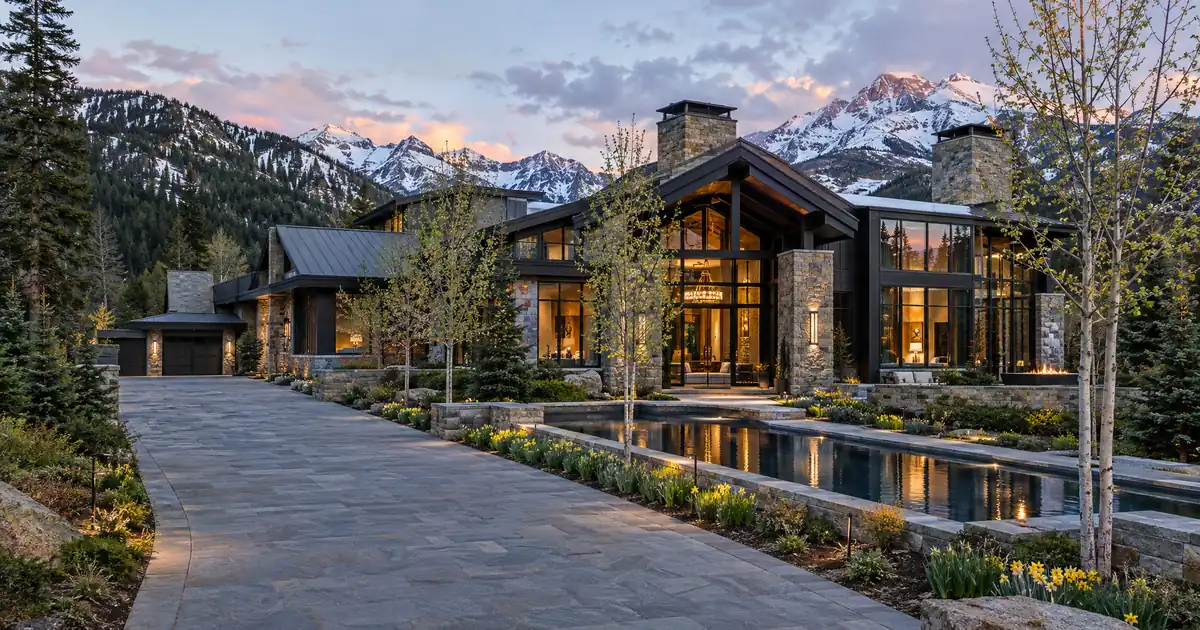
The Quick Read: Yes, but only when the cabin reads as a residence, the appraiser can support the number with real comparable sales, and the property stays inside the program’s rural limits. Bank statements decide whether the borrower qualifies. They never set what the cabin is worth.
- Deposits prove income. A separate appraisal proves collateral value.
- Through select wholesale programs, rural property typically tops out at 80% leverage on ten acres or less, and the loan cannot exceed $3,000,000.
- Above the super-jumbo line, rural property is excluded under the overlays described below.
- A low appraisal shrinks the loan, or raises the cash needed, because the loan sizes off the lower of price or value.
- Log homes, manufactured homes and barndominiums are typically not offered in these programs.
Most buyers of a remote cabin worry about the wrong test. The income file is the easy part for a self-employed founder, physician or attorney. The harder question is whether an appraiser can find enough sales to defend the purchase price. This article walks through how that works, where it breaks, and what to ask before writing an offer.
What Does “Fair Value” Mean to a Lender?
Fair value is the supportable value: the number an appraiser can defend with comparable sales. It is not the listing price, an online estimate, or what the rental income suggests. A cabin that earns strong bookings still appraises as a house, using sales of similar houses.
That distinction trips up many investors. One short-term rental seller guide gives an example in which a cabin earning $150,000 in revenue is still likely to appraise near a similar cabin that sold for $800,000. Treat that as an illustration of the principle, not a market benchmark.
Lenders in a wholesale network see this daily. The appraisal is the lender’s protection, so it is built on sales, not on the seller’s story or the buyer’s projections.
How Do Appraisers Build a Value When Sales Are Scarce?
They widen the search and explain every choice. Rural appraisals take more research and more written justification, and the usual obstacles are few nearby sales, unique homes, time between sales and wide geography, according to McKissock’s guidance on appraising rural properties.
The appraiser may reach into neighboring towns or regions. Each distant or dated sale needs a written reason. Agency appraisal rules show the logic, though they do not govern bank statement loans. Fannie Mae‘s Selling Guide says the same. Those are agency rules, so use them only to understand how an appraisal gets built.
So the old rule of thumb, comps within a mile and sold in the last 90 days, does not bind a rural report. Enact’s appraiser training notes there is no maximum comp distance. The appraiser only has to show the distant sales are the best indicators of value.
Here’s the catch. Flexibility on the appraiser’s side does not mean flexibility on the lender’s side.
Why Cabins Are Harder to Value Than Ordinary Homes
Cabins combine every rural problem at once. Few sales, unusual construction, uncertain land value and thin rental data all land on one file.
| Cabin trait | Effect on the appraisal |
|---|---|
| Remote location | Fewer comps, wider search |
| Log or unusual build | Needs extra market-acceptance support |
| Excess acreage | Often separated from home value |
| Off-grid utilities | Can stop the file outright |
| Rental use | Rent schedule only; no income-based value |
Unconventional construction matters twice. McKissock lists log homes, earth berm homes and converted barns as improvements that need extra support. Separately, through select wholesale programs, log homes, manufactured homes and barndominiums are typically not offered at all. Confirm construction type before anything else.
Utilities are the quiet deal killer. A cabin with no permitted septic, no legal water source or no grid power may not be reviewable regardless of price. A remote cabin also has few comparable rentals, so a projected rent can be thin. A seller’s booking history can help fill that gap.
Where Bank Statement Income Stops and the Property Test Begins
Two separate tests run on every file, and strength on one cannot repair weakness on the other.
| Test | What it measures | What it uses |
|---|---|---|
| Income test | Can the borrower repay? | 12 or 24 months of deposits after an expense ratio |
| Collateral test | Is the property worth the loan? | Appraisal, comps, property eligibility |
On the income side, the lender totals eligible deposits, removes transfers and loan proceeds, and applies an expense ratio to business accounts. Transfers from the borrower’s own business into a personal account typically count in full. Qualifying income is deposits divided by the statement months after that ratio, subject to lender guidelines.
On the collateral side, nothing about deposits matters. A founder with spotless statements and a cabin that appraises thin faces the same reduced loan as anyone else. That is why Lendmire’s piece DSCR vs Bank Statement Loan for a Jumbo Cabin or Rural Property argues the property often decides the file before the loan type does.
Occupancy shapes the choice. Genuine rental use pushes toward a DSCR structure, where the property’s cash flow carries the qualification. Personal or second-home use pushes toward bank statements. For a deeper look at how DSCR works as a product, the complete DSCR loans guide covers it.
The Rural Limits That Shape the Loan
Rural property faces its own ceiling in the network. Through select wholesale programs, subject to full underwriting, rural property typically runs to 80% leverage on ten acres or less, and the loan typically cannot exceed $3,000,000.
Above the super-jumbo line, the overlays tighten. That line sits at $3,500,000 on a primary residence and $3,000,000 on a second home or investment property. Past it, typical overlays include a 700 credit floor, a ten-acre maximum and no rural property at all. A rural cabin on a super jumbo loan above those thresholds does not fit.
“Super jumbo” itself is a lender line, not a legal category. The conforming limit is set by the FHFA. Everything above it is lender or investor policy, which is why the line moves from one program to another.
Anything above $4,000,000 is reviewed case by case before submission, so no leverage figure at that size is a flat promise.
Acreage is also relative to the market. Where five-acre homesites are normal, five acres is typical. A 40-acre parcel in a one-acre-lot market draws questions. And farm use, not size, is what can flip eligibility. A few goats and a line of milk income on a tax return can turn a residence into an agricultural file.
How Acreage Gets Valued
Appraisers do not multiply acres by a per-acre price. An independent Oregon appraisal practice explains that acreage affects value through its market contribution. The first acres support the homesite, and additional acres add value at different marginal rates.
The appraiser separates the home and its contributing site from excess land. That has a direct consequence. A price that bundled in extra acres can appraise below what you paid, because the excess land is valued at its own, often lower, contribution.
On a cash-out, the same logic works against you in reverse. Strip out excess land and the number the whole loan is built on drops.
How a Low Appraisal Changes Your Loan
The loan sizes off the lower of price or appraised value. A thin appraisal therefore shrinks proceeds or raises the cash you need at closing.
Run the numbers on a modeled purchase. Assume a rural cabin under contract at $1,000,000, on a primary residence, with leverage at the 80% rural ceiling. If the appraisal supports only $900,000, the loan sizes off $900,000 and the gap comes out of your pocket. That example is a modeled assumption, not a market fact.
Purchases and cash-outs feel this differently:
| Transaction | What a low value does |
|---|---|
| Purchase | You cover the gap or renegotiate |
| Rate-term refinance | Smaller loan; payoff may need cash |
| Cash-out | Proceeds shrink, often sharply |
Cash-out ceilings run lower than purchase ceilings at every size, so a low value compresses cash-out proceeds the most. On a primary residence up to $1,000,000, cash-out tops out around 80%, and a rural property sits under the same 80% ceiling. Cash-out at or below 60% LTV typically carries no proceeds cap, while above 60% a $1,500,000 cash-in-hand cap applies on the portfolio program.
If the appraisal is on a DSCR file, rent also matters. Form 1007 covers a one-unit property and Form 1025 covers two to four units. McKissock notes that the 1007 captures monthly rent, not nightly rent or business income, and the lender decides which income counts. Short-term rental rules can vary by city, county, HOA, and property type, so investors should confirm local rules before relying on projected rental income.
Before You Make an Offer
Most cabin problems are visible before the appraisal is ordered. Ask these questions first:
1. Is the construction type offered in the program, or is it log, manufactured or barn-style? 2. How many acres, and does that sit at or under the ten-acre line? 3. Does the loan size land above $3,000,000, or above the super-jumbo line for this occupancy? 4. Are power, permitted septic and a legal water source confirmed? 5. How will the lender treat excess land in the valuation? 6. Are there recent sales you can point to, even if distant?
Then prepare documents. Gather permits, septic and well records, a survey, and any rental booking history. Pull your own comp list, since a reviewer weighs a supported argument more than a bare complaint.
Also match the structure to the property. If rental use is real, the DSCR path may be cleaner. Lendmire’s piece Super Jumbo DSCR vs Bank Statement Reserves on a Rural or Cabin Property walks through that decision.
If the Number Comes In Low
A low value is a decision point, not a dead end. Work the ladder in order:
1. Request reconsideration with additional comps or documentation the appraiser missed.
2. Check the neighborhood definition. Enact’s training flags comps outside the area the appraiser defined as the neighborhood as a review problem.
3. Renegotiate the price toward the supported value.
4. Add cash to cover the gap, if the deal still makes sense at that basis.
5. Restructure the occupancy, loan size or program.
6. Walk away. A cabin you cannot finance at its contract price is sometimes the wrong cabin.
Think about the third and fourth steps honestly. A genuine toss-up exists when the cabin is a lifestyle purchase and the gap is small. It stops being a toss-up when the gap pushes leverage past what the cash flow or your reserves can carry.
When a Rural Cabin Is Not the Right Fit
Skip the super jumbo route if the cabin sits above ten acres, carries log or manufactured construction, lacks permitted utilities, or pushes the loan past the rural dollar cap. Rural land also often produces little cash flow on its own, so carrying costs matter when income is thin.
Alternatives exist. A smaller loan below the super-jumbo line, a DSCR structure for a true rental, a different property, or a larger down payment can each solve a different version of the problem. Tax treatment varies; consult a qualified professional.
Key Terms Defined
Appraised value: the property value an appraiser supports using comparable sales, which caps how much the lender will lend.
Comparable sale (comp): a recent sale of a similar property used to support the appraised value.
Excess land: acreage beyond what supports the home, valued separately from the house and homesite.
Super jumbo: a loan above a lender-set dollar line, not a legal category.
Reconsideration of value: a request that the appraiser review the report using new comps or facts.
Expense ratio: the share of business deposits removed before calculating qualifying income.
Frequently Asked Questions
Can an appraiser use comps that are old or far away on a rural cabin?
Yes, when the report explains why. Appraisers may widen the search by date and distance and must justify each choice. A lender still reviews the result, and a thin report on a large loan gets close attention.
Can strong bank statements offset a low appraisal?
No. Deposits prove you can repay, while the appraisal proves the property supports the loan. A low value cuts the loan amount regardless of how strong your income file looks, so the gap usually has to come from cash or a renegotiated price.
Does rental income raise the appraised value of a cabin?
Not directly. Appraisers value a cabin as a house using comparable sales. On a DSCR file, a rent schedule can affect coverage, but it does not lift the value of the property itself.
Are log cabins eligible?
Typically not through select wholesale programs. Log homes, manufactured homes and barndominiums are generally not offered, and eligibility is subject to lender guidelines. Confirm construction type before you pay for an appraisal.
How many acres is too many?
Through select wholesale programs, rural property typically runs to 80% leverage on ten acres or less, and above the super-jumbo line no rural property is eligible. That ten-acre line is network policy, not law. Farm use can cause trouble at any acreage.
Next Steps
If you are financing a high-balance property on business or personal bank statements and want to see how the numbers work, Lendmire can help you compare super jumbo bank statement loan options based on your deposits, the property, credit profile, leverage, and your goals. Reach the team at 828-256-2183.
A cabin that clears the program lines and has sales to support it can price fairly. One that sits outside them cannot be fixed by a strong income file.
Lendmire’s self-employed mortgages page presents both super jumbo programs, bank statement and DSCR, side by side.
About Lendmire
As a DSCR and non-QM mortgage broker, Lendmire (NMLS# 2371349) connects investors with wholesale lending channels across 41 markets, including Washington, D.C. The property’s rental income, not the borrower’s traditional personal-income documentation, is central to lender review, which works for self-employed operators and portfolios beyond four financed properties. Scotsman Guide named Lendmire a Top Mortgage Workplace in both 2025 and 2026.
Get Started
Ready to find the right loan for you?
In about 30 seconds you can review financing options available for your home or investment property. No commitment required.
Informational only. Not a Loan Estimate, approval, or commitment to lend. Program availability and eligibility are subject to lender guidelines, credit approval, property review, and underwriting.
References
1. McKissock, Appraising Rural Properties
2. Fannie Mae
3. Enact rural appraisal training
4. McKissock, Form 1007 and short-term rentals
This article is part of Lendmire’s super jumbo bank statement loan program — full qualification details, guidelines, and scenarios live on the program page.
Related reading: How a Super Jumbo Bank Statement Second-Home Loan Works · Can a Portfolio Operator Get a 40-Year Super Jumbo Bank Statement Loan? · How Super Jumbo Bank Statement Loan Appraisal Options Work for a Rural Estate
Brandon Miller
Founder & CEO, Mortgage Loan Originator, Lendmire LLC
- Mortgage Loan Originator · NMLS# 1129696 · Verify on NMLS Consumer Access
- North Carolina Real Estate Broker · License# 343312 · Verify on NCREC
- North Carolina Insurance Producer · License# 19053198 · Property, Casualty, Life, Health · Verify on NAIC SBS
- Lendmire LLC · Firm NMLS# 2371349 · Verify firm licensure
Legal disclosures. Lendmire (NMLS# 2371349) is a state-licensed mortgage brokerage that arranges financing through wholesale lender relationships. Lendmire is not a direct lender, depository institution, or registered financial advisor. The discussion above is general informational content about real estate financing — it is not financial, legal, or tax advice, and readers should consult licensed professionals for guidance on their individual circumstances. Loan inquiries are subject to lender underwriting; this article does not represent a commitment to lend. Loan terms, rates, and qualification standards vary by borrower, property, and state, and are subject to change at any time. Equal Housing Opportunity. NMLS Consumer Access: nmlsconsumeraccess.org.