
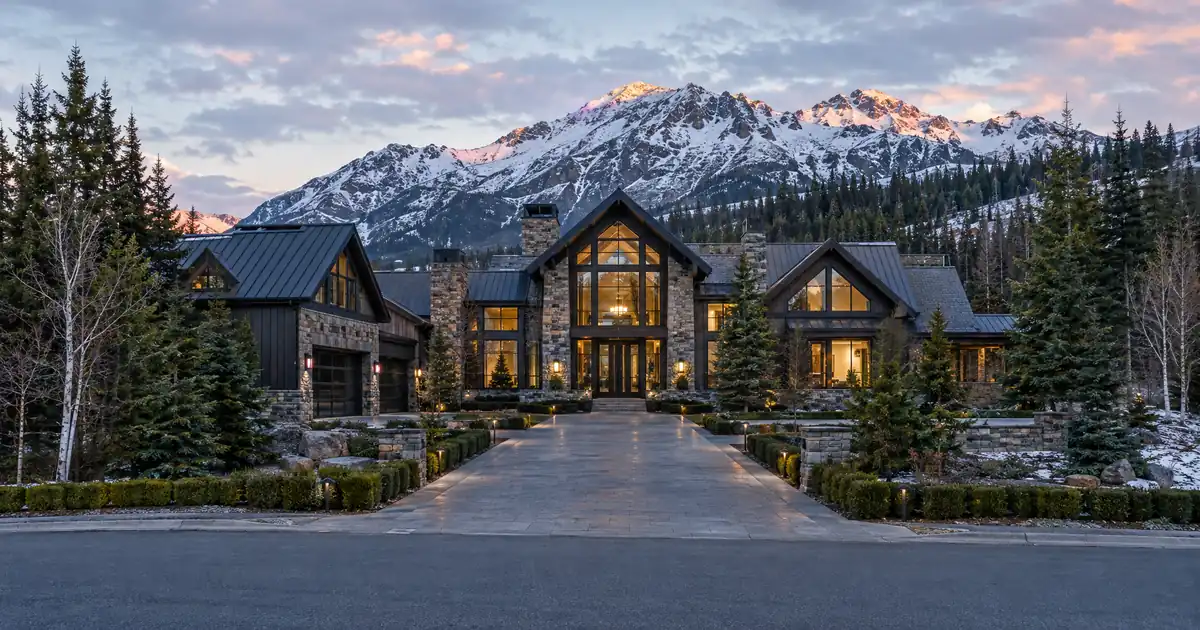
The Quick Read: A luxury rental DSCR loan in Alaska is a large-balance, business-purpose investor loan that qualifies primarily on whether the property’s rent covers its full monthly payment, subject to lender guidelines, with leverage stepping down as the balance climbs and short-term rental income judged on documented operating history rather than a single strong summer. There is no official “luxury” loan class. It is a size lane, and the rules tighten as you move up it.
- Balances run from $150,000 to $10,000,000 through select wholesale programs. Lendmire’s standard DSCR program stops at $3,000,000, and short-term-rental files stop at $2,000,000.
- Leverage on an investment-property purchase is typically 80% to $1,000,000 and 75% from $1,000,000 to $3,000,000. It is 65% from $3,000,000 to $4,000,000, and 60% above that on review.
- Credit has a 660 floor, with 700 required above $3,000,000. Two appraisals are needed above $2,000,000, and reserves typically run six months.
- Coverage of 1.00 earns full leverage. Select programs look below 1.00 at reduced leverage, with LTV and terms adjusted, subject to underwriting.
Key Terms Defined
DSCR (debt service coverage ratio): The property’s qualifying monthly rent divided by its full monthly payment. Above 1.00 means the rent covers the payment.
PITIA: Principal, interest, taxes, insurance and association dues. It is the full payment the rent has to cover.
ITIA: The same payment with the principal removed. It is used when a loan is interest-only.
LTV (loan-to-value): The loan balance as a percentage of the appraised value or purchase price.
Non-QM: A loan that sits outside standard consumer-mortgage boxes. DSCR loans are one kind.
Business-purpose loan: A loan for an investment property you do not live in.
Reserves: Liquid savings, counted in months of payments, that sit behind the loan.
Seasoning: A waiting period or clean-history requirement, such as the 48 months after a credit event on larger files.
The complete DSCR loans guide covers these basics in more depth.
DSCR Calculator
Run the numbers in Alaska
Rate source: Freddie Mac 30-yr average via FRED® — Federal Reserve Bank of St. Louis · effective Oct 15, 2026
Prefilled with starting assumptions — enter your own rent or nightly figures, taxes, insurance, and HOA for a more accurate picture.
Program parameters update from Lendmire’s centralized guideline source. Taxes and insurance are editable estimates.
As of Oct 15, 2026 · General Freddie Mac market benchmark, not a Lendmire loan offer. Rent, nightly rate, occupancy, taxes, and insurance are editable estimates. Short-term rental figures are estimates only and vary significantly by season, property type, management approach, and local short-term-rental rules — confirm local regulations before relying on them. Qualifying income for short-term rentals varies by program — some use appraisal market rent, others use documented STR history or projections — and is confirmed in underwriting. Not a Loan Estimate, approval, or commitment to lend. Program availability and eligibility are subject to lender guidelines, credit approval, property review, and underwriting.
What Makes a Rental “Luxury” in DSCR Terms?
Luxury means loan size, not finish level or zip code. Lenders do not care about marble. They care about the balance, because the balance sets the leverage, credit, appraisal and reserve rules.
“Jumbo” has a precise meaning: a loan above the conforming limit. FHFA sets the baseline limit at $832,750. It also gives Alaska a statutory baseline 50% higher, which puts the one-unit figure at $1,249,125. “Super jumbo” is a trade label with no official line.
Here is the catch. DSCR loans do not follow those agency limits at all. The number only tells you where “jumbo” starts in Alaska. Pricing and available terms vary by lender, borrower profile, property type, and full underwriting review.
How the Math Works, Step by Step
The underwriting runs in five steps. Each one can sink a file on a high-value property.
1. Pick the rent. On a long-term rental, rent used for lender review comes from the signed lease or the appraiser’s market-rent opinion. Most programs use the lower of the two. A big lease signed with a friendly tenant does not override the appraisal.
2. Build the full payment. That is principal, interest, taxes, insurance and any association dues. On high-value alaska property, insurance and taxes move the ratio more than most first-time luxury buyers expect. Remote or unusual buildings can be harder to insure.
3. Divide. Rent over payment gives the coverage number. Clearing 1.00 means the rent covers the payment, and full leverage generally starts there.
4. Let the appraisal speak. The appraisal sets both the value and the rent opinion. Long-term rent is usually supported by the rent schedule form (Form 1007) on a single-family home or the operating-income form (Form 1025) on two to four units. On a one-of-a-kind lodge, the appraiser’s view often becomes the binding constraint.
5. Check credit, reserves and entity papers. Qualification rests on the property’s rent, not on traditional personal-income documentation. The file still needs credit, assets, reserves and, if you buy in an LLC, entity documents.
Run the numbers on a $2,500,000 purchase at 75% leverage with credit at 720 or better. Two appraisals are required, since the price is above $2,000,000. The appraisal supports rent that clears the full payment at roughly 1.15x. That is a modeled assumption, not a market figure. The file works because the rent covers the payment with cushion, and the leverage sits inside the ladder. Terms depend on the lender’s guidelines, the property type, the leverage, and a full review of the credit profile.
Now flip it. Same property, but the appraiser’s rent opinion lands just under 1.00x. That is a different conversation, and the section on thin coverage below walks through it.
Short-Term and Seasonal Income in Alaska
Short-term rental income gets treated differently from lease income, and Alaska’s seasons make the difference sharper. On a refinance, qualifying income comes from twelve months of operating history. On a purchase, it comes from the appraisal’s short-term-rent analysis. Either way, the program counts 80% of gross, and coverage must be 1.00 or higher. Loan amounts stop at $2,000,000, and the borrower needs to be an experienced investor: twelve months of owning income property in the last thirty-six.
| Income type | Evidence used | Counted at |
|---|---|---|
| Long-term lease | Lease or appraiser’s market rent | Lower of the two |
| Short-term, refinance | Twelve months of operating history | 80% of gross |
| Short-term, purchase | Appraisal’s short-term-rent analysis | 80% of gross |
Seasonality is why the twelve-month view matters. A summer peak looks wonderful in a snapshot. Underwriters want the whole year. AirDNA scores Seward at 42 on seasonality with 69% annual occupancy, while Big Lake scores 62 with 49% occupancy. Two Alaska markets, two very different income shapes.
Averages also mislead at the top. In Valdez, AirDNA shows 137 listings averaging $18.9K in annual revenue, with revenue down 15.9% year over year. Market-wide figures like that are not a luxury benchmark. A lodge needs property-specific evidence.
One rule applies everywhere. Programs want municipal permission documented for the specific property. It is never assumed for a town or a state.
Here is a genuine toss-up. In a weak short-term year, the long-term-rental number may be the one that clears the ratio, even if the Airbnb pitch deck looks better. Many investors keep both calculations on the table until the appraisal comes back.
How Requirements Shift as the Loan Grows
Every step up the size ladder costs you leverage. This is the part most investors do not see coming. The figures below are typical ceilings through select wholesale programs, subject to underwriting.
| Loan size | Purchase / rate-term (investment property) | Cash-out (standard rental) |
|---|---|---|
| $150K–$1M | 80% | 75% |
| $1M–$1.5M | 75% | 70% |
| $1.5M–$2M | 75% | 60% |
| $2M–$3M | 75% | 60% |
| $3M–$4M | 65% | — |
| $4M–$6M | 60%, on review | — |
| $6M–$10M | 60%, on review | — |
Credit works the same way. The top leverage cell in each band needs a certain score: 660 or better to $1,000,000, 700 or better from $1,000,000 to $1,500,000, and 720 or better from $1,500,000 to $3,000,000. Those are not floors. The program floor is 660 on loans to $3,000,000 and 700 above it, and a lower score takes a lower leverage cell inside the same band.
Above $3,000,000, a super-jumbo overlay adds more. It calls for a clean housing history (0x30x24), 48 months of seasoning after a credit event, citizens and permanent residents only, no rural property, ten acres at most, and cash-out proceeds that never count toward reserves. Above $4,000,000, every request is reviewed case by case before submission, and only for purchase or rate-and-term.
Appraisal, Reserves and Documents: The Checklist
“No personal income documents” does not mean no documents. Qualification runs on the property’s income, and the file still carries paper. A typical luxury file includes:
- Government ID and a credit report.
- An appraisal with rent evidence, and a second appraisal above $2,000,000.
- Six months of reserves on the subject property, counted as PITIA (or ITIA on interest-only), and twelve months for first-time investors.
- Asset statements showing where the reserves sit.
- Entity documents if the property closes in an LLC.
- For short-term rentals, platform or management statements and local permission paperwork.
Programs in the network allow up to twenty financed properties, and they do not add extra reserves for the others. Reserves are about the subject property only.
Which Alaska Properties Trip Files?
Remote and unusual property causes more trouble than the loan size does. Alaska has plenty of it.
Rural and acreage. Rural collateral of five acres or less can reach 75% leverage, but only on loans of $3,000,000 or less. Acreage can run up to twenty acres on loans to $3,000,000. Above $3,000,000: no rural property, and no more than ten acres on a non-rural one. A fly-in lodge on a big parcel may sit outside standard programs entirely.
Thin comps. Small markets mean few comparable sales and few rent comps. The appraisal gets harder, and so does the rent evidence.
Condos. Warrantable and non-warrantable condos are both possible. Non-warrantable units top out at 75% and $1,500,000. Condotels reach 75% on a purchase and 65% on a refinance, up to $1,500,000, with $250,000 cash-in-hand.
Insurance and association dues. These feed straight into the payment. Get the insurance quote before the file goes to a lender, because a surprise there can move coverage.
DSCR vs. conventional financing
There are two common ways to finance an investment property, and they qualify you differently — here’s how investors weigh them.
Why investors choose it
- Qualifies on the property’s rental income — no personal tax returns, W-2s, or pay stubs needed to document income.
- No personal debt-to-income ceiling to clear, so existing mortgages and obligations don’t cap your borrowing the same way.
- Can be closed in an LLC, keeping the property inside a business entity.
- Built for scaling — not held to the limit on number of financed properties that conventional financing applies.
- Underwriting centers on the deal: generally qualifies when the rent covers the payment, a 1.00x coverage ratio being a common baseline (confirmed in underwriting).
- Designed specifically for investment property, including long-term and, where the program allows, short-term rentals.
Where it’s strong
- Often the lowest ongoing financing cost for a buyer who fully qualifies on personal income — a fit for a first property or a cost-first purchase.
Trade-offs for investors
- Requires full personal income documentation and must fit within a debt-to-income limit — salary, existing debts, and other mortgages all count.
- Typically held in your personal name rather than a business entity.
- Caps how many financed properties you can carry, which can become a ceiling as a portfolio grows.
- Evaluates you as a borrower as much as the property, which usually means more paperwork.
How investors usually choose: a first or single property often optimizes for the lowest financing cost; portfolio builders often optimize for leverage, vesting in an LLC, and scaling past conventional caps. The right answer depends on your goals, the property, and current guidelines — both paths run through select lenders in Lendmire’s wholesale network, with eligibility and terms confirmed in underwriting.
What If Coverage Comes in Thin?
Thin coverage is a structuring problem, not an automatic no. The options a lender may review:
- Interest-only. Programs offer a 120-month interest-only period on 30- and 40-year terms, capped at 75% leverage, with the loan qualified on ITIA. Skipping principal shrinks the payment the rent has to cover.
- Lower leverage. A smaller loan means a smaller payment against the same rent.
- Select sub-1.00 programs. A handful of lenders in the network will look at coverage below 1.00 on loans to $2,000,000. LTV and terms adjust, subject to underwriting.
- Better rent evidence. A stronger lease, or twelve clean months of short-term operating history, can lift the coverage figure. The exact numbers vary by lender and program and follow a full review of property, leverage, and credit.
Qualification still depends on lender guidelines, credit, reserves and the property review. None of this is a commitment to lend.
Entity, Cash-Out and Scaling
Buying in an LLC is common at this level, subject to program terms. Programs welcome entity vesting but do not accept layered entities. Lendmire’s piece How to Vest a Luxury Short-Term Rental in an LLC covers the setup in detail.
DSCR loans are designed for non-owner-occupied investment properties. Because they are business-purpose investor loans, they are reviewed differently from a standard owner-occupied mortgage. The Federal Reserve’s Regulation Z supervisory manual treats credit used to buy or improve non-owner-occupied rental property as business-purpose credit. A vacation home you plan to use yourself does not fit. Keep the purpose strictly investment.
Cash-out follows its own ladder. Proceeds are unlimited at or below 60% LTV, and capped at $1,500,000 above 60%. There is no cash-out above $3,000,000, and none for credit of 680 and below on loans above $1,500,000. On a cash-out of a standard rental, the ceiling is 75% at the low end of the size ladder, then it steps down. Final terms depend on the lender’s guidelines, the property type, and the borrower’s complete credit picture.
Tax treatment can depend on how the funds are used and how the property is held; investors should keep clear records and speak with a qualified tax professional before relying on any deduction.
Pros, Cons and Why Deals Stall
The upside is real. Qualification rests on the property’s rent, not your traditional personal-income documentation. That helps self-employed owners and entity-held portfolios. Interest-only runway gives breathing room, and balances reach $10,000,000 on review.
The downsides are just as real. Leverage falls as the balance rises. Short-term income is discounted. Rural or remote collateral can fall outside programs. The loan only works for investment property.
Deals usually stall for the same few reasons:
- Short-term income is pitched off a peak month instead of twelve months of history.
- The appraised rent lands below the lease rent, and the lower number controls.
- Insurance or association dues push the payment above what the rent supports.
- Local permission for the rental is not documented for that specific property.
- Reserves are expected to come from cash-out proceeds. They cannot.
What the Process Looks Like
1. Share the property, the purchase price or value, and your credit and reserve picture. 2. Decide the rent basis: lease, appraisal rent or short-term history. 3. Compare programs across the network, since leverage, acreage and condo rules differ by lender. 4. Order the appraisal, or two above $2,000,000. 5. Assemble reserves, entity papers and rental evidence. 6. Review the full file with the lender before final approval, which stays subject to underwriting.
Frequently Asked Questions
Is there a minimum price for a luxury rental DSCR loan?
No. Luxury is a size lane, not a defined product. The leverage and credit steps start to bite at $1,000,000 and tighten again at $1,500,000, $3,000,000 and $4,000,000. Programs run from $150,000 to $10,000,000, with Lendmire’s standard program stopping at $3,000,000.
Can I use a DSCR loan on a short-term rental lodge or cabin?
Often, with conditions. Programs want coverage of 1.00 or higher, loan amounts to $2,000,000, and twelve months of operating history on a refinance or the appraisal’s short-term-rent analysis on a purchase. Income counts at 80% of gross, and the borrower must have owned income property for twelve of the last thirty-six months. Local permission has to be documented for the specific property.
Does Alaska’s seasonality hurt the ratio?
It can, because underwriters average the whole year instead of the peak season. A property that earns most of its income in summer needs a full twelve-month record or a credible appraisal analysis. A long-term-rental number is sometimes the stronger fallback.
What if the appraisal rent is below my lease?
Most programs use the lower of the lease and the appraiser’s market rent. If coverage falls short, lower leverage, an interest-only structure, or a select program that reviews coverage below 1.00 may help.
Do I need extra reserves for other properties I own?
No. Reserves are six months on the subject property, or twelve for first-time investors, and programs do not add reserves for other financed properties. Cash-out proceeds from the same loan cannot satisfy them on larger files.
Next Step
If you are buying or refinancing a high-balance rental property and want to see how the numbers work, Lendmire can help you compare super jumbo DSCR loan options based on the property income, the loan balance, credit profile, leverage, and investor goals. Call 828-256-2183 to talk through a specific file.
Lendmire’s self-employed mortgages page presents both super jumbo programs, bank statement and DSCR, side by side.
About Lendmire
Lendmire is a non-QM mortgage brokerage (NMLS# 2371349) arranging DSCR investor loans in 41 markets, including Washington, D.C., through wholesale and investor-lending channels. DSCR loans are evaluated by the lender on rental income rather than personal income, subject to lender guidelines — a fit for LLC-owned portfolios, self-employed investors, and operators scaling beyond conventional loan caps. Recognized as a Scotsman Guide Top Mortgage Workplace in 2025 and 2026.
Get Started
Ready to find the right loan for you?
In about 30 seconds you can review financing options available for your investment property. No commitment required.
Informational only. Not a Loan Estimate, approval, or commitment to lend. Program availability and eligibility are subject to lender guidelines, credit approval, property review, and underwriting.
References
1. FHFA conforming loan limit addendum
5. Federal Reserve Regulation Z supervisory manual
This article is part of Lendmire’s super jumbo DSCR loan program — full qualification details, guidelines, and scenarios live on the program page.
Related reading: How a Luxury Rental DSCR Loan Works in New Hampshire · How a DSCR Loan Works for a Luxury Duplex · Asset Depletion vs Bank Statements vs DSCR for a Luxury Rental Buyer
Guides: Super Jumbo DSCR Loans in Alaska
Brandon Miller
Founder & CEO, Mortgage Loan Originator, Lendmire LLC
- Mortgage Loan Originator · NMLS# 1129696 · Verify on NMLS Consumer Access
- North Carolina Real Estate Broker · License# 343312 · Verify on NCREC
- North Carolina Insurance Producer · License# 19053198 · Property, Casualty, Life, Health · Verify on NAIC SBS
- Lendmire LLC · Firm NMLS# 2371349 · Verify firm licensure
Disclosure information. Lendmire is a state-licensed mortgage brokerage under NMLS# 2371349. Lendmire is not a depository institution, direct lender, or financial advisor — all loans referenced are placed through wholesale lender partners and are subject to each lender's underwriting standards. This article is provided for general informational purposes and is not a commitment to lend, nor does it constitute financial, legal, or tax advice. Loan programs, terms, rates, and qualification standards change without notice and depend on borrower profile, property type, and the state in which the subject property is located. Equal Housing Opportunity provider. NMLS Consumer Access: nmlsconsumeraccess.org.