
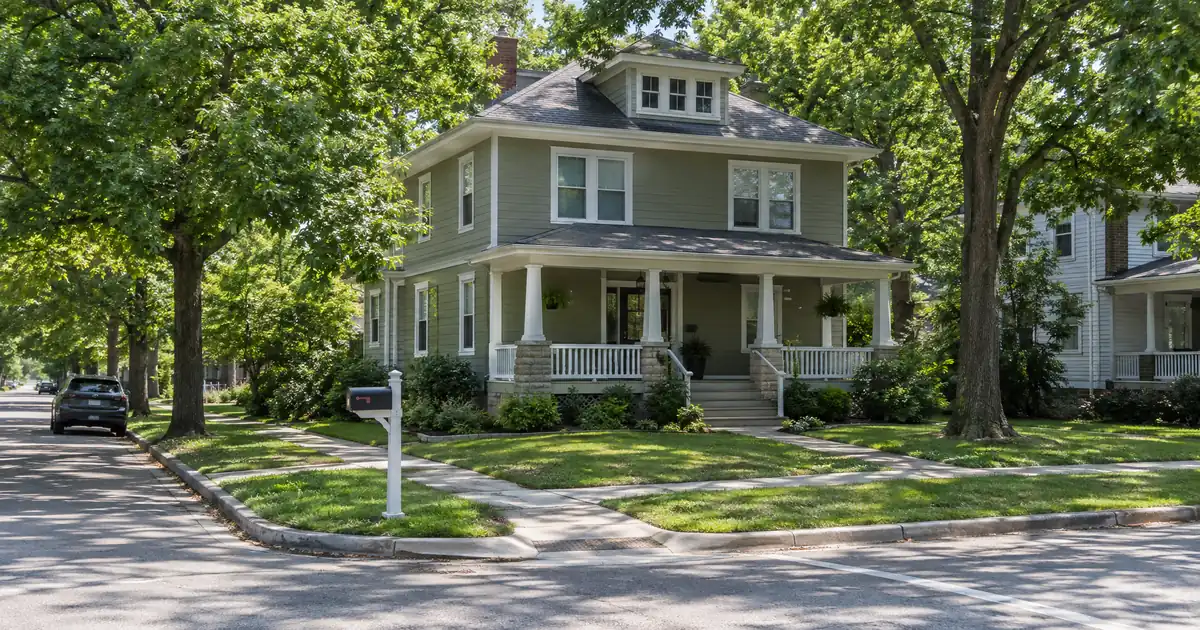
The Quick Read: A portfolio lender puts twenty rentals under one note and tests them as a group. Each house still gets its own appraisal, title work, insurance and rent support. The loan is a pool of debt, not a swimming pool or a condo rental pool.
- One test, many houses. Pooled rent is divided by pooled debt service, so stronger houses can offset weaker ones.
- No house skips diligence. Every property needs a lease or an appraiser-supported market rent.
- The exit is the hard part. Release terms decide whether you can sell one house later without hurting the rest.
- Pool size is a program setting. Across Lendmire’s wholesale network, one 30-year portfolio structure accepts up to 20 properties per note, subject to lender guidelines.
Key Terms Defined
DSCR (debt service coverage ratio) is the property’s rent divided by its monthly debt payment. Corporate Finance Institute explains the formula and the 1.0 threshold.
PITIA is principal, interest, taxes, insurance and association dues. It is the full monthly obligation used in the test.
Blanket loan is one loan secured by two or more properties. A conventional mortgage finances one property.
Portfolio loan is a loose label. Here it means a single DSCR note covering many rentals, not a loan a bank keeps on its own books.
Pooled coverage is total rent across the pool divided by total PITIA on the one note.
Cross-collateralization means every house secures the whole debt, not just its own share.
Cross-default means a default tied to one part of the loan can become a default on the entire note.
Release clause is the loan term that lets one property leave the pool when you pay down part of the balance.
Allocated amount is the slice of the loan assigned to each house. The release price is measured against it.
What Is a Twenty-House Pool, Really?
It is one promissory note and one security instrument recorded against every house. Ten loans closed on the same day are not the same thing. If each house has its own note, you have separate loans, even when they closed together.
A blanket structure is more common in commercial settings, but landlords with residential rentals use it too. Nav describes how a blanket lien lets several properties secure a single loan. It also notes that investors often use it to buy or refinance a portfolio.
Lendmire is a broker, so it arranges these loans through select lenders. Across that network, two structures matter for a twenty-house pool.
- A 30-year portfolio DSCR loan takes 2 to 20 properties under one note. Loan sizes run from $300,000 to $5,000,000, with larger balances on review. Leverage goes up to 80% of value on a purchase or rate-and-term refinance of investment rentals. The coverage floor is 1.00, measured on the pool. Interest-only periods are available, and property types include single-family, 2-4 unit, condo and townhome.
- A rental portfolio term loan fits five or more rentals or units under one loan. Loan sizes run from $500,000 to $50,000,000, with leverage up to 75% of value. Terms are fixed at 3, 5, 7 or 10 years with a balloon at maturity. Prepayment uses yield maintenance, and both recourse and non-recourse versions exist. Every figure here varies by lender and program — guidelines, property type, leverage, and credit profile all apply.
Twenty houses sit at the ceiling of the first structure. They sit comfortably inside the second. Every figure is a program ceiling or floor, not a quote, and each file is underwritten individually.
How Does Underwriting Work, Step by Step?
The lender runs the file in a set order. Here is the sequence on a twenty-house pool.
1. Scenario screening. The lender checks property count, property types, location mix and total loan size against the pool guidelines. Owner-occupied homes, mobile homes, co-ops, mixed-use and commercial property are ineligible. Manufactured homes, log homes and barndominiums are also not offered.
2. The data tape. You send a list of the houses with entities, rents, leases, insurance and payoff figures. The lender builds one schedule from it.
3. Per-house diligence. Each house is appraised, titled and insured on its own. Appraisers typically use the rent schedule (Form 1007) and the small residential income form (Form 1025), both listed on Fannie Mae’s forms page. The forms are used here only for appraisal. Fannie Mae’s loan rules do not govern DSCR files.
4. Rent evidence. Every house needs a lease or an appraiser-supported market rent.
5. The pooled test. Total rent is divided by total PITIA on the one note.
6. Borrower and entity review. The lender reviews the LLC documents, the guarantor’s credit and the source of funds. Credit floors start around 640 on portfolio structures, and some want 680 or 720.
7. Structure and release terms. This step sets the allocated amounts and the release price for each house.
8. Conditions, closing and servicing. One closing creates one note and one servicer.
One framing note. DSCR loans are designed for non-owner-occupied investment properties. Because they are business-purpose investor loans, they are reviewed differently from a standard owner-occupied mortgage, a distinction the CFPB’s Truth in Lending guidance also draws for business-purpose credit.
How Is the Pooled Coverage Test Calculated?
Add up the rent on all twenty houses, then divide by the total PITIA on the single loan. The pool qualifies primarily on property-level rental income covering the payment, subject to lender guidelines. Pooling is aggregation, not averaging, and the difference matters when the houses are unequal.
For standard 1-4 unit rentals, the test is rent against PITIA. Some commercial-style pages subtract operating expenses first, which is a net-operating-income method. Do not assume that method applies to your residential pool.
Run the numbers on this modeled example. It assumes every house carries equal debt service, which keeps the arithmetic simple. Real pools do not, so treat it as an illustration.
| House group | Count | Coverage each |
|---|---|---|
| Strong houses | 17 | 1.25x |
| Thin houses | 2 | 0.90x |
| Vacant house, scored at zero | 1 | 0.00x |
| Pool result | 20 | about 1.15x |
With equal payments, the pool ratio is the sum of the coverage numbers divided by twenty. That is 23.05 divided by 20, or about 1.15x. If the vacant house scores at an appraiser-supported market rent near 1.10x, the pool rises to about 1.21x.
The pool clears a 1.00 floor even with two thin houses and one empty one. Underwriting still tests pooled coverage, leverage and terms on a pool that includes weak houses, subject to underwriting. If your strong houses are few, the cushion shrinks quickly.
Clearing 1.00 is also not the same as earning cash flow. DSCR compares rent to PITIA only. Repairs, vacancy, management, utilities and capital spending sit outside the test.
What Gets Reviewed House by House?
The pooled ratio hides a lot of file work.
| Item | Source document | What can stall the file |
|---|---|---|
| Value | Appraisal | Value below the lender’s per-house minimum |
| Rent | Lease or Form 1007 | No lease and no market-rent support |
| Title | Title commitment | A lien or ownership gap in one entity |
| Insurance | Policy and declarations | A lapse or gap in one policy |
| Condition | Appraisal notes | Deferred repairs that affect value |
| Entity | LLC documents | Missing authority or mismatched names |
Every property gets its own appraisal, which is one reason these files cost more to assemble than a single-property loan. Industry sources note the multiple-appraisal burden and the foreclosure risk after default, which come up again below.
What Does One Weak or Vacant House Do to the Pool?
It lowers the blended number, but it does not stop the file by itself. A house that rents below its own payment can sit in the pool when the strong houses carry it. The lender then looks at pooled coverage, leverage and terms.
| Condition | Typical read | What helps |
|---|---|---|
| One thin house | Absorbed if the pool clears its floor | More strong houses in the pool |
| One vacant house | Scored on market rent when supported | An appraiser’s rent schedule |
| Several thin houses | Pool ratio drifts toward the floor | Lower leverage or fewer houses |
| A house below the value minimum | May be pulled from the pool | Moving it to its own loan |
Cheap houses sometimes qualify better inside a pool than alone, because a single small loan can miss a lender’s minimum. A per-property value floor can still apply inside the pool.
How Do Releases, Sales and Swaps Work?
Release terms decide how freely you can sell. A release clause lets one property leave the pool when you pay down part of the balance. The release price runs above that property’s allocated balance, so selling a house does not simply return its slice of the loan.
Lender practice varies. Nav says some lenders allow you to sell or refinance individual properties, and that otherwise you typically need lender approval. Some lenders require repayment of a percentage of the original individual loan amount and may also set higher coverage requirements than separate loans would carry. Read the release section before you sign, not after.
After a release, the lender retests the remaining pool. That is where sequencing bites. Suppose a pool sits near 1.05x and your two strongest houses sell first. The remaining houses may fall below 1.00x, and the lender can require more paydown or other terms. Selling the weakest houses first usually leaves the pool healthier.
Partial releases, substitutions and one-house sales all follow the loan documents and the lender’s release terms. The remaining portfolio must still cover its debt service. Tax treatment can depend on how the funds are used and how the property is held; investors should keep clear records and speak with a qualified tax professional before relying on any deduction.
On the term loan, yield-maintenance prepayment adds another cost to exiting early. Ask how it interacts with a partial sale.
Where the Risk Hides
Shared collateral is the trade. You get one loan, but you also give up the walls between houses.
| Risk | What it means | How investors limit it |
|---|---|---|
| Cross-collateralization | Every house secures the whole debt | Keep reserves and avoid thin pools |
| Cross-default | One breach can trigger the whole note | Know the covenants and cure terms |
| Personal guarantee | Reaches beyond the collateral | Ask about non-recourse versions |
| Multi-LLC notes | Several entities share one lender claim | Confirm entity authority before closing |
| Exit friction | Selling one house needs lender action | Negotiate release terms up front |
An LLC does not erase a guaranty. Recourse loans carry a personal guarantee, and a special-purpose entity (typically an LLC) is required on some structures, subject to program terms. Non-recourse versions exist on the term loan, with carve-outs such as fraud and bankruptcy. In a downturn, a lender holding all twenty houses can pursue the whole pool, not one weak property.
Pool, Separate Loans, or a Split?
Your real choice is between one blanket note and separate DSCR loans. A third option is a split, where some houses go in a pool and others stay on their own loans. A property can carry only one first lien, so a house cannot sit in both structures at once.
| Factor | One pool | Separate loans | Split |
|---|---|---|---|
| Closings and payments | One of each | One per house | A few of each |
| Coverage test | Pooled | Per house | Mixed |
| Selling one house | Release terms apply | Usually simple | Depends on the house |
| Default exposure | Whole pool | One house | One group |
| Best fit | Long holds, uniform houses | Mixed quality, planned sales | Keepers plus likely sales |
Four questions decide it. Will you hold all twenty together? How strong is each house on its own? How do the release terms work? Can you tolerate a shared default?
For a deeper look at choosing between lender types, see Lendmire’s piece Non-QM DSCR vs Portfolio Lender for an $8M Acreage Rental. The complete DSCR loans guide covers the single-property basics.
Where the General Rule Breaks
- Pool size is not a universal cap. Twenty is the ceiling on one 30-year portfolio structure in the network. The term loan structure starts at five properties and has no such 20-house ceiling.
- Cash-out has its own limit. A cash-out on a portfolio loan never exceeds 75% of the pooled value. Within the first six months of ownership, the seasoning rule caps the cash-out amount.
- Pools can fail on one house. A property that misses the value minimum or has a title problem may be pulled out and financed separately.
- Short-term rentals are treated differently. They are reviewed on their own history, and rules vary by city, county, HOA and property type, so investors should confirm local rules before relying on projected rental income.
- Release terms are lender-specific. Some lenders allow clean partial releases. Others make single-house exits costly. The difference can matter more than the pooled coverage number.
- Different lenders see different pools. One lender may value each asset individually. Another leans on the portfolio as a whole. Asking which is true is part of choosing a lender.
For investors still deciding on a lender, Lendmire’s guide How to Choose the Right DSCR Lender for a Growing Rental Portfolio goes deeper.
What Should You Gather Before Asking for a Quote?
A complete package saves time on both sides. Assemble these items before you request a quote on twenty houses.
- A rent roll with leases for each house.
- Entity documents for every LLC that owns a property.
- Current payoff statements for existing loans.
- Insurance declarations for each property.
- A schedule showing which houses are vacant and why.
- Guarantor credit and a statement of reserves.
- Notes on any house you may want to sell during the hold.
Reserves vary by structure. On standard DSCR files, about 6 months of PITIA is common, rising to about 9 months above $1,500,000. The term loan structure holds reserves for taxes, insurance and capital expenditures. Everything is subject to lender guidelines.
Frequently Asked Questions
Can I put more than twenty houses in one loan?
Yes, on a different structure. The 30-year portfolio loan tops out at 20 properties per note. A rental portfolio term loan starts at five properties or units and can carry much larger pools, with loan sizes up to $50,000,000 on review. Final terms depend on lender guidelines, property type, leverage, and the borrower’s complete credit picture.
Can I sell one house without paying off the whole loan?
Usually, if the loan documents include a release clause. You pay down part of the balance, and the rest stays in place. The release price runs above that house’s allocated balance.
Can I add houses to the pool later?
Substitutions and additions follow the loan documents and the lender’s terms. Do not assume they are allowed. If you plan to grow the pool, ask about substitution rights before closing.
Does an LLC protect me if the pool defaults?
Not by itself. Recourse loans carry a personal guarantee that reaches past the collateral. Non-recourse versions exist on the term loan, with carve-outs. A special-purpose entity is required on some structures, per lender program requirements.
Is clearing the coverage test the same as making money?
No. The test compares rent to PITIA only. Repairs, vacancy, management and utilities are outside it, so a pool can clear the ratio and still run thin on actual cash.
Next Step
If you are buying or refinancing a rental property and want to see how the numbers work, Lendmire can help you compare DSCR loan options based on the property income, credit profile, leverage, and investor goals. Lendmire arranges these loans through select lenders across 41 markets, including Washington, D.C., and every file is underwritten individually and is not a commitment to lend.
Twenty houses is where the exit terms matter more than the entry terms, so read the release section first.
About Lendmire
Lendmire (NMLS# 2371349), a non-QM mortgage broker serving investors in 41 markets including Washington, D.C., helps structure DSCR scenarios commonly evaluated around a property’s rental income rather than personal income paperwork, subject to lender guidelines. A Scotsman Guide Top Mortgage Workplace in 2025 and 2026, Lendmire places loans through wholesale investor lenders and is not a direct lender.
Get Started
Ready to find the right loan for you?
In about 30 seconds you can review financing options available for your investment property. No commitment required.
Informational only. Not a Loan Estimate, approval, or commitment to lend. Program availability and eligibility are subject to lender guidelines, credit approval, property review, and underwriting.
References
1. Corporate Finance Institute: Coverage Ratio Overview
2. Nav: Cross-Collateralization
3. Fannie Mae: Selling Servicing Guide Forms
This article is part of Lendmire’s DSCR loan program — full qualification details, guidelines, and scenarios live on the program page.
Related reading: House-Only Pool vs Mixed Pool With Condos for a DSCR Loan · How a DSCR Lender Calculates Coverage on a Whole Portfolio · How Much Leverage a Rental Portfolio Should Carry Under One DSCR Loan
Brandon Miller
Founder & CEO, Mortgage Loan Originator, Lendmire LLC
- Mortgage Loan Originator · NMLS# 1129696 · Verify on NMLS Consumer Access
- North Carolina Real Estate Broker · License# 343312 · Verify on NCREC
- North Carolina Insurance Producer · License# 19053198 · Property, Casualty, Life, Health · Verify on NAIC SBS
- Lendmire LLC · Firm NMLS# 2371349 · Verify firm licensure
Compliance and disclosures. Lendmire (NMLS# 2371349) is a licensed mortgage broker and is not a direct lender, depository institution, financial advisor, or tax professional. Content in this article is general market analysis and educational information — not financial, legal, or tax advice for any specific situation. Lendmire does not guarantee loan approval; every transaction is subject to underwriting by the funding lender. Mortgage pricing and loan program guidelines are subject to change at any time without notice and vary by borrower characteristics, property type, and state regulations. Lendmire complies with Equal Housing Opportunity. Licensure verification: NMLS Consumer Access.