
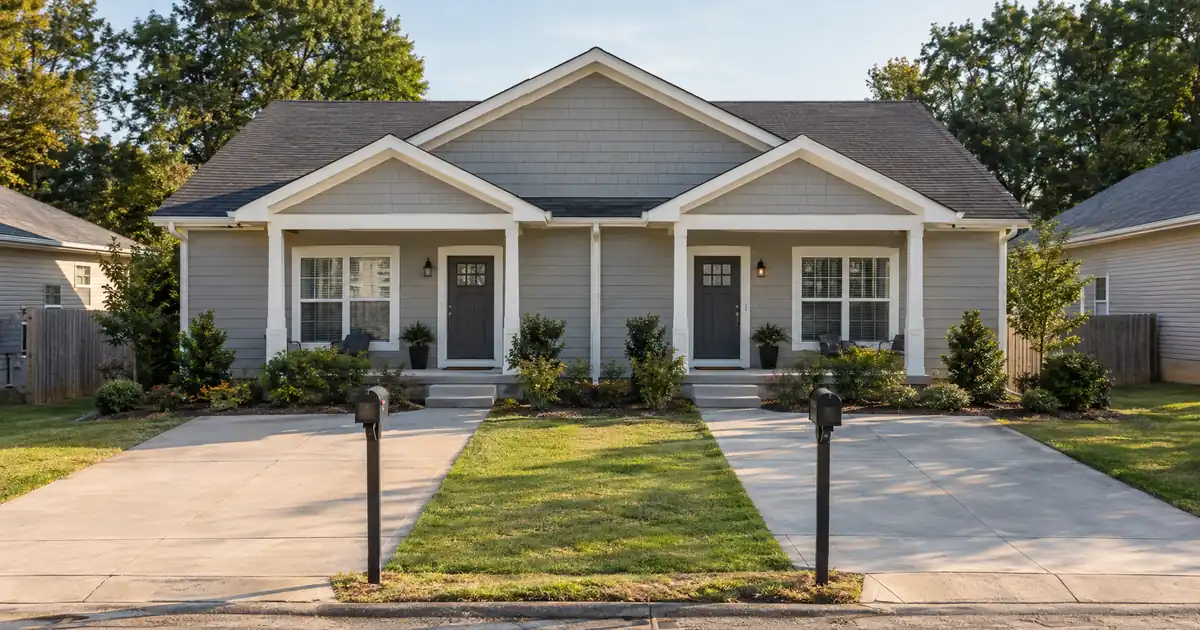
The Quick Read: Mostly yes on eligibility and the pooled math, but no on how each property is reviewed. A single-family house, a 2-4 unit building and a condo can sit under one note and are tested together on one blended coverage ratio, subject to lender guidelines. Each type still brings its own rent evidence, appraisal form and review.
- The pool is tested on one ratio: total rent divided by total PITIA, with 1.00 as the floor on the 30-year portfolio structure.
- Houses, townhomes, 2-4 unit buildings and condos are all eligible collateral on that structure.
- Condos get an extra project review that houses and duplexes do not.
- Duplexes are appraised per unit, so a vacant unit shows up in the file.
- Passing coverage is not the same as positive cash flow.
Let’s be clear about what “alike” means. There are three layers: eligibility, file review, and the pooled test. Treatment is close to identical on the first and third. It splits on the second.
What Is a Portfolio DSCR Loan, Exactly?
A portfolio DSCR loan is one note secured by several rental properties. The terms “blanket loan” and “cross-collateralized loan” name the same thing. It is different from a bank’s “portfolio loan,” which just means a loan the bank keeps on its own books.
The lender looks at the pool, not each property alone. Pooled rent is set against pooled debt service, so stronger properties can offset weaker ones. DSCR loans are designed for non-owner-occupied investment properties, and they are reviewed differently from a standard owner-occupied mortgage because the property’s income does the work. Qualification runs primarily on property-level rental income covering the payment, subject to lender guidelines.
Lendmire is a broker. It arranges these loans through a wholesale network of DSCR lenders across 40 states plus Washington, D.C. (41 markets total). The network’s lenders review eligibility and approve.
Two structures matter here:
- The 30-year portfolio DSCR loan covers 2 to 20 properties under one note, typically $300,000 to $5,000,000, with leverage up to 80% of value on a purchase or rate-and-term refinance. The pool floor is 1.00. It allows fixed or adjustable types and an interest-only period.
- The rental portfolio term loan covers five or more rental properties or units under one loan, typically $500,000 to $50,000,000, with leverage up to 75% of value and fixed terms of 3, 5, 7 or 10 years with a balloon at maturity.
Both accept single-family, 2-4 unit, condo and townhome collateral. Small multifamily (five or more units) is eligible only inside the rental portfolio term loan. Larger balances go on review for either structure. For the full picture of how these loans work, see the complete DSCR loans guide.
Where Do Houses, Duplexes and Condos Get Treated the Same?
All three property types face the same gate and the same pooled math. Each must be non-owner-occupied, and each needs a lease or an appraiser-supported market rent. All three feed one coverage ratio and one leverage test on pooled value.
The shared rules look like this:
- Occupancy. Owner-occupied property is out of the pool, whatever the type. Co-ops, mixed-use property and commercial property are out too.
- Rent support. Every property still needs a lease or an appraiser-supported market rent. No property gets credit on a guess.
- One test. Coverage is measured on the pooled rents and debt service of the whole portfolio. Leverage is tested on pooled value.
- Credit. The portfolio programs set a credit floor of 640, and some structures ask for 680 or 720.
- Entity. Some structures require a special-purpose entity, typically an LLC, subject to program terms.
One more point catches people. Owning everything in one LLC does not make it one loan. A standard DSCR loan is written per property. Only a true blanket structure pools them.
How Does Each Property Type Get Reviewed Differently?
Each type is reviewed on its own terms before the pool is built. The biggest differences are the appraisal form, how rent is evidenced, and whether a project review applies. A mixed pool means different forms inside one file.
| Factor | House / Townhome | Duplex (2-4 unit) | Condo |
|---|---|---|---|
| Rent evidence | Lease or market rent | Per-unit rent | Lease or market rent |
| Appraisal rent form | Form 1007 | Form 1025 | Form 1007 or 1025 by unit count |
| Extra review | Condition, rent comps | Vacant-unit test | HOA questionnaire, project review |
| Payment items | PITIA | PITIA | PITIA including HOA dues |
| Usual sticking point | Rent comps | Vacancy | Project health |
On forms: a single-family house documents monthly rent on Form 1007. A 2-4 unit building uses Form 1025, which, per the Fannie Mae Selling Guide, covers 2-4 unit properties, including those in PUD, condo or co-op projects. The Form 1025 itself reports rent per unit. That contrast is only about form names. These agencies do not govern DSCR files. The network’s lenders set the rules.
A mixed pool of a house, a fourplex and a condo means three rent documents of different shapes. Missing one stalls the file. Not ideal.
What Changes for Condos?
Condos get the most extra scrutiny of any type in the pool. The lender sends a questionnaire to the HOA to check the project, and the answers can shape leverage and terms. HOA dues also sit in the PITIA side of the ratio, which pulls coverage down compared with a house that has no dues.
This is where one property can hold up the whole file. A condo with a project problem, such as pending litigation, a deed restriction or mandatory rental pooling, can hold up or limit the pool. Warrantable and non-warrantable are financing labels, not verdicts on the building. Some issues that block other loan types do not block DSCR, but exact treatment varies by lender.
Concentration is the quiet risk. Several units in one tower raise the share of investor-owned units in that building, which the project review looks at. Investors who plan to stack condos in one building should expect questions.
Condo paperwork also runs on the HOA’s schedule, not yours. An incomplete HOA questionnaire is a common reason a condo lags the rest of the pool. Order it early.
What Changes for Duplexes?
A duplex brings more than one rent stream under one lien, and the appraiser reports each unit separately. That helps the pooled number when both units are leased. It hurts when one is vacant, because the vacant unit is tested too.
Unit count and property count are different things. A fourplex is one property for pool purposes but four doors of rent. The 30-year portfolio structure counts properties, from 2 to 20 under one note. The rental portfolio term loan is written for five or more rental properties or units under one loan, so doors and properties both matter there.
A duplex is still residential. Small multifamily at five or more units is eligible only inside the rental portfolio term loan, not on the 30-year portfolio structure and not on a single-property DSCR loan.
What Does the Pooled Math Look Like?
The pooled ratio is total rent divided by total PITIA, not an average of each property’s own ratio. A weak property can ride inside a strong pool, but underwriting tests the pooled coverage, the leverage and the terms.
Run the numbers this way, as a modeled illustration and not market data. Say a house covers at 1.25x, a duplex at 1.20x, a condo at 1.05x and a vacated townhome at 0.80x. Blended, the four land near 1.13x. That clears the 1.00 floor on the 30-year structure even with one property under water on its own.
Now pull the townhome out. The remaining three blend higher, because the weakest property left the pool. The reverse also holds. Add a condo with heavy HOA dues and thin rent, and the blended number slips. Dues and vacancy move the pool more than most borrowers expect.
Leverage works on the same pooled basis. On a purchase or rate-and-term refinance, the 30-year structure goes up to 80% of value. Cash-out never goes above 75% of pooled value, and it is also capped by the seasoning rule: inside the first six months of ownership, the loan is capped at 90% of total cost (purchase price plus documented improvements), and from six to twelve months it is capped at 100% of total cost. The leverage ceiling still applies, so the loan is the lower of the two. After twelve months the appraised value alone is the basis. A rate-and-term refinance is not subject to the cost-basis cap.
One more caution. DSCR compares rent to PITIA only. A pool that clears 1.00 is not necessarily cash-flowing. Repairs, vacancy, management, utilities and capex sit outside the calculation.
What Is the Catch With Cross-Collateralization?
The tradeoff for pooling is that every property secures the same note. A problem with one can put the whole pool at risk, and selling one property means working through the loan’s release terms.
Partial releases, substitutions and the sale of one property out of the pool follow the loan documents and the lender’s release terms. The release price runs above the property’s allocated balance, and the remaining portfolio must still cover its debt service. A release clause is a contract term, not a right to sell freely.
Compare that to separate DSCR loans. Each property sits on its own lien and must qualify alone. A weak condo cannot hide behind a strong house. But selling one property is cleaner, and a default on one does not touch the rest. Neither structure is better in all cases. It comes down to whether the pooled ratio helps more than the shared lien hurts.
Where Does “Alike” Break Down?
The general rule breaks on ineligible types, condo project problems and structure mismatches. Know these before ordering appraisals.
- Not offered. Owner-occupied property, co-ops, mixed-use and commercial property cannot go in the pool. Manufactured and mobile homes are not reviewable on any of these programs.
- Short-term rentals. Rent evidence is different. Form 1007 documents monthly rent, not nightly income, per McKissock. Short-term rental rules can vary by city, county, HOA, and property type, so investors should confirm local rules before relying on projected rental income.
- Property-level tests. Some lenders test the pool only. Others test the pool and each property. Ask which applies before submitting.
- Notes and liens. A true blanket is one note with liens on every property. A batch of separate notes closed together is a different thing. Ask how many notes and how many liens.
- Reserves. On the rental portfolio term loan, reserves are held for taxes, insurance and capital expenditures.
Where the pool includes a rental under 1.00 coverage, underwriting tests the pooled coverage, the leverage and the terms. Coverage below the pool floor itself is not part of the 30-year structure. A separate select-lender path on single-property loans takes coverage below 1.00 with leverage and terms adjusted. That is a different program, not a lower floor on this one.
Which Structure Fits: Pooled or Separate?
Pooled works when the stronger properties can carry the weaker ones and the investor wants one set of terms. Separate works when each property qualifies alone and flexibility on a future sale matters more.
A few rules of thumb from broker-level file work:
- A strong-rent house paired with a thin-margin condo is a common and workable mix.
- A condo with a project issue can hold up the entire file, so consider leaving it out of the pool.
- If one property is likely to sell soon, separate liens are simpler.
- With five or more rentals, the rental portfolio term loan is built for the size, with balloon terms and prepayment structure to understand first.
Key Terms Defined
Blanket loan: One note secured by liens on several rental properties, also called a portfolio DSCR loan or cross-collateralized loan.
Pooled coverage: Total rent across all properties divided by total PITIA across all properties, measured once.
Cross-collateralization: Every property in the pool secures the same debt, so one problem can affect all.
Release clause: Loan terms that let one property leave the pool, usually at a price above its allocated balance.
Warrantable condo: A condo project that clears the lender’s project review without issues that limit financing.
Pre-Submission Checklist
1. Confirm every property is non-owner-occupied and an eligible type. 2. Gather a lease or support for market rent on each property. 3. Line up the right appraisal form: Form 1007 for houses, Form 1025 for 2-4 unit buildings. 4. Send the condo questionnaire to the HOA early. 5. Confirm all properties sit in one entity before the pool is built. 6. Ask whether the lender tests the pool only or each property too.
Frequently Asked Questions
Can a house, a duplex and a condo go into one portfolio DSCR loan?
Yes. The 30-year portfolio DSCR loan accepts single-family, 2-4 unit, condo and townhome collateral together, with 2 to 20 properties under one note. Each property is still reviewed on its own type-specific evidence, subject to lender guidelines.
Can a weak condo be carried by stronger properties?
Often, because coverage is measured on the pool. Underwriting tests the pooled coverage, the leverage and the terms, and a condo with a project problem can still hold up the file regardless of the pooled number.
Do townhomes count like houses?
Generally they are listed alongside houses as eligible collateral on both portfolio structures. Individual lenders may review the project or association, so confirm treatment for the specific property.
How does a duplex count toward the property minimum?
A duplex or fourplex is typically one property for pool purposes, though its rent is reported per unit. The rental portfolio term loan is written for five or more rental properties or units, so doors can count there.
Do I need one entity for everything?
Properties held in different entities are generally not pooled until they are deeded into one. Some structures require a special-purpose entity, typically an LLC, depending on program guidelines.
Can I live in one unit of a duplex in the pool?
No. Owner-occupied property is ineligible in the pool. A house-hack purchase would run through a different loan type first.
If you are buying or refinancing a rental property and want to see how the numbers work, Lendmire can help you compare DSCR loan options based on the property income, credit profile, leverage, and investor goals. Programs change and every file is underwritten individually. This is not a commitment to lend.
Tax treatment varies; consult a qualified professional before relying on any deduction.
About Lendmire
As a DSCR and non-QM mortgage broker, Lendmire — NMLS# 2371349 — connects investors with wholesale lending channels across 41 markets, including Washington, D.C. The property’s rental income, not the borrower’s tax returns, is central to lender review, which works for self-employed operators and portfolios beyond four financed properties. Scotsman Guide named Lendmire a Top Mortgage Workplace in both 2025 and 2026.
Get Started
Ready to find the right loan for you?
In about 30 seconds you can review financing options available for your investment property. No commitment required.
Informational only. Not a Loan Estimate, approval, or commitment to lend. Program availability and eligibility are subject to lender guidelines, credit approval, property review, and underwriting.
References
1. Fannie Mae Selling Guide B4-1.2-01
3. McKissock: Form 1007 and short-term rental appraisals
This article is part of Lendmire’s DSCR loan program — full qualification details, guidelines, and scenarios live on the program page.
Related reading: Can Several Condos in One Building Go in a DSCR Portfolio Loan? · Can Houses, Condos and a Small Apartment Building Share One DSCR Loan? · Five-Year vs Ten-Year DSCR Portfolio Term Loan at Maturity
Brandon Miller
Founder & CEO, Mortgage Loan Originator, Lendmire LLC
- Mortgage Loan Originator · NMLS# 1129696 · Verify on NMLS Consumer Access
- North Carolina Real Estate Broker · License# 343312 · Verify on NCREC
- North Carolina Insurance Producer · License# 19053198 · Property, Casualty, Life, Health · Verify on NAIC SBS
- Lendmire LLC · Firm NMLS# 2371349 · Verify firm licensure
Disclosures. The information presented in this article is general market commentary, not financial, legal, or tax advice. Lendmire is a mortgage brokerage (NMLS# 2371349) — not a direct lender or depository institution — and loan placement is subject to lender underwriting. Nothing in this content represents a commitment to lend. Loan terms, pricing, and program availability vary based on borrower qualifications, property characteristics, and state of subject property, and are subject to change at any time. Lendmire complies with Equal Housing Opportunity requirements. Consumer access: nmlsconsumeraccess.org.