
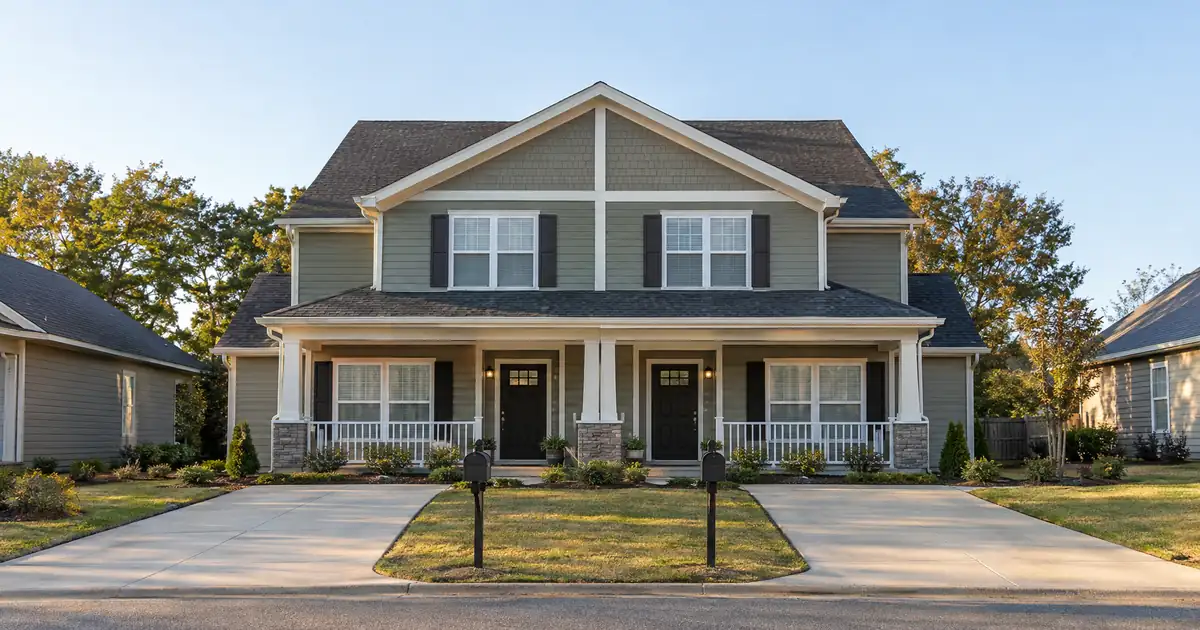
The Quick Read: Each property type needs its own policy form, and a DSCR lender reviews the policy on every property. Houses and duplexes usually carry a landlord policy. Condos pair the owner’s unit policy with the association’s master policy. One carrier can often write all of them, but the insurance structure never decides the loan structure.
- Houses and duplexes typically need a landlord (dwelling-fire) policy, not a homeowners policy.
- A condo needs two layers: the association’s master policy and your own unit policy.
- Loss-of-rents coverage and a flood check belong on the file before you apply.
- Every premium counts in the payment the lender tests your rent against.
- The named insured and the lender clause must match the loan documents exactly.
This guide is about a portfolio of separate rentals: single-family houses, duplexes and condos. It is not about mixed-use buildings, such as apartments above a storefront. Those are commercial risks and sit outside these programs.
DSCR stands for debt service coverage ratio. It is the property’s monthly rent divided by its monthly PITIA. Lenders count insurance as part of that payment, so the policy is both a closing condition and an input to the math. The complete DSCR loans guide covers the loan side in full. This piece covers the insurance side.
Key Terms Defined
Landlord (dwelling-fire) policy: A policy for a rented building the owner does not live in. The most common form is the DP-3.
DP-3: An open-perils form. It covers every cause of loss except the ones it lists as exclusions.
HO-6: The unit owner’s condo policy. It covers the inside of the unit and the owner’s liability.
Master policy: The condo association’s policy on the building structure and common areas.
Loss of rents (fair rental value): Coverage that pays the owner’s lost rent while a covered loss makes the unit unrentable.
PITIA: Principal, interest, taxes, insurance and association dues. It is the full monthly obligation the lender tests rent against.
Named insured: The person or entity listed as the policyholder. It must match the borrower on the loan.
Mortgagee clause: The wording that names the lender on the policy so claim money protects the collateral.
Scheduled policy: One policy that lists each property with its own limit.
Blanket policy: One policy that applies a shared limit across all listed properties.
Portfolio (blanket) DSCR loan: One note secured by several rentals. Portfolio loan, blanket loan and cross-collateralized loan all describe this same thing.
What Does Each Property Type Need?
A house needs a landlord policy on the whole structure. A duplex needs the same policy on the whole building, with two rent streams to protect. A condo needs a unit policy that sits on top of the association’s master policy. The forms differ, and so do the documents a lender asks to see.
| Factor | House | Duplex | Condo |
|---|---|---|---|
| Typical form | DP-3 landlord | DP-3 landlord | HO-6 plus master |
| Insured structure | Whole house | Whole building | Interior per master type |
| Rent protection | Loss of rents | Loss of rents, both units | Loss of rents |
| Lender document | Declarations page | Declarations page | HO-6 plus master certificate |
Carriers describe dwelling-fire policies as written for rented single-family or duplex buildings that are not vacant. Once you reach three and four units, carrier appetite varies. Confirm each carrier’s unit limits before you assume one company will write the whole set.
Here is the trap that catches first-time landlords. An owner-occupant homeowners policy (HO-3) usually does not respond properly after a tenant moves in. Bluefield Group notes that a homeowners policy can deny a claim on a tenant-occupied home. If you converted a former residence to a rental, check the form before you check anything else.
Tenants are a separate matter. A DP-3 protects your building, not your tenant’s belongings. Tenants need their own renters policy, and many landlords require one in the lease.
How Does a DSCR Lender Treat the Policy?
Underwriting treats insurance as a closing condition and as a line in the payment. The lender wants the right form, the right named insured, the lender listed correctly, enough coverage on the structure and an effective date no later than closing. Each property is checked on its own, even when the loan covers several.
Here is the sequence that works across the wholesale network Lendmire uses.
1. Classify each asset. Label every property as house, duplex or condo. That tells you which form to quote.
2. Collect lender requirements. Ask the loan officer for the insurance requirements early and hand them to the agent. Agents write better when they see the lender’s wording up front.
3. Get condo documents. For each condo, request the master policy declarations page and certificate. Ask about recent amendments too.
4. Run a flood determination. Standard property and HO-6 forms exclude flood. A mapped high-risk flood zone calls for a separate flood policy.
5. Match the paperwork. The named insured must be the borrower, exactly. An LLC borrower with an individually named policy is a common cause of a stalled file. Entity borrowing is subject to lender program eligibility.
6. Add loss of rents. Without it, a covered loss can leave you paying the loan with no rent coming in.
7. Put the premium in the payment. Underwriters count insurance whether or not it is escrowed. Get a binding quote before you settle the structure.
8. Bind and deliver proof. Send declarations pages with the correct clauses before closing, not after.
Most files stall on small mismatches rather than on the big coverage questions. Typical culprits are an entity name that differs by one word, a lender clause with the wrong address, or a gap between the old policy’s end date and the new one’s start date. Ten minutes with the agent usually prevents all three.
The Condo Two-Layer Rule
The association insures the building. You insure what the association leaves to you. How much is left depends on the master policy type, and the labels are not consistent from one association to the next.
| Master type | What it covers | What your HO-6 must cover |
|---|---|---|
| Bare walls | Shell and common areas | Full interior, fixtures, appliances |
| Single entity | Original fixtures | Upgrades and improvements |
| All-in | Fixtures, appliances, improvements | Mostly improvements, plus gaps |
Policygenius explains how the master type shifts what the unit owner must carry. Read the master policy itself rather than trusting the label. Terms vary by association, insurer and state.
An all-in master does not remove the need for your own policy. Deductibles still apply, and a board can change the master at renewal. Loss-assessment coverage matters too, because an association can pass a large loss on to owners. Your HO-6 is where that protection lives.
Condo dues also sit inside PITIA. A condo with heavy dues and a modest premium can test differently than a house with the opposite mix, even at similar rent.
Scheduled, Blanket or Separate Policies?
You can insure a mixed set three ways. The right choice depends on how much control you want over each property’s limit.
| Structure | Limit control | Underinsurance risk | Lender comfort |
|---|---|---|---|
| Separate policies | Per property | Low | Simple to document |
| Scheduled policy | Per property | Low | Clear per-property limits |
| Blanket policy | One shared limit | Higher | Needs per-property proof |
A scheduled policy keeps each property’s limit visible, which helps when a lender wants to see adequate coverage on its collateral. A blanket policy is simpler to renew. The shared limit can fall short if a loss hits one building hard. Multi-property policies also may not fit buildings with very different risk levels, so mixed portfolios are exactly where a blanket limit deserves a second look.
Bundling can lower cost or simply simplify billing. Treat any discount as unconfirmed until you hold a quote.
The key point is that the insurance structure is separate from the loan structure. A blanket insurance policy does not create a blanket loan. Only a true portfolio DSCR loan puts several rentals under one note. Loans closed together on separate properties still carry separate notes.
For context, the 30-year portfolio DSCR loan covers 2 to 20 properties under one note, including single-family homes, 2-4 unit buildings, condos and townhomes. Its 1.00 coverage floor is measured on the pool, subject to lender guidelines. Either way, each property still needs its own proof of coverage.
How Premiums Move the Ratio
A higher premium lowers coverage dollar for dollar. Insurance is part of PITIA, so a coastal house with a heavy wind premium or a condo with a flood add-on can drop a property below the ratio a program wants. The lender may then lower the leverage or adjust terms.
Run the numbers this way. These are modeled assumptions, not market figures. Say a house clears about 1.15x on its first quote. A flood requirement appears after the determination, and the new premium pulls coverage toward 1.05x. The rent did not change. The file did. Quote early, so the final number is the one underwriting tests.
On a pooled loan, coverage is measured across the whole pool. A condo sitting near 0.95x can ride alongside a house at 1.25x and a duplex at 1.10x. When a rental below 1.00 sits in the pool, underwriting tests the pooled coverage, the leverage and the terms. That works the other direction too. One property’s insurance spike lowers the pool’s number, not just its own.
Coverage below 1.00 is also a path on single-property loans. It is available through select lenders in the network, with leverage and terms adjusted. 1.00 is where many select programs start. A stronger ratio opens better pricing and leverage.
Clearing 1.00 does not mean the property cash flows. DSCR compares rent to PITIA only. Repairs, vacancy, management, utilities and capital costs sit outside the calculation.
Deductibles are a cash risk outside the ratio. Wind, flood and condo-assessment deductibles should be built into your reserves. Reserves commonly run around 6 months of PITIA on investment-property files and step up for larger loans, subject to lender guidelines.
Tax treatment varies; consult a qualified professional before relying on any deduction for premiums.
Where the General Rule Breaks
The rules above cover most mixed portfolios. These cases need extra attention.
Condo flood coverage. Associations can buy a Residential Condominium Building Association Policy (RCBAP), the federal master flood policy for residential condo buildings. FEMA’s brochure for condominium associations describes it as available to associations. The federal bank regulators’ RCBAP help page says a building needs at least 75% residential floor area to be eligible. It also sets maximum building coverage at the lesser of full replacement cost or $250,000 times the number of units.
The maximum is not the payout. What the association actually bought, the valuation and the coinsurance terms control a claim. Ask for the declarations page rather than assuming the maximum applies. An RCBAP also does not cover a unit owner’s contents or lost rent. A ground-floor condo owner should ask whether a separate unit flood policy makes sense.
Short-term rentals. Standard landlord forms are written for long-term occupancy. A hosted rental needs a policy built for hosting. Short-term rental rules can vary by city, county, HOA, and property type, so investors should confirm local rules before relying on projected rental income. STR files also carry their own program terms. Purchase leverage tops out at 75% LTV on an investment property, with about 12 months of hosting history expected. Terms vary by lender guidelines, property type, leverage, credit profile, and full file review.
Umbrella liability. An umbrella can sit over several landlord policies. CoverageCat notes that each property must be listed as a covered location, and business-activity exclusions may apply to larger portfolios. Confirm every house, duplex and condo is on the schedule.
A fire on one house in a pool. On a true portfolio note, one idle house lowers pooled rent while debt service continues. Loss-of-rents coverage bridges that gap. Partial releases and sales out of the pool follow the loan documents, and the remaining pool must still cover its debt service.
Property types that are not offered. Manufactured homes, log homes and barndominiums are not offered in these DSCR programs.
Which Structure Fits You?
Pick the insurance setup by how different your properties are, not by what is easiest to renew.
| Your situation | Likely fit |
|---|---|
| Similar houses, one state | Scheduled or blanket |
| House, duplex and condo mix | Separate or scheduled |
| Several condos, different HOAs | Separate HO-6 each |
| Hosted short-term rentals | Hosting-specific policy |
| Growing portfolio, one carrier | Scheduled plus umbrella |
For a true mix, separate or scheduled policies are the safer default. They keep each limit visible and give the lender a clean document for each property. A blanket policy makes sense mainly when the properties carry similar risk and value.
Consider an investor with two houses, a duplex and a condo. The houses and duplex go on a scheduled landlord policy. The condo gets its own HO-6 after the master policy is reviewed. An umbrella then sits over all four. Each document maps to one property, and the lender sees the same on every file.
Whether to close those four as separate loans or one note is a financing decision.
Frequently Asked Questions
Can one policy cover my houses, duplexes and condos?
Often yes for houses and duplexes, through a scheduled or blanket landlord policy. Condos usually need their own HO-6 because the master policy sits with the association. A carrier may write everything, but each property still needs its own proof of coverage for the lender.
Does the lender need to be named on every policy?
Yes, the lender must be listed through the mortgagee clause on each property it holds as collateral. On separate loans, each lender is named on its own property. On a portfolio note, the lender appears on every property in the pool.
Will a high premium stop me from qualifying?
It can lower the coverage number, and a lower number can reduce leverage or change terms. It does not end the file by itself. Many select programs start at 1.00, and a separate select-lender path accepts coverage below 1.00 with leverage and terms adjusted. Eligibility depends on lender guidelines, credit and property review.
Does the policy need to match my LLC?
Yes. The named insured must match the borrower on the loan exactly, whether that is you or an entity, subject to lender program eligibility. A mismatch is a common reason files stall. Check the entity name on the policy against the loan documents before you bind.
Does an insurance claim on one property hurt the others?
Under separate policies, a claim on one property does not touch the others’ coverage. Under a blanket policy, one shared limit means a large loss can reduce what remains. On a portfolio loan, an idle property lowers pooled rent, so loss-of-rents coverage matters.
Next Step
If you are buying or refinancing a rental property and want to see how the numbers work, Lendmire can help you compare DSCR loan options based on the property income, credit profile, leverage, and investor goals. As a broker, Lendmire arranges DSCR investor loans through select lenders across 41 markets, including Washington, D.C. Programs change, every file is underwritten individually. This is not a commitment to lend.
About Lendmire
Lendmire — NMLS# 2371349 — is a mortgage brokerage specializing in DSCR investor loans, helping arrange financing across 41 markets, including Washington, D.C., through wholesale and investor-lending channels. The model centers on property-level rental income reviewed by the lender rather than W-2 documentation, subject to lender guidelines, suiting entity-owned and multi-property investors. Lendmire holds Scotsman Guide Top Mortgage Workplace recognition for 2025 and 2026.
Get Started
Ready to find the right loan for you?
In about 30 seconds you can review financing options available for your investment property. No commitment required.
Informational only. Not a Loan Estimate, approval, or commitment to lend. Program availability and eligibility are subject to lender guidelines, credit approval, property review, and underwriting.
References
1. Bluefield Group: What landlords should know about DP-3 policies
2. Policygenius: HO-6 condo insurance
3. FEMA NFIP Flood Insurance for Condominium Associations brochure
4. HelpWithMyBank.gov: Residential Condominium Building Association Policy
5. CoverageCat: Should landlords use a personal umbrella
This article is part of Lendmire’s DSCR loan program — full qualification details, guidelines, and scenarios live on the program page.
Related reading: How a DSCR Portfolio Loan Counts HOA Dues on Condos · Can an Investor With 10+ Doors in LLCs Get a DSCR Portfolio Loan? · Can Houses, Condos and a Small Apartment Building Share One DSCR Loan?
Brandon Miller
Founder & CEO, Mortgage Loan Originator, Lendmire LLC
- Mortgage Loan Originator · NMLS# 1129696 · Verify on NMLS Consumer Access
- North Carolina Real Estate Broker · License# 343312 · Verify on NCREC
- North Carolina Insurance Producer · License# 19053198 · Property, Casualty, Life, Health · Verify on NAIC SBS
- Lendmire LLC · Firm NMLS# 2371349 · Verify firm licensure
Compliance and disclosures. Lendmire (NMLS# 2371349) is a licensed mortgage broker and is not a direct lender, depository institution, financial advisor, or tax professional. Content in this article is general market analysis and educational information — not financial, legal, or tax advice for any specific situation. Lendmire does not guarantee loan approval; every transaction is subject to underwriting by the funding lender. Mortgage pricing and loan program guidelines are subject to change at any time without notice and vary by borrower characteristics, property type, and state regulations. Lendmire complies with Equal Housing Opportunity. Licensure verification: NMLS Consumer Access.