
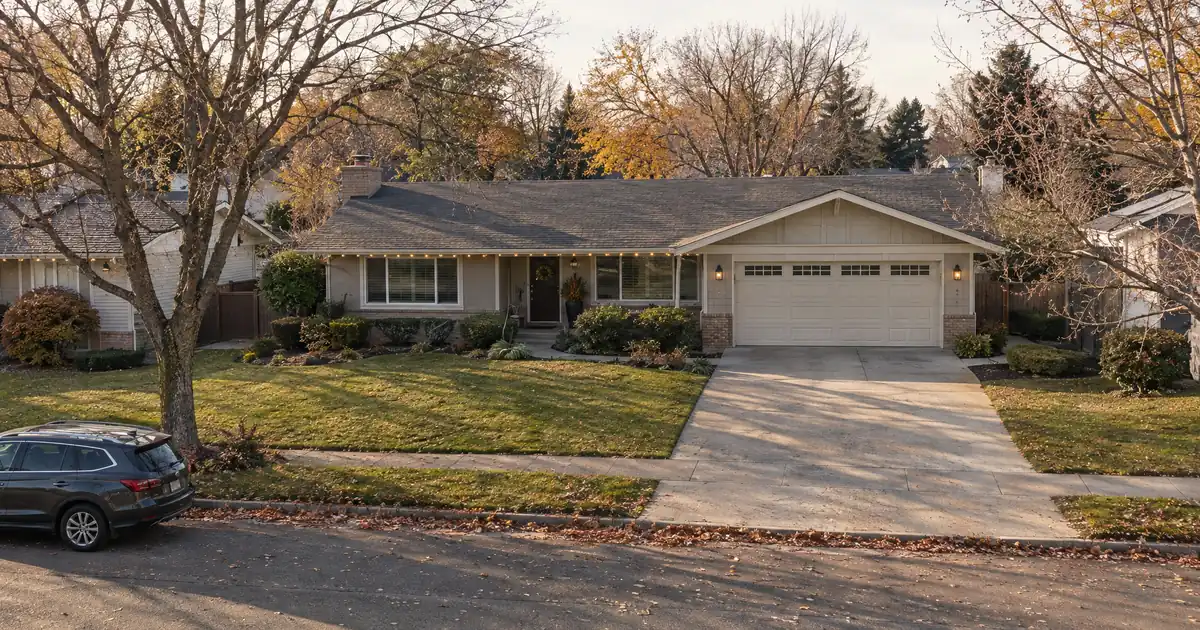
The Quick Read: A portfolio DSCR lender sizes the loan on the rent an appraiser supports for each house, then checks how the whole set behaves as one pool. Several houses near one campus share a single demand driver, so concentration matters as much as any one property’s coverage.
- Each house gets its own appraisal and its own market-rent opinion for the whole house.
- Room-by-room student income is treated as upside, not as the number that sizes the loan.
- Coverage on the pool is total rent divided by total PITIA, so strong houses can offset a weak one.
- Every house secures the whole loan, so one problem can touch all of them.
- Enrollment, new campus housing, and local rule changes hit every house at once.
Owning several rentals around one university feels like a diversified portfolio. To a lender it looks closer to one bet placed several times. This article walks through how the bet gets measured, the structures that exist, and where the usual rules break down. For the broader product picture, Lendmire’s complete DSCR loans guide covers the basics.
What Does a Lender Actually See in a College-Town Set?
A lender sees two layers. The first is the individual house: its appraised value, its supportable rent, and its payment. The second is the pool: combined rent against combined payments, plus the shared risks that follow from owning everything in one place.
Property-level questions are familiar. Is the appraised rent enough to cover the payment? Is the house an eligible type? Does the borrower meet the credit and reserve expectations?
Town-level questions are different. What happens to all these houses if enrollment dips? What if a large new student building opens near the walkable core? What if a local rental rule changes? These risks do not strike one house. They move together.
| Question type | Example | Hits one house or all? |
|---|---|---|
| Property-level | Roof failure, a long vacancy | One house |
| Property-level | Appraised rent comes in low | One house |
| Town-level | Enrollment decline | All houses |
| Town-level | New purpose-built student beds | Mostly all |
| Town-level | A local rental ordinance change | All houses |
Lenders cannot fix the town-level risk with paperwork. They respond through leverage, reserves, and how they read the borrower’s overall exposure.
Is the House Student Housing or an Ordinary Rental?
The label depends on lease structure more than on who lives there. A house leased on one joint lease for twelve months reads as an ordinary rental, even if the tenants are students. A house leased room by room, on academic-year terms, reads as student housing, and many programs add caution or restrict it.
A practical test has three parts:
1. Lease structure. One lease signed by all occupants, or separate leases per room?
2. Lease term. Twelve months, or an academic year with summer gaps?
3. Marketing and rent basis. Is the house advertised and priced by the bedroom, or as a whole home?
The more your answers lean toward whole-house, twelve-month, joint-lease, the more the file looks like a standard rental. The more they lean toward per-room, academic-year, per-bed pricing, the more a lender may restrict or adjust it. Treatment varies across the wholesale network, and some lenders will not touch the second pattern at all.
How Is Rent Counted Across Several Houses?
The rent used for lender review is the appraiser’s whole-house market rent, not the sum of what you collect room by room. The appraiser completes a rent schedule as part of the appraisal. For one-unit homes the form is the single-family comparable rent schedule, Form 1007, which the appraiser prepares as an attachment to the appraisal of a single-family investment property. For two-to-four-unit properties the matching appraisal form is Form 1025.
These are agency form names, used here only because they describe the rent document. DSCR loans are not agency products, and agency selling rules do not govern them. The form simply captures the appraiser’s opinion of what the house as a whole would rent for, based on comparable rentals. The schedule documents estimated monthly market rent for a single-family investment property.
Here is the practical consequence. Say you rent four bedrooms individually and the per-room total looks strong. The appraiser compares your house to other whole-house rentals. If that number is lower, the lower number sizes the loan. Room-level income may help you later, but it is a cushion, not the basis.
Coverage itself is straightforward on one-to-four-unit loans: qualifying monthly rent divided by the full monthly housing obligation of principal, interest, taxes, insurance, and any HOA dues. Commercial finance uses a different version, net operating income over debt service. Do not mix the two when you model a house.
How Does the Pooled Loan Work?
A portfolio DSCR loan, also called a blanket or cross-collateralized loan, is one note secured by several rentals. (A bank’s own “portfolio loan,” meaning a loan the bank keeps on its books, is a different use of the same word.)
Two structures exist in Lendmire’s wholesale network. The 30-year portfolio DSCR loan covers 2 to 20 properties under one note, with sizes from $300,000 to $5,000,000 and leverage up to 80% of value on a purchase or rate-and-term refinance. Coverage is measured on the pool, with a 1.00 floor, so pooled rent against pooled payments is what counts. Eligible types are single-family, two-to-four-unit, condo, and townhome. Interest-only periods are available. Terms depend on the lender’s guidelines, the property type, the leverage, and a full review of the credit profile.
The rental portfolio term loan fits five or more rental properties or units under one loan, sized from $500,000 to $50,000,000, with leverage up to 75% of value. Terms are fixed at 3, 5, 7, or 10 years with a balloon at maturity. Non-recourse versions exist, with carve-outs for things like fraud and bankruptcy. Small multifamily of five or more units is eligible only on this term structure. All figures are ceilings or floors, subject to lender guidelines, never quotes.
Qualifying the pool typically starts with a credit floor around 640, and 680 or 720 on some structures. Some structures require a special-purpose entity, usually an LLC, subject to program terms. Owner-occupied property, co-ops, mixed-use, and commercial property are ineligible in the pool. Manufactured and mobile homes are not reviewable on any of these programs.
Each house still needs its own appraisal and a lease or appraiser-supported market rent. Pooling does not skip valuation. It blends the individual results.
What Changes When All the Houses Share One Campus?
The correlation changes. In a scattered portfolio, a vacancy in one market has nothing to do with a repair in another. In one college town, the main drivers are shared: the university’s enrollment, its academic calendar, the supply of newer purpose-built beds, and local rental rules.
Lenders have no published concentration formula that borrowers can look up, so the treatment shows up in practice as caution on leverage, reserves, and which structure fits. It also shows up in how hard the borrower’s exposure gets read. Whatever the exact overlay, the underlying logic is simple: five houses in a town with one dominant employer-like institution behave more like one asset than five.
| Risk | Hits all houses? | Signal to watch |
|---|---|---|
| Enrollment decline | Yes | Direction of admissions and housing demand |
| New student bed supply | Mostly | Permits and construction near the core |
| Rule changes on rentals | Yes | Local council agendas |
| Seasonal vacancy | Mostly | Summer lease-up history |
| Repairs, turnover | No | Per-house condition |
How to Read the Campus Like a Lender
A short checklist works better than a gut feeling:
- Enrollment direction. Rising, flat, or falling over several years.
- Bed supply pipeline. Are new student buildings opening near your houses?
- Student mix. Undergraduate, graduate, and other tenant groups behave differently.
- Comp depth. Many nearby whole-house rentals make the appraiser’s job easier and the rent opinion firmer.
- Non-student demand. Staff, hospital workers, and local employers keep a house rented when students thin out.
That last item matters most for resilience. A house that appeals to a non-student tenant at a similar rent has a second exit from a bad semester. This is demand described by employment and lease length, not by who the tenants are.
Core versus periphery also matters. Houses in a tight walkable cluster share the same fortunes. Houses spread across the town’s edges diversify somewhat, though less than owners tend to hope.
Separate Notes or One Pooled Loan?
It is a real tradeoff, and the right answer depends on the investor.
A pooled loan helps when one house sits below 1.00 on its own but the set clears the floor together. The stronger properties offset the weaker one. A rental below 1.00 can sit in the pool, with underwriting testing the pooled coverage, the leverage, and the terms. It also simplifies management of one note instead of several.
Separate loans win when you want each lien standing alone. With cross-collateralization, every house secures the whole loan, so trouble at one can affect the standing of all. Selling one house later depends on the release terms in the note. The release price runs above the property’s allocated balance, and the remaining pool must still cover its debt service.
If you plan to sell houses individually in a few years, separate notes usually preserve more flexibility. If you plan to hold the set and want the pooled coverage to carry a thin house, the blanket structure earns its complexity.
Where the Rules Break
Short-term rentals near campus. Game-weekend and graduation demand is real, but income varies, and lenders document it differently. Short-term rental programs typically allow purchase leverage up to 75% and cash-out up to 70% on short-term rental collateral, with a 640+ score and about 12 months of hosting history expected. Short-term rental rules can vary by city, county, HOA, and property type, so investors should confirm local rules before relying on projected rental income.
Cash-out on a pool. Cash-out is capped at 75% of pooled value on standard rental collateral. Inside the first six months of ownership the loan is also capped at 90% of total cost (purchase price plus documented improvements), and at 100% of total cost from six to twelve months. The loan is the lower of that cap and the leverage ceiling. After twelve months, appraised value alone is the basis. A rate-and-term refinance is not subject to the cost-basis cap.
Coverage below 1.00. On a single-property loan, coverage below 1.00 is available through select lenders in the network, with leverage and terms adjusted. That is a separate path from the pooled 1.00 floor, which does not move.
Clearing 1.00 is not cash flow. Coverage compares rent to PITIA only. Utilities, turnover, furnishing, repairs, vacancy, management, and capital expenses sit outside it. Student-heavy houses usually carry more of those costs, so a thin ratio leaves little room.
A Three-House Illustration
Picture an investor with three whole-house rentals within a mile of one campus. Assume House A clears the payment with a comfortable margin, around 1.3x. House B lands near 1.1x. House C comes in below 1.0x because its appraised rent was lower than expected. Those are modeled assumptions, not market data.
Pooled together, the set may land comfortably above 1.00, because A and B offset C. That is the pooled-coverage advantage.
Now stress it. Suppose enrollment softens and new beds open nearby, and appraised or achievable rent drops across the board. Every house slips together. House A might fall toward 1.15x, B toward 1.0x, and C further below. The pool can slip below its floor even though each house is the same physical asset. This is the point of the exercise: the stress hits all three at once, and the pooled cushion shrinks exactly when you need it.
The useful habit is to run the stress before adding the next house, not after. Test the pool at lower rent and at partial occupancy, and see what remains.
Key Terms Defined
Portfolio DSCR loan: One note secured by several rental properties, also called a blanket or cross-collateralized loan.
Pooled coverage: Total rent used for lender review across the pool divided by total PITIA across the pool.
PITIA: Principal, interest, taxes, insurance, and any HOA dues, the full monthly housing obligation.
Market rent: The appraiser’s opinion of what the whole house would rent for, based on comparable rentals.
Cross-collateralization: Every property in the pool secures the whole loan.
Release terms: The loan-document rules for selling or substituting one property out of the pool.
When to Diversify
If every house sits in one walkable cluster and leans on one tenant group, adding a different town, a different tenant segment, or a different lease structure usually lowers shared risk more than adding another nearby house. The flip point is skill and local knowledge. An investor who knows one town deeply may do better there than in an unfamiliar market. Concentration is a deliberate choice only when the reserves and the stress test back it up.
Lendmire arranges these loans through select lenders in its wholesale network, a 41-market footprint that includes Washington, D.C. Eligibility, leverage, and terms depend on lender guidelines, credit approval, and property review, and nothing here is a commitment to lend.
Frequently Asked Questions
Can I finance several student rentals in the same town?
Yes, subject to lender guidelines. Each house needs its own appraisal and rent support, and the pool is tested on combined rent against combined payments. Houses leased room by room on academic-year terms face more restrictions than whole-house, twelve-month rentals.
Does it matter that all my houses are near one campus?
It matters mostly for risk, not eligibility. Enrollment, new bed supply, and local rules hit every house together, so lenders and investors should treat the set as correlated. Expect that to show up in leverage and reserve expectations.
Can I use by-the-room income to qualify?
Usually not as the basis. The appraiser’s whole-house market rent sizes the loan, and room-level income is treated as upside. Some programs restrict separate room leases altogether.
Should I use one pooled note or separate loans?
It depends on your plan. A pooled note lets strong houses offset a weak one, while separate loans keep each lien standing alone. Cross-collateralization means one problem can affect all houses, and selling one later follows the release terms.
Does clearing 1.00 mean the houses cash-flow?
No. Coverage compares rent to PITIA only, and repairs, vacancy, management, utilities, and capital expenses sit outside it. Student-heavy rentals tend to carry more of those costs.
If you are buying or refinancing a rental property and want to see how the numbers work, Lendmire can help you compare DSCR loan options based on the property income, credit profile, leverage, and investor goals. Tax treatment varies; consult a qualified professional.
About Lendmire
Lendmire, NMLS# 2371349, is a mortgage brokerage focused on investor financing, arranging DSCR loans in 40 states plus Washington, D.C. — 41 markets total. Qualification is based on the property’s income rather than personal income documentation, subject to lender guidelines, making it a fit for LLC-held rentals and scaling portfolios. Scotsman Guide named Lendmire a Top Mortgage Workplace in both 2025 and 2026.
Get Started
Ready to find the right loan for you?
In about 30 seconds you can review financing options available for your investment property. No commitment required.
Informational only. Not a Loan Estimate, approval, or commitment to lend. Program availability and eligibility are subject to lender guidelines, credit approval, property review, and underwriting.
References
1. Freddie Mac Form 1000 / Fannie Mae Form 1007 instructions
2. Form 1025
This article is part of Lendmire’s DSCR loan program — full qualification details, guidelines, and scenarios live on the program page.
Related reading: How a Portfolio DSCR Lender Counts a Fourplex and a Duplex · How a Portfolio DSCR Lender Reads a Blanket Bridge Loan · Does a Portfolio DSCR Loan Save Money Over One Loan per Rental?
Brandon Miller
Founder & CEO, Mortgage Loan Originator, Lendmire LLC
- Mortgage Loan Originator · NMLS# 1129696 · Verify on NMLS Consumer Access
- North Carolina Real Estate Broker · License# 343312 · Verify on NCREC
- North Carolina Insurance Producer · License# 19053198 · Property, Casualty, Life, Health · Verify on NAIC SBS
- Lendmire LLC · Firm NMLS# 2371349 · Verify firm licensure
Disclosures. The information presented in this article is general market commentary, not financial, legal, or tax advice. Lendmire is a mortgage brokerage (NMLS# 2371349) — not a direct lender or depository institution — and loan placement is subject to lender underwriting. Nothing in this content represents a commitment to lend. Loan terms, pricing, and program availability vary based on borrower qualifications, property characteristics, and state of subject property, and are subject to change at any time. Lendmire complies with Equal Housing Opportunity requirements. Consumer access: nmlsconsumeraccess.org.