
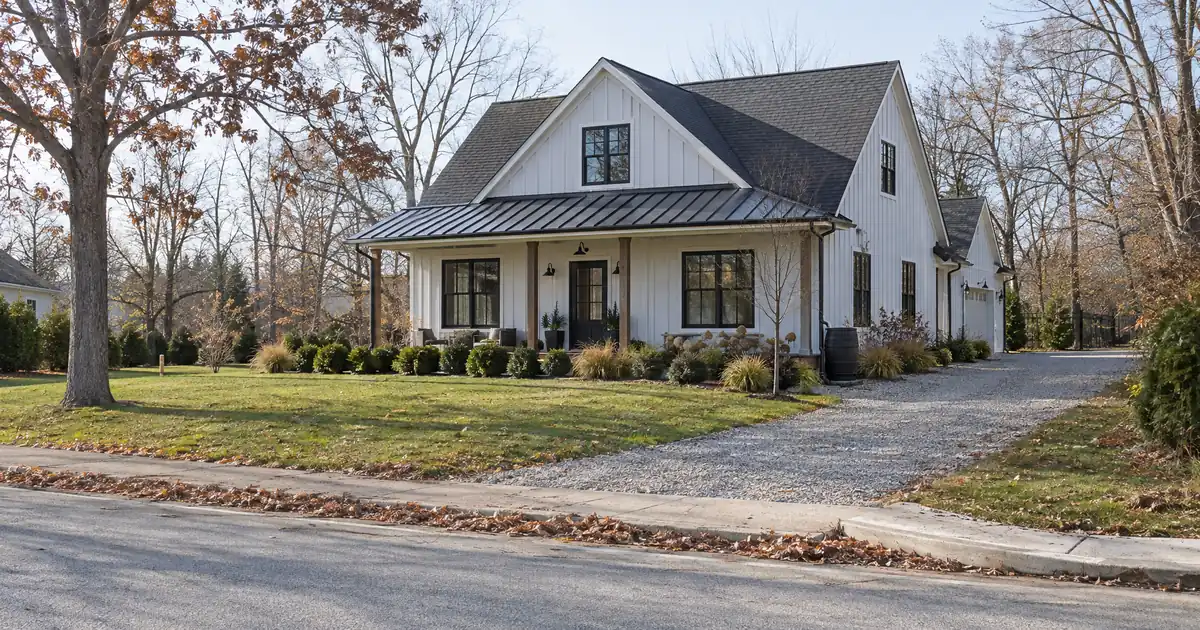
The Quick Read: Usually, yes. Nothing in a portfolio DSCR loan requires the rentals to sit in different areas, so a group of homes in one subdivision can be pooled under one note. Lenders do treat tight clustering as a concentration factor, and the pool is tested on combined rent against combined debt service, subject to lender guidelines and property review.
- The 30-year portfolio DSCR loan covers 2 to 20 properties under one note, typically with a pooled coverage floor of 1.00.
- One subdivision can make rents and values easy to document, but one local shock hits every home at once.
- HOA dues count in the debt service, and rental restrictions are a property-level eligibility question.
- Two or three homes often gain little from pooling. Separate loans may fit better.
- Clearing 1.00 on the pool is not the same as positive cash flow.
What Is a Portfolio DSCR Loan?
A portfolio DSCR loan is one note secured by several rentals, with a lien recorded against each property. Brokers also call it a blanket loan or a cross-collateralized loan. These are the same thing. Nav explains that a blanket lien lets multiple properties secure a single loan, and that one default can trigger default on the related obligations.
Don’t confuse it with a bank’s “portfolio loan.” That phrase can simply mean a bank keeps the loan on its own books. It is a different use of the word, and it says nothing about how many properties secure the note.
Our wholesale network offers two structures. They differ a lot, so here they are side by side.
| Factor | 30-year portfolio DSCR loan | Rental portfolio term loan |
|---|---|---|
| Property count | 2 to 20 under one note | 5 or more properties or units |
| Loan size | Typically $300,000 to $5,000,000 | Typically $500,000 to $50,000,000 |
| Leverage | Up to 80% on purchase and rate-and-term | Up to 75% of value |
| Term | 30-year, fixed or adjustable | Fixed 3, 5, 7 or 10 years with a balloon |
| Property types | SFR, 2-4 unit, condo, townhome | Adds small multifamily (5+ units) |
Larger balances go on review in both. Everything above is a program ceiling or floor, not a quote, and it is subject to lender guidelines. For the single-property basics, see our complete DSCR loans guide.
How Do Lenders Treat Rentals in One Subdivision?
They treat them like any other pool, then look harder at concentration. Coverage is measured on pooled rent divided by pooled PITIA (principal, interest, taxes, insurance, and association dues). Stronger homes can offset weaker ones, so the test runs on the whole pool, not each house.
Each property still needs a lease or an appraiser-supported market rent. Appraisals are usually done property by property. For a one-unit rental, the rent opinion typically rides on the Single-Family Comparable Rent Schedule, Form 1007. A 2-4 unit property uses the Small Residential Income Property Appraisal Report, Form 1025. DSCR loans are not agency loans. Those forms are just the common appraisal tools.
On the pool, credit and entity rules matter too. The portfolio programs generally look for a credit floor around 640, and some structures want 680 or 720. Some require a special-purpose entity, typically an LLC, depending on program guidelines. Recourse loans carry a personal guarantee. Non-recourse structures exist on the term loan, with carve-outs for things like fraud and bankruptcy.
Published guidelines don’t speak directly to single-subdivision pools, so how one is treated comes down to how each lender underwrites the file. Expect the approach to vary by program and by lender.
Where a One-Subdivision Pool Helps
A uniform pool is easy to underwrite. Similar floor plans mean similar rents, and the appraiser works from the same neighborhood comparables. Lease terms and rent levels are simple to document.
Management gets easier too. One neighborhood means one set of vendors and one HOA to learn. If the association maintains exteriors, that can steady your operating costs, though those costs sit outside the DSCR math.
There is a decent case for pooling a cluster of five to ten similar homes. You get one closing, one servicer, and one payment. A weak month on one home gets absorbed by the others in the pooled test.
Where It Gets Harder
Correlated risk is the problem. A single rent drop, a soft sale market, or an HOA special assessment lands on every property at the same moment. A pool across several neighborhoods dilutes that. A pool in one subdivision does not.
The shared comps cut both ways. If an appraiser leans on the same few sales for every home, one weak comparable can pull down values across the pool. That is our inference from how appraisals work, not a published rule.
HOA dues belong in the debt service, so they lower pooled coverage directly. Rental caps or leasing restrictions in an association are a property-level eligibility question. Check the governing documents before you build a pool around a community.
Property type matters as well. Single-family homes, townhomes, condos, and 2-4 unit buildings fit the pool. Owner-occupied homes, co-ops, mixed-use, and commercial property are ineligible. Manufactured and mobile homes are not reviewable on any of these programs.
Here is where each risk shows up and what to check.
| Risk | Why it matters | What to check |
|---|---|---|
| Local rent drop | Hits every home together | Lease expirations and rent rolls |
| HOA special assessment | Adds cost across the pool | Association reserves and budget |
| Rental caps | Can disqualify a home | Governing documents |
| Shared comps | Values move together | Recent sales in the neighborhood |
| Uniform product | Same repair cycle at once | Age and condition of homes |
A Worked Example: Pool vs. Single Test
Run the numbers this way, using modeled assumptions only. Picture an investor holding six near-identical townhomes, each covering its own PITIA at roughly 1.10x. Pooled coverage lands near 1.10x too. That clears a 1.00 floor with some cushion.
Now say one townhome sits vacant. Pooled rent falls by one home’s share, but the other five keep covering. Pooled coverage drops to roughly 0.92x if the vacant home’s rent disappears entirely, since 1.10 times five-sixths is about 0.92. That would fail a 1.00 floor on a strict pooled test. Margins like 1.10x leave little room.
Compare a pool covering at roughly 1.30x. One vacancy takes it to about 1.08x. It still clears. The takeaway is simple: in a uniform subdivision, vacancies and rent cuts tend to arrive together, so build in more cushion than you would for a scattered pool.
A rental that sits below 1.00 on its own can still be in the pool. Underwriting tests the pooled coverage, the leverage and the terms. Two different things are happening there, so don’t read a weak house as a separate low-coverage program.
Pool or Separate Loans?
Here is how the two paths compare for a subdivision cluster.
| Factor | One pooled loan | Separate DSCR loans |
|---|---|---|
| Collateral | Every home secures the whole balance | Each lien stands alone |
| Selling one home | Follows the release terms | Sell it, pay it off |
| Shared risk | High, cross-default | Contained to each loan |
| Paperwork | One closing | Several closings |
| Weak home | Offset by stronger ones | Must qualify alone |
Small groups rarely justify a pool. With two or three homes, the cross-collateral exposure often outweighs the convenience. A pool earns its keep as the count climbs and the homes are seasoned and held for the long term.
Separate loans keep each lien independent. A DSCR loan on one rental is a different product with its own figures.
What Happens When You Sell or Refinance One Home?
Release terms come from the loan documents, not from a general rule. Partial releases, substitutions, and sales out of the pool follow the lender’s release terms. The release price runs above the property’s allocated balance, and the remaining pool must still cover its debt service.
Without a release clause, a blanket loan typically carries a due-on-sale provision. Read the note and each security instrument before you sign.
Interest-only periods are available on the 30-year structure. The whole pool converts on one date. Flat rents can then fail the pooled test, so plan for that date.
Cash-out on a pool never goes above 75% of the pooled value. Inside the first six months the loan is also capped at 90% of total cost (purchase price plus documented improvements), 100% of total cost from six to twelve months, and the leverage ceiling still applies, so the loan is the lower of the two. After twelve months the appraised value alone is the basis. A rate-and-term refinance is not subject to the cost-basis cap.
Key Terms Defined
Blanket loan: One loan secured by several properties, with a lien on each.
Cross-collateralization: Every property backs the whole balance, not just its own share.
Pooled DSCR: Total rent used for lender review divided by total PITIA across all the properties.
Release clause: A loan term that lets you sell one property by paying a set amount.
PITIA: Principal, interest, taxes, insurance, and association dues.
Allocated balance: The share of the loan assigned to one property for release purposes.
What to Gather Before You Apply
- A lease or market rent support for every home.
- The entity documents, if the structure requires an LLC.
- HOA budgets, dues, and rental rules for the community.
- A property list with ownership dates and any improvements.
- Proof of reserves, which on the term loan are held for taxes, insurance, and capital expenditures.
Passing the ratio is not profit. DSCR compares rent to PITIA only. Repairs, vacancy, management, and utilities sit outside it.
Frequently Asked Questions
Is a portfolio DSCR loan the same as a blanket loan?
Yes. One note secured by several rentals goes by all three names: portfolio DSCR loan, blanket loan, cross-collateralized loan. A bank’s own portfolio loan is a different sense of the word.
Do all the properties need to be in one state?
No. The rental portfolio term loan allows multi-market cross-collateralization, so properties in several markets or states may sit under one loan, subject to lender guidelines. A subdivision pool sits at the simple end of that range.
Does the HOA affect my coverage?
Yes. Dues count as part of PITIA, so they lower pooled coverage directly. Rental restrictions are a separate eligibility question for each property.
Are two or three homes too few to pool?
Not too few to qualify, since the 30-year structure starts at 2 properties. But the benefit is often small and the cross-collateral exposure real. Many investors in that spot do better with separate loans.
Does each home still need its own appraisal?
Typically, yes. Each home needs a lease or an appraiser-supported market rent, and appraisals are usually done property by property.
Investors who want the broader program framework can review how DSCR loans work.
About Lendmire
A DSCR-focused mortgage broker, Lendmire (NMLS# 2371349) places investor financing across 41 markets — 40 states plus Washington, D.C. — with DSCR eligibility generally reviewed by the lender on property cash flow instead of tax returns, subject to lender guidelines. Scotsman Guide named Lendmire a Top Mortgage Workplace in 2025 and 2026.
Get Started
Ready to find the right loan for you?
In about 30 seconds you can review financing options available for your investment property. No commitment required.
Informational only. Not a Loan Estimate, approval, or commitment to lend. Program availability and eligibility are subject to lender guidelines, credit approval, property review, and underwriting.
References
1. Nav: Cross-Collateralization
2. Fannie Mae: Appraiser forms
3. Fannie Mae Selling Guide B4-1.2-01
This article is part of Lendmire’s DSCR loan program — full qualification details, guidelines, and scenarios live on the program page.
Related reading: Can an Investor With 10+ Doors in LLCs Get a DSCR Portfolio Loan? · Can a Rental Portfolio in One Small Market Get a DSCR Portfolio Loan? · Can a Mortgage Broker Place a DSCR Loan on a Rental Portfolio?
Brandon Miller
Founder & CEO, Mortgage Loan Originator, Lendmire LLC
- Mortgage Loan Originator · NMLS# 1129696 · Verify on NMLS Consumer Access
- North Carolina Real Estate Broker · License# 343312 · Verify on NCREC
- North Carolina Insurance Producer · License# 19053198 · Property, Casualty, Life, Health · Verify on NAIC SBS
- Lendmire LLC · Firm NMLS# 2371349 · Verify firm licensure
Compliance and disclosures. Lendmire (NMLS# 2371349) is a licensed mortgage broker and is not a direct lender, depository institution, financial advisor, or tax professional. Content in this article is general market analysis and educational information — not financial, legal, or tax advice for any specific situation. Lendmire does not guarantee loan approval; every transaction is subject to underwriting by the funding lender. Mortgage pricing and loan program guidelines are subject to change at any time without notice and vary by borrower characteristics, property type, and state regulations. Lendmire complies with Equal Housing Opportunity. Licensure verification: NMLS Consumer Access.