
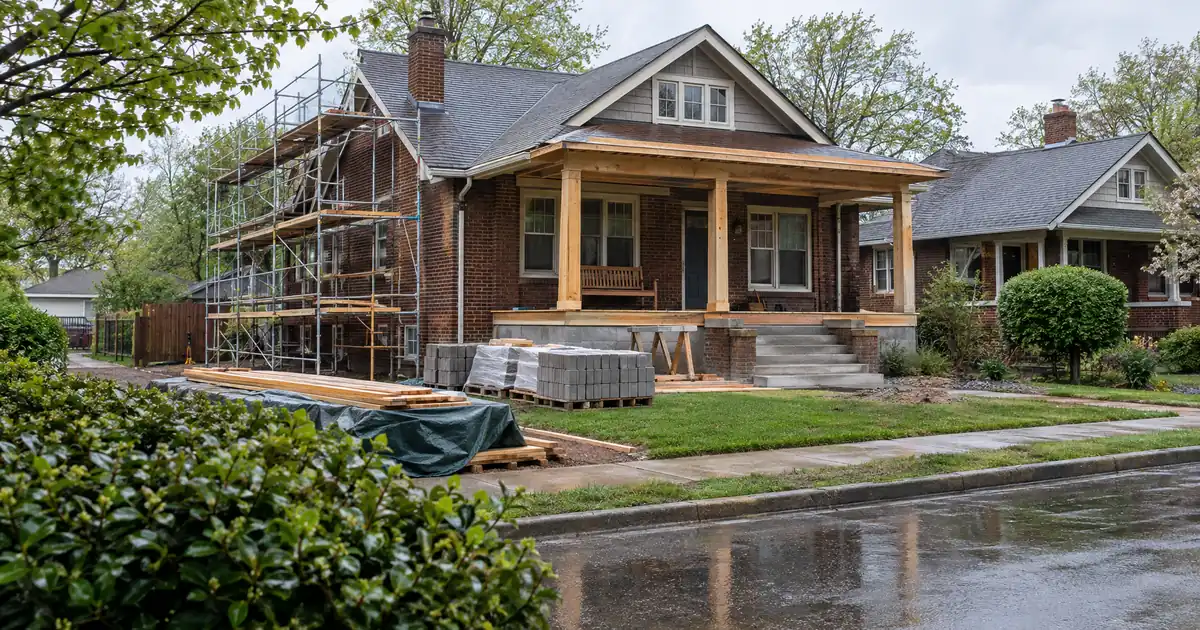
The Quick Read: You repay a short-term construction note by closing a new long-term DSCR loan on the finished, rented property and sending its proceeds to the original lender. A DSCR loan is a rental-property loan that qualifies primarily on property-level rental income covering the payment, subject to lender guidelines. There is no special conversion product. It is an ordinary refinance, and the new lender sets the loan size.
- The build has to be finished and rentable before a DSCR lender will look at it.
- The new lender’s own appraisal sets value. Your projected after-repair number does not.
- Value and rent coverage are two separate gates. The loan is the lower of what each allows.
- Ownership clocks vary by program, and cash-out is where they bite hardest.
- Plan the exit before the construction loan closes, not at maturity.
Key Terms Defined
Hard money construction loan: a short-term, interest-only loan that funds a ground-up build or heavy rehab. Terms typically run 6 to 18 months, and the loan is underwritten on the property, the plan, and the exit. Figures vary by lender, property, and experience.
DSCR (debt service coverage ratio): the property’s rent divided by its monthly debt cost. A ratio of 1.00 means rent equals the payment.
PITIA: principal, interest, taxes, insurance, and association dues. Residential DSCR programs typically divide rent by this full payment.
LTV (loan-to-value): the loan amount as a share of the property’s appraised value. Loan-to-cost is the same idea measured against what the project cost.
Seasoning: the waiting period a lender wants after you take title before it will lend on appraised value.
Rate-and-term refinance: a refinance that pays off the old loan and returns no cash. Cash-out refinance: a refinance that returns cash to you.
Holdback: construction money the lender keeps back and releases in draws as work is completed.
What Does Paying Off Construction Debt With a DSCR Loan Mean?
It means a second lender replaces the first. The new loan closes, the title company wires the payoff to the hard money lender, and the construction note is satisfied. That is the whole transaction.
This is the engine behind the BRRRR method (buy, rehab, rent, refinance, repeat). The University of San Diego’s continuing education explainer describes the refinance step as borrowing against the improved value, which is what separates the method from a simple flip. The Motley Fool’s BRRRR definition frames the cash-out refinance as the step that pulls your capital back out.
Ground-up construction adds a wrinkle. A rehab already has walls and, often, a rental history. A new build has neither until the work is done. That makes completion evidence and the first lease more important than they are on an older property.
Selling is the other common exit, and a DSCR loan is not always the right one. Here is how the routes compare.
| Route | Best when | Main risk | New lender needs |
|---|---|---|---|
| DSCR refinance | Rent supports the loan | Appraisal or rent comes in low | Finished build, lease or rent opinion |
| Sale | Market is strong, no hold plan | Slow buyers | Buyer’s financing |
| Extension | Need a bit more time | Extra cost, no real fix | Current lender’s consent |
| Cash paydown | Gap is small | Ties up your capital | Funds plus a new loan |
| Partner or other capital | Gap is large | Shared upside | Partner agreement |
The DSCR refinance is the focus here. Many investors move from hard money into long-term rental financing once the property is stabilized, and Lendmire arranges that through its wholesale network. The hard money exit refinance page covers that path.
The Gates the DSCR Lender Checks
Four gates stand between a finished build and a payoff. Clear all four. A strong result on one does not buy you a pass on another.
Gate one: completion. The property has to be done and legally usable as a rental. Lenders look for a certificate of occupancy or the local equivalent, a passed final inspection, and closed permits. They also want the final draw released and lien waivers collected. A property that still needs material work is not ready for this exit.
Gate two: the ownership clock. The new lender counts a window from the date title was recorded, not from the day the last nail went in. For a cash-out refinance, about six months of ownership is the common expectation across the network. Seasoning is lender policy, not law, so programs differ. For a ground-up build, ask in writing which clock the lender counts, because land you owned long before construction may be treated differently from a fresh purchase.
Gate three: the lender’s appraisal. The new lender orders its own appraisal. It returns a value and a market-rent opinion. Your spreadsheet number is a planning tool and nothing more. Appraisers value new construction against nearby sales, and a build that costs a lot does not automatically appraise for a lot.
Gate four: rent coverage. This is a separate test. The lender divides rent used for lender review by the full payment and checks the ratio. Corporate Finance Institute explains the standard formula (net operating income over debt service) and notes that lenders adjust it. It also cites a 1.25x minimum, which is a commercial-lending benchmark. Residential programs in the network differ: 1.00 is where select programs start. A separate select-lender path takes coverage below 1.00 with leverage and terms adjusted.
Here is the catch most builders miss. The new loan’s payment is almost always larger than the old interest-only payment, so the payment steps up. A bigger payment lowers the ratio.
Value Limit vs. Rent Limit: A Worked Example
The loan is the lower of what value allows and what rent allows. One limit always binds. This illustration uses modeled index numbers, not real dollars or market data.
Say the finished build was planned at a completed value of 120 index points, with a project cost of 100. A hard money ground-up loan can run up to 90% of project cost and 75% of completed value at the top experience tier, varying by lender and borrower. That puts the construction balance near 90 points.
Now the DSCR lender’s appraisal arrives.
- Appraisal at 120: a DSCR cash-out refinance at the 75% ceiling supports 90 points. That just covers the payoff.
- Appraisal at 110: the same 75% ceiling supports about 82.5 points. You bring roughly 7.5 points of your own cash to close.
That is the value limit. Now add the rent limit. Suppose the market-rent opinion supports a loan of only 80 points at 1.00 coverage. Rent, not value, binds. You now bring about 10 points to close, even though value could have supported more. Coverage is a separate gate from the appraisal.
Two honest cautions follow. First, clearing 1.00 does not mean the property cash-flows. DSCR compares rent to PITIA only. Repairs, vacancy, management, utilities, and capital reserves all sit outside the number. Second, overspent rehab money that the appraiser does not credit simply stays in the deal as your cash. (This is the most common place builders discover the gap.)
Step by Step: Planning Backward From Maturity
Work from the maturity date backward. Every step below has a checkpoint, and timing on each varies by file and lender.
1. Before the construction loan closes: pick a term long enough to cover completion, leasing, and the ownership clock. Hard money terms run 6 to 18 months, so the build plus the wait has to fit inside that window.
2. During the build: track the final draw, inspections, and permit closeouts. Collect lien waivers as each trade finishes.
3. At completion: secure the certificate of occupancy and get the property listed for rent. Place a tenant, or line up documentation for a market-rent opinion.
4. Well before maturity: request a payoff statement from the hard money lender. Check how per-diem interest accrues and whether extension terms exist. The hard money side typically carries no prepayment penalty, but confirm this on your note.
5. Start the DSCR file: give the broker the entity documents, the lease, proof of reserves, and completion evidence. The lender orders the appraisal.
6. Decision checkpoint: if the appraisal or rent opinion comes in low, decide among a cash paydown, an extension, or another route. Make that call before the note is stressed, not after.
7. Closing: the title company disburses the payoff to the old lender, and the construction note is released.
Core documents typically include the lease, deposit and first-month rent proof, the certificate of occupancy, the hazard insurance binder, entity papers, and reserves. Lenders vary on the exact list.
If the build sits in an LLC, DSCR lenders can often lend to that entity, subject to program terms. The entity on the new loan should match the entity on title, so sort that out early.
Where the Rules Bend
The general rule says wait for seasoning, then borrow against appraised value. These edge cases bend it.
Payoff-only versus cash-out. Many lenders treat a pure payoff, where no cash comes back, more leniently on seasoning than a cash-out. On a DSCR loan, a rate-and-term refinance can run up to 85% LTV through select programs. A cash-out tops out around 75% LTV. If any cash returns to you, expect cash-out rules. Programs differ, so check before you count on the lighter treatment.
Delayed financing rarely rescues this. Delayed financing is a provision meant for all-cash buyers. A construction-loan purchase shows financing on the settlement statement, and even when delayed financing applies, it returns documented cost, not completed value.
Short-term rental builds. Practice varies on whether a lender wants a long-term lease first. Where a DSCR loan is sized on a short-term rental, a 70% cash-out ceiling applies to that collateral, while a standard rental runs to 75%. Programs want a 640+ score and about 12 months of hosting history. Terms vary by lender guidelines, property type, leverage, credit profile, and full file review.
Property types the network will not finance. Manufactured homes (single- and double-wide), log homes, and barndominiums are not offered on DSCR programs. If your build is any of those, this exit does not exist.
Larger builds. Hard money construction can run up to ten units, but a DSCR exit depends on the property type. A build above four units needs a property-type check before you assume a refinance is available.
Experience of Lendmire’s team. In files like these, the failure point is usually the appraisal, not the borrower. Investors pencil the exit on a completed value that no comparable sale supports, and the DSCR lender’s number lands lower. The stronger files collect three or four nearby sales while still building and test the exit against a value 5 to 10 points below plan.
What If the Plan Slips?
Things go wrong in a few predictable ways. Each has a decision rule.
The bridge matures first. If you are close, ask the current lender for an extension. Another option is a payoff-only DSCR loan now, with a cash-out later once seasoning clears. Each extra closing adds cost, and a prepayment penalty on the first DSCR loan is a hidden cost of refinancing twice.
The appraisal comes in low. Your choices are a smaller loan with cash to close, a challenge backed by better comparable sales, or a different exit. If the gap is small, a paydown is usually cleaner than another bridge.
Rent does not support the loan. Rent can limit the loan before value does. Options include more cash down, a lower-leverage structure, an interest-only period, or a longer term. Extended terms such as 40-year and interest-only periods are available through select lenders in the network, which lowers the payment and can lift the ratio. Coverage below 1.00 is available through select lenders in the network, with leverage and terms adjusted. Eligibility stays subject to lender guidelines and credit approval.
Reserves are short. Reserves vary by lender, leverage, loan size, and transaction type. They are commonly around 6 months of PITIA, stepping up to about 9 months above $1,500,000. A DSCR loan can run up to $3,000,000 on standard programs.
The property is not ready. If the build needs material work or cannot legally operate as a rental, do not force a DSCR file. Finish with other funds, extend, or sell.
Where Most Builders Get This Wrong
Five mistakes show up again and again.
- Treating the budget as the value. What you spent is not what it appraises for.
- Assuming a strong ratio waives seasoning. Coverage and ownership timing are separate tests.
- Starting the file at maturity. Everything that can slip, will. Start while the note still has runway.
- Ignoring the credit tier. A 620 floor exists in parts of the network, most programs want around 660, and 700+ opens the strongest leverage tiers.
- Believing a DSCR loan skips the appraisal. It skips the personal-income path, not the appraisal.
A larger down payment lowers the payment and can lift the ratio. It never erases leverage caps, credit floors, reserve rules, or property eligibility. The strongest files clear both tests: enough equity and enough rental coverage.
Tax treatment varies; consult a qualified tax professional before relying on any deduction.
Frequently Asked Questions
Will a new lender really pay off my hard money lender?
Yes, when the property qualifies. The DSCR lender funds a new loan, and the title company sends the payoff to the old lender. The old lender’s note is released at that closing. Whether the new loan covers the full payoff depends on appraisal, rent coverage, and program limits.
How long do I have to wait before refinancing?
It depends on the program and the transaction. On a DSCR cash-out refinance, about six months of ownership from title recording is the common expectation. A payoff-only refinance is often treated more leniently, though programs differ. Ask which clock the lender counts for a new build.
Can I refinance before I have a tenant?
Often not. Every property needs a lease or an appraiser-supported market-rent opinion, and some lenders want a tenant in place.
What leverage can a DSCR loan reach on the payoff?
A DSCR cash-out refinance tops out around 75% LTV across most of the network. A rate-and-term refinance, which returns no cash, can reach 85% LTV on select programs. These are ceilings, not promises. Value, rent coverage, credit, and reserves can each hold the loan below them. Exact terms depend on the lender’s guidelines, property type, leverage, and a full review of the borrower’s file.
What if the DSCR does not clear 1.00?
Select lenders in the network offer coverage below 1.00, with leverage and terms adjusted. Alternatives include more cash down, an interest-only period, a longer term, an extension, or a sale. Details depend on the lender, the credit profile, and the property.
Next Step
If you are buying or refinancing a rental property and want to see how the numbers work, Lendmire can help you compare DSCR loan options based on the property income, credit profile, leverage, and investor goals. The brokerage arranges DSCR financing through select lenders across 41 markets, including Washington, D.C. For the full picture of how these loans fit together, read the complete DSCR loans guide.
Whatever the exit, the investors who get out cleanly are the ones who priced the appraisal and the rent test before they poured the first foundation.
About Lendmire
Lendmire is a DSCR-focused mortgage brokerage, NMLS# 2371349, placing investor loans across 41 markets, including Washington, D.C. DSCR eligibility is generally reviewed by the lender around a property’s rental income rather than personal income documentation, which fits LLC-held rentals, self-employed investors, and portfolios scaling past conventional financed-property limits. Scotsman Guide named Lendmire a Top Mortgage Workplace in both 2025 and 2026.
Get Started
Ready to find the right loan for you?
In about 30 seconds you can review financing options available for your investment property. No commitment required.
Informational only. Not a Loan Estimate, approval, or commitment to lend. Program availability and eligibility are subject to lender guidelines, credit approval, property review, and underwriting.
References
1. University of San Diego Professional and Continuing Education: BRRRR Method
2. The Motley Fool: BRRRR Method
3. Corporate Finance Institute: Debt Service Coverage Ratio
This article is part of Lendmire’s hard money loan program — full qualification details, guidelines, and scenarios live on the program page.
Related reading: Portfolio DSCR Loan vs. a DSCR Loan on Every Rental · Can You Sell One Rental Before Your DSCR Blanket Loan Matures? · Is a DSCR Portfolio Loan Smart If You Will Sell Within Ten Years?
Brandon Miller
Founder & CEO, Mortgage Loan Originator, Lendmire LLC
- Mortgage Loan Originator · NMLS# 1129696 · Verify on NMLS Consumer Access
- North Carolina Real Estate Broker · License# 343312 · Verify on NCREC
- North Carolina Insurance Producer · License# 19053198 · Property, Casualty, Life, Health · Verify on NAIC SBS
- Lendmire LLC · Firm NMLS# 2371349 · Verify firm licensure
Disclosures. The information presented in this article is general market commentary, not financial, legal, or tax advice. Lendmire is a mortgage brokerage (NMLS# 2371349) — not a direct lender or depository institution — and loan placement is subject to lender underwriting. Nothing in this content represents a commitment to lend. Loan terms, pricing, and program availability vary based on borrower qualifications, property characteristics, and state of subject property, and are subject to change at any time. Lendmire complies with Equal Housing Opportunity requirements. Consumer access: nmlsconsumeraccess.org.