
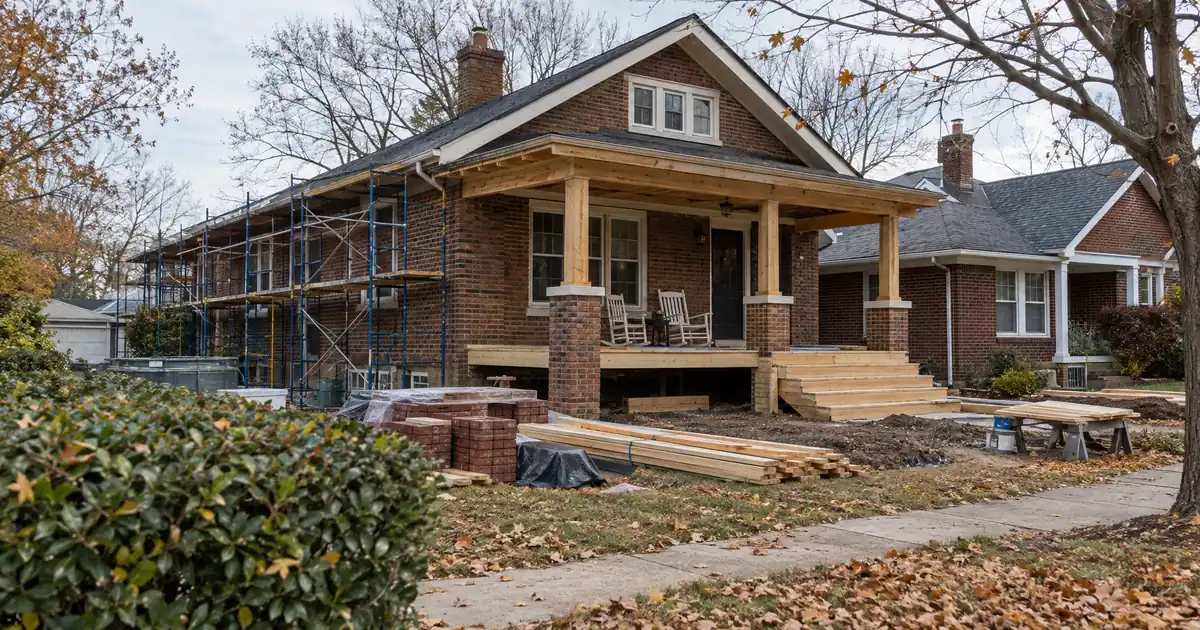
The Quick Read: You fund the package with a short-term, interest-only hard money loan, finish the work, lease the units, and then refinance into a long-term DSCR loan that pays the bridge off, which only works if you size the bridge backward from what the exit lender’s own appraisal and rent test will support. Hard money gets you in the door. The DSCR loan decides how much of your capital comes back.
- Hard money terms typically run 6 to 18 months, interest-only, with no prepayment penalty (varies by lender, property, and experience).
- The exit lender sets value with its own appraisal, so your after-repair estimate does not set the loan.
- Value and rent coverage are tested separately, and the lower result sets the loan.
- The seasoning clock starts when the deed records, not when the rehab ends.
- A package can exit as one pooled note or as separate loans, and each choice carries different risk.
What Does It Mean to Buy a Package on Hard Money?
A package is two or more rentals bought together, usually from one seller under one contract. Hard money is asset-based bridge financing. The lender looks at the property, the plan, and the exit rather than your traditional personal-income documentation.
On the program side, hard money loans on non-owner-occupied one- to four-unit residential property can run up to $5,000,000, with larger loans by exception. Purchases without rehab can reach up to 80% of the purchase price. Fix-and-flip structures are sized on project cost, with tiers tied to how many projects you have completed and a cap at 75% of after-repair value. The rehab budget itself can be funded in draws against completed work. The top tiers go to experienced investors, and a minimum credit score of 620 applies, with added conditions below 660. All of it varies by lender, property, and experience.
Then the clock starts. The bridge matures in months, not years. The exit is a refinance, and for rentals that refinance is usually a DSCR loan. DSCR stands for debt service coverage ratio, and the loan is reviewed primarily on property-level rental income covering the payment, subject to lender guidelines. Many investors refinance out of hard money into long-term DSCR financing once the property is stabilized, and Lendmire brokers that path through its hard money exit refinance program.
DSCR loans are designed for non-owner-occupied investment properties. Because they are business-purpose investor loans, they are reviewed differently from a standard owner-occupied mortgage.
Should You Bridge This Package at All?
Bridge only when the package is not yet ready for a DSCR loan. If every unit is finished, leased, and priced at a level the exit lender will appraise, going straight to a DSCR purchase loan saves you a second closing and a second set of costs.
| Situation | Bridge needed? | Likely exit |
|---|---|---|
| Stabilized, fully leased | Usually no | DSCR purchase loan directly |
| Mixed: some leased, some vacant | Often yes | Pooled DSCR loan after lease-up |
| Heavy rehab on several units | Yes | DSCR loan after rehab and seasoning |
| Seller needs a simple, certain buyer | Sometimes | DSCR loan once units are leased |
Stacking two closings adds cost. You pay for the bridge, its interest, any extension or draw fees, and then the exit loan’s closing costs. A package makes this math heavier because every fee scales with the number of properties. If the plan only works when everything goes right, the package is probably too thin to bridge.
Key Terms Defined
Hard money loan: A short-term, interest-only loan secured by the property and underwritten mostly on the asset and the plan.
Package: Several rentals bought together, often from one seller, under one contract.
DSCR: Monthly rent divided by the monthly payment, a ratio showing whether the rent covers the debt.
PITIA: Principal, interest, taxes, insurance, and association dues, which together form the payment the rent is compared against.
Seasoning: The ownership period a lender wants before it will refinance on current value.
Blanket (portfolio) DSCR loan: One note secured by several rentals. Lenders also call it a cross-collateralized loan.
Cash-out refinance: A refinance that returns cash beyond the payoff and closing costs.
Rate-and-term refinance: A refinance that pays off the old loan and returns no cash at closing.
Underwrite the Exit Before You Sign
The exit lender’s rules, not the bridge lender’s advance, decide how much capital comes back. Two loans mean two ceilings. A high advance on cost at the bridge does nothing to the exit lender’s test on appraised value.
Start by choosing the exit lender’s program before you buy. Get the seasoning clock, leverage cap, and coverage floor in hand. Then work backward to the bridge.
The exit has two independent tests. The first is value. The second is rent coverage. The lower result sets the loan.
Here is what the tests look like on a pooled loan. On a 30-year portfolio DSCR loan, leverage runs up to 80% of value on a purchase or rate-and-term refinance of investment rentals. Cash-out never goes above 75% of pooled value. Inside the first six months of ownership, the loan is also capped at 90% of total cost (purchase price plus documented improvements), and at 100% of total cost from six to twelve months. The leverage ceiling still applies, so the loan is the lower of the two. After twelve months, appraised value alone is the basis. A rate-and-term refinance is not subject to the cost-basis cap.
That cost rule matters when you buy cheap and rehab hard. Your bridge may have funded a high share of project cost, and the exit lender may lend on the lower of cost or value. The gap between those two numbers is cash you bring to closing.
Picture a bridge that covered 90% of project cost, with an appraisal that comes in roughly equal to cost. A pooled exit lending up to 80% of value on a rate-and-term refinance leaves about ten points of the payoff uncovered. Plan for that gap before you buy.
Coverage is the second test. DSCR divides the rent used for lender review by PITIA. Wikipedia’s debt service coverage ratio entry notes that a ratio above 1.0 means income covers debt service and below 1.0 means a shortfall. Across the network, 1.00 is where many select programs start, and stronger ratios open better pricing and leverage. A separate select-lender path takes coverage below 1.00, with leverage and terms adjusted.
Clearing 1.00 does not mean the property cash flows. The ratio compares rent to the payment only. Repairs, vacancy, management, utilities, and capital expenses sit outside it.
Rent used for lender review usually comes from the appraiser’s market rent schedule, not from the lease alone. For a single-family home that is a rent schedule form, and for two to four units it is an operating income statement. The signed lease is still a core document, but treat asking rent as a planning input only.
Screen every property before you sign:
| Property | Check | Ready for exit? |
|---|---|---|
| Leased, finished | Lease vs. market rent | Yes, if rents align |
| Vacant, finished | Needs a lease or supported market rent | Not until leased |
| Needs rehab | Needs work done, then lease-up | Not yet |
| Low rent for the payment | Coverage near or under 1.00 | Drags the pooled result |
One Note or Many?
You have two exit shapes. You can pool the package under one note, or you can place a separate loan on each property. Both work. They fail differently.
The first pooled option is the 30-year portfolio DSCR loan. It covers two to twenty properties under one note, with loan sizes from $300,000 to $5,000,000 (larger balances on review). Property types are single-family, two- to four-unit, condo, and townhome, with fixed or adjustable rate types and an interest-only period available. Coverage is measured on the pool, so pooled rent is compared against pooled payments. Stronger properties can offset weaker ones. The credit floor is 640, and some portfolio structures want 680 or 720. Final terms depend on lender guidelines, property type, leverage, and the borrower’s complete credit picture.
The second is the rental portfolio term loan. It is built for five or more rental properties or units under one loan, from $500,000 to $50,000,000 (larger balances on review), with leverage up to 75% of value. Terms are fixed at 3, 5, 7, or 10 years with a balloon at maturity. It comes in recourse and non-recourse forms. A recourse loan carries a personal guarantee. A non-recourse loan looks to the real estate, with recourse limited to carve-outs such as fraud and bankruptcy. Prepayment runs on yield maintenance. It also allows properties in several markets under one loan, and it is the only structure here that takes small multifamily of five or more units. These specifics are subject to lender guidelines and a full review of property, leverage, and credit.
| Factor | Pooled note | Separate loans |
|---|---|---|
| Coverage test | Blended across the pool | Each property alone |
| Weak property | Offset by stronger ones | Can sink its own loan |
| Default risk | Cross-collateralized | Contained per property |
| Selling one unit | Follows release terms | Pay off that loan |
| Closings and costs | One note, one set | Several sets |
Pooling helps when one property comes in thin. A rental below 1.00 coverage can sit in the pool, though underwriting tests the pooled coverage, the leverage and the terms. The pool itself still has to clear its floor.
The tradeoff is release mechanics. Partial releases, substitutions, and the sale of one property follow the loan documents and the lender’s release terms. The release price runs above the property’s allocated balance. The remaining portfolio must still cover its debt service. Read those clauses as carefully as the headline loan amount.
One thing to confirm early: the pool excludes owner-occupied property, co-ops, mixed-use buildings, and commercial property. Manufactured homes (single- and double-wide), log homes, and barndominiums are not offered in the network’s DSCR programs.
The Step-by-Step Sequence
Work in this order and keep a buffer before the bridge matures.
1. Pick the exit lender and its rules first. Get the seasoning clock, leverage cap, and coverage floor in writing. Then size the bridge backward from the exit.
2. Buy the package on the bridge. Choose a bridge term that outlasts rehab, lease-up, seasoning, the appraisal, and underwriting. Terms of 6 to 18 months are typical.
3. Choose one note or many. Decide before closing on the bridge, because it changes how you allocate value across properties.
4. Rehab and lease up. Document every draw with invoices. Collect signed leases.
5. Run the seasoning clock. DSCR lenders commonly want about six months of seasoning before refinancing on current value, as an investor discussion of seasoning when BRRRRing points out. The same discussion makes the more useful point: a hard money lender’s no-seasoning claim does not carry over to the exit lender. Across the network, a cash-out refinance on a DSCR loan generally expects about six months, counted from title recording. That is the date the deed is recorded, not when the rehab ends or the lease is signed.
6. Appraise. The exit lender orders its own appraisal, and each property gets one. Your after-repair value is not the number that counts.
7. Underwrite. The value test and the coverage test run separately. The lower one sets the loan.
8. Pay off the bridge. Request the payoff statement early. Interest, extension fees, and draw fees all raise the payoff.
Documents typically involved: the settlement statement, draw history and invoices, leases or rent evidence, insurance, the payoff statement, appraisals, entity documents, and title.
A Worked Example With One Weak Link
Run the numbers on a three-property package. These are modeled assumptions, not market data, and they assume equal debt service across the three properties so the ratios average cleanly.
Property A is finished and leased, with coverage around 1.30x. Property B is finished with a new lease and runs about 1.15x. Property C needed heavy work, has just leased, and its appraiser-supported rent leaves coverage near 0.85x.
On a pooled 30-year portfolio DSCR loan, the blended coverage is the average: (1.30 + 1.15 + 0.85) ÷ 3 = 1.10x. The pool clears a 1.00 floor even though Property C sits under it. As separate loans, Property C would stand alone below 1.00. It would need a select-lender path that accepts sub-1.00 coverage, with leverage and terms adjusted.
Now test value. Suppose the appraisals support the package, but the exit lender sizes on the lower of cost basis or value because you are still inside the first six months of ownership. If the bridge funded a high share of project cost, the exit loan may come up short of the payoff. You bring cash to closing, or you wait for the six-month mark so more of the appraised value counts.
The lesson is that Property C did not fail the package, but it narrowed the margin. If its rent had come in lower, the pool could have slipped under 1.00. Plan for the conservative rent figure.
Where the General Rule Breaks
Payoff-only versus cash-out. If proceeds cover only the payoff and closing costs, the file is treated as a rate-and-term refinance. Cash beyond that makes it a cash-out refinance, with a tighter leverage ceiling and the seasoning rule. On the single-property DSCR loan, cash-out tops out around 75% of value on a standard rental. The pooled version never exceeds 75% of pooled value. If you plan to recycle that cash, Lendmire’s piece How to Roll Hard Money Exit Cash-Out Into the Next BRRRR Purchase covers the sequence.
Delayed financing rarely rescues a hard money buyer. Agency delayed financing is an exception for arm’s-length cash purchases, and a hard money lien on the purchase generally breaks it. Some non-agency programs do offer a delayed-purchase variant, as this discussion of long-term financing with little seasoning shows, so ask each lender.
Appraisal misses. Options, in rough order of cost: bring cash to closing, take a smaller loan or switch to payoff-only, extend or pay down the bridge, challenge the value with better comps, or sell.
Bridge maturity. If seasoning clears after the hard money matures, an extension fee lands in the payoff. A delayed exit can erase the cash-out you planned on.
Rent coverage can cap the loan before equity does. Thin rents limit loan size even when value is fine. That is where a select-lender path below 1.00 comes in, with leverage and terms adjusted. For thinner files, Lendmire’s article Exiting Hard Money Into a No-Ratio DSCR Loan When the Rent Is Still Thin explains how that lane works.
Carry costs keep growing every month the bridge stays open. Tax treatment varies; consult a qualified professional.
Seller and Diligence Checklist for Packages
A package is only as good as the seller’s paperwork. Before the contract goes hard, check these:
- Rent roll versus leases. Match each stated rent to a signed lease.
- Estoppel statements. Confirm tenant deposits and any side agreements.
- Deferred maintenance. List roofs, systems, and units that cannot be leased as-is.
- Who pays what. Note tenant-paid and owner-paid utilities, since they affect the real margin.
- Allocated pricing. Get a price per property, because release and pooling both use it.
- Eligibility. Remove any mixed-use, commercial, or ineligible property types before you rely on a pool.
Entity, Title, Reserves, and Liquidity
Most investors close in an LLC, subject to lender program eligibility. A special-purpose entity is required on some pooled structures, and recourse loans carry a personal guarantee. Title should be clean on every property, because a defect on one can hold up a pooled closing.
Reserves vary by lender, leverage, loan size, and transaction. On single-property DSCR loans, about six months of PITIA is common, and loans above $1,500,000 typically step up to about nine months. Pooled structures hold their own reserve terms. With several properties, liquidity adds up fast, so budget for it before you close on the bridge.
Frequently Asked Questions
Can I refinance a package into one DSCR loan?
Often yes, through a 30-year portfolio DSCR loan covering two to twenty properties, or a rental portfolio term loan for five or more properties or units. Underwriting measures coverage on the pool and tests leverage separately. Qualification is subject to lender guidelines, credit approval, and property review.
Can I release one property from a pooled loan?
Release terms live in the loan documents. A partial release, substitution, or sale generally requires a release price above the property’s allocated balance, and the remaining pool must still cover its debt service. Ask for the release language before you commit.
What if one property isn’t leased by the time I want to exit?
Underwriting needs a lease or an appraiser-supported market rent on every property. A vacant unit can sit in a pool, but underwriting tests the pooled coverage, the leverage and the terms. You can also refinance the leased properties first or extend the bridge, and the extension cost lands in the payoff.
Do I need an LLC?
Many investors use one, and a special-purpose entity is required on some pooled structures. Eligibility depends on program terms, so confirm with the lender before you title the properties.
Is hard money better than going straight to DSCR?
Only when the package is not ready for DSCR financing. If the units are finished, leased, and supportable on rent, a direct DSCR purchase loan typically costs less because you skip the second closing and the bridge costs.
What to Do Next
If you are buying, rehabbing, or refinancing an investment property on a short timeline and want to see how the numbers work, Lendmire can help you compare hard money options based on the project, the exit plan, leverage, and your goals. The complete DSCR loans guide explains how the exit loans work in more detail, and a good package plan starts from that end.
About Lendmire
Lendmire (NMLS# 2371349) is a mortgage brokerage focused on DSCR investor financing, helping arrange programs through wholesale and investor-lending channels in 41 markets, including Washington, D.C. DSCR loans are evaluated by the lender on property cash flow rather than personal income, subject to lender guidelines, supporting LLC closings and accommodating investors with four or more financed properties. Scotsman Guide Top Mortgage Workplace in both 2025 and 2026.
Get Started
Ready to find the right loan for you?
In about 30 seconds you can review financing options available for your investment property. No commitment required.
Informational only. Not a Loan Estimate, approval, or commitment to lend. Program availability and eligibility are subject to lender guidelines, credit approval, property review, and underwriting.
References
1. Wikipedia – Debt service coverage ratio
2. BiggerPockets – Seasoning Periods when BRRRRing
3. BiggerPockets – Long term financing with little to NO seasoning
This article is part of Lendmire’s hard money loan program — full qualification details, guidelines, and scenarios live on the program page.
Related reading: How to Size a DSCR Loan for a Newly Assembled Rental Pool · Portfolio DSCR Loan vs Per-Rental Loans for a W-2 Investor Scaling Up · Can You Sell One Rental Before Your DSCR Blanket Loan Matures?
Brandon Miller
Founder & CEO, Mortgage Loan Originator, Lendmire LLC
- Mortgage Loan Originator · NMLS# 1129696 · Verify on NMLS Consumer Access
- North Carolina Real Estate Broker · License# 343312 · Verify on NCREC
- North Carolina Insurance Producer · License# 19053198 · Property, Casualty, Life, Health · Verify on NAIC SBS
- Lendmire LLC · Firm NMLS# 2371349 · Verify firm licensure
Disclosures. The information presented in this article is general market commentary, not financial, legal, or tax advice. Lendmire is a mortgage brokerage (NMLS# 2371349) — not a direct lender or depository institution — and loan placement is subject to lender underwriting. Nothing in this content represents a commitment to lend. Loan terms, pricing, and program availability vary based on borrower qualifications, property characteristics, and state of subject property, and are subject to change at any time. Lendmire complies with Equal Housing Opportunity requirements. Consumer access: nmlsconsumeraccess.org.