
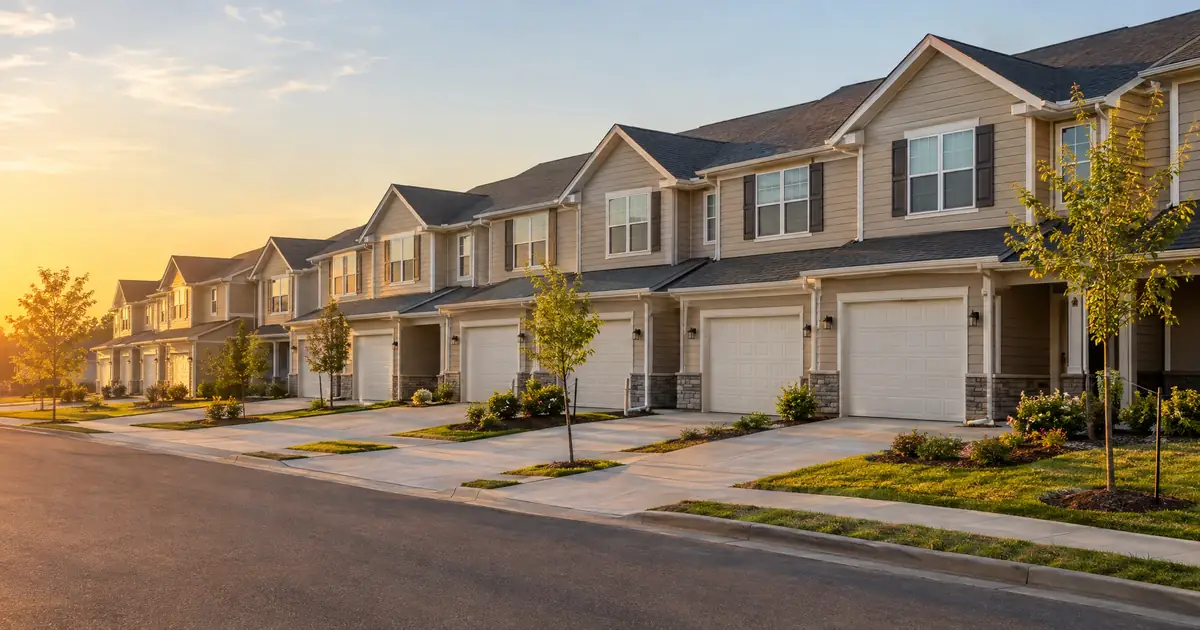
The Quick Read: Usually yes for finished homes, because most programs underwrite a completed, vacant rental on the appraiser’s market-rent opinion rather than a signed lease (subject to lender guidelines), but no if the question means financing a community that is still under construction. A DSCR loan is take-out financing, not construction money. The rent figure on the appraisal, not your pro forma, carries the coverage test.
- DSCR does not pay for the build. A builder or construction lender carries the project first.
- A finished, rentable home does not need a lease on a purchase. The appraiser’s market rent stands in for it.
- The appraiser’s rent number decides the outcome, and new subdivisions often have thin rent comps.
- Partial lease-up changes the file when homes are pooled under one loan, because coverage is measured on the whole pool.
Can DSCR Fund the Build, or Only the Finished Homes?
DSCR funds the finished homes. An unbuilt house has no rent and no payment to test, so the loan cannot exist yet. Across the wholesale network Lendmire works with, the sequence is two financing events: a construction loan first, then a DSCR take-out once the home is complete.
Completion means more than framing and drywall. The home must be occupancy-ready, and lenders want a certificate of occupancy or equivalent proof before the permanent loan closes. An unfinished home raises completion questions and does not count as turnkey. Turnkey means the home could be leased today without further work.
If you want the full picture of how these loans work, start with Lendmire’s complete DSCR loans guide.
DSCR loans are designed for non-owner-occupied investment properties. Because they are business-purpose investor loans, they are reviewed differently from a standard owner-occupied mortgage.
Does Every Home Need a Lease First?
No. “Every home leased” is not a DSCR requirement. It is a convention of construction-to-permanent take-outs, where a construction lender wants proof the rent roll is real. On a purchase, most programs we see underwrite a finished, empty new build on market rent from the appraisal. No lease is needed and no seasoning period applies.
The appraiser documents that rent on a rent schedule. For a single-family home, that is Form 1007, which Fannie Mae’s appraiser guidance describes as the Single-Family Comparable Rent Schedule used to estimate monthly market rent. Form 1025 is the 2-4 unit equivalent. These are only form references. DSCR loans are not agency loans, and agency rules do not govern them.
Where a lease does exist, the common convention is the lower of the lease rent and the market rent. That is a program convention, not a federal rule. A lease above market adds nothing, because the lower figure sets the coverage.
Refinances are a different story from purchases. Programs are stricter about vacancy on a refinance, and some want the property leased or occupied. Confirm the refinance rule with the specific program before you plan around it.
How Does the Lender Get a Rent Number With No Lease?
The appraisal does two jobs. It sets value, which drives leverage, and it sets market rent, which drives coverage. DSCR is that rent divided by the full monthly obligation: principal, interest, taxes, insurance, and association dues.
Most single-property purchase files land at 75%-80% LTV, which means loan-to-value, the loan as a share of appraised value. A larger down payment can lift coverage, but it never erases leverage caps, reserve rules, or property eligibility. The file has to clear both tests: enough equity and enough rental coverage. These specifics are subject to lender guidelines and a full review of property, leverage, and credit.
The weak spot in a new community is the comps. When a whole block was built in the same stretch, few comparable rentals exist nearby. Appraisers lean harder on the cost approach when sales data is thin, and the rent figure becomes one opinion with no lease or deposit history behind it. Cost also does not establish value. The final appraised value can land below the construction budget, and a lower value reduces the loan under the leverage limit.
Check rent comps before you go under contract. Do not rely on a pro forma, because your projected rent does not count. Only the appraiser’s rent does.
Clearing 1.00 coverage is also not the same as positive cash flow. DSCR compares rent to the payment only. Repairs, vacancy, management, utilities, and capital expenses sit outside the calculation.
What Changes When Only Some Homes Are Leased?
For one house, nothing much changes. A leased home and a vacant one both qualify on rent. For a pooled loan, partial lease-up matters in a different way.
A portfolio DSCR loan is one note secured by several rentals. The same structure is called a blanket loan or a cross-collateralized loan. Lenders add up the pool’s rent and debt service, then divide. Stronger homes can offset weaker ones, while each house is still valued individually.
The network has two portfolio structures:
| Feature | 30-year portfolio DSCR loan | Rental portfolio term loan |
|---|---|---|
| Properties | 2 to 20 under one note | 5 or more properties or units |
| Loan size | $300,000 to $5,000,000 | $500,000 to $50,000,000 |
| Leverage | Up to 80%, purchase and rate-and-term | Up to 75% |
| Coverage | 1.00 floor on the pool | Reviewed by the lender |
| Structure | 30-year term, interest-only available | 3, 5, 7, or 10-year fixed, balloon at maturity |
Larger balances are reviewed case by case on both. Small multifamily of five or more units is eligible only inside the rental portfolio term loan. Owner-occupied, mixed-use, and commercial property are ineligible in either pool. The credit floor on these programs is 640, and it runs to 680 or 720 on some structures.
Picture a pool of five homes with payments of similar size. Three cover their own payment at roughly 1.25x on market rent. One covers about 1.05x. One new build appraises to about 0.92x. Pooled coverage lands near 1.14x, above the 1.00 floor. A rental below 1.00 can sit in the pool in that case, and underwriting tests the pooled coverage, the leverage and the terms.
Every house still needs a lease or appraiser-supported market rent. A home that is not lease-ready is an eligibility problem that rent cannot fix. One vacant or low-appraising house can delay or reshape a pooled closing.
Here is how the community’s status usually maps to a path:
| Community status | Likely path | What to prepare |
|---|---|---|
| Unbuilt | Construction financing | Builder or construction lender |
| Built, vacant | DSCR per home or pool | Certificate of occupancy, rent comps |
| Partly leased | Pool or per-home loans | Leases, rent roll, appraisals |
| Mostly leased | Pool or term loan | Full rent roll, entity documents |
A larger amenitized community with shared common areas and one site plan may be treated as multifamily or commercial rather than as a set of single-family rentals. Property count and unit type matter before you choose a product. Manufactured and mobile homes are not reviewable on any of these programs.
What Counts as Leased Enough?
There is no universal number. Stabilization is the point where a community is leased well enough that a permanent lender trusts the rent roll. Construction lenders and permanent lenders define it differently, and a construction lender often writes its own occupancy trigger into the loan documents.
DSCR lenders mostly sidestep the question. On a per-home loan, each house stands alone on its own rent. On a pooled loan, the test is whether pooled coverage clears the floor with every house eligible, not a leased percentage.
If you are choosing which homes go into the first pool, start with the finished, lease-ready ones. Hold back homes that are not turnkey. A remaining pool must still cover its debt service after any later release, so a weak first pool leaves no room for error.
Do Concessions and Lease-Up Pricing Change the Ratio?
They can. A lease signed at a discount, or with free months, may lower the rent a lender is willing to count. Because the lower of lease and market rent is the usual convention, a deeply discounted lease can pull coverage down. The lender may also discount vacancy or reduce leverage, and that varies by program.
If you plan to fill the community with introductory pricing, ask the program how it treats concessions before you sign leases. Sometimes the cleaner file is a vacant home that rests on appraiser market rent.
What Does a Lender Want in the File?
Expect the same credit, leverage, and reserve checks as on any leased property, plus completion evidence. Reserves vary by lender, leverage, and loan size. They commonly run around 6 months of the full payment on single-property files, and loans above $1,500,000 typically step up to about 9 months. The rental portfolio term loan holds reserves for taxes, insurance, and capital expenditures. Add a contingency for certificate-of-occupancy delays.
A practical checklist:
- Certificate of occupancy or equivalent proof for every home
- Appraisals with rent schedules (Form 1007 or 1025)
- Leases and a current rent roll, for homes that are leased
- Insurance and tax details, plus association dues
- Entity formation documents and operating agreement, if an LLC holds title, subject to program terms
- Proof of reserves
What If the Construction Loan Matures Before Lease-Up Ends?
This is the gap most builders worry about. If the construction loan matures before enough homes are finished or leased, you typically need an extension or a bridge loan. Neither is a DSCR product. Plan for that cost when you set the build schedule.
Once homes are complete, a DSCR take-out can be done home by home, which lets you close on finished units while others are still under construction.
If you refinance recently built homes, cost basis becomes a second cap. On a portfolio loan, inside the first six months the loan is also capped at 90% of total cost (purchase price plus documented improvements), 100% of total cost from six to twelve months, and the leverage ceiling still applies, so the loan is the lower of the two. After twelve months the appraised value alone is the basis. A rate-and-term refinance is not subject to the cost-basis cap. Cash-out on any portfolio loan never exceeds 75% of pooled value.
For the cash-out side, Lendmire’s piece How to Close a Cash-Out Refinance Before Buying a Second Home or Rental covers the mechanics.
What Happens After Closing If One Home Drops Out?
Partial releases, substitutions, and the sale of one property follow the loan documents and the lender’s release terms. The release price runs above the property’s allocated balance, and the remaining portfolio must still cover its debt service. Read the release clause before you close, not after.
If one lease fails after closing, a pooled loan absorbs it better than a single-home loan, because the pool’s coverage is the test at underwriting. It does not guarantee your cash flow, so keep operating reserves outside the loan.
Can You Underwrite Short-Term Rental Income on a New Build?
Rarely. Fannie Mae’s guidance says Form 1007 is not for estimating nightly short-term rates. A new build also has no hosting history, and short-term rental programs expect about 12 months of it along with a 640+ score. Purchase leverage tops out at 75% on short-term rental collateral. Most new-build files underwrite on long-term market rent instead.
Short-term rental rules can vary by city, county, HOA, and property type, so investors should confirm local rules before relying on projected rental income.
What About the Government Build-to-Rent Route?
HUD has opened FHA multifamily insurance to build-to-rent communities of detached homes, duplexes, or triplexes. NAR’s summary says Section 221(d)(4) covers new construction and Section 223(f) covers purchase or refinance of recently built communities. The community needs at least five homes on one contiguous, professionally managed site. Individual homes cannot be sold separately while the insured loan is in place.
That is a multifamily-lender path, not DSCR. It suits a builder who wants to hold the whole community. A builder who wants to sell or refinance homes one at a time fits the DSCR route better.
Terms for build-to-rent construction depend on the lender’s guidelines, the property type, the leverage, and a full review of the credit profile.
The Investor Decision
Lease-up delay does not block a single-home DSCR close. The appraisal carries the whole rent numerator, so the quality of the comps is your real risk. The thin-comp risk can mean a lower leverage tier than you expected.
If coverage comes in under 1.00, there is a path. Many select programs start at 1.00. A separate select-lender path takes coverage below 1.00 with leverage and terms adjusted.
Budget for two financing events, with timing risk on completion. Tax treatment varies; consult a qualified professional.
Key Terms Defined
- DSCR (debt service coverage ratio): Monthly rent divided by the full monthly payment on the loan.
- Stabilization: The point where a community is leased well enough that a permanent lender trusts the rent roll.
- Market-rent opinion: The appraiser’s estimate of what the home would rent for, used when there is no lease.
- Turnkey: Finished and ready to lease today without further work.
- Take-out: The permanent loan that replaces construction financing.
- Release clause: The loan term that sets how one property leaves a pooled loan.
Frequently Asked Questions
Can I get a DSCR loan on a brand-new home with no tenant?
Usually yes on a purchase, subject to lender guidelines. Most programs use the appraiser’s market rent in place of a lease, provided the home is finished and has a certificate of occupancy.
Does a signed lease raise my DSCR?
Only up to market rent. Coverage typically uses the lower of the lease and the appraiser’s market rent, so a lease above market adds nothing.
Can DSCR cover a whole community on one loan?
Sometimes. The 30-year portfolio DSCR loan holds 2 to 20 properties under one note, and the rental portfolio term loan covers five or more properties or units. Each home still needs rent support, and a very large amenitized community may be treated as multifamily.
Do refinances work the same as purchases on vacant homes?
Not always. Refinances face stricter vacancy treatment than purchases, so confirm the rule with the specific program before relying on a vacant refinance.
What if my construction loan matures before the homes are leased?
Plan on an extension or a bridge, since DSCR cannot fund the build. Finished homes can be taken out one at a time while others are still finishing.
Next Steps
If you are buying or refinancing a rental property and want to see how the numbers work, Lendmire can help you compare DSCR loan options based on the property income, credit profile, leverage, and investor goals. Lendmire is a broker arranging financing through select lenders across 41 markets, including Washington, D.C. Programs are not a commitment to lend, and every file is underwritten individually.
About Lendmire
Lendmire (NMLS# 2371349) is a DSCR-focused mortgage broker that helps arrange investor financing across 41 markets, including Washington, D.C., through wholesale and investor-lending channels. DSCR eligibility is generally reviewed by the lender around the property’s rental income rather than personal income documentation, subject to lender guidelines, which works for self-employed investors, LLC operators, and portfolios above four financed properties. Scotsman Guide named Lendmire a Top Mortgage Workplace in both 2025 and 2026.
Get Started
Ready to find the right loan for you?
In about 30 seconds you can review financing options available for your investment property. No commitment required.
Informational only. Not a Loan Estimate, approval, or commitment to lend. Program availability and eligibility are subject to lender guidelines, credit approval, property review, and underwriting.
References
1. Fannie Mae Appraiser Update
This article is part of Lendmire’s DSCR loan program — full qualification details, guidelines, and scenarios live on the program page.
Related reading: How to Decide on One DSCR Loan for Rentals in Three or More Markets · How a DSCR Lender Adds a Rental to an Existing Portfolio Loan · Portfolio DSCR Loan vs Leaving Private Money in Your Rental Pool
Brandon Miller
Founder & CEO, Mortgage Loan Originator, Lendmire LLC
- Mortgage Loan Originator · NMLS# 1129696 · Verify on NMLS Consumer Access
- North Carolina Real Estate Broker · License# 343312 · Verify on NCREC
- North Carolina Insurance Producer · License# 19053198 · Property, Casualty, Life, Health · Verify on NAIC SBS
- Lendmire LLC · Firm NMLS# 2371349 · Verify firm licensure
Disclosure information. Lendmire is a state-licensed mortgage brokerage under NMLS# 2371349. Lendmire is not a depository institution, direct lender, or financial advisor — all loans referenced are placed through wholesale lender partners and are subject to each lender's underwriting standards. This article is provided for general informational purposes and is not a commitment to lend, nor does it constitute financial, legal, or tax advice. Loan programs, terms, rates, and qualification standards change without notice and depend on borrower profile, property type, and the state in which the subject property is located. Equal Housing Opportunity provider. NMLS Consumer Access: nmlsconsumeraccess.org.