
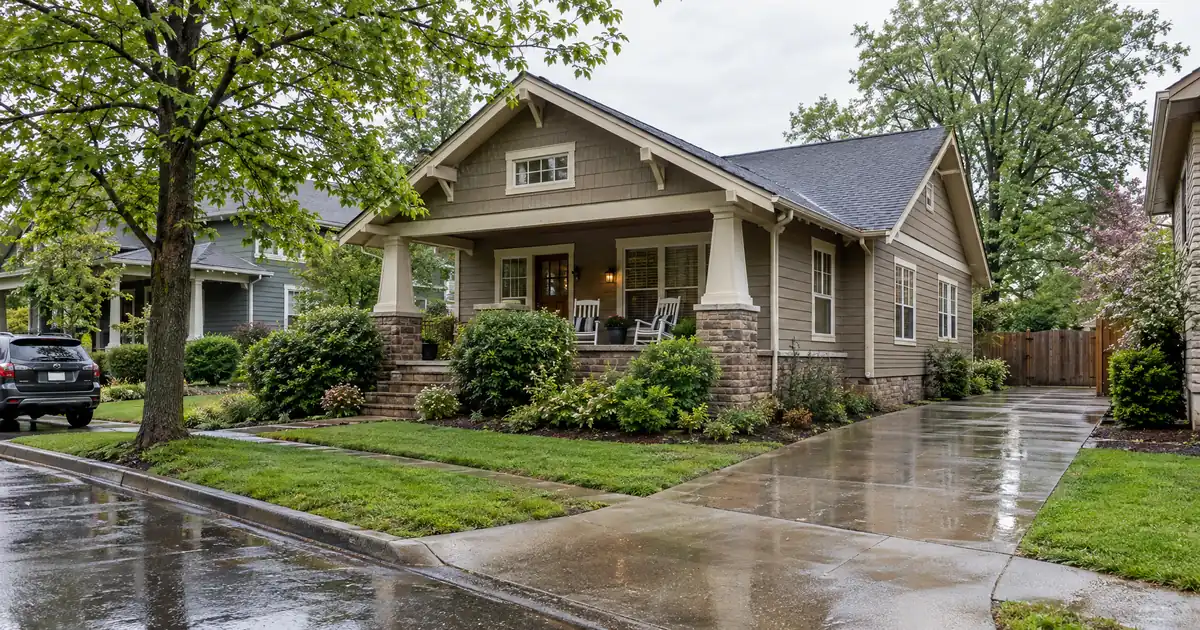
The Quick Read: Yes, whenever the rental sits in a mapped high-risk flood zone, a DSCR lender will attach a flood insurance condition to the loan. Outside those zones it is usually not required, though a lender can still ask for it by contract. The premium also lands inside the monthly obligation your rent has to cover.
- High-risk zones (the A and V zones on the federal flood map) trigger the requirement on most programs.
- A standard landlord policy excludes flood, so you buy a separate flood policy.
- The premium counts in the payment, so it lowers your coverage ratio even when rent stays flat.
- Coverage generally has to stay in force for the life of the loan, not just at closing.
- Details differ by lender, so confirm the zone and get a flood quote before you go under contract.
Key Terms Defined
You will see these terms throughout, so here they are in plain English.
DSCR (debt service coverage ratio) is the property’s monthly rent divided by its monthly housing obligation. A result of 1.00 means rent covers the obligation exactly.
PITIA is principal, interest, taxes, insurance, and any association dues. It is the monthly obligation in the denominator of the DSCR calculation.
Special flood hazard area (SFHA) is the federal flood map’s label for high-risk zones, which start with the letter A or V.
Flood determination is the lender’s official check of whether a specific building sits inside one of those zones.
NFIP is the National Flood Insurance Program, the federally backed program that sells flood policies. Private insurers sell flood coverage too.
Mortgagee clause is the wording on the policy that names the lender as the party to be paid if there is a loss.
LOMA (Letter of Map Amendment) is a federal document saying a specific building sits above the mapped flood level and does not belong in the high-risk zone.
DSCR Calculator
Run the numbers in your market
Rate source: Freddie Mac 30-yr average via FRED® — Federal Reserve Bank of St. Louis · effective Oct 15, 2026
Prefilled with starting assumptions — enter your own rent or nightly figures, taxes, insurance, and HOA for a more accurate picture.
Program parameters update from Lendmire’s centralized guideline source. Taxes and insurance are editable estimates.
As of Oct 15, 2026 · General Freddie Mac market benchmark, not a Lendmire loan offer. Rent, nightly rate, occupancy, taxes, and insurance are editable estimates. Short-term rental figures are estimates only and vary significantly by season, property type, management approach, and local short-term-rental rules — confirm local regulations before relying on them. Qualifying income for short-term rentals varies by program — some use appraisal market rent, others use documented STR history or projections — and is confirmed in underwriting. Not a Loan Estimate, approval, or commitment to lend. Program availability and eligibility are subject to lender guidelines, credit approval, property review, and underwriting.
What Does the Flood Zone Label Actually Mean for Your Loan?
The zone letter decides whether flood coverage is a hard condition or a judgment call. High-risk A and V zones almost always bring a flood insurance requirement. Zone X sits outside the high-risk area, so coverage is usually not required unless the lender adds it.
Here is how the main situations break down.
| Situation | What lenders typically do | Your move |
|---|---|---|
| High-risk zone (A or V) | Require a flood policy | Quote it before you offer |
| Zone X, outside the high-risk area | Usually no requirement | Ask if the lender adds one |
| Community outside the national program | Rules loosen, lender may still ask | Ask about private coverage |
| Letter of Map Amendment in hand | Lender reviews, may keep requirement | Send the letter early |
Two details catch investors off guard. First, if any part of a building sits in the high-risk zone, the whole building is treated as inside it. A property with a clean front yard and a mapped back corner still carries the condition.
Second, flood is not only a beachfront problem. Low-lying inland lots, creek-adjacent streets, and neighborhoods near drainage channels sit in high-risk zones all the time. Check the map for every deal, whatever the region.
How Does a Lender Decide, and in What Order?
The lender’s own flood determination controls, not a listing site and not an insurance agent’s guess. A listing may say “not in a flood zone” while the lender’s check says otherwise. The lender’s answer is the one that sets your conditions.
The order of operations usually runs like this:
1. Check the map before you offer. Look up the address on the federal flood map yourself so you are not surprised later.
2. Get a real flood quote. Premiums depend on more than the zone letter, so an estimate from the zone alone is a guess.
3. Run coverage with the premium in it. Rerun your ratio with the flood premium added to the monthly obligation.
4. Go under contract and apply. The lender orders its own determination as part of the file.
5. Bind the policy. The lender wants proof of coverage with the right lender wording and an effective date that works for the file.
6. Keep it renewed. The condition does not end at closing.
A fresh flood quote is the item most often skipped. Many investors run coverage on last season’s insurance numbers, then find the file looks different once flood is added. Across the wholesale network, a stale insurance figure is one of the most common reasons a rental’s coverage ratio shifts late in the process.
Why Is the Answer Yes for a Business-Purpose Loan?
The short version is that the law and the lenders both point the same direction, though through different doors. A federal statute, the Flood Disaster Protection Act, bars federally regulated lenders from making, increasing, extending, or renewing a loan on a building in a high-risk zone unless it carries flood insurance. That applies where the community takes part in the national program. The OCC’s Comptroller’s Handbook on the act lays out that mandate and the coverage rules that follow from it.
Here is the nuance most investors miss. DSCR loans are business-purpose, non-agency loans, and they are often made by non-bank lenders. The statute does not directly reach every one of those lenders.
So why does the condition still show up? For a non-bank DSCR lender, flood insurance in a high-risk zone is typically a program and contract requirement. The lender writes it into its guidelines, and you agree to it when you sign. Where a bank or other regulated entity holds or funds the loan, the statutory requirement can apply on top of that.
Business-purpose status does not exempt you either way. The forum chatter that says DSCR loans are commercial, so no flood insurance applies, has it backward in practice. Whatever the legal source, the practical result in a high-risk zone is that coverage is required.
Is Flood Insurance Required on a DSCR Loan Outside a Flood Zone?
Usually not, but a lender is allowed to require it. Outside a high-risk zone, no federal mandate applies, yet a lender can make flood coverage a contract term anyway. That is the same contractual route that makes the requirement stick for non-bank lenders in high-risk zones.
On most files, Zone X properties close without a flood policy. A few programs in the network ask for coverage in moderate-risk areas, on older buildings, or on properties with a flood history. The only way to know is to ask the lender for its insurance guidelines up front.
Even when no one requires it, you may want it. A standard landlord policy does not pay for flood damage. If the property is in a low-lying area and you own it free and clear, the choice is yours, but the risk is real. A lender’s requirement and your own risk tolerance are two separate questions.
What Does the Flood Policy Have to Look Like?
The policy has to cover the building, name the right parties, and stay in force. The details below are where files get stuck.
Amount. For federally regulated lenders, the required amount is at least the lesser of the outstanding loan balance or the maximum coverage available for that building type. Land is excluded because flood policies do not insure it. DSCR programs set their own amounts, so ask what yours requires.
The national program’s limits. For a 1–4 unit residential building, the national program tops out at $250,000 of building coverage and $100,000 of contents, according to FEMA’s Risk Rating 2.0 guide for 2–4 family buildings. For non-condo residential buildings with five or more units, the OCC handbook puts the building limit at $500,000, with $100,000 of contents.
That ceiling sits below the loan balance or replacement cost on many rentals. A small private market sells excess coverage above those limits for 1–4 unit buildings. Whether your program requires the excess layer is a program question, so raise it early.
Federal or private. Many investors compare both. A private policy can price differently from the national program, sometimes by a wide margin, and some programs accept it while others prefer the federal policy. Get both quotes, then confirm acceptance with the lender before you bind anything.
Names and wording. The lender must appear correctly on the policy through the mortgagee clause, with the right effective date. If the property is titled in an LLC, the policy should name that entity, subject to lender program eligibility. A mismatched name or a missing lender clause is a classic late-file fix.
Condos and multi-unit buildings. Master-policy and unit-level flood treatment varies by program. Ask which policy carries the building coverage before you assume the association’s policy satisfies the lender.
For a deeper look at how landlord coverage and flood fit together on these loans, see Lendmire’s piece Does a DSCR Loan Require Landlord Insurance and Flood Coverage?.
DSCR vs. conventional financing
There are two common ways to finance an investment property, and they qualify you differently — here’s how investors weigh them.
Why investors choose it
- Qualifies on the property’s rental income — no personal tax returns, W-2s, or pay stubs needed to document income.
- No personal debt-to-income ceiling to clear, so existing mortgages and obligations don’t cap your borrowing the same way.
- Can be closed in an LLC, keeping the property inside a business entity.
- Built for scaling — not held to the limit on number of financed properties that conventional financing applies.
- Underwriting centers on the deal: generally qualifies when the rent covers the payment, a 1.00x coverage ratio being a common baseline (confirmed in underwriting).
- Designed specifically for investment property, including long-term and, where the program allows, short-term rentals.
Where it’s strong
- Often the lowest ongoing financing cost for a buyer who fully qualifies on personal income — a fit for a first property or a cost-first purchase.
Trade-offs for investors
- Requires full personal income documentation and must fit within a debt-to-income limit — salary, existing debts, and other mortgages all count.
- Typically held in your personal name rather than a business entity.
- Caps how many financed properties you can carry, which can become a ceiling as a portfolio grows.
- Evaluates you as a borrower as much as the property, which usually means more paperwork.
How investors usually choose: a first or single property often optimizes for the lowest financing cost; portfolio builders often optimize for leverage, vesting in an LLC, and scaling past conventional caps. The right answer depends on your goals, the property, and current guidelines — both paths run through select lenders in Lendmire’s wholesale network, with eligibility and terms confirmed in underwriting.
What Does Flood Insurance Do to Your DSCR?
It lowers the ratio, because the premium joins the monthly obligation your rent must cover. The lender divides rent by PITIA, and flood premiums sit inside that insurance line. Rent does not change, but the denominator grows.
Run the numbers this way, using modeled assumptions rather than market data. Say you are buying a duplex at 75% LTV on an investment-property purchase, and rent covers the monthly obligation at 1.25x before flood. Now add a flood premium that raises the total obligation by 10%. Coverage drops to about 1.14x. Terms vary by lender guidelines, property type, leverage, credit profile, and full file review.
If the premium raises the obligation by 25%, coverage lands at 1.00x. That is the break-even. Any increase beyond it pushes the file below 1.00x.
That breakpoint matters because 1.00 is where many select programs start. A separate select-lender path takes coverage below 1.00, with leverage and terms adjusted. Neither path is automatic, and both depend on lender guidelines, credit approval, and property review.
Two more points keep the math honest.
First, the premium can be escrowed or paid directly, but lenders typically count it in the obligation either way. Skipping escrow does not make the cost disappear from the ratio.
Second, clearing 1.00 is not the same as positive cash flow. DSCR compares rent to PITIA only. Repairs, vacancy, management, utilities, and capital expenses all sit outside the calculation. A flood-zone rental that passes the test can still be a thin deal once real operating costs are in.
Flood pricing is also not stable. Rating changes and map updates can move a premium from one renewal to the next.
What If Flood Pushes the Deal Under the Line?
You have several levers, and each one trades something. Sometimes the answer is a better quote. Sometimes it is a different deal.
| Option | What it does | Tradeoff |
|---|---|---|
| Compare federal and private quotes | May cut the premium | Lender must accept the policy |
| Raise the deductible | Lowers the premium | More out-of-pocket risk |
| Put more down | Shrinks the loan payment | Leverage caps still apply |
| Interest-only structure | Lowers the monthly obligation | Select lenders only |
| Sub-1.00 path | Allows coverage below 1.00 | Select lenders, adjusted leverage |
| Renegotiate the price | Improves the whole equation | Seller must agree |
A larger down payment lowers the monthly payment and can lift the ratio. It never erases the other rules, though. Leverage caps, credit floors, reserve requirements, and property eligibility still apply. The strongest files clear both tests: enough equity and enough rental coverage. Exact terms depend on the lender’s guidelines, property type, leverage, and a full review of the borrower’s file.
For context, most purchase files on investment properties land at 75%–80% LTV. A cash-out refinance on a standard rental tops out around 75%. Most programs want a credit score near 660, a floor of 620 exists in parts of the network, and 700 and above unlocks the strongest leverage. Reserves are commonly around 6 months of PITIA, stepping up to about 9 months for loans above $1,500,000. Every figure is a typical range, subject to lender guidelines, and none is a commitment to lend.
Interest-only and extended terms are available through select lenders in the network. They can help a tight file, but they come with their own pricing and leverage adjustments.
Can You Get Out of the Requirement?
Sometimes, but do not count on it. The usual route is a Letter of Map Amendment or a Letter of Map Revision. Only the federal flood agency can revise maps or make the flood-level determinations that exempt a loan. A lender cannot swap in its own reading of elevations.
Even with the letter in hand, the lender must receive it before any waiver applies. The lender may then keep the requirement anyway if it considers that prudent. An elevation certificate or a surveyor’s report alone does not remove the zone, and a pending application does not end the condition.
Treat remapping as a possible upside, never as the plan. If the numbers only work without flood coverage, the deal does not work yet.
The reverse can happen too. A map update can pull a property into a high-risk zone mid-loan. Because the requirement runs for the term of the loan, a lender can ask for coverage at that point.
Four Things Investors Get Wrong
Cash buyers are not exempt forever. If you pay cash, no lender requires flood coverage on day one. The moment you finance or do a cash-out refinance, the lender sees the high-risk zone and attaches the condition. Plan the exit with that in mind.
The national program does not cover the whole property. Building limits are capped and land is excluded. Your loan balance can exceed the maximum coverage.
A standard landlord policy does not include flood. Water that rises from outside needs its own policy, and rent-loss coverage is a separate conversation with the insurer.
The requirement is not a one-time closing item. Lapses, renewals, and map changes matter long after the file funds. Letting a policy lapse can trigger lender-placed coverage, which is rarely a more affordable option. The tax angle on premiums varies by situation: tax treatment can depend on how the funds are used and how the property is held, so keep clear records and speak with a qualified tax professional before relying on any deduction.
Your Pre-Offer Checklist
Before you go under contract on anything near water, low ground, or a mapped zone, run through these steps.
- Look up the zone on the federal flood map.
- Request flood quotes from both the federal program and a private carrier.
- Rerun your coverage ratio with the premium included.
- Ask the lender whether a flood-zone property changes leverage, eligibility, or reserves on its program.
- Ask whether it accepts private policies and what coverage amount it wants.
- Confirm how the policy should be titled if the property sits in an LLC.
- Ask about condo or multi-unit treatment if either applies.
- Add lease language and renters insurance requirements to your landlord checklist.
To see how this fits into the rest of DSCR financing, the complete DSCR loans guide walks through qualification from start to finish.
Frequently Asked Questions
Do I need flood insurance if my rental is in Zone X?
Usually not. Outside a high-risk zone, there is no federal mandate, and most programs do not require a flood policy. A lender can still add the requirement by contract, particularly for low-lying lots or properties with a flood history, so ask for the written insurance guidelines.
Can I skip flood insurance and self-insure?
Not on a financed property in a high-risk zone. The flood policy is a condition of the loan, and the lender needs proof of it. If you want to carry the risk yourself, the options are paying cash or finding a Zone X property.
Does the flood premium count against my DSCR?
Yes. The premium becomes part of PITIA, so it increases the monthly obligation and lowers the ratio. A flood quote that adds 25% to a 1.25x file leaves it at about 1.00x. Price the deal with the real quote, not the zone letter.
Will a private flood policy work instead of the federal one?
Often, but acceptance depends on the program. Private quotes can come in lower, and they can also carry different terms. Confirm with the lender that it accepts the policy, and check the coverage amount and lender wording before you bind it.
What happens if the flood map changes after I close?
If a map update puts the property in a high-risk zone, the lender can ask for coverage because the requirement runs for the life of the loan. If an update takes the property out, the lender still decides whether to release the condition after receiving the paperwork.
Next Steps
If you are buying or refinancing a rental property and want to see how the numbers work, Lendmire can help you compare DSCR loan options based on the property income, credit profile, leverage, and investor goals. Lendmire is a mortgage broker arranging DSCR financing through select lenders in its wholesale network across 41 markets, including Washington, D.C. Qualification is subject to lender guidelines, and nothing here is a commitment to lend. Reach the team at 828-256-2183 or request a quote.
About Lendmire
Lendmire (NMLS# 2371349) is a mortgage brokerage focused on DSCR investor financing, helping arrange programs through wholesale and investor-lending channels in 41 markets, including Washington, D.C. DSCR loans are evaluated by the lender on property cash flow rather than personal income, subject to lender guidelines, supporting LLC closings and accommodating investors with four or more financed properties. Scotsman Guide Top Mortgage Workplace in both 2025 and 2026.
Get Started
Ready to find the right loan for you?
In about 30 seconds you can review financing options available for your investment property. No commitment required.
Informational only. Not a Loan Estimate, approval, or commitment to lend. Program availability and eligibility are subject to lender guidelines, credit approval, property review, and underwriting.
References
1. OCC Comptroller’s Handbook – Flood Disaster Protection Act
2. FEMA – Risk Rating 2.0 Simple Guide, 2–4 Family Building
This article is part of Lendmire’s DSCR loan program — full qualification details, guidelines, and scenarios live on the program page.
Related reading: Can You Refinance a Rental Awarded in Divorce With a DSCR Loan? · Is a 30-Year DSCR Loan Safer When Your Blanket Loan Matures? · How to Shop and Document Rental Insurance Before a DSCR Loan
Brandon Miller
Founder & CEO, Mortgage Loan Originator, Lendmire LLC
- Mortgage Loan Originator · NMLS# 1129696 · Verify on NMLS Consumer Access
- North Carolina Real Estate Broker · License# 343312 · Verify on NCREC
- North Carolina Insurance Producer · License# 19053198 · Property, Casualty, Life, Health · Verify on NAIC SBS
- Lendmire LLC · Firm NMLS# 2371349 · Verify firm licensure
Compliance and disclosures. Lendmire (NMLS# 2371349) is a licensed mortgage broker and is not a direct lender, depository institution, financial advisor, or tax professional. Content in this article is general market analysis and educational information — not financial, legal, or tax advice for any specific situation. Lendmire does not guarantee loan approval; every transaction is subject to underwriting by the funding lender. Mortgage pricing and loan program guidelines are subject to change at any time without notice and vary by borrower characteristics, property type, and state regulations. Lendmire complies with Equal Housing Opportunity. Licensure verification: NMLS Consumer Access.