
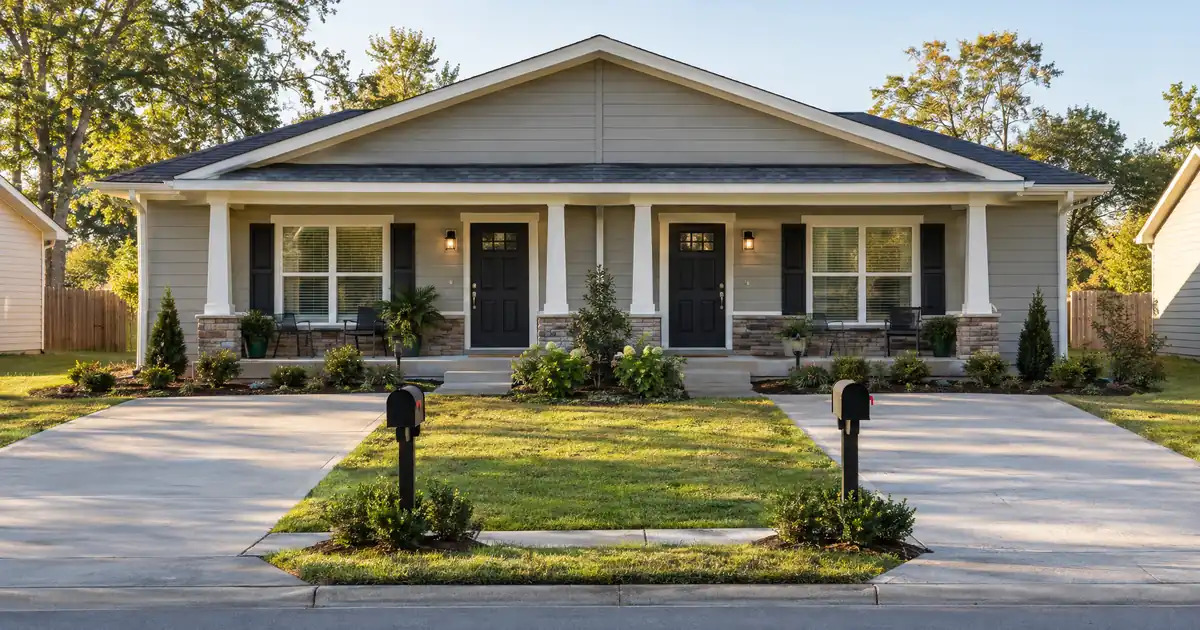
The Quick Read: Yes, but only when two conditions are both met: the note contains a partial release clause, and the side being sold is already its own legal parcel or condo unit that the lender holds as separate collateral. If the duplex sits on one deed, there is no “side” for the lender to release.
- A release clause is a contract term in the note, not a legal right.
- The half must have its own deed, parcel number, or recorded condo unit.
- The release price typically runs above that half’s allocated balance.
- The half you keep may be retested against the pooled coverage floor.
- An unsplit duplex needs lender consent to subdivide or convert before any release.
Investors who finance two properties under one note often treat the exit as an afterthought. With a split duplex, the exit is the whole question. This article walks through how a release works on a two-side pool, where it breaks, and what to settle before closing.
Why Can’t You Just Sell One Side of a Blanket-Financed Duplex?
You can’t because a blanket note secures everything it names, and a lender can only release what the recorded documents describe as separate collateral. A blanket DSCR loan, also called a portfolio or cross-collateralized loan, is one note secured by several rentals. Selling any part of the collateral without the lender’s consent can trigger the note’s due-on-sale language.
That language has federal backing. The due-on-sale statute, 12 U.S.C. § 1701j-3, defines the clause as one that lets a lender call the loan when “all or any part of the property” is sold without written consent. A Duke Law Journal note explains that the Garn–St Germain Act preempted state limits and authorized routine enforcement. The statute grants the borrower no partial-release right. If the note is silent, the lender owes you nothing.
The statute’s protected transfers do not rescue an arm’s-length sale either. Exceptions such as transfers to a spouse or child apply to residential property with fewer than five units, and they do not cover selling to a buyer. A transfer into an LLC is not protected, as WealthCounsel notes.
So the release clause is the contractual exception. It lets one piece leave the lien when a specified payment is made.
What Does “Split Duplex” Mean for the Lien?
It means the two halves must exist as separate legal collateral. A standard duplex is one building on one parcel, under one deed, with one tax parcel number, as LegalClarity describes. To a lender, that is a single property.
There are two ways a duplex becomes two sellable pieces:
- Lot subdivision. The land is divided into two parcels, each with its own deed. Zero-lot-line and twin-home layouts often start here.
- Condominium conversion. The airspace is divided into two units while land and structure stay shared. LegalClarity lays out both paths.
A quick test: two parcel numbers usually mean two legal parcels. One parcel number with two unit designations usually means a condominium. A title officer should confirm which one you have.
Co-ownership is not the same thing. A tenancy-in-common or “half-duplex” arrangement gives each owner an undivided share of the whole. It is not a separately deeded half and cannot be resold as its own home.
How Does a Release Work on a Two-Side Pool?
When each half is already separate collateral, the release follows a set sequence. The file is built at origination, then used at exit.
1. Allocation at origination. The note assigns each half an allocated loan amount. The release price is built from that allocation.
2. Release request before listing. Ask the lender for a release or payoff statement before the home goes on the market. The lender sets the release price.
3. Sale through title or escrow. The closing agent pays the lender the release price from proceeds.
4. Lien release recorded. The lender records a release of lien in the county where that half sits.
5. Retest of the half you keep. The remaining collateral may be reviewed for coverage and leverage.
The release price typically runs above the half’s allocated balance. Lenders want the loan to pay down faster than the collateral leaves. Net proceeds from the sale will therefore be smaller than a simple pro-rata view suggests. This is the number investors most often underestimate.
Wording matters too. A clause that says the lender “shall” release on stated conditions is a stronger position than one that says “may” release. For a fuller walkthrough of the request itself, see Lendmire’s guide How to Request a Release to Sell One House From a DSCR Blanket Loan.
Will the Half You Keep Still Qualify?
It may have to. Across the wholesale network, a 30-year portfolio DSCR loan typically measures coverage on the pool: pooled rent against pooled debt service, with a 1.00 floor on those structures, subject to lender guidelines. That pooling is a strength at origination, because a stronger property can offset a weaker one.
On a two-side pool, it becomes a risk at exit. Sell the stronger-rent half and the remaining half carries the leftover balance alone. The retest is common but note-specific, so the loan documents decide whether it applies and how it is measured.
Picture an investor who holds a duplex whose left side rents well above the right. Together the pool clears 1.00 comfortably. After the left side sells, the right side stands alone at a coverage near 0.9x. Depending on the note, the lender may ask for a larger paydown, cash in, or a refinance of the remainder. A rental below 1.00 can sit inside a pool, but underwriting tests the pooled coverage, the leverage and the terms together.
Remember what DSCR measures: rent against principal, interest, taxes, insurance and any HOA dues. Clearing 1.00 is not the same as positive cash flow. Repairs, vacancy, management and capital costs sit outside the ratio, so a half that “passes” can still be thin in practice.
What If the Duplex Is Still on One Deed?
Then no release is possible yet, because there is no separate collateral. The investor has four real options:
- Get the lender’s written consent, then subdivide or convert to condos before any release.
- Pay off or refinance the loan.
- Sell the whole building.
- Hold both sides.
Consent is the sticking point. Mortgages commonly carry condominium-conversion or due-on-sale language that requires written approval. Nixon Peabody describes the conditions a conversion clause may impose: prior written consent, lender approval of the declaration and condo documents, evidence of separate tax lots and insurance, counsel opinions, and payment of the lender’s costs.
Condo law is state-specific. The New Hampshire Condominium Act, for example, addresses separate titles and taxation for units, and other states handle it differently. Subdivision also needs surveys, legal descriptions and municipal approval. Confirm the steps with title, counsel and the local planning office.
One more wrinkle. A two-unit condo association is treated by many lenders as a small condo project, and a buyer’s lender may apply extra review. That can narrow the pool of buyers for your half.
What Must Be True Before a Release Works?
| Requirement | Why it matters |
|---|---|
| Separate deed or recorded condo unit | Lender can only release described collateral |
| Release clause in the note | No clause, no contractual right |
| Allocation per side | Sets the base for the release price |
| “Shall” vs “may” wording | Decides how firm the lender’s duty is |
| Post-release retest terms | Determines if the kept half must qualify alone |
| Lender consent for any split | Required if the duplex is not yet separate |
Adding a release clause later is difficult. Practitioners generally say to negotiate it at origination, because later changes need discretionary lender consent.
Release, Refinance, Separate Notes, or Sell Whole?
The right path depends on how likely a one-side exit is. This comparison frames the choice.
| Path | Best when | Main tradeoff |
|---|---|---|
| Blanket with release clause | Halves are separate collateral and an exit is plausible | Release price above allocation; possible retest |
| Separate notes from the start | One-side sale is likely | Two closings and two payments |
| Refinance one half out | No clause, halves already separate | Full refinance process on the pooled loan |
| Condo conversion first | Single deed, lender consents | Cost, approvals, project-review friction |
| Sell the whole building | Halves cannot be separated | Gives up the keep-one option |
A blanket gives one payment and one closing. Separate notes give each half free movement. If you expect to sell one side within a few years, separate notes may be the cleaner choice even though they cost more upfront. If you plan to hold both for the long term, the blanket’s simplicity may win.
One related trap: a “portfolio” loan that is really separate notes closed together has no blanket lien, so each note is paid off on its own. Confirm which structure you actually have. Lendmire’s piece How to Decide Whether to Split a Blanket DSCR Loan to Sell One Rental covers that decision from the portfolio side.
What Does a Broker See in Duplex Pools?
Across the wholesale network, two-property pools are where release terms get skipped. Most guidance and most lender conversation centers on larger portfolios. On a two-side duplex, the pool is so small that one sale changes everything. Investors who ask about allocation per side, order of release and retest terms before signing tend to avoid the surprises. Lenders in the network differ on all three, which is why comparing several is useful.
Small multifamily of five or more units is eligible only inside the rental portfolio term loan, a separate structure for five or more rentals under one loan. A duplex fits the 30-year portfolio DSCR loan, which takes 2 to 20 properties, including 2-4 unit buildings, subject to lender guidelines. Loan size on that structure runs from $300,000 to $5,000,000, with leverage up to 80% of value on a purchase or rate-and-term refinance, and a credit floor of 640 on the portfolio programs, with 680 or 720 on some. Cash-out on a portfolio loan stays at or below 75% of pooled value.
Manufactured and mobile homes are not reviewable on these programs.
Entity structure matters too. If the duplex sits in an LLC, subject to lender program eligibility, check whether selling one half to a new owner or moving each half to a different entity needs separate consent. Recourse loans also carry a personal guarantee, and that guarantee may continue after a property leaves the lien.
If you are weighing structure on a duplex or small building, Lendmire’s complete DSCR loans guide explains how the programs fit together, and Lendmire can compare options across its wholesale network.
Questions to Ask Before You Sign
- Will the lender allocate the loan per side, and how?
- Does the note have a release clause, and is it “shall” or “may”?
- Is the order of release restricted?
- Is there a retest on the remaining collateral, and what happens if it fails?
- Does the personal guarantee survive a release?
- What does the lender need to consent to a split?
Tax consequences of selling half a duplex depend on how the property is held and used, so tax treatment varies; consult a qualified professional.
Frequently Asked Questions
Can I sell one side if the duplex is on one deed?
Not through a release. With one deed, the lender sees one property and has no separate collateral to free. You would need lender consent and a subdivision or condo conversion first, or you would pay off the loan and sell the whole building.
What if the note has no release clause?
Then the lender has no duty to release anything. Selling part of the collateral can trigger due-on-sale language. Your options are a full payoff, a refinance, holding the property, or asking the lender to agree to a release, which is discretionary.
Can I add a release clause after closing?
Only with the lender’s agreement, and that agreement is discretionary. Practitioners generally advise negotiating the clause at origination, when the terms are part of the loan itself.
Does the half I keep have to qualify on its own?
It depends on the note. Many structures retest coverage and leverage after a release, and a strong-rent half leaving can weaken the remainder. Ask for the retest terms in writing before closing the loan.
Does a blanket loan work for just one duplex?
A blanket loan secures two or more properties under one note. For a duplex, that works only when each half is separate collateral, such as two parcels or two condo units. Otherwise a standard single-property DSCR loan is the usual fit.
If you are buying or refinancing a rental property and want to see how the numbers work, Lendmire can help you compare DSCR loan options based on the property income, credit profile, leverage, and investor goals. Program details are subject to lender guidelines, and nothing here is a commitment to lend.
About Lendmire
Lendmire, NMLS# 2371349, is a non-QM mortgage broker serving real estate investors in 41 markets, including Washington, D.C., through DSCR investor loan programs. Qualification is generally reviewed around the subject property’s rental income, not the borrower’s W-2 history — a practical fit for LLC-titled portfolios and self-employed investors. All scenarios remain subject to lender review and program guidelines. Two consecutive Scotsman Guide Top Mortgage Workplace recognitions (2025, 2026).
Get Started
Ready to find the right loan for you?
In about 30 seconds you can review financing options available for your investment property. No commitment required.
Informational only. Not a Loan Estimate, approval, or commitment to lend. Program availability and eligibility are subject to lender guidelines, credit approval, property review, and underwriting.
References
1. Cornell LII, 12 U.S.C. § 1701j-3
2. Duke Law Journal note on due-on-sale preemption
4. LegalClarity, duplex definition and classification
5. LegalClarity, splitting a duplex
6. Nixon Peabody, condominium conversions by borrowers
7. New Hampshire Condominium Act
This article is part of Lendmire’s DSCR loan program — full qualification details, guidelines, and scenarios live on the program page.
Related reading: How to Document a Below-Market Lease for a DSCR Loan · How to Protect a DSCR Loan File With a Backup Lender · How to Shop and Document Rental Insurance Before a DSCR Loan
Brandon Miller
Founder & CEO, Mortgage Loan Originator, Lendmire LLC
- Mortgage Loan Originator · NMLS# 1129696 · Verify on NMLS Consumer Access
- North Carolina Real Estate Broker · License# 343312 · Verify on NCREC
- North Carolina Insurance Producer · License# 19053198 · Property, Casualty, Life, Health · Verify on NAIC SBS
- Lendmire LLC · Firm NMLS# 2371349 · Verify firm licensure
Important disclosures. Lendmire (NMLS# 2371349) is a licensed mortgage brokerage. Lendmire is not a direct lender, depository institution, or financial advisor. All loan inquiries are subject to lender underwriting; this article does not constitute a commitment to lend. Rates, terms, and program guidelines are subject to change without notice and vary by borrower profile, property type, and state. Information in this article is general in nature and is not financial, legal, or tax advice. Equal Housing Opportunity. NMLS Consumer Access: nmlsconsumeraccess.org.