
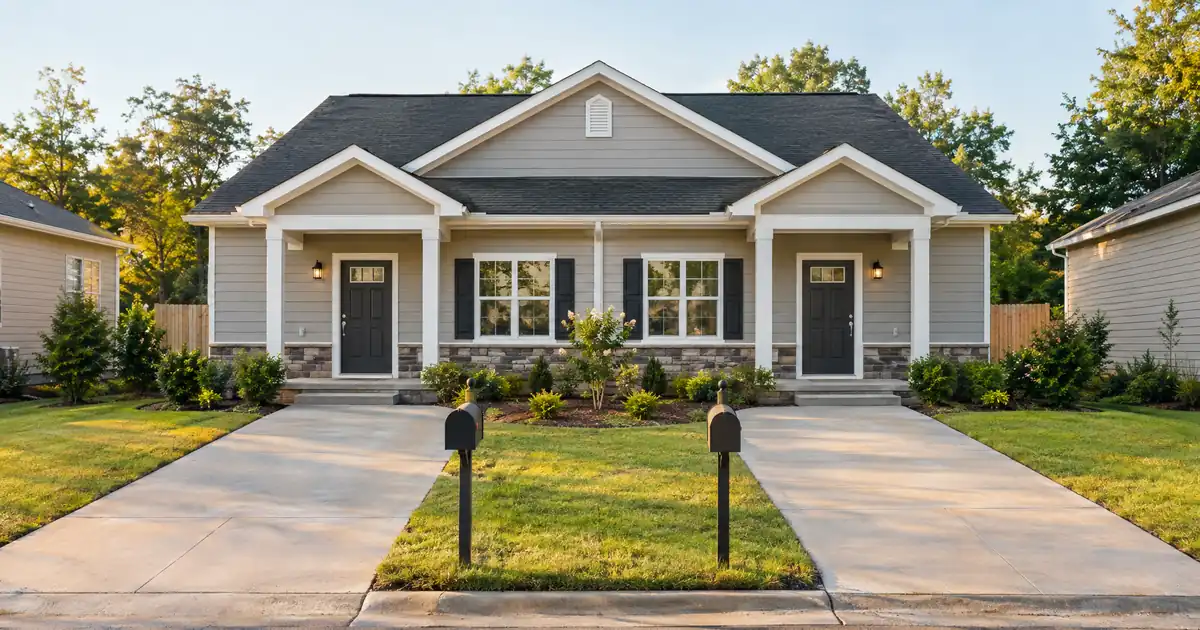
The Quick Read: Dividing a duplex that still carries a loan into two separately owned parcels works only when the building layout, the local approval process, and your current lender all agree, and the loan usually ends as a partial release, a refinance into two loans, or a payoff before any new deed is recorded. Each is judged on its own value and its own rent.
- Layout decides first. A side-by-side duplex with separate foundations can often be divided. A stacked duplex cannot be divided into land parcels.
- The loan note decides second. No borrower has a right to a partial release, so your documents control the path.
- Coverage gets measured per parcel. A strong side no longer props up a weak side.
- Order matters. Lender consent comes first, then local approval, then the release or refinance, then the deed.
Key Terms Defined
Parcel split (lot subdivision): a division of the land into two legal lots, each with its own deed and tax parcel number.
Condo conversion: a division of the airspace into two units while the land stays under shared ownership.
Partial release: the lender’s agreement to remove its lien from one parcel and keep it on the other.
Due-on-sale clause: a loan provision that lets the lender demand repayment if the property, or any part of it, is sold or transferred without consent.
Plat: the recorded map that shows the new lot lines.
Party-wall agreement: a recorded contract that sets who owns, maintains, and pays for the shared wall.
Cross-easement: a recorded right for one parcel to use part of the other, such as for access or utility lines.
Form 1007 and Form 1025: appraisal forms. The 1007 estimates market rent on a single-family property, and the 1025 reports rent for each unit of a two-to-four-unit property.
DSCR Calculator
Run the numbers in your market
Rate source: Freddie Mac 30-yr average via FRED® — Federal Reserve Bank of St. Louis · effective Oct 15, 2026
Prefilled with starting assumptions — enter your own rent or nightly figures, taxes, insurance, and HOA for a more accurate picture.
Program parameters update from Lendmire’s centralized guideline source. Taxes and insurance are editable estimates.
As of Oct 15, 2026 · General Freddie Mac market benchmark, not a Lendmire loan offer. Rent, nightly rate, occupancy, taxes, and insurance are editable estimates. Short-term rental figures are estimates only and vary significantly by season, property type, management approach, and local short-term-rental rules — confirm local regulations before relying on them. Qualifying income for short-term rentals varies by program — some use appraisal market rent, others use documented STR history or projections — and is confirmed in underwriting. Not a Loan Estimate, approval, or commitment to lend. Program availability and eligibility are subject to lender guidelines, credit approval, property review, and underwriting.
Can Your Duplex Be Split at All?
Your layout answers this before any lender does. Side-by-side duplexes with clear physical separation are the usual candidates. Stacked duplexes, and buildings where the units share a foundation, are generally not. LegalClarity draws the same line between lot subdivision and condo conversion, and it notes that each new lot must still meet local size, frontage, and setback rules.
| Layout | Parcel split feasible? | Why |
|---|---|---|
| Side-by-side, separate foundations | Often | Land divides along the party wall |
| Side-by-side, shared foundation | Rarely | Structure crosses the new line |
| Stacked (up and down) | No | No vertical land boundary exists |
| Building straddles proposed line | Rarely | Setbacks fail on one lot |
Zoning is the second screen. Investor Fuel, which profiles a builder who creates two deeded homes from new-construction duplexes, says feasibility depends entirely on zoning and local subdivision rules. Check minimum lot size, frontage, setbacks, and utility connections before you spend money on a survey. Some states also have by-right lot-split statutes, but local rules vary widely, so confirm yours with the planning office.
Parcel Split vs. Condo Conversion
This article covers the parcel route. The two structures look similar from the street, but they differ in title, paperwork, and lender treatment.
| Factor | Parcel split | Condo conversion |
|---|---|---|
| What divides | The land | The airspace |
| Title result | Two deeds, two lots | Two units, shared land |
| Typical paperwork | Plat, party-wall agreement | Condo documents, association |
| Lender view | Often single-family or townhome | Condo project review |
A parcel split keeps things simpler for financing. Many programs in our wholesale network treat a townhome-style parcel like a single-family property. A condo adds project-level review, and each program has its own condo rules. If your building can only be divided by airspace, you are in a different conversation.
Why Investors Split in the First Place
Two deeded homes can sell to owner-occupants as well as investors, which widens the buyer pool. Investor Fuel’s builder argues that this raises equity at exit. Separate parcels can also carry separate loans, so you can sell or refinance one side while you hold the other.
The cost is real. You may face title work, survey and legal fees, and a refinance or paydown on the existing loan. A split that adds exit options but weakens coverage on one side can leave you worse off.
What Happens to the Existing Loan?
The existing loan is the gating step, and your note decides what is possible. Federal law defines a due-on-sale clause as a provision that lets a lender call the loan when all or any part of the property, or an interest therein, is sold or transferred without written consent. Lenders may enforce those clauses even where state law says otherwise, and the loan contract governs the rights of both sides.
In plain terms, the law gives you no right to a partial release. If the note is silent, the lender does not have to release the lien on either half. The statute’s family-transfer exceptions, covered in the edge cases below, do not help with an arm’s-length sale of one half.
Three routes exist, and the choice depends on your note and your goals.
| Path | How it works | Best fit |
|---|---|---|
| Partial release | Lender frees one parcel, keeps the other | Note allows it, loan has equity cushion |
| Refinance into two loans | Each parcel gets its own new loan | No release right, or you want separate terms |
| Pay off and re-originate | Retire the old loan, finance fresh | Prepayment terms are manageable |
Partial release. The lender reviews your request, gives conditional approval, and then title or an attorney records the release documents. Expect the lender to ask for the survey or plat. It may require a paydown, fees, and final municipal approval. Some lenders simply decline, depending on the note.
Refinance. This is the usual route when no release right exists. A lender may accept the subdivision itself as long as its lien position does not change, yet still refuse to release one half. In that case you refinance the parcel you keep, or both parcels, before you deed anything. Tell the new lender about the split plan up front so the new loan reflects the reduced lot.
Payoff. This is the cleanest exit. Check your note for prepayment terms first, because those can change the math.
How DSCR Underwriting Changes After the Split
A DSCR loan qualifies primarily on property-level rental income covering the payment, subject to lender guidelines. The ratio divides monthly rent by the full monthly obligation: principal, interest, taxes, insurance, and any association dues, together called PITIA. Splitting changes the unit of measurement.
Before the split, the appraiser reports rent for both units on a Form 1025, and the lender looks at the building as one property. After the split, each parcel is its own collateral. We typically see a single-family or townhome-style report with a Form 1007 for each. Each parcel is then underwritten on its own value and its own rent. Treat that as typical, not a fixed rule, because every file is underwritten individually.
Three practical consequences follow:
- Rent gets tested per parcel. Most programs use the lower of the in-place lease rent or the appraiser’s market rent. A great lease does not rescue a parcel if market rent comes in lower.
- One weak side stands alone. Under one blanket loan, a strong unit offsets a weak one. Two separate notes remove that cushion.
- Pooled loans work differently. A pooled or blanket loan measures coverage and leverage across the whole pool, though each property still needs its own appraisal and rent support.
Program ranges for investment properties give you the target. On a purchase, most files land at 75%–80% LTV. On a cash-out refinance of a standard rental, the ceiling is around 75% LTV. Coverage of 1.00 is where many select programs start, and stronger ratios open better terms. A separate select-lender path accepts coverage below 1.00, with leverage and terms adjusted. A 620 credit score is the floor in parts of the network, most programs want around 660, and 700 or higher unlocks the strongest leverage tiers. Reserves typically run about six months of PITIA and step up to about nine months on loans above $1,500,000.
Clearing 1.00 does not mean the property produces positive cash flow. Repairs, vacancy, management, utilities, and capital expenses all sit outside the ratio. Our complete DSCR loans guide covers how the calculation works in full.
The Step-by-Step Sequence
Read your loan documents before you pay for a survey. The release language, consent requirements, and prepayment terms tell you which path is even open. The steps below follow the order that protects you from a default.
| Step | What happens | Who is involved |
|---|---|---|
| 1. Review loan documents | Find release, consent, prepayment terms | You, attorney |
| 2. Talk to the lender | Ask about release or refinance | Lender or broker |
| 3. Zoning pre-check | Confirm lot size, setbacks, utilities | Planning office |
| 4. Survey and plat | Draw the new lot lines | Licensed surveyor |
| 5. Municipal approval | Approve and record the plat | Local government |
| 6. Release or refinance | Clear the old lien or replace it | Lender, title company |
| 7. Deeds and agreements | Record new deeds, party-wall terms | Title company, attorney |
| 8. Insurance and tax setup | Separate policies and tax bills | Insurer, assessor |
Do not skip ahead. A deed recorded before lender consent risks a default. Municipal approval alone is only half the job, because without a release, selling a split-off parcel can trigger the due-on-sale clause.
Shared-Structure Issues
Two attached homes still share a wall, a roof line, and sometimes a foundation and utilities. A fee-simple split typically triggers a recorded party-wall agreement and often a maintenance agreement covering the roof, foundation, and exterior. LegalClarity describes the same package: a recorded plat, a party-wall agreement, and a separate tax parcel number for each lot.
Fire separation matters on existing buildings. Some jurisdictions want proof of a rated firewall along the dividing line, and a builder doing this from the ground up can design it in. Retrofitting an existing building is harder.
Cross-easements matter too. If one parcel’s water line or driveway crosses the other, record the right to use it. A lender and a title insurer both want to see that each parcel has legal access and working services. Each parcel also needs its own insurance policy, and lenders will want proof on each.
Each new parcel typically gets its own tax parcel number and its own bill. Tax treatment can depend on how the funds are used and how the property is held; investors should keep clear records and speak with a qualified tax professional before relying on any deduction.
DSCR vs. conventional financing
There are two common ways to finance an investment property, and they qualify you differently — here’s how investors weigh them.
Why investors choose it
- Qualifies on the property’s rental income — no personal tax returns, W-2s, or pay stubs needed to document income.
- No personal debt-to-income ceiling to clear, so existing mortgages and obligations don’t cap your borrowing the same way.
- Can be closed in an LLC, keeping the property inside a business entity.
- Built for scaling — not held to the limit on number of financed properties that conventional financing applies.
- Underwriting centers on the deal: generally qualifies when the rent covers the payment, a 1.00x coverage ratio being a common baseline (confirmed in underwriting).
- Designed specifically for investment property, including long-term and, where the program allows, short-term rentals.
Where it’s strong
- Often the lowest ongoing financing cost for a buyer who fully qualifies on personal income — a fit for a first property or a cost-first purchase.
Trade-offs for investors
- Requires full personal income documentation and must fit within a debt-to-income limit — salary, existing debts, and other mortgages all count.
- Typically held in your personal name rather than a business entity.
- Caps how many financed properties you can carry, which can become a ceiling as a portfolio grows.
- Evaluates you as a borrower as much as the property, which usually means more paperwork.
How investors usually choose: a first or single property often optimizes for the lowest financing cost; portfolio builders often optimize for leverage, vesting in an LLC, and scaling past conventional caps. The right answer depends on your goals, the property, and current guidelines — both paths run through select lenders in Lendmire’s wholesale network, with eligibility and terms confirmed in underwriting.
A Worked Example
Picture a side-by-side duplex held on one DSCR loan. These coverage figures are modeled assumptions, not market data.
Treated as one property, the building clears about 1.10x. Both units rent for similar amounts, and the combined rent covers the combined obligation with a small cushion. The east unit is newer and carries lower expenses, so on its own it would clear roughly 1.25x. The west unit has an older roof and higher insurance, so on its own it lands near 0.95x.
After the split, each parcel is judged alone. The east parcel looks strong on a refinance at standard leverage. The west parcel sits below 1.00, so it would need one of several adjustments. A select-lender path takes coverage below 1.00, with leverage and terms adjusted. More cash down lowers the monthly obligation and can lift the ratio. Better rent support can help too, but market rent still caps what counts. Eligibility depends on lender guidelines, credit profile, reserves, and property review.
The lesson is that the blended 1.10x was hiding a weak half. Run each side separately before you commit to the split.
Our experience with files like this is consistent. The deal that looks clean on paper often depends on the lender’s willingness to release a lien, not on the coverage ratio. Investors who ask the lender first, and survey second, avoid most of the expensive surprises.
Where the General Rule Breaks
LLC titleholder. Many DSCR borrowers hold title in an LLC, subject to lender program eligibility. Moving title or deeding a new parcel between entities can itself trigger a due-on-sale clause. Federal law lists exceptions for certain transfers of residential property with fewer than five units, but they mostly cover family and estate transfers, such as a transfer to a spouse or child. WealthCounsel notes that moving mortgaged property into an LLC is not protected. Get written lender consent before any new deed.
Blanket or portfolio loans. These sometimes carry a release clause. Release prices typically run above the allocated balance, and the remaining properties must still cover the loan. Lendmire’s piece Can an Investor With 30 Rentals Split Them Into Two 30-Year DSCR Loans? covers that family of structures.
Newly originated loans. Some lenders will not discuss a release on a recent loan. Terms are set by the note, so ask.
Stacked duplexes. These need a condo conversion, not a parcel split.
Ineligible structures. DSCR on manufactured homes, log homes, and barndominiums is not offered through the network’s programs. A split that leaves one of those on a parcel removes it from financing eligibility.
When Splitting Is the Wrong Move
Skip the split in these cases:
- The note refuses a partial release and refinancing would cost more than the added exit value.
- One side would land well below 1.00 and you cannot cure it with leverage or cash down.
- You plan to hold both sides long term, so the split adds cost without benefit.
- Zoning or the building’s structure makes the lot lines awkward.
Costs and timelines vary widely. Many investors find that keeping the duplex as one asset, or financing it as a duplex under a DSCR loan for duplexes, triplexes and fourplexes, is the better answer.
Mistakes That Stall or Void a Split
- Starting municipal approval before reading the loan terms.
- Recording a deed before the lender releases its lien.
- Assuming the family-transfer exceptions cover a sale to a buyer.
- Moving a parcel into a new LLC without written consent.
- Underwriting the split on blended rent instead of per-parcel rent.
- Skipping the cross-easement for shared utilities.
Frequently Asked Questions
Do I need my lender’s approval to split a duplex?
Yes, in practice. A survey and a recorded plat may not breach your loan by themselves, but selling or transferring a parcel can trigger the due-on-sale clause. Ask your lender before you record anything.
Can I split a duplex and sell one side right away?
Only after the lien question is settled. You need a partial release, a refinance of the side you keep, or a payoff. The buyer’s title company will not insure a parcel that still sits under your old lien.
Does a split force a refinance?
Not always. If your note allows a partial release, you may keep the existing loan on one parcel. Many lenders refuse a release, which makes a refinance the usual route.
Can a stacked duplex be split into two parcels?
No. A stacked duplex has no vertical land boundary, so the usual alternative is a condo conversion, which divides airspace instead of land.
Can each parcel carry its own DSCR loan?
Often, yes. Each parcel is typically appraised and underwritten on its own value and rent, subject to lender guidelines. Leverage, credit, and reserve rules apply to each loan separately.
If you are buying or refinancing a rental property and want to see how the numbers work, Lendmire can help you compare DSCR loan options based on the property income, credit profile, leverage, and investor goals. Lendmire is a broker that arranges these loans through select lenders in its wholesale network across 41 markets, including Washington, D.C., and nothing here is a commitment to lend.
About Lendmire
Lendmire (NMLS# 2371349), a non-QM mortgage broker serving investors in 41 markets including Washington, D.C., helps structure DSCR scenarios commonly evaluated around a property’s rental income rather than personal income paperwork, subject to lender guidelines. A Scotsman Guide Top Mortgage Workplace in 2025 and 2026, Lendmire places loans through wholesale investor lenders and is not a direct lender.
Get Started
Ready to find the right loan for you?
In about 30 seconds you can review financing options available for your investment property. No commitment required.
Informational only. Not a Loan Estimate, approval, or commitment to lend. Program availability and eligibility are subject to lender guidelines, credit approval, property review, and underwriting.
References
1. LegalClarity: Can You Split a Duplex Into Two Separate Properties
3. Cornell LII, 12 U.S.C. §1701j-3
4. FindLaw, 12 U.S.C. §1701j-3
5. LegalClarity: Is a Duplex a Condo or Townhouse
This article is part of Lendmire’s DSCR loan program — full qualification details, guidelines, and scenarios live on the program page.
Related reading: Can a Cash Buyer Get a Second Appraisal Before a DSCR Cash-Out? · How to Document a Below-Market Lease for a DSCR Loan · How Much a Lost Property Changes DSCR Terms Past Ten Financed Properties
Brandon Miller
Founder & CEO, Mortgage Loan Originator, Lendmire LLC
- Mortgage Loan Originator · NMLS# 1129696 · Verify on NMLS Consumer Access
- North Carolina Real Estate Broker · License# 343312 · Verify on NCREC
- North Carolina Insurance Producer · License# 19053198 · Property, Casualty, Life, Health · Verify on NAIC SBS
- Lendmire LLC · Firm NMLS# 2371349 · Verify firm licensure
Important disclosures. Lendmire (NMLS# 2371349) is a licensed mortgage brokerage. Lendmire is not a direct lender, depository institution, or financial advisor. All loan inquiries are subject to lender underwriting; this article does not constitute a commitment to lend. Rates, terms, and program guidelines are subject to change without notice and vary by borrower profile, property type, and state. Information in this article is general in nature and is not financial, legal, or tax advice. Equal Housing Opportunity. NMLS Consumer Access: nmlsconsumeraccess.org.