
The Quick Read:
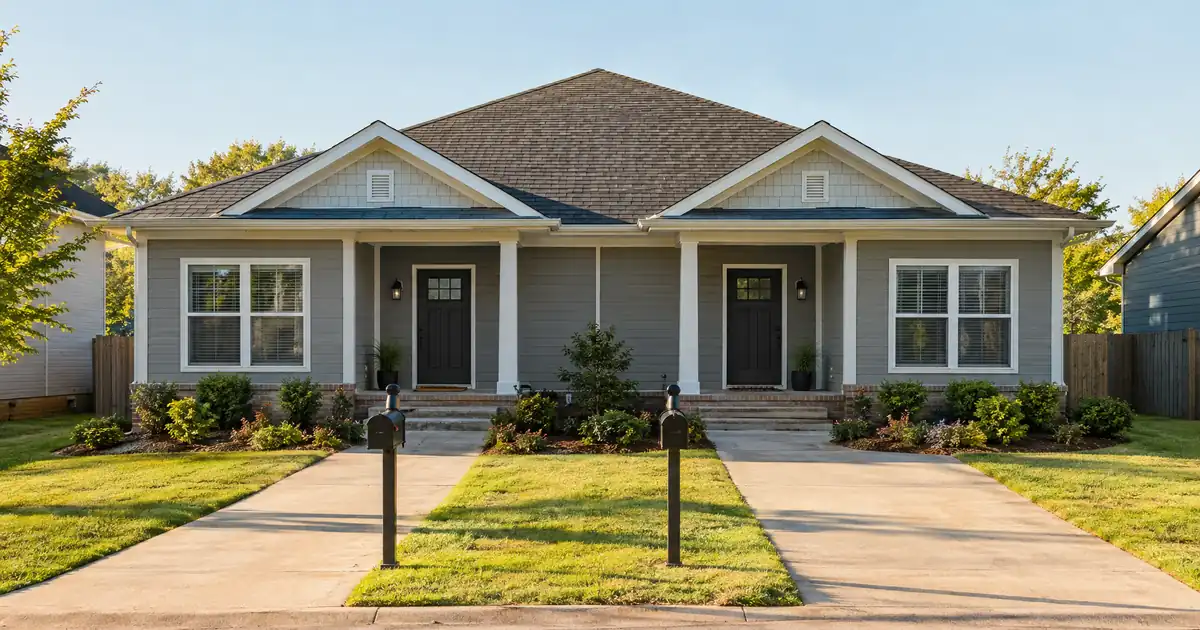
- A duplex on one deed has one lien, one tax parcel, and one rent schedule. There is nothing to carve out.
- “Half” becomes real only through a condominium regime, a lot split, or a build platted as two lots from day one.
- The release terms live in the loan documents. If they are silent, the lender decides, and it may ask for a payoff instead.
- The half you keep must still cover its own debt on its own rent.
- DSCR loans generally take out a finished property. The builder’s construction lender usually controls any release during the build.
Why Can’t You Just Sell One Side?
Because the lender’s lien covers the whole building until the lender agrees otherwise. Splitting a deed on paper does not change that. Neither does recording a condo declaration. The lender approved one asset, one income stream, and one repayment plan.
DSCR Calculator
Run the numbers in your market
Rate source: Freddie Mac 30-yr average via FRED® — Federal Reserve Bank of St. Louis · effective Oct 15, 2026
Prefilled with starting assumptions — enter your own rent or nightly figures, taxes, insurance, and HOA for a more accurate picture.
Program parameters update from Lendmire’s centralized guideline source. Taxes and insurance are editable estimates.
As of Oct 15, 2026 · General Freddie Mac market benchmark, not a Lendmire loan offer. Rent, nightly rate, occupancy, taxes, and insurance are editable estimates. Short-term rental figures are estimates only and vary significantly by season, property type, management approach, and local short-term-rental rules — confirm local regulations before relying on them. Qualifying income for short-term rentals varies by program — some use appraisal market rent, others use documented STR history or projections — and is confirmed in underwriting. Not a Loan Estimate, approval, or commitment to lend. Program availability and eligibility are subject to lender guidelines, credit approval, property review, and underwriting.
An attorney’s answer on Avvo makes the point plainly: recording a condominium declaration does not by itself release the mortgage on either unit. The lien still covers the entire property. Splitting without lender consent can also put you in technical breach of the mortgage.
Investors say the same thing in practice. In a BiggerPockets discussion on selling half a duplex, commenters note that a one-parcel duplex has one assessor ID and one mortgage. The usual fix is to pay off the loan and take a new one on the unit you keep. That thread is anecdotal, but it matches how collateral works.
Our view from placing DSCR files through a wholesale network of lenders is simple. Most DSCR notes are written for one property and are not built to be divided. Partial release is a negotiated exception, not a feature.
Key Terms Defined
Partial release: The lender’s recorded document freeing one parcel or unit from the lien while the rest stays pledged.
Allocated amount: The share of the loan balance the lender assigns to the piece being released.
Condo regime: A recorded declaration that turns one building into separately owned units, each with its own title.
Lot split: A subdivision that turns one parcel into two fee-simple parcels, often called a twin home or halfplex.
Cross-collateralization: Pledging more than one asset to secure the same loan, so each asset backs the whole debt.
Due-on-sale clause: A loan term that lets the lender demand repayment if the property, or part of it, is sold or transferred without consent.
PITIA: Principal, interest, taxes, insurance, and association dues. It is the monthly debt a DSCR test compares to rent.
Two Legal Ways to Make “Half” Real
You can create two sellable interests by condo conversion or by subdividing the lot. Both need local approval and recorded documents. Without one of them, the duplex sells as a single property. Osborne Homes, a builder, notes that selling one half takes either a formal subdivision into two titled parcels or a condo setup from the start.
| Factor | Condo regime | Lot split (halfplex) |
|---|---|---|
| What it creates | Two units, one shared parcel | Two separate fee-simple parcels |
| Shared elements | Governed by declaration | Party-wall agreement |
| Approvals | Declaration, local review | Subdivision, new legal descriptions |
| Association | Often needed | Can sometimes be avoided |
| Lender view | Reviews the declaration | Reviews plat and new parcels |
LegalClarity’s explainer on splitting a duplex describes condo conversion as turning one deed into two units. Each unit gets its own title and tax parcel number once the declaration is recorded. The Avvo answer adds the practical steps for a lot split: new legal descriptions, a survey, and separate parcel IDs from the county.
Not every duplex qualifies. Zoning, minimum lot size, and conversion rules all matter. A duplex buyer’s guide from Live Near Friends notes that not all duplexes are eligible for condo conversion. Check eligibility before you plan an exit around it.
What Does the Lender Look At?
A lender reviewing a release request looks at four things: consent, the release price, the retained collateral, and the paperwork. The terms depend on the note, the security instrument, and the lender’s own policy. Nothing makes them automatic.
Here is how that usually plays out.
1. Consent. The lender reviews your proposed declaration or plat before you record anything. LegalClarity reports that lenders typically also want evidence of separate tax lots and insurance, no-default certificates, and reimbursement of review costs.
2. Release price. In blanket-loan practice, the clause sets the amount paid to free a parcel. Lenders set it from the allocated balance and often above it. The exact figure is a contract term, so get it in writing.
3. Retained collateral. The lender typically expects the half it still holds to meet coverage tests on its own.
4. Paperwork. Title or escrow gets a release statement. The payoff comes from the seller’s proceeds. The lender then records a partial release or reconveyance, and the form varies by state.
The structure usually lands one of two ways. The lender releases one half for a payment and keeps the other as collateral. Or it pays off the whole loan and re-originates, usually as two loans.
Where Due-on-Sale Fits
The due-on-sale clause is why a quiet sale of half can backfire. Federal law, 12 U.S.C. §1701j-3, defines the clause as a provision letting a lender call the loan if “all or any part of the property, or an interest therein” is sold or transferred without prior written consent.
That statute does not give you a right to a partial release. It governs what lenders can enforce. The exemptions for residential property with fewer than five units cover things like certain family transfers, not selling half to a buyer. Have a real estate attorney confirm how it applies to your file.
Pricing and available terms vary by lender, borrower profile, property type, and full underwriting review.
Each Half Must Qualify on Its Own
After a split, each half stands or falls on its own rent. One half cannot borrow strength from the other. That is the part many sellers miss.
DSCR is a ratio of rent to PITIA. If rent covers the full monthly obligation exactly, the ratio is 1.00. Most DSCR files we place target 1.00 or better, and stronger ratios open better pricing and leverage. A separate select-lender path takes coverage below 1.00, with leverage and terms adjusted.
Run the test on the half you plan to keep. Say the stronger-renting side is the one you sell. The retained half may now carry the remaining balance on weaker rent, and the ratio can drop. Picture two units where one rents well above the other. Selling the better one can leave the keeper short of coverage.
Each half also needs its own appraisal and rent evidence once it is separate collateral. On most programs in our network, borrowers see purchase leverage land between 75% and 80% LTV, a cash-out refinance tops out around 75% LTV on standard rentals, and credit expectations start around 660 on most programs, with a 620 floor in parts of the network. Reserves commonly run around 6 months of PITIA. Those figures vary by lender, loan size, and transaction, and the retained half is tested against them again.
One caution. Clearing 1.00 does not mean the property cash flows. Repairs, vacancy, management, utilities, and capital costs sit outside the DSCR calculation. Size your exit with those in mind.
Construction Lender vs. DSCR Lender
DSCR loans generally finance a completed property, with the loan sized from its rent. Construction loans fund the build. During construction, your builder’s construction lender normally holds the release rights. Release clauses are a common feature of tract and development loans.
That sequence shapes your options. If you build with a construction loan, the cleanest time to separate the halves is before it closes or before the permanent loan is placed. Our piece How to Find a Lender Offering Bank Statement and DSCR Loans for New Construction covers where DSCR and construction financing meet.
DSCR financing in our network also has property limits. Manufactured homes (single- and double-wide), log homes, and barndominiums are not offered, so the duplex needs to be a conventional site-built or comparable structure.
DSCR vs. conventional financing
There are two common ways to finance an investment property, and they qualify you differently — here’s how investors weigh them.
Why investors choose it
- Qualifies on the property’s rental income — no personal tax returns, W-2s, or pay stubs needed to document income.
- No personal debt-to-income ceiling to clear, so existing mortgages and obligations don’t cap your borrowing the same way.
- Can be closed in an LLC, keeping the property inside a business entity.
- Built for scaling — not held to the limit on number of financed properties that conventional financing applies.
- Underwriting centers on the deal: generally qualifies when the rent covers the payment, a 1.00x coverage ratio being a common baseline (confirmed in underwriting).
- Designed specifically for investment property, including long-term and, where the program allows, short-term rentals.
Where it’s strong
- Often the lowest ongoing financing cost for a buyer who fully qualifies on personal income — a fit for a first property or a cost-first purchase.
Trade-offs for investors
- Requires full personal income documentation and must fit within a debt-to-income limit — salary, existing debts, and other mortgages all count.
- Typically held in your personal name rather than a business entity.
- Caps how many financed properties you can carry, which can become a ceiling as a portfolio grows.
- Evaluates you as a borrower as much as the property, which usually means more paperwork.
How investors usually choose: a first or single property often optimizes for the lowest financing cost; portfolio builders often optimize for leverage, vesting in an LLC, and scaling past conventional caps. The right answer depends on your goals, the property, and current guidelines — both paths run through select lenders in Lendmire’s wholesale network, with eligibility and terms confirmed in underwriting.
Three Sequencing Paths
You can split the duplex before the construction loan closes, after the certificate of occupancy but before the permanent loan, or take out the whole building and sort it out later. Each trades convenience for flexibility.
| Path | Pros | Cons | Best for |
|---|---|---|---|
| Split before construction loan | Two separate notes, no release talks | Platting and approvals come first | Builders planning to sell one half |
| Split after completion | Building is done, rents are clear | Needs lender consent at takeout | Investors who change plans late |
| Whole takeout, refinance later | Simplest to start | Any sale means payoff or consent | Long-term holders |
If each half already has its own note and lien, as on a pre-split new build, selling one side needs no release negotiation. That is the cleanest outcome, and it is only available if you plan for it.
If you expect to sell a side, decide at origination, not at listing. Ask whether the structure supports separate parcels or notes. Ask for the release terms in writing. Our broader complete DSCR loans guide covers the basics of how coverage, leverage, and reserves work across programs.
Step-by-Step Order of Operations
Follow this order and you avoid most of the traps.
1. Check zoning and minimum lot size for a split or condo conversion.
2. Decide on a condo regime or a lot split, and gather the survey, plat, or declaration.
3. Read the existing loan documents for release language and due-on-sale terms.
4. Ask the lender for written consent before recording anything.
5. Confirm the retained half meets coverage on its own rent.
6. Record the split and get separate tax parcel IDs.
7. Make any buyer’s contract contingent on the lender’s release.
8. Pay the release price at closing and have the lender record the partial release.
What Kills These Deals?
Most failures come from the same few causes. A duplex that is still one parcel is a common reason the answer is no.
- No release provision. Without a clause, the lender may decline or demand a full payoff.
- Recording first, asking later. A condo declaration recorded after closing does not free the lien, and the lender could call for payoff.
- Shared infrastructure. Common utilities, shared meters, easements, and party walls need written agreements.
- Municipal refusal. Zoning and subdivision rules can block the split outright.
- A weaker retained half. The remaining unit cannot carry the debt on its own rent.
- A higher release price than expected. If the price exceeds the allocated balance, your net proceeds shrink.
A resale note too. A halfplex can be harder to market and usually sells for less than a whole duplex, per Osborne Homes. That is general commentary, not a number. Buyers also need their own financing, and attached units can narrow the buyer pool.
Tax treatment varies; consult a qualified professional.
Questions to Ask Before You Close
Bring these to your lender, title company, and municipality.
- Does the note include a partial release provision, and what does it require?
- How is the release price set, and is it above the allocated balance?
- Will the lender consent in writing to a condo declaration or lot split?
- Does the remaining half need to meet a separate coverage test?
- What documents does the lender need: survey, plat, declaration, separate insurance?
- Will the county issue separate parcel IDs, and what does it require?
- Does the buyer’s lender have any attached-unit concerns?
Your Goal and the Likely Path
| Your goal | Likely path |
|---|---|
| Hold both halves long term | Single DSCR loan on the whole duplex |
| Sell one half after completion | Split first, then separate notes or negotiated release |
| Keep one half, refinance the other | Split, then place separate loans on each |
Frequently Asked Questions
Can I record a condo declaration to split my duplex after I have a DSCR loan?
You can record it, but the lien still covers the whole property. You need the lender’s written consent before recording, and the lender may demand a payoff or a new loan structure instead of a release.
Does a DSCR loan on a duplex include a partial release clause?
Not by default. A release clause is a contract term. Some loans include one and many do not, so read the note and security instrument before you count on it.
What if I only sell one side of the duplex to a family member?
That can trigger the due-on-sale clause, because a transfer of part of the property or an interest in it is covered. Get lender consent in writing first.
Can a DSCR loan fund the construction of the duplex?
Generally no. DSCR loans are permanent financing on a finished property, and a construction lender typically funds the build and holds release rights during it.
Will the half I keep qualify on its own?
It has to. The retained half must cover its remaining debt through its own rent, subject to lender guidelines, credit approval, and property review. Sub-1.00 coverage is available through select lenders in the network, with leverage and terms adjusted.
Plan the Exit Before You Plan the Loan
If you are buying or refinancing a rental property and want to see how the numbers work, Lendmire, a mortgage broker arranging DSCR financing through select lenders in its wholesale network across 41 markets including Washington, D.C., can help you compare DSCR loan options based on the property income, credit profile, leverage, and investor goals. Reach the team at 828-256-2183 before you break ground on a duplex you might want to sell in halves, since a split that is planned up front costs far less than one negotiated later.
About Lendmire
Lendmire is a DSCR-focused mortgage brokerage, NMLS# 2371349, placing investor loans across 41 markets, including Washington, D.C. DSCR eligibility is generally reviewed by the lender around a property’s rental income rather than personal income documentation, which fits LLC-held rentals, self-employed investors, and portfolios scaling past conventional financed-property limits. Scotsman Guide named Lendmire a Top Mortgage Workplace in both 2025 and 2026.
Get Started
Ready to find the right loan for you?
In about 30 seconds you can review financing options available for your investment property. No commitment required.
Informational only. Not a Loan Estimate, approval, or commitment to lend. Program availability and eligibility are subject to lender guidelines, credit approval, property review, and underwriting.
References
1. Avvo Legal Answers, duplex with one mortgage
2. BiggerPockets, tax consequence of selling half a duplex
3. Osborne Homes, are duplexes hard to sell
4. LegalClarity, splitting a duplex into two properties
5. Live Near Friends duplex guide
6. U.S. Code via GovInfo, 12 U.S.C. §1701j-3
This article is part of Lendmire’s DSCR loan program — full qualification details, guidelines, and scenarios live on the program page.
Related reading: DSCR Refinance Documentation for a Rental in a Life Estate · How a Community-Property Lender Counts Spouse Debt on an Airbnb DSCR Loan · DSCR Seller-Carry Second Requirements for a Purchase
Brandon Miller
Founder & CEO, Mortgage Loan Originator, Lendmire LLC
- Mortgage Loan Originator · NMLS# 1129696 · Verify on NMLS Consumer Access
- North Carolina Real Estate Broker · License# 343312 · Verify on NCREC
- North Carolina Insurance Producer · License# 19053198 · Property, Casualty, Life, Health · Verify on NAIC SBS
- Lendmire LLC · Firm NMLS# 2371349 · Verify firm licensure
Disclosure information. Lendmire is a state-licensed mortgage brokerage under NMLS# 2371349. Lendmire is not a depository institution, direct lender, or financial advisor — all loans referenced are placed through wholesale lender partners and are subject to each lender's underwriting standards. This article is provided for general informational purposes and is not a commitment to lend, nor does it constitute financial, legal, or tax advice. Loan programs, terms, rates, and qualification standards change without notice and depend on borrower profile, property type, and the state in which the subject property is located. Equal Housing Opportunity provider. NMLS Consumer Access: nmlsconsumeraccess.org.