
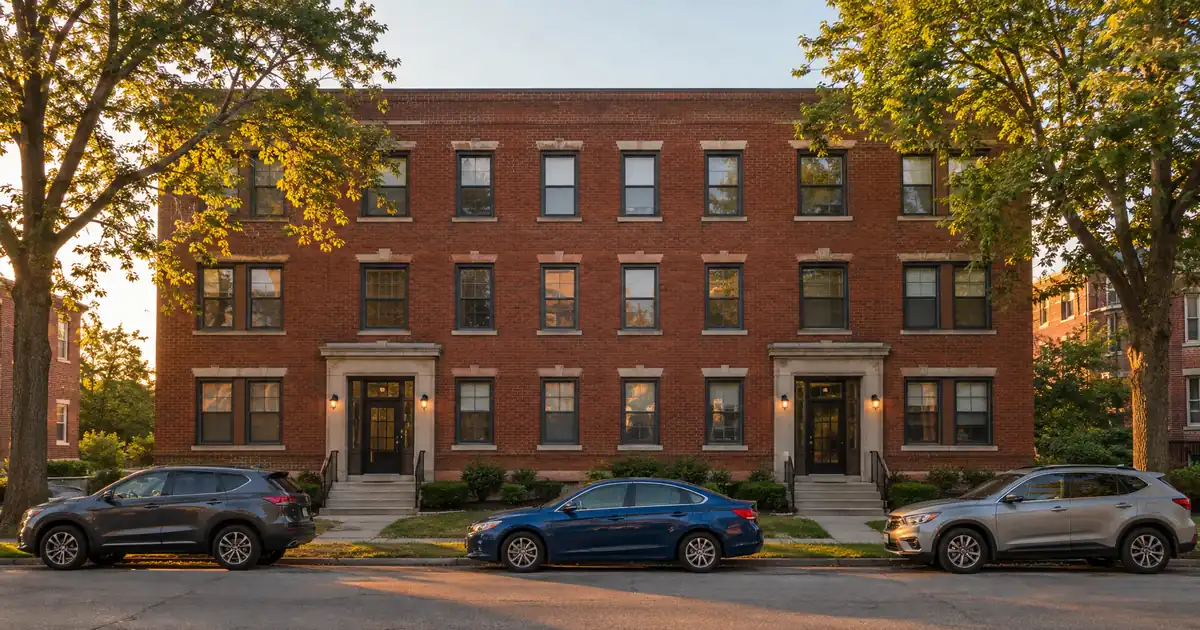
The Quick Read: A 10-unit building is judged on net operating income, not on one rent figure set against a payment. The underwriter takes your rent roll, leases, and trailing 12-month statement, rebuilds the income and expenses their own way, and divides the result by annual debt service. Your job is to hand over a statement that survives that rebuild.
- Build from in-place rents, not listing rents or seller projections.
- Reconcile the rent roll, leases, bank deposits, and statement before anyone else does.
- Expect the underwriter to add vacancy, a management charge, and sometimes a replacement reserve.
- Lender NOI and your own cash flow are different numbers, so keep both.
- Program terms vary by lender and by file, so confirm them before you price the deal.
Why Does Ten Units Change the Math?
At one to four units, a DSCR loan compares monthly rent to the full monthly payment. Starting at five units, the test generally becomes net operating income divided by annual debt service. Ten units sits well inside that second group, so the operating statement becomes the main exhibit in your file.
DSCR Calculator
Run the numbers in your market
Rate source: Freddie Mac 30-yr average via FRED® — Federal Reserve Bank of St. Louis · effective Oct 15, 2026
Prefilled with starting assumptions — enter your own rent or nightly figures, taxes, insurance, and HOA for a more accurate picture.
Program parameters update from Lendmire’s centralized guideline source. Taxes and insurance are editable estimates.
As of Oct 15, 2026 · General Freddie Mac market benchmark, not a Lendmire loan offer. Rent, nightly rate, occupancy, taxes, and insurance are editable estimates. Short-term rental figures are estimates only and vary significantly by season, property type, management approach, and local short-term-rental rules — confirm local regulations before relying on them. Qualifying income for short-term rentals varies by program — some use appraisal market rent, others use documented STR history or projections — and is confirmed in underwriting. Not a Loan Estimate, approval, or commitment to lend. Program availability and eligibility are subject to lender guidelines, credit approval, property review, and underwriting.
DSCR stands for debt service coverage ratio. It measures whether the property’s income covers its loan obligation. On a small rental, the lender checks rent against PITIA, which is principal, interest, taxes, insurance, and association dues. On a larger building, the lender checks what is left after the building pays its own operating costs.
Per EquityMultiple, NOI is gross income less operating expenses, and it leaves out debt service and capital expenditures. That one sentence explains most of the differences below.
| Factor | 1-4 units | 5+ units (your 10-unit) |
|---|---|---|
| Coverage test | Rent vs. PITIA | NOI vs. annual debt service |
| Taxes and insurance | Inside the payment | Operating expense lines |
| Income documents | Lease, rent schedule | Rent roll, leases, T-12 |
| Value method | Mostly comparable sales | Income approach, NOI-driven |
Lenders differ on details, especially on where taxes and insurance sit. A later section covers how to handle that.
Key Terms Defined
Net operating income (NOI): The building’s income after vacancy and operating expenses, before debt service, capital expenditures, and income taxes.
Rent roll: A unit-by-unit schedule showing tenant, lease dates, contract rent, deposits, and balances owed.
T-12: A trailing 12-month operating statement showing actual income and expenses for the most recent twelve months.
Effective gross income (EGI): Gross potential rent minus vacancy, credit loss, and concessions, plus documented other income.
Gross potential rent: What the building would collect if every unit were leased at its in-place rent all year.
Reserves (lender sense): Liquid funds the borrower must hold after closing, commonly measured in months of PITIA. Do not confuse these with a replacement reserve line inside the statement.
What Does the Statement Look Like, Top to Bottom?
The layout runs in a fixed order, and the order matters because each line feeds the next. Build it this way:
1. Gross potential rent. Use in-place rents from signed leases, not asking rents or pro forma rents.
2. Less vacancy, credit loss, and concessions. This produces income actually collected, or what you could expect to collect.
3. Plus other income. Laundry, parking, storage, and fees count only when bank deposits or ledgers show them.
4. Equals effective gross income.
5. Less operating expenses. Property taxes, insurance, owner-paid utilities, repairs and maintenance, management, payroll or admin, landscaping, pest control, trash, and marketing.
6. Divide by annual debt service. That gives the coverage ratio.
PropertyMetrics lays out the same sequence. It deducts vacancy and credit loss from potential gross income, then subtracts operating expenses. It also lists debt service, income taxes, and depreciation as typical exclusions, which is why a tax-return page is not the same thing as an operating statement. Tax treatment can depend on how the funds are used and how the property is held; investors should keep clear records and speak with a qualified tax professional before relying on any deduction.
Keep both sides of the ratio on the same period. Annual NOI goes over annual debt service. Mixing a monthly figure with an annual one is a classic way to get a number that looks wonderful and is wrong.
How Do You Assemble It, Step by Step?
Start with the document set, then work down the statement. Most files need a current rent roll, a sample of leases, a T-12, and year-to-date income and expenses. Some lenders also ask for the prior year.
Step 1: Build the unit-by-unit rent schedule. List each unit, its tenant, lease start and end, contract rent, deposit, and any concession. Mark vacant and month-to-month units clearly.
Step 2: Reconcile it to leases and deposits. Every rent on the roll should match a signed lease and show up in bank deposits.
Step 3: Apply vacancy and credit loss. Use what the building actually experienced, then expect the underwriter to compare it to a market or minimum figure.
Step 4: Add only supported other income. If laundry income cannot be traced to deposits, leave it off for now.
Step 5: Compile expenses by category. Pull from the general ledger, invoices, the tax bill, the insurance policy, and utility statements. Use one consistent chart of accounts across all twelve months.
Step 6: Choose the period. A T-12 is the usual base, with year-to-date figures alongside it.
Step 7: Reach NOI and compare it to debt service. Then run it again on the underwriter’s likely assumptions, which is where the next two sections come in.
The presentation matters more than most owners expect. A one-page summary on top, monthly columns behind it, and supporting schedules behind that make the file easier to read. An easy-to-read file gets fewer follow-up questions.
Which Document Feeds Which Line?
Each statement line needs a document behind it. When you cannot point to one, the underwriter will treat the line as unsupported.
| Statement line | Supporting document | Common pitfall |
|---|---|---|
| Gross potential rent | Rent roll and leases | Roll shows rents the leases do not |
| Vacancy and loss | Roll, ledger, deposits | Hiding concessions in rent |
| Other income | Bank deposits, ledgers | Cash income with no trail |
| Taxes | Current tax bill | Using the seller’s old bill |
| Insurance | Current policy or quote | Using a stale premium |
| Utilities | Utility statements | Missing master-metered costs |
| Repairs, management | Ledger, invoices | Zero management on self-managed |
The two lines owners get wrong most often are management and repairs. Management is often missing on self-managed buildings, and repairs often get mixed up with capital work.
Seller Version vs. Underwritten Version
Here is how one hypothetical 10-unit building moves from the seller’s statement to the underwriter’s. These inputs are modeled assumptions, not market data. To avoid dollar figures, gross potential rent is set to 100 points and everything else is measured against it.
Seller’s version
- Gross potential rent: 100 points.
- Vacancy and credit loss: 3 points.
- Other income: 3 points.
- Effective gross income: 100 points.
- Operating expenses: 38 points.
- NOI: 62 points.
- Annual debt service: 40 points.
- Coverage: 1.55x.
Underwritten version
- Gross potential rent: 100 points.
- Vacancy and credit loss at a market-style level: 5 points.
- Other income, only the part documented: 1 point.
- Effective gross income: 96 points.
- Seller’s expenses: 38 points.
- Management charged though the owner self-manages: 5 points.
- Taxes reset to the current bill: 3 points.
- Replacement reserve, if the lender includes one: 2 points.
- Total expenses: 48 points.
- NOI: 48 points.
- Annual debt service: 40 points.
- Coverage: 1.20x.
Same building, same loan, and the ratio fell from 1.55x to 1.20x. Nothing sinister happened; each change has a reason.
Now test your cushion. Add three more points of vacancy and NOI falls to 45, a ratio of 1.125x. Add three more points of tax increase instead and you get the same result. Do both and NOI is 42, a ratio of 1.05x. That is still above 1.00x, but with little room left.
If your own version lands below 1.00x, a separate path exists. Select lenders in the network offer coverage below 1.00, with leverage and terms adjusted, and each file is reviewed individually.
What Do Underwriters Actually Change?
Underwriters rebuild the statement because the seller’s version is a sales document and theirs is a credit document. The federal regulator’s guidance sits behind this approach. The OCC Comptroller’s Handbook on commercial real estate lending says the value of an income-producing property depends to a great degree on its expected NOI. That is why the lender cares so much about each NOI input.
An earlier edition of the same handbook explains the second part. NOI analysis may assume market vacancy rates and expenses that are not an immediate cash cost, such as management fees on owner-managed properties and capital replacement reserves. So the underwriter will not simply accept your self-managed P&L.
| Seller’s figure | Typical adjustment | Why |
|---|---|---|
| Low or zero vacancy | Market-style vacancy | Units turn over |
| No management fee | Management charged | Someone must run it |
| Old tax bill | Current bill, possible reset | Taxes follow the sale |
| Undocumented income | Excluded | No paper trail |
| One-time items | Normalized | Not recurring |
| No reserve | Reserve may be added | Roofs and boilers wear out |
The ratio on the table is therefore the lender’s ratio, not yours. Keep your own statement for your own decisions, and build the lender’s version next to it.
One pattern shows up often in files of this size. Owners who bring a reconciled rent roll and a clean T-12 get questions about the building. Owners who bring loose numbers get questions about the owner. The first conversation is much easier to have.
DSCR vs. conventional financing
There are two common ways to finance an investment property, and they qualify you differently — here’s how investors weigh them.
Why investors choose it
- Qualifies on the property’s rental income — no personal tax returns, W-2s, or pay stubs needed to document income.
- No personal debt-to-income ceiling to clear, so existing mortgages and obligations don’t cap your borrowing the same way.
- Can be closed in an LLC, keeping the property inside a business entity.
- Built for scaling — not held to the limit on number of financed properties that conventional financing applies.
- Underwriting centers on the deal: generally qualifies when the rent covers the payment, a 1.00x coverage ratio being a common baseline (confirmed in underwriting).
- Designed specifically for investment property, including long-term and, where the program allows, short-term rentals.
Where it’s strong
- Often the lowest ongoing financing cost for a buyer who fully qualifies on personal income — a fit for a first property or a cost-first purchase.
Trade-offs for investors
- Requires full personal income documentation and must fit within a debt-to-income limit — salary, existing debts, and other mortgages all count.
- Typically held in your personal name rather than a business entity.
- Caps how many financed properties you can carry, which can become a ceiling as a portfolio grows.
- Evaluates you as a borrower as much as the property, which usually means more paperwork.
How investors usually choose: a first or single property often optimizes for the lowest financing cost; portfolio builders often optimize for leverage, vesting in an LLC, and scaling past conventional caps. The right answer depends on your goals, the property, and current guidelines — both paths run through select lenders in Lendmire’s wholesale network, with eligibility and terms confirmed in underwriting.
Confirm the Lender’s Method Before You Build
Taxes and insurance. Some analysts treat them as operating expenses and compare NOI to principal-and-interest debt service. Others fold them into the debt side. The two methods give different ratios, so a mismatch will make your ratio look wrong. Ask which method the lender uses and match it.
Reserves inside NOI. Textbook NOI excludes replacement reserves. According to PropertyMetrics, most lenders include reserves for replacement in NOI when determining debt service coverage and maximum loan amount. That means lender NOI and investor NOI can differ by design. Leverage, reserves, and pricing vary by lender and program; the final terms follow the full file review.
Repairs vs. capital work. Bob’s Bookkeepers notes that operating expenses reduce NOI while capital expenditures do not, and misclassifying one as the other changes valuation and borrowing capacity. A new roof is capital. A patched roof is repairs. Label them honestly, because an underwriter will relabel them anyway.
Where the Rule Breaks: Special Situations
Ten-unit buildings rarely look like the clean example above. These are the cases that cause the most questions.
Self-managed buildings. The management charge still applies, as the example showed. Treat it as a line item, not an insult.
Missing seller history. On a new acquisition, you may have only the seller’s records. When history is thin, underwriters lean on the appraiser’s estimates and generic expense ratios, and those can come out higher than the seller’s actual costs. Gather every ledger, invoice, and deposit record you can get during due diligence.
Vacant and month-to-month units. Treatment depends on the program. Some underwrite vacant units at current in-place rent, which is zero, and others use a market-rent schedule. Confirm this with the lender before you assume either one.
A manager’s or owner’s unit. If someone lives in a unit rent-free, say so in the file and show whether it earns income. A related-party lease needs an explanation and market support.
A commercial or non-residential unit. Show its lease separately from the residential rent roll, with its own terms and tenant history.
Master-metered utilities. If the owner pays for water, gas, or electric for the whole building, those costs belong on the statement. Reimbursements from tenants belong in other income, and only when documented.
A refinance with messy books. Clean the ledger first. Reclassify items consistently, tie deposits to the roll, and write a short note explaining any unusual month.
What Does the Loan Side Look Like in Practice?
Operating statements decide coverage, but they are only half of the file. Across the wholesale network, most investment-property purchase files land at 75%-80% LTV, which is 20%-25% down. Select high-leverage programs reach 85% LTV on a purchase with roughly a 700+ score. Cash-out refinances on investment property top out around 75% LTV, with about six months of seasoning as the common expectation. Terms vary by lender guidelines, property type, leverage, credit profile, and full file review.
LTV means loan-to-value, the loan balance as a percentage of the property’s value. On 5-10 unit buildings, individual lenders may tighten these tiers, so treat them as typical ranges, subject to lender guidelines.
Credit works in tiers. A 620 floor exists in parts of the network, most programs want around 660, and 700+ unlocks the strongest leverage. Loan sizes reach up to $3,000,000 on standard programs, and above $2,500,000 the network generally holds to 30-year fixed structures. Reserves vary by lender, leverage, and loan size, commonly around 6 months of PITIA. Conservative rate-and-term files at modest leverage under $1,500,000 can see reserves waived, and larger loans typically step up to about 9 months.
On coverage, 1.00 is where select programs start. It is a floor for those programs, not a standard, and stronger ratios open better pricing and leverage. A separate select-lender path takes coverage below 1.00 with leverage and terms adjusted. No-ratio structures are available only through select lenders, generally for borrowers who already own a primary residence.
A bigger down payment lowers the payment and can lift the ratio. It does not erase leverage caps, credit floors, reserve rules, or property eligibility. The strongest files have enough equity and enough rental coverage. Term structures also matter: the 30-year fixed is the spine, while extended terms and interest-only periods are available through select lenders in the network.
One important caution: clearing 1.00 is not the same as positive cash flow. DSCR compares NOI to debt service only. Your own cash flow also has to cover capital projects, turnover costs, and anything the lender left out. As a mortgage broker, the Lendmire team can walk through how placing a 5 to 10 unit file through a broker compares with going to a lender directly. For the wider program picture, see the complete DSCR loans guide.
Tie-Out Checklist Before You Submit
Run these checks before the file goes anywhere.
- Rent roll total matches the sum of lease rents.
- Collected rent on the T-12 ties to bank deposits.
- Occupancy on the roll matches occupancy implied by collections.
- Every other-income line has a deposit trail.
- Taxes and insurance reflect current bills, not the seller’s old ones.
- Management is charged, even if you self-manage.
- Repairs and capital work are labeled consistently.
- Every unusual month has a short written note.
- Annual NOI and annual debt service cover the same period.
- You have run a version with higher vacancy and higher expenses.
Frequently Asked Questions
Do I need an operating statement for a building I just bought?
Yes, though it may be thin. Use the seller’s records, your own deposits since closing, and the current tax and insurance bills. Underwriters fill gaps with conservative assumptions, so more real documentation generally helps your ratio.
Will a seller’s pro forma be accepted?
Generally not as the basis for qualifying. Underwriters work from in-place rents and documented history. A pro forma can help you plan, but the lender’s version is built from what the building has actually done.
Why is the lender’s ratio lower than mine?
Usually because of added vacancy, an imputed management charge, reset taxes, and sometimes a replacement reserve. Each of those lowers NOI. Run your own statement on the lender’s assumptions and the gap will make sense.
How many months of history are needed?
A trailing 12 months is the usual base, with year-to-date figures. Some lenders also ask for a prior year.
Do reserves count as an expense?
It depends on the lender. Many include a replacement reserve inside NOI. Separately, the lender may require post-closing liquid reserves, commonly around 6 months of PITIA. These are two different things.
Next Step
If you are buying or refinancing a rental property and want to see how the numbers work, Lendmire (NMLS# 2371349) can help you compare DSCR loan options based on the property income, credit profile, leverage, and investor goals. As a mortgage broker, Lendmire arranges financing through select lenders in its wholesale network, with DSCR programs across 41 markets, including Washington, D.C. Final terms are subject to lender guidelines and individual file review. This is not a commitment to lend. Reach the team at 828-256-2183.
Ten-unit buildings reward the owner who treats the operating statement as the product: a reconciled, documented one makes the lender’s job easier and your own numbers more honest.
About Lendmire
Lendmire (NMLS# 2371349) is a DSCR-focused mortgage broker that helps arrange investor financing across 41 markets, including Washington, D.C., through wholesale and investor-lending channels. DSCR eligibility is generally reviewed by the lender around the property’s rental income rather than personal income documentation, subject to lender guidelines — which works for self-employed investors, LLC operators, and portfolios above four financed properties. Scotsman Guide named Lendmire a Top Mortgage Workplace in both 2025 and 2026.
Get Started
Ready to find the right loan for you?
In about 30 seconds you can review financing options available for your investment property. No commitment required.
Informational only. Not a Loan Estimate, approval, or commitment to lend. Program availability and eligibility are subject to lender guidelines, credit approval, property review, and underwriting.
References
1. EquityMultiple, What Is NOI in Real Estate
2. PropertyMetrics, Net Operating Income
3. OCC Comptroller’s Handbook, Commercial Real Estate Lending
4. OCC Comptroller’s Handbook, Commercial Real Estate Lending (earlier edition)
5. Bob’s Bookkeepers, Net Operating Income (NOI)
This article is part of Lendmire’s DSCR loan program — full qualification details, guidelines, and scenarios live on the program page.
Related reading: Can You Refinance a Rental Awarded in Divorce With a DSCR Loan? · Can an Investor With a W-2 Job Skip the Bank for a DSCR Loan? · How to Underwrite a Condo on a DSCR Loan With the Dues and Budget
Brandon Miller
Founder & CEO, Mortgage Loan Originator, Lendmire LLC
- Mortgage Loan Originator · NMLS# 1129696 · Verify on NMLS Consumer Access
- North Carolina Real Estate Broker · License# 343312 · Verify on NCREC
- North Carolina Insurance Producer · License# 19053198 · Property, Casualty, Life, Health · Verify on NAIC SBS
- Lendmire LLC · Firm NMLS# 2371349 · Verify firm licensure
Legal disclosures. Lendmire (NMLS# 2371349) is a state-licensed mortgage brokerage that arranges financing through wholesale lender relationships. Lendmire is not a direct lender, depository institution, or registered financial advisor. The discussion above is general informational content about real estate financing — it is not financial, legal, or tax advice, and readers should consult licensed professionals for guidance on their individual circumstances. Loan inquiries are subject to lender underwriting; this article does not represent a commitment to lend. Loan terms, rates, and qualification standards vary by borrower, property, and state, and are subject to change at any time. Equal Housing Opportunity. NMLS Consumer Access: nmlsconsumeraccess.org.