
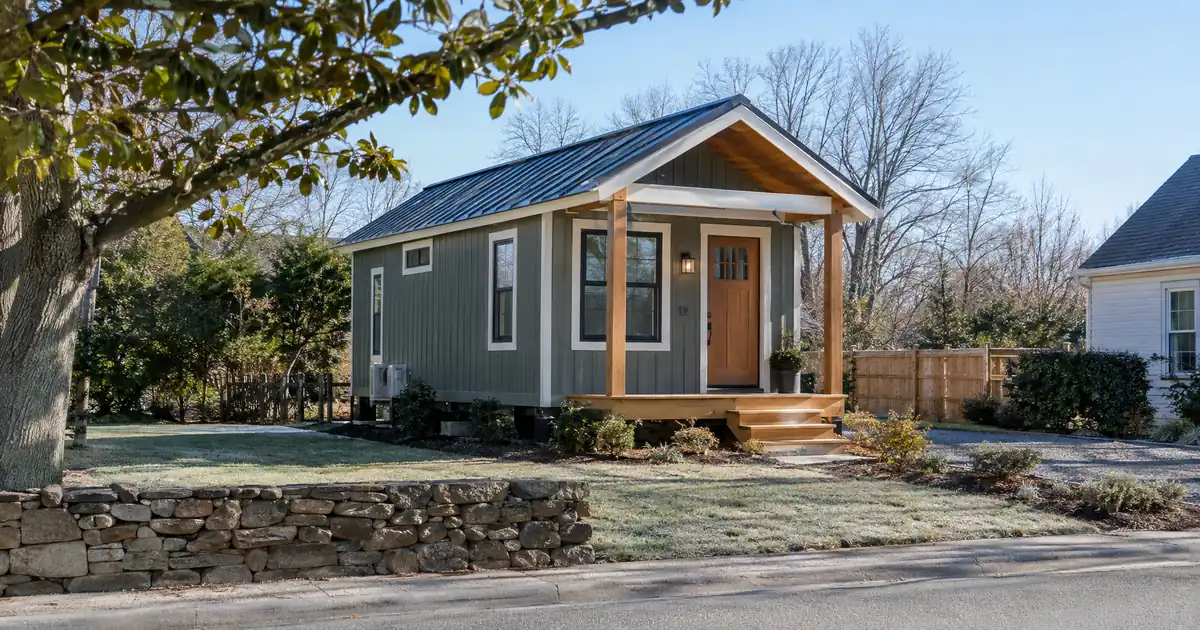
The Quick Read: Sometimes. A tiny home can qualify only when it is a permitted, foundation-built dwelling titled as real property, because classification decides eligibility, not rent. A tiny house on wheels is treated as personal property or an RV, so it falls outside mortgage-style DSCR underwriting. Even a qualifying unit still has to clear lender minimums for size, appraisal support, and rent coverage.
- Foundation, deeded, with a certificate of occupancy: potentially eligible, subject to lender guidelines.
- On wheels with a VIN and title: not offered through DSCR programs.
- Thin rent and sales comparables are the usual stumbling block.
- Strong Airbnb numbers do not count until there is hosting history.
- Manufactured homes, log homes, and barndominiums are not offered in the network at all.
Here is the straight version from the broker’s chair. Lenders look at the collateral first and the rent second. A DSCR loan is a business-purpose loan on a non-owner-occupied investment property, and it qualifies primarily on property-level rental income covering the payment, subject to lender guidelines. DSCR means debt service coverage ratio: monthly rent divided by the full monthly obligation (principal, interest, taxes, insurance, and any HOA dues). If you want the full mechanics, the complete DSCR loans guide walks through them.
DSCR Calculator
Run the numbers in your market
Rate source: Freddie Mac 30-yr average via FRED® — Federal Reserve Bank of St. Louis · effective Oct 15, 2026
Prefilled with starting assumptions — enter your own rent or nightly figures, taxes, insurance, and HOA for a more accurate picture.
Program parameters update from Lendmire’s centralized guideline source. Taxes and insurance are editable estimates.
As of Oct 15, 2026 · General Freddie Mac market benchmark, not a Lendmire loan offer. Rent, nightly rate, occupancy, taxes, and insurance are editable estimates. Short-term rental figures are estimates only and vary significantly by season, property type, management approach, and local short-term-rental rules — confirm local regulations before relying on them. Qualifying income for short-term rentals varies by program — some use appraisal market rent, others use documented STR history or projections — and is confirmed in underwriting. Not a Loan Estimate, approval, or commitment to lend. Program availability and eligibility are subject to lender guidelines, credit approval, property review, and underwriting.
A tiny home that fails the property test never reaches the rent test.
What Decides Eligibility: Wheels or Foundation?
Classification decides it. A tiny home on a permanent foundation, deeded with land, can be treated like a small single-family rental. A tiny house on wheels is generally personal property. That single fork routes you to completely different lenders.
| Factor | Foundation, deeded | On wheels (THOW) |
|---|---|---|
| Classification | Real property | Personal property or RV |
| Title | Deed with the land | Vehicle title or VIN |
| DSCR outlook | Possible, if other tests pass | Not offered |
| Typical financing | Mortgage-style | RV or chattel loans |
| Next step | Confirm size and appraisal | Consider a permanent foundation |
An appraisal-measurement explainer draws the same line: foundation homes are real property that can be mortgaged, while wheeled homes are not appraised with standard residential methods. A DSCR loan is secured by real estate. A trailer with a title is not real estate.
RV certification does not change this. Certification can open RV and chattel lending, but that is a different product from a DSCR mortgage.
Does “Tiny” in the Building Code Mean “Eligible” for a Loan?
No. The code definition of a tiny house and a lender’s property guidelines are two separate questions. The International Code Council’s model residential code includes an appendix on tiny houses, Appendix Q, which in the edition linked here describes a tiny house as a dwelling of 400 square feet or less, excluding lofts. Later editions may differ, and the appendix is not mandatory unless a jurisdiction adopts it. Check which edition your local jurisdiction actually uses.
Adoption is local. Where it has not been adopted, builders can sometimes seek approval project by project, as the Tiny House Alliance explains. So a unit can be legal to build in one place and a headache in the next county.
Here is the practical consequence. A home that is “tiny” under code may still be smaller than what a lender wants to see in the collateral. Minimum size requirements vary by lender and property type, and many true tiny homes sit near or below them even on a foundation. That is a file-by-file check, and it is worth making before you fall in love with a floor plan.
The Four Gates a Tiny Home Must Clear
A tiny rental has to pass four gates in order: structure and title, permits and lawful use, supportable income, then standard DSCR coverage. Fail the first and the rest is academic.
1. Structure and title. Permanent foundation, deeded as real property. No trailer title.
2. Permits and occupancy. A foundation structure goes through municipal plan checks and inspections, and it is generally deeded as real property once a certificate of occupancy is issued. Lawful full-time occupancy matters too. RV-type labels do not guarantee the right to live in a unit year-round. Local zoning decides that, per a tiny-house guide.
3. Supportable income. Market rent evidence, or documented hosting history for short-term rental credit.
4. Coverage. Rent compared against the full monthly obligation, under the program’s rules.
Insurance sits across all four. If a carrier will not write the policy, the lender will not move forward. Non-standard or self-built units can often be insured, but fewer carriers participate and premiums climb.
Why Is the Appraisal the Real Obstacle?
Appraisers need comparable sales, and tiny homes rarely have them. Without comps, an underwriter cannot defend the collateral value, and the loan amount suffers.
A lower value means lower proceeds at any given leverage. Across the wholesale network, purchase leverage typically lands at 75%-80% LTV (loan-to-value, the loan as a share of the property’s value) on investment properties. If the appraisal comes in light, that percentage applies to the smaller number.
Rent support has the same weakness. DSCR files usually rely on a market rent schedule from the appraiser. Tiny homes often have no true rent comparables, which makes the income harder to prove. An investor discussion on tiny-home rental experience calls the lack of real rent comps the biggest risk of single-container tiny homes. Treat that as one investor’s view, not a rule.
What Happens to the Coverage Math?
Rent has to clear the full monthly obligation under the program’s floor, and a tiny home’s small rent can still work if the loan is small too. Smaller price means a smaller payment, so coverage is not automatically worse than on a larger house.
Most DSCR programs we see start at a 1.00 coverage floor, and stronger ratios open better pricing and leverage. A separate path through select lenders in the network goes below 1.00, with leverage and terms adjusted. A larger down payment lowers the payment and can lift the ratio.
Remember what the ratio does not measure. Clearing 1.00 is not the same as positive cash flow. Repairs, vacancy, management, utilities, and capital expenses all sit outside the calculation. A tiny home with a seasonal tenant base can clear coverage and still lose money in a slow quarter.
Loan size is the other practical check. Standard programs run up to $3,000,000. Smaller balances route through select lenders in the network, so a low-priced tiny home narrows your options rather than closing every door.
Do Airbnb Numbers Help a Tiny Home Qualify?
Not at first. Short-term-rental income generally needs about 12 months of hosting history before it counts. A brand-new tiny-home listing has no history, so a first-time unit usually has to qualify on long-term rent comparables.
Programs built around short-term rentals typically allow purchase leverage up to 75% LTV, with refinance around 70% and cash-out at 70% on short-term-rental collateral. A cash-out on a standard long-term rental tops out around 75%. Expect a score of 640 or better, and a 1.00 coverage floor on both purchases and refinances, subject to lender guidelines.
Nightly-rate claims on forums are marketing until a booking calendar proves them. Short-term rental rules can vary by city, county, HOA, and property type, so investors should confirm local rules before relying on projected rental income.
Picture an investor who buys a permitted foundation cabin and lists it nightly. Booked heavily, it looks great. But the lender sees no history, so the file runs on long-term rent. If that rent only supports coverage in the borderline-to-slightly-below-1.00 range, the investor is looking at a sub-1.00 path through select lenders, with lower leverage and adjusted terms, or at a larger down payment. Run both versions before you offer.
Edge Cases Worth Knowing
Most edge cases resolve the same way: if the lender cannot treat it as real, appraisable, lawfully rentable property, it does not fit.
- A wheeled unit placed on a foundation. The foundation helps only if it is permitted and the unit is retitled as real property. The model code’s tiny-house appendix matters only where a jurisdiction has adopted it.
- A larger “tiny” cabin. An investor on a BiggerPockets thread reported a 600-square-foot cabin on a crawl space getting a conventional loan, while a wheeled unit could not be financed. One anecdote, not a rule, but it fits the pattern.
- A backyard unit on the owner’s lot. An accessory dwelling on the same parcel as the main house is typically not a separate reviewable property. If you live in the main house, you are also in owner-occupied territory. Confirm with a broker before you plan around it.
- A unit on leased lot space. The lender gets no land. Lot rent is an ongoing cost, and wheeled units tend to depreciate like RVs.
- Manufactured, log, and barndominium-style builds. Not offered in the network. A tiny home built as a manufactured unit lands here.
What to Use When DSCR Does Not Fit
If the unit is on wheels or too small, match the product to the property, not the other way around.
| Scenario | Likely route |
|---|---|
| Permitted foundation home, deeded, adequate size | DSCR, subject to lender guidelines |
| Certified wheeled unit | RV or chattel lender |
| Not yet built | Fund the build separately, then pursue DSCR after the certificate of occupancy |
| Too small or unusual | Cash purchase, or a different loan type |
| Guest unit on your own lot | Not a standalone DSCR property |
Cash-only is a real market reality for the smallest projects. One developer in a BiggerPockets discussion described tiny-home projects as cash-only because of appraisal problems. That thread is several years old, so treat it as a flag, not current practice.
DSCR vs. conventional financing
There are two common ways to finance an investment property, and they qualify you differently — here’s how investors weigh them.
Why investors choose it
- Qualifies on the property’s rental income — no personal tax returns, W-2s, or pay stubs needed to document income.
- No personal debt-to-income ceiling to clear, so existing mortgages and obligations don’t cap your borrowing the same way.
- Can be closed in an LLC, keeping the property inside a business entity.
- Built for scaling — not held to the limit on number of financed properties that conventional financing applies.
- Underwriting centers on the deal: generally qualifies when the rent covers the payment, a 1.00x coverage ratio being a common baseline (confirmed in underwriting).
- Designed specifically for investment property, including long-term and, where the program allows, short-term rentals.
Where it’s strong
- Often the lowest ongoing financing cost for a buyer who fully qualifies on personal income — a fit for a first property or a cost-first purchase.
Trade-offs for investors
- Requires full personal income documentation and must fit within a debt-to-income limit — salary, existing debts, and other mortgages all count.
- Typically held in your personal name rather than a business entity.
- Caps how many financed properties you can carry, which can become a ceiling as a portfolio grows.
- Evaluates you as a borrower as much as the property, which usually means more paperwork.
How investors usually choose: a first or single property often optimizes for the lowest financing cost; portfolio builders often optimize for leverage, vesting in an LLC, and scaling past conventional caps. The right answer depends on your goals, the property, and current guidelines — both paths run through select lenders in Lendmire’s wholesale network, with eligibility and terms confirmed in underwriting.
Prep Checklist Before You Talk to a Broker
A clean file saves everyone time. Gather these first:
- Deed or title showing real property, not a VIN
- Permit history and certificate of occupancy
- Square footage and foundation details
- Proof the unit can be lawfully rented, and for how long
- Insurance quote for the exact structure
- Whatever rent evidence exists, such as lease history or booking records
The strongest files clear two tests: enough equity and enough rental coverage. Credit matters as well. A 620 floor exists in parts of the network, most programs want around 660, and 700 or better unlocks the strongest leverage. Reserves commonly run about 6 months of PITIA (principal, interest, taxes, insurance, and HOA dues), and about 9 months on loans above $1,500,000. These vary by lender, leverage, and transaction type.
Key Terms Defined
DSCR: Debt service coverage ratio, meaning monthly rent divided by the full monthly obligation on the property.
THOW: A tiny house on wheels, generally classed as personal property or an RV.
Real property: Land and permanent structures deeded together, which is what a DSCR lender takes as collateral.
Chattel loan: A loan secured by movable personal property, such as a titled trailer.
Certificate of occupancy: The local sign-off that a finished structure is lawful to occupy.
LTV: Loan-to-value, the loan amount as a percentage of the property’s value.
Frequently Asked Questions
Can a tiny house on wheels get a DSCR loan?
No. Wheeled units are generally personal property or RVs, and DSCR programs lend against real estate. RV and chattel lenders are the usual route. Placing the unit on a permitted foundation and retitling it as real property is the path that can change the answer.
Is there a minimum size for a tiny-home rental?
Lenders set minimum sizes that vary by property type, and many true tiny homes under 400 square feet may fall below them even on a foundation. Check the specific lender’s guidelines before you contract. A larger cabin-style home on a foundation has a better chance.
Can I use short-term rental income to qualify a new tiny home?
Usually not at first. Short-term rental income generally needs about 12 months of hosting history before it is credited, so a new listing typically is reviewed on long-term rent comparables. Short-term rental purchase leverage tops out at 75% LTV.
Does a tiny home in my backyard count as its own rental property?
Typically not. An accessory unit on the same parcel as your main house is usually not a separate reviewable property, and living on the lot raises owner-occupancy issues. Have a broker review the parcel and the structure.
Why does appraisal matter so much for tiny homes?
Thin comparable sales make value hard to defend, and a lower appraisal reduces the loan amount at any LTV. Rent support is thin too, which can make coverage harder to prove.
Tax treatment varies; consult a qualified professional.
If you are buying or refinancing a rental property and want to see how the numbers work, Lendmire can help you compare DSCR loan options based on the property income, credit profile, leverage, and investor goals.
For current guidelines and terms, see Lendmire’s DSCR loan programs page.
About Lendmire
As a non-QM mortgage broker (NMLS# 2371349), Lendmire facilitates DSCR investor loans across 41 markets, including Washington, D.C. DSCR eligibility is generally reviewed around property-level rental income instead of personal income documentation, subject to lender guidelines, serving LLC-structured portfolios and self-employed borrowers who don’t fit conventional boxes. A two-time Scotsman Guide Top Mortgage Workplace (2025, 2026).
Get Started
Ready to find the right loan for you?
In about 30 seconds you can review financing options available for your investment property. No commitment required.
Informational only. Not a Loan Estimate, approval, or commitment to lend. Program availability and eligibility are subject to lender guidelines, credit approval, property review, and underwriting.
References
1. MeasureFloorPlan, Tiny House Appraisal Rules
2. International Code Council, IRC Appendix Q: Tiny Houses
3. Tiny House Alliance USA, Appendix Q
4. Tinyhouses.to, Wheels vs. Foundation Guide
5. BiggerPockets, Any Experience With Tiny Homes
6. BiggerPockets, Any Issues With Tiny Homes
7. BiggerPockets, Tiny Houses Discussion
This article is part of Lendmire’s DSCR loan program — full qualification details, guidelines, and scenarios live on the program page.
Related reading: Can Three Friends Buy a Rental Together on One DSCR Loan? · Renting to a Parent vs. a Stranger on a DSCR Loan · How to Document a Well and Septic for a DSCR Rental Appraisal
Brandon Miller
Founder & CEO, Mortgage Loan Originator, Lendmire LLC
- Mortgage Loan Originator · NMLS# 1129696 · Verify on NMLS Consumer Access
- North Carolina Real Estate Broker · License# 343312 · Verify on NCREC
- North Carolina Insurance Producer · License# 19053198 · Property, Casualty, Life, Health · Verify on NAIC SBS
- Lendmire LLC · Firm NMLS# 2371349 · Verify firm licensure
Required disclosures. Lendmire (NMLS# 2371349) operates as a licensed mortgage broker, not a direct lender or depository. The discussion in this article is general in nature and should not be relied upon as financial, legal, or tax advice — every investment scenario is unique and should be reviewed by a qualified professional. Any loan inquiry is subject to lender underwriting, and this article is not a commitment to lend or a guarantee of approval. Mortgage rates, loan terms, and program guidelines vary by borrower, property, and state, and may change without notice. Equal Housing Opportunity. Verify licensure at NMLS Consumer Access.