
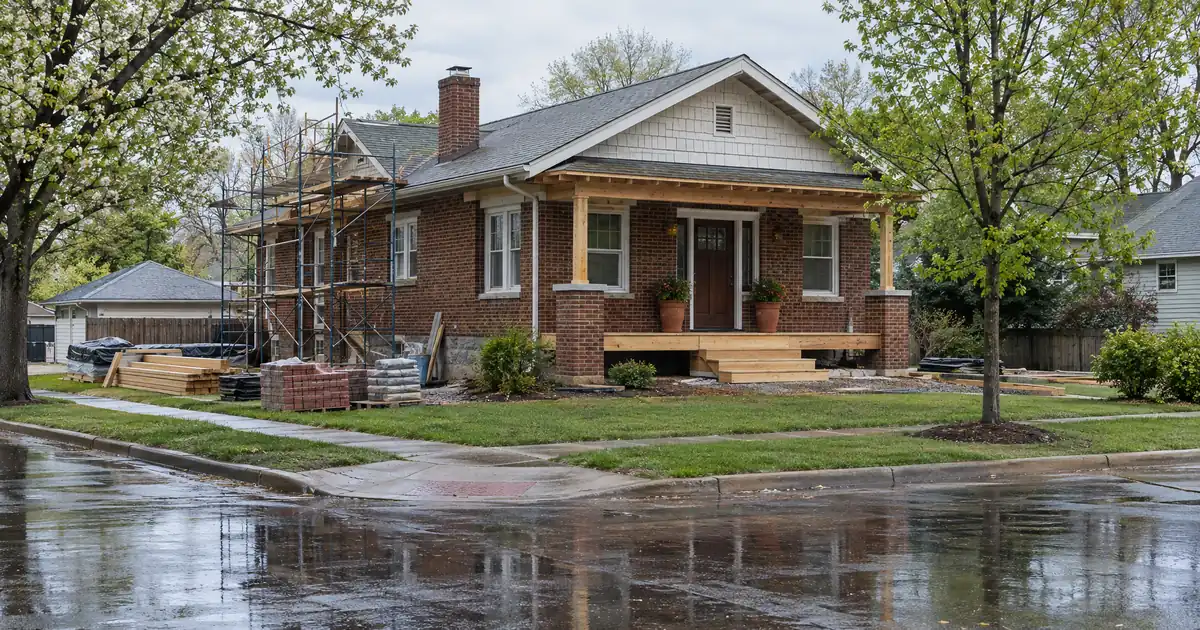
The Quick Read: Supporting your after-repair value means proving, with closed sales and a documented scope, what the finished property will realistically sell for. Lenders treat the number as a claim to be tested, not a fact to be accepted. Three things carry it: renovated comparable sales, a repair budget that matches the claimed finish level, and an as-is value that shows you are not overpaying.
- Closed, recorded sales are the foundation. Listings and automated estimates are not.
- The comps must be renovated to the standard you plan to deliver.
- A scope of work and line-item budget should make the finished value believable.
- The as-is value is the early warning that you overpaid.
- First-timers qualify at lower leverage tiers, and every tier is capped at 75% of after-repair value, subject to lender guidelines.
What ARV Actually Is
ARV is the potential sale price of a property after the work is done, as determined by the market. BiggerPockets defines it this way and notes that “repair” is used loosely. It covers cosmetic updates like floors, counters, paint and bathrooms, not just major defects.
What this loan actually costs to carry.
Hard money is sized against the project and priced by time. Enter the deal and see how much the program will lend, the cash required at closing, the carry while you hold it, and what is left at the exit.
Leverage tiers on the current program: 85% with fewer than 2, 90% with 2 or more, 93% with 5 or more completed projects — every tier capped at 75% of after-repair value. Loan amounts up to $5,000,000, larger by exception; terms of 6 to 18 months, interest-only, no prepayment penalty. The rehab portion funds in draws against completed work, not at closing.
Program parameters shown update from Lendmire’s centralized guideline source. Rate, points, and months are editable assumptions, not quoted terms.
Cost cap sets the loan · positive spread
Illustrative estimate only — not a quote, Loan Estimate, approval, or commitment to lend. Rate, points, and months are editable assumptions. Hard money is business-purpose financing for real estate investors, not a consumer mortgage. Leverage on the current program tops out at 93% of project cost for investors with a documented track record, capped at 75% of after-repair value, with rehab funding up to 100% of the documented budget released in draws; actual terms vary by lender, borrower experience, property, and exit. Lendmire is a mortgage broker, not a lender.
The market sets the number. Your opinion, your contractor’s opinion and your spreadsheet do not.
Two values matter on every flip. The as-is value reflects the property in its current condition, judged against comps in similar shape. The ARV reflects the finished product, judged against renovated comps. A lender looks at both, and the gap between them is where the deal lives or dies.
Why a First Flip Gets Extra Scrutiny
Hard money underwriting stays asset-based. Lenders look at the property, the plan and the exit. A first-timer has no completed projects to point to, so the plan itself has to carry the weight.
Experience changes leverage more than eligibility. Across lenders in Lendmire’s wholesale network, fix-and-flip leverage is tiered by documented completed projects: 93% of project cost at 5+ projects, 90% at 2+, and 85% with fewer than 2. Every tier is capped at 75% of after-repair value. First-time investors typically sit in the lowest tier, and a 620 minimum credit score applies, with added conditions below 660. All of this varies by lender, property and experience, and none of it is a commitment to lend.
Notice what the cap means. If your ARV is inflated, the cost-based tier may look generous on paper while the 75% ARV cap quietly shrinks the loan. If your ARV is well supported, the cap stops being the constraint.
Build the Comp Set
Start with sold properties. A BiggerPockets forum contributor makes the point directly: use sold comps, not listings. Active and pending listings are asking prices. They are hopes, not evidence.
A defensible comp set shares these traits:
- Closed and recorded. The sale actually happened.
- Recent. Investor-education guidance suggests roughly the last six months, and lenders weigh recency by market speed.
- Nearby. Stay inside the same neighborhood and avoid crossing a school, flood or street boundary that changes value.
- Similar. Match beds, baths, square footage, lot size and style.
- Renovated. The comps must reflect the finish level you will deliver, not distressed condition.
Aim for at least three comps, and more when the market is thin. The BiggerPockets glossary suggests at least three and a note of beds, baths, square footage and lot size. That is investor-education guidance, not a lender rule.
Comps to reject
- Any sale that closed at a price tied to a distressed or as-is condition.
- Several nearby sales to the same buyer, which can distort what the comps suggest.
- The best sale on the street. Using the one outlier is the classic first-timer move.
- Investor flips that sold off-market with no verifiable price.
Turn comps into a number
Price per square foot is the usual normalizing step. One forum contributor describes calculating it for each comp, dropping the highest and lowest, averaging the rest and multiplying by the subject’s square footage. Treat that as investor commentary, not a rule.
Then adjust. Adjustment values for bedrooms, baths, garages and lots differ from market to market, as another BiggerPockets thread notes. Ask local agents or appraisers what the market pays for each feature. Do not borrow adjustment values from a different town.
Be conservative. Appraisers usually are, and your market and rehab level decide whether you land near the top or the median of the comps.
Match Your Scope to the Number
A claimed ARV without a scope behind it is just a number. An appraiser building an as-completed value reviews contractor bids, plans or a detailed scope of work, then looks at comps reflecting the post-renovation condition, as an appraiser’s Substack explains.
Prepare these before the lender asks:
| Document | What it proves |
|---|---|
| Contractor bid or contract | The work is priced and real |
| Line-item budget | The spend fits the finish level |
| Floor plans or drawings | Any square-footage change is planned |
| Permits | The work is legal and countable |
| Comp grid with adjustments | Your ARV came from sales, not hope |
Match the finish tier to the neighborhood. Granite and designer fixtures in a block of modest renovations will not earn their cost back. Cost is not value. Finished work shows up in value only through comparable sales, not at what it cost to build, and improvements need not add value at all. A scope and budget that do not match the claimed ARV is a red flag in either direction.
How the Lender Verifies Your ARV
Do not expect a self-reported ARV to be taken at face value. Lenders typically order an independent valuation, which may be an appraisal, a broker price opinion or an internal comp analysis.
On an appraisal, the appraiser reports two numbers. A practitioner discussion on the Appraisers Forum explains that a subject-to-completion appraisal with a current value date uses a hypothetical condition: the improvements are treated as complete on the date of value. A prospective value, set at a future date, relies on an extraordinary assumption instead. Appraisal reports must state these assumptions clearly, as WorkingRE’s USPAP overview describes.
In plain terms, the appraiser values the home as if your plan already exists. That is why the plan has to be specific.
The client decides whether an appraisal is as-is or subject-to. A subject-to appraisal needs a return visit to confirm the work matches the plans and specs, per a Birmingham appraiser’s blog. So the appraisal is not final until the work is verified.
What If the Appraisal Comes In Low?
It will happen to some first flips. Value is somewhat subjective, and two professionals can reach different numbers from the same data. Here are the realistic paths:
| Situation | Option | Tradeoff |
|---|---|---|
| Missing comps | Submit additional closed sales with a short explanation | Works only if the sales are truly comparable |
| Scope unclear | Re-submit a tighter scope and bids | May raise value, but costs time |
| Price too high | Renegotiate the purchase | Seller may walk |
| Gap is small | Add equity | Lowers your return |
| Gap is large | Walk away | You lose the deposit, not the project |
A first flip that only works at the original ARV is a thin deal. Walking is a legitimate outcome.
Stress-Test Before You Submit
Run the deal at a haircut ARV before a lender does. If your profit disappears when the ARV drops by a modest margin, the margin was never real. Test the as-is value too. An as-is value below the contract price is an early warning that you may be overpaying.
Also remember the leverage structure. Bridge purchases without rehab run up to 80% of purchase price, and the rehab budget can fund in draws against completed work, up to 100% of the rehab budget. Those draws follow the work, so a delayed rehab means delayed funds. Terms run 6 to 18 months, interest-only, with no prepayment penalty. There are no multi-year options, so the plan needs a real exit inside that window.
Edge Cases Where the Rule Bends
- Few or no comps. Appraisers may use similar neighborhoods and year built when nothing nearby exists, as a BiggerPockets thread on ARV with no comps notes. Expect a wider range.
- Small multifamily. The sales comparison approach covers single-family and other small residential, while larger multifamily needs a different process, per BiggerPockets.
- Value changes with the plan. Adding square footage changes the comp set entirely, so floor plans matter.
- Agency renovation loans. FHA and conforming renovation products use their own as-completed appraisal rules. They are a different category from hard money.
The Exit Link
Your ARV has to survive two reviews. A hard money lender checks it now. If the plan changes to a hold, a long-term lender checks value again later. Many investors refinance out of hard money into long-term DSCR financing once the property is stabilized, and Lendmire brokers that path. The rental side qualifies primarily on property-level rental income covering the payment, subject to lender guidelines, so an inflated ARV helps nobody twice. Lendmire’s complete DSCR loans guide covers how that second stage works.
For help sizing the project itself, see Lendmire’s piece How to Budget a First Flip So the DSCR Cash-Out Still Clears Hard Money.
Key Terms Defined
ARV (after-repair value): The market-determined sale price of a property once planned work is complete.
As-is value: What the property is worth today, in its current condition.
Subject-to-completion appraisal: An appraisal that values the home as if the planned work were already finished.
Hypothetical condition: An appraisal assumption, known to be contrary to fact, that the work is complete on the date of value.
Comp (comparable sale): A closed sale of a similar nearby property used to indicate value.
Loan-to-cost: The loan as a share of total project cost, used in hard money tiers alongside the ARV cap.
Frequently Asked Questions
Can I use active listings as comps?
No. Listings show asking prices, not what buyers paid. Use closed, recorded sales, and treat automated estimates as reference points only.
How many comps do I need?
At least three is the common investor guidance, and more is better in thin markets. Quality matters more than count. Three renovated, nearby, recent sales beat ten loose matches.
Do I need my own appraisal before applying?
Not necessarily. A lender usually orders its own independent valuation. A comp grid and scope package of your own helps you pre-test the number and explain it if the lender’s figure differs.
Does ARV change how much I can borrow?
Yes. On a flip, the loan is limited by both a cost-based tier and the 75% after-repair value cap. A lower valuation can pull the loan below what the cost tier alone would allow. All figures vary by lender, property and experience.
What if my first flip becomes a rental?
That is a common backup exit. The long-term loan is sized on rent and property value rather than ARV, so the plan should be tested both ways before you close on the flip.
If you are buying, rehabbing or refinancing an investment property on a short timeline and want to see how the numbers work, Lendmire can help you compare hard money options based on the project, the exit plan, leverage and your goals.
For current guidelines and terms, see Lendmire’s DSCR loan programs page.
About Lendmire
Lendmire — NMLS# 2371349 — is a mortgage brokerage specializing in DSCR investor loans, helping arrange financing across 41 markets, including Washington, D.C., through wholesale and investor-lending channels. The model centers on property-level rental income reviewed by the lender rather than W-2 documentation, subject to lender guidelines, suiting entity-owned and multi-property investors. Lendmire holds Scotsman Guide Top Mortgage Workplace recognition for 2025 and 2026.
Get Started
Ready to find the right loan for you?
In about 30 seconds you can review financing options available for your investment property. No commitment required.
Informational only. Not a Loan Estimate, approval, or commitment to lend. Program availability and eligibility are subject to lender guidelines, credit approval, property review, and underwriting.
References
1. BiggerPockets glossary: After Repair Value
2. BiggerPockets forum contributor
3. BiggerPockets forum: Best ways to figure out ARV
4. The Valuation Piece: Playing Pretend
5. Appraisers Forum: As-is Value in USPAP
6. WorkingRE: Understanding USPAP, SR-2
7. Birmingham appraiser’s blog
8. BiggerPockets forum: ARV with no comps
9. BiggerPockets: How to Estimate ARV
This article is part of Lendmire’s hard money loan program — full qualification details, guidelines, and scenarios live on the program page.
Related reading: FHA Loan House Hack vs DSCR Loan for a First-Time Investor · How Long Each Step of a DSCR Refinance Takes to Pay Off Hard Money · Can a Retired First-Time Airbnb Host Get a DSCR Loan Without a W-2?
Brandon Miller
Founder & CEO, Mortgage Loan Originator, Lendmire LLC
- Mortgage Loan Originator · NMLS# 1129696 · Verify on NMLS Consumer Access
- North Carolina Real Estate Broker · License# 343312 · Verify on NCREC
- North Carolina Insurance Producer · License# 19053198 · Property, Casualty, Life, Health · Verify on NAIC SBS
- Lendmire LLC · Firm NMLS# 2371349 · Verify firm licensure
Legal disclosures. Lendmire (NMLS# 2371349) is a state-licensed mortgage brokerage that arranges financing through wholesale lender relationships. Lendmire is not a direct lender, depository institution, or registered financial advisor. The discussion above is general informational content about real estate financing — it is not financial, legal, or tax advice, and readers should consult licensed professionals for guidance on their individual circumstances. Loan inquiries are subject to lender underwriting; this article does not represent a commitment to lend. Loan terms, rates, and qualification standards vary by borrower, property, and state, and are subject to change at any time. Equal Housing Opportunity. NMLS Consumer Access: nmlsconsumeraccess.org.