
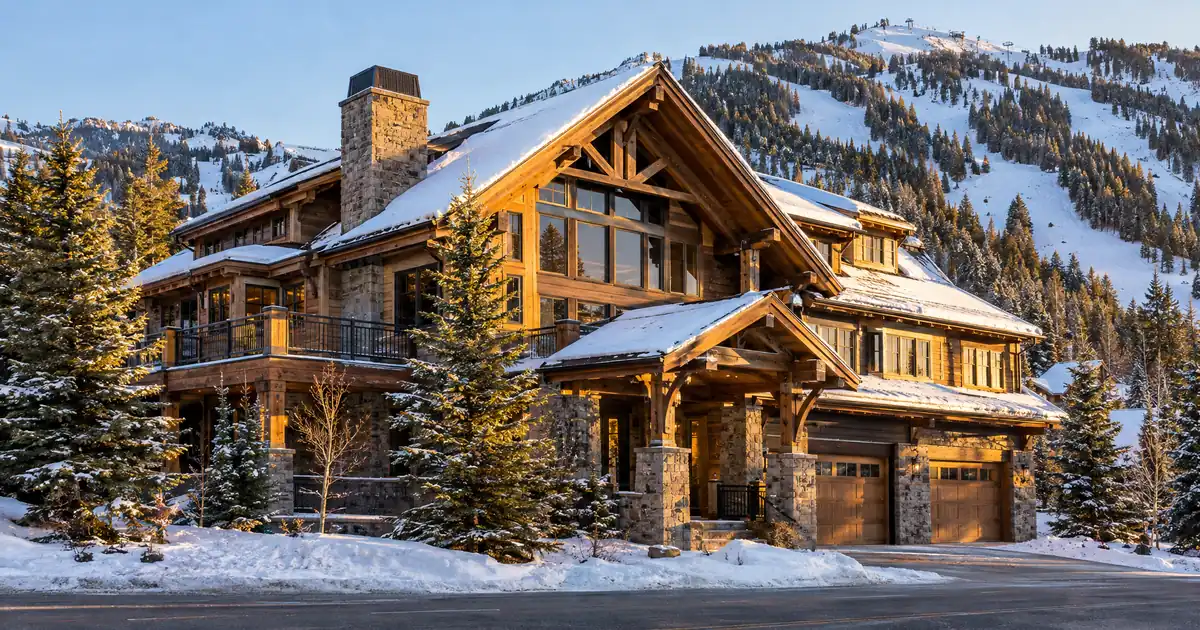
The Quick Read: Shopping insurance on a ski-town rental for a super jumbo DSCR loan means choosing a policy form that fits nightly guest use, quoting it before you bid, and feeding the real premium into your coverage ratio, because the premium sits in the monthly obligation that your rent must cover. This is about insuring the building you own, not ski-gear rental coverage or trip insurance.
- A homeowners or plain landlord policy often fits a furnished, nightly-rented chalet poorly.
- Every dollar of premium lowers your coverage ratio, so get the real quote before you commit to a price.
- A more affordable quote is not automatically the winner. A more affordable quote that meets the lender’s conditions is.
- Mountain markets can have thin carrier availability, so start shopping early.
Key Terms Defined
DSCR (debt service coverage ratio): The property’s monthly rent divided by its monthly obligation, which covers principal, interest, taxes, insurance, and any HOA dues. A DSCR loan is reviewed primarily on property-level rental income covering the payment, subject to lender guidelines.
Super jumbo: A loan size well above standard conforming limits. In Lendmire’s network, the portfolio program runs from $150,000 to $10,000,000, while the standard DSCR program stops at $3,000,000.
Loss of rents (loss of income): Coverage that replaces rental income after a covered loss. Short-term rentals usually want it measured against the property’s real earnings.
Replacement cost: What it takes to rebuild the structure today. Actual cash value subtracts depreciation, so it pays less.
Mortgagee clause: The policy wording that names the lender as a protected party on the property. It must match the loan file exactly.
PITIA: Principal, interest, taxes, insurance, and association dues. This is the monthly obligation that rent has to cover.
DSCR Calculator
Run the numbers in your market
Rate source: Freddie Mac 30-yr average via FRED® — Federal Reserve Bank of St. Louis · effective Oct 15, 2026
Prefilled with starting assumptions — enter your own rent or nightly figures, taxes, insurance, and HOA for a more accurate picture.
Program parameters update from Lendmire’s centralized guideline source. Taxes and insurance are editable estimates.
As of Oct 15, 2026 · General Freddie Mac market benchmark, not a Lendmire loan offer. Rent, nightly rate, occupancy, taxes, and insurance are editable estimates. Short-term rental figures are estimates only and vary significantly by season, property type, management approach, and local short-term-rental rules — confirm local regulations before relying on them. Qualifying income for short-term rentals varies by program — some use appraisal market rent, others use documented STR history or projections — and is confirmed in underwriting. Not a Loan Estimate, approval, or commitment to lend. Program availability and eligibility are subject to lender guidelines, credit approval, property review, and underwriting.
Which Policy Form Fits a Ski-Town Rental?
An STR can be insured on three contract types: homeowners, dwelling (landlord), or commercial, per BiggerPockets. For a furnished chalet rented by the night, the commercial or STR-specific form usually fits best. The other two often leave gaps.
True STR insurance is a commercial form built for furnished, nightly-rented property. A landlord policy with a note about short-term use is still a dwelling form underneath, as BiggerPockets explains. That distinction matters when you have a claim.
| Form | Fit for nightly guests | Contents and income |
|---|---|---|
| Homeowners | Poor | Belongings only |
| Landlord (dwelling) | Weak without endorsement | Contents left to tenant |
| Landlord plus STR endorsement | Varies by carrier | Check wording closely |
| STR or commercial form | Built for it | Business income measured on actual earnings |
Most landlord policies carry a business-pursuits exclusion. They also assume the owner keeps no personal property in the unit, and they often exclude equipment breakdown unless it is endorsed, according to BiggerPockets. A hot tub and a furnished great room are exactly where those gaps bite.
Platform host protection is not a substitute for your own policy. Contributors on a BiggerPockets thread also warn that a carrier can reassess a mismatched policy, demand back premium, or deny a claim.
What Does the Lender Check on the Policy?
The lender checks that the policy protects its collateral and matches your loan file. Across the wholesale network, the typical checklist is consistent, though each lender sets its own conditions. Get those conditions in writing before you ask for quotes.
Expect reviewers to look at:
- Hazard coverage on the structure, sized to replacement cost.
- The correct mortgagee wording.
- An insured address and names that match the loan file, including your LLC where the property sits in an entity, subject to lender program eligibility.
- Effective dates and evidence the premium is paid.
- Possible requirements for flood, wind, liability, or loss of rents, depending on the property and lender.
A name or mortgagee mismatch is among the most common reasons a file stalls at closing. Fix it at the quote stage, not after.
Mountain Risks to Raise With the Carrier
Ski-town carriers care about snow load, freeze damage, vacancy, wildfire, and amenities that add liability. Tell the agent about each one up front. Answers feed straight into the premium and into what the policy will cover.
Snow is the one most owners misjudge. Homeowners policies generally cover snow-weight roof collapse, but a leak from a roof already in disrepair is not covered, per Insurance.com. Maintenance records matter.
Expect questions on roof age and material, the heating system, defensible space, and distance to a fire station. Carriers weigh features like these when they model catastrophe risk. A chalet that sits empty between guests also draws attention, so ask how the policy treats vacant stretches and whether it requires heat to be maintained.
Say plainly that the property is a short-term rental. STR liability claims run higher than those on long-term rentals, which is why premiums are higher and some carriers avoid the class, according to a BiggerPockets discussion. Short-term rental rules can vary by city, county, HOA, and property type, so investors should confirm local rules before relying on projected rental income. Lenders also want municipal permission documented for the specific property.
The Shopping Sequence
Start quoting as soon as you have a property under serious consideration, not after you are in underwriting. Here is the order that works.
1. Get the lender’s insurance conditions in writing. Cover acceptable forms, mortgagee wording, deductible limits, any separate wind or hail terms, flood requirements, and proof of paid premium.
2. Disclose the use in writing. State short-term rental use, furnished, rented by the night. Many rental dwelling policies do not cover it.
3. Quote the right product. A landlord carrier has to accept STR occupancy explicitly. A change in occupancy changes the policy, and there is no piggyback fix.
4. Gather rating inputs. Collect roof age, construction class, year built, heating type, and defensible-space details.
5. Compare on the same coverage basis. Hold replacement cost, deductible type, liability limit, income basis, and exclusions constant.
6. Re-run the ratio with the real premium. Use the actual quoted premium, not an estimate, and do this before you finalize your offer.
An independent agent can shop several carriers at once, which matters where availability is thin.
How Do You Compare Quotes Fairly?
A cheaper quote with weaker terms can fail the lender’s conditions, so build a simple scorecard.
Ask each agent the same questions:
- Is the dwelling limit on replacement cost or actual cash value?
- Is the deductible a flat amount or a percentage, and does it differ for wind, hail, or snow?
- Is loss of income measured on actual earnings with no time limit, or a fixed period?
- What is the liability limit, and does an umbrella sit on top?
- Are the hot tub, fireplace, and deck covered or excluded?
- Does the policy restrict vacancy or require heat to be maintained?
- Is the STR coverage an endorsement or a standalone form?
An STR income measure tied to the property’s real earnings fits a ski chalet better than a fixed rent-loss window, because ski-season income is lumpy. A fixed window sized to an average month may undershoot a peak-season loss. Ask how the carrier measures it.
Super Jumbo Adds Its Own Layer
Larger balances generally mean larger dwelling limits, higher liability limits, and often an umbrella policy. That is a practitioner read, not a published rule, so confirm each item with the lender’s conditions. High-value mountain homes can also have narrower carrier appetite, which can push you toward specialty carriers.
Here is what the program looks like at these sizes. Through select wholesale programs, and subject to underwriting, an investment-property purchase reaches 80% LTV up to $1,000,000, then 75% to $3,000,000, 65% to $4,000,000, and 60% to $6,000,000 on review. Each figure is a ceiling that applies to the loan amount, not the purchase price. The top cell in each band needs stronger credit. The program floor is 660 on loans to $3,000,000 and 700 above that. The exact numbers vary by lender and program and follow a full review of property, leverage, and credit.
Above $2,000,000, the file needs two appraisals. Lendmire’s piece How Two Appraisals Work on a Super Jumbo DSCR Rental Loan for a Trust walks through that step. Reserves typically run 6 months of PITIA on the subject property (12 for first-time investors), and the insurance premium sits inside that number.
Short-term-rental files carry their own envelope. They need coverage of 1.00 or higher, loans to $2,000,000, and income counted at 80% of gross. The income comes from twelve months of operating history on a refinance, or from the appraisal’s short-term-rent analysis on a purchase. Investors need recent experience owning income property. For more on that path, see Lendmire’s explanation of how vacation rental investors qualify for a super jumbo DSCR loan.
How Does the Premium Move Your Coverage Ratio?
Premium moves your ratio dollar for dollar. The annual premium is divided by 12 and added to the monthly obligation, so a higher quote lowers the ratio directly. This is standard DSCR treatment, and no outside rule dictates it. The full mechanics are in Lendmire’s complete DSCR loans guide.
Run the numbers on a modeled ski chalet purchase. Assume the loan lands in the $1,000,000 to $1,500,000 band, so the ceiling is 75% on an investment-property purchase, and the top cell needs 700+ credit. Suppose your first estimate gives coverage near 1.15x. Then the real STR-appropriate quote arrives and pulls coverage to roughly 1.05x. The deal still clears 1.00x, but the margin is thinner. These ratios are modeled assumptions, not market data.
If the premium drags the file under 1.00, you still have options to review with a lender. Select programs in the network accept coverage from 0.75 to 0.99, with LTV and terms adjusting, subject to underwriting. Interest-only terms of 120 months, up to 75% maximum, qualify on interest, taxes, and insurance rather than full amortization. Short-term-rental files are different, because they need 1.00 or higher.
DSCR vs. conventional financing
There are two common ways to finance an investment property, and they qualify you differently — here’s how investors weigh them.
Why investors choose it
- Qualifies on the property’s rental income — no personal tax returns, W-2s, or pay stubs needed to document income.
- No personal debt-to-income ceiling to clear, so existing mortgages and obligations don’t cap your borrowing the same way.
- Can be closed in an LLC, keeping the property inside a business entity.
- Built for scaling — not held to the limit on number of financed properties that conventional financing applies.
- Underwriting centers on the deal: generally qualifies when the rent covers the payment, a 1.00x coverage ratio being a common baseline (confirmed in underwriting).
- Designed specifically for investment property, including long-term and, where the program allows, short-term rentals.
Where it’s strong
- Often the lowest ongoing financing cost for a buyer who fully qualifies on personal income — a fit for a first property or a cost-first purchase.
Trade-offs for investors
- Requires full personal income documentation and must fit within a debt-to-income limit — salary, existing debts, and other mortgages all count.
- Typically held in your personal name rather than a business entity.
- Caps how many financed properties you can carry, which can become a ceiling as a portfolio grows.
- Evaluates you as a borrower as much as the property, which usually means more paperwork.
How investors usually choose: a first or single property often optimizes for the lowest financing cost; portfolio builders often optimize for leverage, vesting in an LLC, and scaling past conventional caps. The right answer depends on your goals, the property, and current guidelines — both paths run through select lenders in Lendmire’s wholesale network, with eligibility and terms confirmed in underwriting.
Where the General Rule Breaks
Availability in mountain states. Some buyers cannot find coverage outside state-created insurers of last resort, and that coverage can cost more or be less complete, according to the Congressional Research Service. The same paper lists Colorado among states with premium increases or insurer withdrawals. Whether a state-plan or surplus-lines policy satisfies a given lender is a lender-specific question, so confirm it before you rely on one.
California data gives a sense of the pattern. The Government Accountability Office found that zip codes at severe or extreme wildfire risk had a higher share of properties on the state plan, by about 12 percentage points. That is California evidence, not a ski-resort benchmark.
Medium-term rentals. Carriers often recognize only STR and long-term rentals. A host renting in the gap between those may be told to carry an STR policy. Ask the carrier directly which bucket your stay length falls in.
Condos and townhomes. Ski condos usually pair an association master policy with your own unit policy. Non-warrantable condos reach 75% and $1,500,000 in the program, subject to underwriting. Confirm what the master policy covers before you size your own.
Flood. Standard property policies exclude it. Ski towns can sit near rivers or creeks, so a flood determination, not the listing, decides whether a lender requires coverage. A DSCR lender sets its own flood overlay.
Rural designation. Many mountain properties are rural. Rural collateral of five acres or less reaches 75% only on loans at or below $3,000,000. Above $3,000,000, the overlay allows no rural property, and no more than ten acres on a non-rural one.
Entity ownership. The insured name, the borrower LLC, and the mortgagee all have to agree.
Traps: Cheap but Non-Compliant Choices
The fastest way to improve your coverage ratio is also the riskiest: weaken the policy. Dropping to actual cash value, raising the deductible, or removing loss of income can all lower the premium. Each can also conflict with the lender’s conditions or leave you exposed after a loss. Do not make those changes without confirming the lender allows them.
Another trap is relying on an STR note stapled to a landlord form. If a claim comes in and the carrier decides the use did not match the policy, you carry the loss. Pay for the right form once.
Finally, do not treat insurance as a post-approval formality. Lenders treat proof of coverage as a closing condition, and a gap can hold up the file.
Tax treatment varies; consult a qualified professional.
Frequently Asked Questions
Can a homeowners policy cover a ski-town rental I finance with a DSCR loan?
Usually not. A homeowners form covers contents only as personal belongings and often excludes business use. For a furnished chalet rented by the night, ask for an STR-appropriate form or an STR endorsement the carrier states in writing. The lender’s conditions decide what is accepted.
Does Airbnb or VRBO host protection replace my own policy?
No. Platform protection is a supplement, not the primary policy, and a landlord policy plus platform coverage leaves gaps. Treat your own policy as the one the lender and any claim will rest on.
Does a higher insurance quote change whether the loan works?
Yes, it can. The premium sits in the monthly obligation, so a higher quote lowers coverage. A modeled 1.15x can become roughly 1.05x with the real quote. Re-run the ratio with the actual figure before you finalize an offer.
What if I can only find coverage through a state insurer of last resort?
Confirm with the lender before relying on it. State-plan coverage can cost more or be less complete, and whether it satisfies a given lender is lender-specific. Raise it at the start of the file, not near closing.
Should I carry an umbrella policy on a super jumbo rental?
Many investors do, since larger balances and guest liability can outgrow a base limit. This is a practitioner read rather than a lender mandate. Ask the lender what liability limits it requires, then size an umbrella to your own exposure.
Next Step
If you are buying or refinancing a high-balance rental property and want to see how the numbers work, Lendmire can help you compare super jumbo DSCR loan options based on the property income, the loan balance, credit profile, leverage, and investor goals. Lendmire is a mortgage broker arranging business-purpose financing through select lenders in its wholesale network, across 41 markets including Washington, D.C. Every file is underwritten individually, and nothing here is a commitment to lend.
Lendmire’s self-employed mortgages page presents both super jumbo programs, bank statement and DSCR, side by side.
About Lendmire
A DSCR-focused mortgage broker, Lendmire (NMLS# 2371349) places investor financing across 41 markets — 40 states plus Washington, D.C. — with DSCR eligibility generally reviewed by the lender on property cash flow instead of tax returns, subject to lender guidelines. Scotsman Guide named Lendmire a Top Mortgage Workplace in 2025 and 2026.
Get Started
Ready to find the right loan for you?
In about 30 seconds you can review financing options available for your investment property. No commitment required.
Informational only. Not a Loan Estimate, approval, or commitment to lend. Program availability and eligibility are subject to lender guidelines, credit approval, property review, and underwriting.
References
2. BiggerPockets – Fine print between landlord and STR insurance policies
4. BiggerPockets – STR insurance vs. landlord insurance discussion
5. Insurance.com – Winter homeowners insurance claims
7. Congressional Research Service – Natural Disasters and the Homeowners Insurance Market
8. Government Accountability Office – GAO-26-107867
This article is part of Lendmire’s super jumbo DSCR loan program — full qualification details, guidelines, and scenarios live on the program page.
Related reading: Can a Trust Finance Its Rental Pool on One Super Jumbo DSCR Loan? · Super Jumbo DSCR vs Private Bank for Selling One Blanket-Loan Rental · How to Refinance 5 to 50 Doors in LLCs on a Super Jumbo DSCR Loan
Brandon Miller
Founder & CEO, Mortgage Loan Originator, Lendmire LLC
- Mortgage Loan Originator · NMLS# 1129696 · Verify on NMLS Consumer Access
- North Carolina Real Estate Broker · License# 343312 · Verify on NCREC
- North Carolina Insurance Producer · License# 19053198 · Property, Casualty, Life, Health · Verify on NAIC SBS
- Lendmire LLC · Firm NMLS# 2371349 · Verify firm licensure
Important disclosures. Lendmire (NMLS# 2371349) is a licensed mortgage brokerage. Lendmire is not a direct lender, depository institution, or financial advisor. All loan inquiries are subject to lender underwriting; this article does not constitute a commitment to lend. Rates, terms, and program guidelines are subject to change without notice and vary by borrower profile, property type, and state. Information in this article is general in nature and is not financial, legal, or tax advice. Equal Housing Opportunity. NMLS Consumer Access: nmlsconsumeraccess.org.