
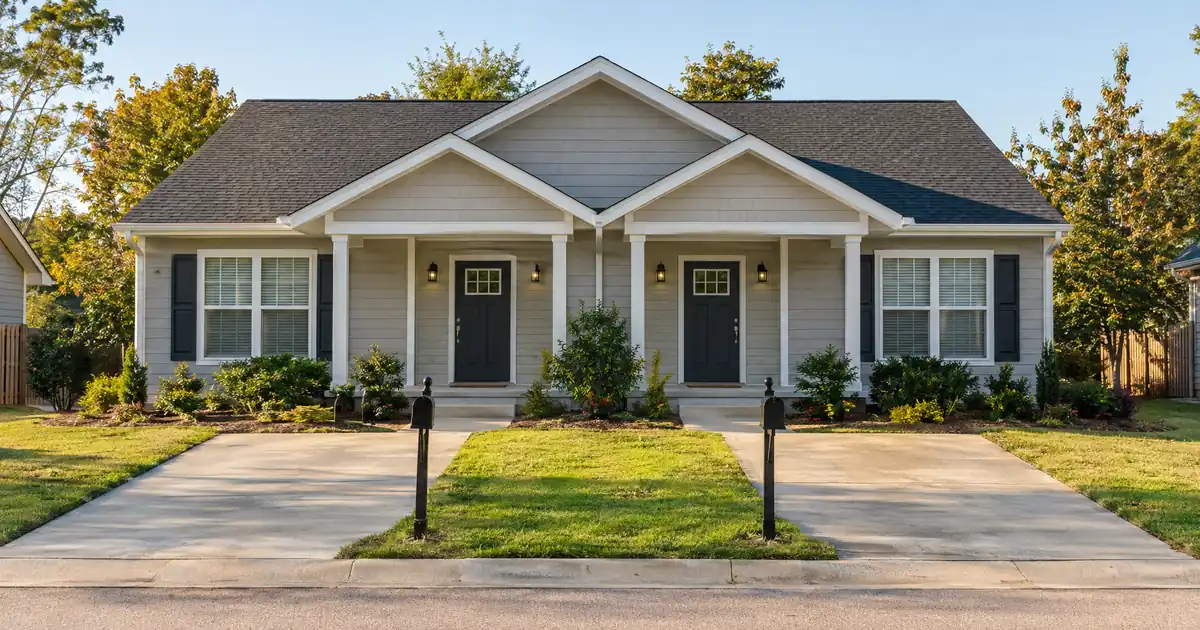
The Quick Read: A W-2 investor’s duplex file centers on the property’s rent, the borrower’s credit, and documented funds for the down payment and reserves, because the loan is reviewed primarily on property-level rental income covering the payment, subject to lender guidelines. Pay stubs, W-2s, and a personal debt-to-income calculation are generally not part of that review. The paycheck still matters indirectly, because it is where your cash and credit come from.
- The file is organized around four things: the property’s rent, your credit, your assets, and (if used) your entity paperwork.
- Both duplex units count toward one rent figure, measured against one monthly obligation.
- Living in one unit usually moves you out of a standard DSCR rental program and into an owner-occupied loan that does use your W-2.
- Co-owners add signatures and credit pulls, not blended personal income.
What Does “Splitting a Duplex” Actually Mean?
The phrase covers three different situations, and the paperwork changes with each one. Before you gather anything, decide which one is yours.
DSCR Calculator
Run the numbers in your market
Rate source: Freddie Mac 30-yr average via FRED® — Federal Reserve Bank of St. Louis · effective Oct 15, 2026
Prefilled with starting assumptions — enter your own rent or nightly figures, taxes, insurance, and HOA for a more accurate picture.
Program parameters update from Lendmire’s centralized guideline source. Taxes and insurance are editable estimates.
As of Oct 15, 2026 · General Freddie Mac market benchmark, not a Lendmire loan offer. Rent, nightly rate, occupancy, taxes, and insurance are editable estimates. Short-term rental figures are estimates only and vary significantly by season, property type, management approach, and local short-term-rental rules — confirm local regulations before relying on them. Qualifying income for short-term rentals varies by program — some use appraisal market rent, others use documented STR history or projections — and is confirmed in underwriting. Not a Loan Estimate, approval, or commitment to lend. Program availability and eligibility are subject to lender guidelines, credit approval, property review, and underwriting.
1. Splitting use. You live in one unit and rent the other.
2. Splitting ownership. You and one or more partners buy the duplex together.
3. Splitting the rent. You rent both units and want to know how each unit’s rent counts.
Most of this article follows the third case, a true rental, because that is the cleanest DSCR file. The first two cases get their own sections below. Each one changes who signs, which loan product fits, or both.
Does a W-2 Matter on a DSCR File?
A W-2 does not decide whether the file qualifies, but it still shapes the file in three quiet ways. Across the lenders in Lendmire’s wholesale network, the review runs on the property’s rent against its monthly obligation (principal, interest, taxes, insurance, and any association dues). Your employer, pay history, and personal debt-to-income ratio are not the test.
Here is where the paycheck still shows up:
- Source of funds. Your down payment and reserves come from somewhere, and the statements that show them are reviewed.
- Payroll deposits. They appear in your bank statements. Regular deposits rarely raise questions. A large, one-time deposit such as a bonus, a gift, or sale proceeds usually needs a short explanation and a paper trail.
- Credit. Your score and payment history are pulled and weighed regardless of how you earn.
DSCR loans are designed for non-owner-occupied investment properties. Because they are business-purpose investor loans, they are reviewed differently from a standard owner-occupied mortgage.
One phrase deserves care. Qualification runs on the property’s income, but the file is not paperwork-free. The documents change from income documents to asset, credit, and property documents.
The Document Checklist, Category by Category
A duplex file has seven document families, and each one answers a specific underwriting question. The table below shows what each family proves and what is different for a W-2 borrower with a duplex.
| Document family | Why the lender wants it | Duplex or W-2 note |
|---|---|---|
| ID and credit authorization | Confirms identity and pulls credit | Your score drives leverage tiers |
| Bank and asset statements | Proves down payment and reserves | Explain large or unusual deposits |
| Purchase contract | Fixes price and parties | Every page and addendum, fully signed |
| Appraisal with rent schedule | Sets market rent per unit | Duplexes use a 2-4 unit report form |
| Leases | Shows actual rent per occupied unit | One lease per unit, matching the rent roll |
| Insurance and title | Protects the collateral | Names must match the borrower exactly |
| Entity documents | Shows who is borrowing | Only if vesting in an LLC |
The 2-4 unit appraisal point is worth knowing. Appraisers value a duplex on the Small Residential Income Property Appraisal Report, known as Form 1025, which Fannie Mae’s published appraisal forms list describes as the form for traditional appraisals of two- to four-unit properties. A single-family rental uses a different rent schedule. The form names are shorthand only, because DSCR programs are not agency products.
Documents you generally do not provide on a DSCR duplex purchase are W-2s, pay stubs, employment verification, traditional personal-income documentation, and a personal debt-to-income worksheet. Those belong to owner-occupied loans, which is where the occupancy question below comes in.
How Underwriting Treats the Two Units, Step by Step
Underwriting combines both units into one numerator and sets it against one payment. The process runs in a fixed order.
1. Occupancy and purpose are fixed first. You sign a business-purpose and occupancy statement saying the property is for investment use.
2. Rent is established per unit. The appraiser gives a market-rent opinion for each unit.
3. Rent is supported. Occupied units usually need a lease. Which figure counts, and how a vacant unit is handled, varies by program.
4. The ratio is calculated. Total rent used for lender review is divided by the full monthly obligation. A result of 1.00 means rent equals the payment.
5. Borrower strength is checked. Credit, reserves, and property eligibility are reviewed alongside the ratio.
A duplex does not get two ratios. It gets one blended figure, so a strong unit can offset a weaker one. The reverse also happens. A single vacant unit can pull a duplex below the number its lender wants to see.
| Situation | Typical treatment | What to bring |
|---|---|---|
| Both units leased | Leases and market rent are compared | Two leases, rent roll, payment history |
| One leased, one vacant | Vacant unit usually leans on market rent; handling varies | One lease, appraisal rent schedule |
| Both vacant (new purchase) | Appraisal market rent drives the ratio | Appraisal rent schedule |
| Owner lives in one unit | Usually leaves the standard DSCR rental program | W-2 package for an owner-occupied loan |
On many files the lower of the lease rent and the appraiser’s market rent is used. A lease signed above market rarely lifts the ratio, so a higher lease does not always mean a higher number. Treatment varies by program, so ask before you assume.
Do not pool this duplex’s rent with another property’s rent. Each financed property stands on its own ratio.
What Happens If You Live in One Unit?
If you will live in either unit, a standard DSCR rental program generally is not the right tool. These programs are built for non-owner-occupied property, and your own occupancy takes the file out of that lane.
The federal consumer-credit rules draw the same line. The CFPB’s commentary to its business-purpose rule treats credit for a non-owner-occupied rental as business purpose regardless of unit count. It also says a property cannot be treated as non-owner-occupied if the owner expects to occupy it for more than 14 days in the coming year. For an owner-occupied rental, credit to acquire is deemed business purpose only when the property has more than two units, so a duplex does not qualify for that carve-out. That is a point of law. It does not mean any investor program will accept an owner in a duplex. Program guidelines decide that separately.
In practice, the W-2 investor who wants to live in the duplex usually takes the owner-occupied route first. That means a conventional or government-backed loan underwritten on pay stubs, W-2s, employment verification, and debt-to-income. These programs typically require you to occupy the home for a set period, so confirm the term before you commit.
The common sequence looks like this:
1. Buy the duplex as an owner-occupant on documented income.
2. Live there for the required period.
3. Move out and rent both units.
4. Later, subject to program rules, refinance into a DSCR loan on the now fully rented property, or use DSCR for your next rental purchase.
State your plan to move out honestly at application. The occupancy statement is a written representation. A genuine change in circumstances later is a different matter from misstating your intent at the start.
Lendmire’s piece How to Refinance Split Duplex Halves on DSCR as a W-2 Investor covers the step after you move out.
What Changes When Co-Investors Split Ownership?
Co-ownership changes who signs and whose credit is pulled, but it does not change the ratio. The duplex’s rent is still measured against one payment, no matter how many owners hold title.
What shifts is the borrower structure:
- Personal names. Every borrower on the note is typically scored and liable.
- LLC vesting. The entity borrows and individuals usually sign guarantees, subject to lender program eligibility. The ownership percentage that triggers a guarantee or a credit pull is set by each program, so ask early.
- Tenants in common versus an LLC. The vesting choice affects liability and exit mechanics. It does not move the coverage number.
Co-owners do not blend personal incomes on a DSCR file. A partner matters as a guarantor with credit and assets, not as a second paycheck. If your partner has stronger credit, that can help the pricing and leverage tier, but the rent still has to carry the payment.
Tax treatment varies by structure; consult a qualified professional before relying on any deduction.
DSCR vs. conventional financing
There are two common ways to finance an investment property, and they qualify you differently — here’s how investors weigh them.
Why investors choose it
- Qualifies on the property’s rental income — no personal tax returns, W-2s, or pay stubs needed to document income.
- No personal debt-to-income ceiling to clear, so existing mortgages and obligations don’t cap your borrowing the same way.
- Can be closed in an LLC, keeping the property inside a business entity.
- Built for scaling — not held to the limit on number of financed properties that conventional financing applies.
- Underwriting centers on the deal: generally qualifies when the rent covers the payment, a 1.00x coverage ratio being a common baseline (confirmed in underwriting).
- Designed specifically for investment property, including long-term and, where the program allows, short-term rentals.
Where it’s strong
- Often the lowest ongoing financing cost for a buyer who fully qualifies on personal income — a fit for a first property or a cost-first purchase.
Trade-offs for investors
- Requires full personal income documentation and must fit within a debt-to-income limit — salary, existing debts, and other mortgages all count.
- Typically held in your personal name rather than a business entity.
- Caps how many financed properties you can carry, which can become a ceiling as a portfolio grows.
- Evaluates you as a borrower as much as the property, which usually means more paperwork.
How investors usually choose: a first or single property often optimizes for the lowest financing cost; portfolio builders often optimize for leverage, vesting in an LLC, and scaling past conventional caps. The right answer depends on your goals, the property, and current guidelines — both paths run through select lenders in Lendmire’s wholesale network, with eligibility and terms confirmed in underwriting.
How Do Reserves and Deposits Get Documented?
Reserves are documented asset statements, and the source of every large deposit should be traceable. Reserves commonly run around 6 months of the full monthly obligation. Conservative rate-and-term files at modest leverage under $1,500,000 can see reserves waived, while loans above that size typically step up to about 9 months. The exact requirement varies by lender, leverage, loan size, and transaction type.
For a W-2 investor, the sources usually look like this:
| Source of funds | Typical support |
|---|---|
| Savings from payroll | Statements showing steady deposits |
| Annual bonus or commission | Statement plus a short explanation |
| Gift from family | Gift letter and the donor’s transfer record |
| Sale of another property | Settlement statement |
| Retirement or brokerage account | Recent statements; liquidation terms vary |
Seasoning matters too. Funds that sit in your account for a period are easier to document than money that arrives the week of the application. If you plan to move money between accounts, do it early and keep the transfer records.
Program Ranges That Frame the File
These are typical ranges across select lenders in the network, not promises. Every file is underwritten individually, so eligibility review depends on lender guidelines, credit approval, and property review.
- Purchase leverage. Most purchase files on investment properties land at 75%-80% loan-to-value, which means 20%-25% down.
- Coverage. 1.00 is where many select programs start. A separate path through select lenders takes coverage below 1.00, with leverage and terms adjusted. Stronger ratios open better pricing and leverage.
- Credit. A 620 floor exists in parts of the network, most programs want around 660, and 700 or higher unlocks the strongest leverage tiers.
- Loan size. Standard programs run up to $3,000,000. Smaller balances route through select lenders in the network.
- Property type. Manufactured homes (single- and double-wide), log homes, and barndominiums are not offered in these programs.
A larger down payment lowers the payment and can lift the ratio. It does not erase leverage caps, credit floors, reserve rules, or property eligibility. The strongest files clear two tests, which are enough equity and enough rental coverage.
Clearing 1.00 is also not the same as positive cash flow. The ratio compares rent to the monthly obligation only. Repairs, vacancy, management, utilities, and capital expenses sit outside the calculation, so a duplex can clear the ratio and still be tight in real life.
If your file works only because of a vacant unit’s market rent, consider that a flag. The unit has to actually rent for the numbers to hold.
A Sample File for a W-2 Investor
Consider a W-2 investor buying a duplex as a pure rental, with both units leased. The scenario is hypothetical and uses ratios, not dollar figures.
The investor buys at 75% loan-to-value on a purchase, with a credit score above 700. The two leases and the appraisal’s rent schedule support combined rent that covers the full monthly obligation at roughly 1.2x. Reserves are documented at about 6 months of that obligation, held in a savings account that shows steady payroll deposits. Each figure is subject to lender guidelines and a complete review of property type, leverage, and credit.
The file would include:
- Photo ID and a credit authorization.
- Two months of bank statements, with a short note on one bonus deposit.
- The fully executed purchase contract with all addenda.
- The appraisal with the 2-4 unit rent schedule.
- Two leases that match the rent roll.
- Hazard insurance naming the borrower exactly as the contract does.
Now change one fact. If one unit is vacant at application and the rent figure relies on the appraiser’s market opinion, the coverage number may fall toward or below 1.00. In that case the investor could ask about a sub-1.00 structure through select lenders, which typically means lower leverage and adjusted terms. Another option is to wait until the unit is leased and the lease supports the number. The better choice depends on how much cash the investor wants to leave in the deal.
Common Mismatches That Create Conditions
Most extra requests from a lender come from inconsistencies between documents, not from missing income. Watch for these:
- The borrower’s name on the contract differs from the name on the insurance policy.
- A lease shows a different rent than the rent roll.
- Bank statements are missing pages or show unexplained large deposits.
- The entity name on the operating agreement differs from the contract.
- A duplex’s second unit is not a legal unit, which changes how it is appraised and reviewed.
Conditions are normal. Cleaning these up before submission shortens the list of requests.
Key Terms Defined
DSCR (debt service coverage ratio): The property’s rent used for lender review divided by its full monthly obligation.
PITIA: Principal, interest, taxes, insurance, and association dues, the full payment the rent is measured against.
Rent roll: A unit-by-unit list of each unit’s rent, lease dates, and tenant status.
Seasoning: The length of time funds have sat in your account, which makes them easier to document.
Guarantor: An individual who signs personally for a loan made to an LLC, subject to program terms.
Owner-occupied loan: A loan for a home you will live in, underwritten on your income and employment.
Frequently Asked Questions
Do I need W-2s or pay stubs for a DSCR duplex loan?
Generally not. The loan is reviewed primarily on property-level rental income covering the payment, subject to lender guidelines. You still document your credit, your assets, and the property. Your paycheck appears indirectly through the bank statements that show your funds.
Can I live in one unit and still use a DSCR loan?
Usually not on a standard DSCR rental program, because those are built for non-owner-occupied property. The typical path is an owner-occupied loan first, then DSCR after you move out and rent both units, subject to program rules. Lendmire’s piece Can a W-2 Investor With Older Mortgages Grow Using a DSCR Portfolio Loan? covers how that sequencing affects the next purchase.
How does a vacant unit affect the file?
It depends on the program. Some lenders lean on the appraiser’s market rent for a vacant unit, while others weigh the lease more heavily. A vacant unit can pull coverage down, so plan for that before you apply.
Does a co-owner add income to the file?
No. Co-owners are not blended into a personal-income calculation. They matter as borrowers or guarantors, with their own credit and assets reviewed. The ownership share that triggers a guarantee varies by program.
What do I do about a large deposit from a bonus or a gift?
Document it. A bonus shows up as a payroll deposit with a short explanation, and a gift needs a letter and the donor’s transfer record. Moving funds early gives them time to season.
Next Steps
If you are buying or refinancing a rental property and want to see how the numbers work, Lendmire, a DSCR-focused mortgage broker arranging loans through select lenders across 41 markets including Washington, D.C., can help you compare DSCR loan options based on the property income, credit profile, leverage, and investor goals. For the full picture of how these loans work, see the complete DSCR loans guide. The strongest duplex files are built before the contract is signed, with names, leases, and funds all lining up.
About Lendmire
Lendmire, NMLS# 2371349, is a non-QM mortgage broker serving real estate investors in 41 markets, including Washington, D.C., through DSCR investor loan programs. Qualification is generally reviewed around the subject property’s rental income, not the borrower’s W-2 history — a practical fit for LLC-titled portfolios and self-employed investors. All scenarios remain subject to lender review and program guidelines. Two consecutive Scotsman Guide Top Mortgage Workplace recognitions (2025, 2026).
Get Started
Ready to find the right loan for you?
In about 30 seconds you can review financing options available for your investment property. No commitment required.
Informational only. Not a Loan Estimate, approval, or commitment to lend. Program availability and eligibility are subject to lender guidelines, credit approval, property review, and underwriting.
References
1. Fannie Mae Selling Guide B4-1.2-01
2. CFPB Reg Z § 1026.3 and Official Interpretation
This article is part of Lendmire’s DSCR loan program — full qualification details, guidelines, and scenarios live on the program page.
Related reading: How to Document a Completed Mortgage Modification for a DSCR Loan · How to Scale Rentals With ADU Rent on a DSCR Loan as a W-2 Investor · Can a Tiny-Home Rental Qualify for a DSCR Loan?
Brandon Miller
Founder & CEO, Mortgage Loan Originator, Lendmire LLC
- Mortgage Loan Originator · NMLS# 1129696 · Verify on NMLS Consumer Access
- North Carolina Real Estate Broker · License# 343312 · Verify on NCREC
- North Carolina Insurance Producer · License# 19053198 · Property, Casualty, Life, Health · Verify on NAIC SBS
- Lendmire LLC · Firm NMLS# 2371349 · Verify firm licensure
Required disclosures. Lendmire (NMLS# 2371349) operates as a licensed mortgage broker, not a direct lender or depository. The discussion in this article is general in nature and should not be relied upon as financial, legal, or tax advice — every investment scenario is unique and should be reviewed by a qualified professional. Any loan inquiry is subject to lender underwriting, and this article is not a commitment to lend or a guarantee of approval. Mortgage rates, loan terms, and program guidelines vary by borrower, property, and state, and may change without notice. Equal Housing Opportunity. Verify licensure at NMLS Consumer Access.