
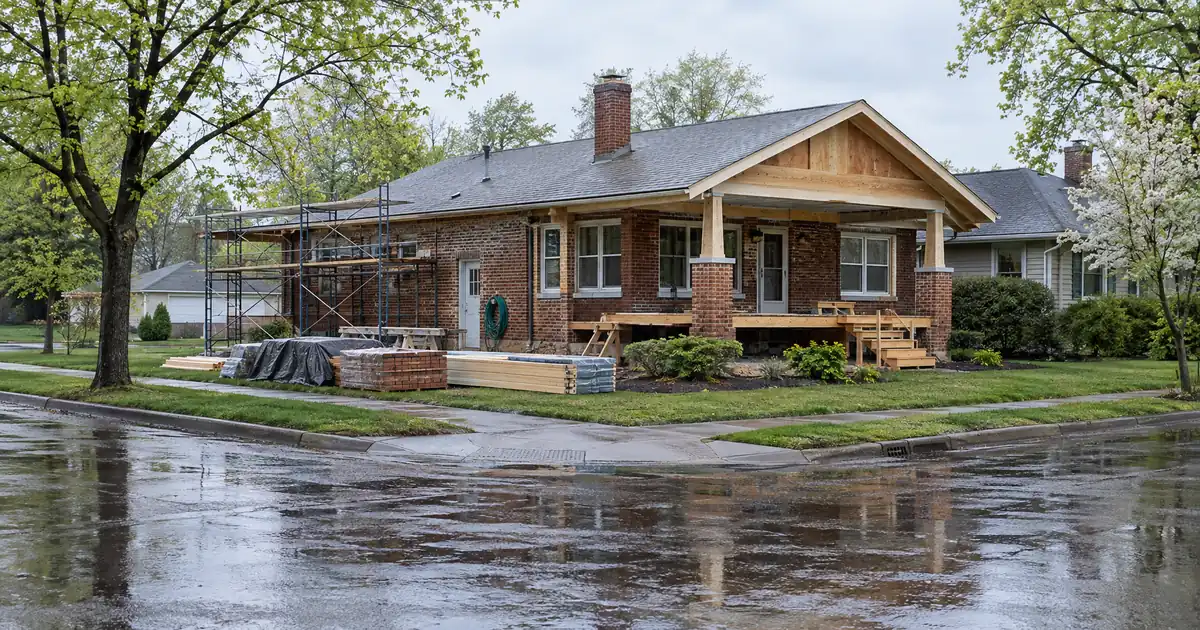
The Quick Read: Hard money lenders hold the rehab budget back and release it in stages after inspected work. The draw rules you accept at closing decide how much of your own cash sits exposed, how large the payoff grows by the exit, and which records you can hand a DSCR (debt service coverage ratio) lender at exit.
- Draws usually reimburse finished work, so you fund each phase first and get repaid after inspection.
- Each draw raises your loan balance, so the payoff at exit is a moving number.
- A DSCR lender never reads your draw schedule. It reads your invoices, proof of payment, appraisal, and ownership clock.
- A bridge note that matures before the seasoning clock runs out is the most common structural mistake.
- Every draw term varies by lender, property, and experience, and nothing here is a commitment to lend.
Brokers see the same pattern on BRRRR files. The investor negotiates the purchase price and the rehab budget carefully, then signs the draw terms without a second look. The draw terms are where the exit gets won or lost. Those terms control your cash float, your timeline, and your paper trail.
DSCR Calculator
Run the numbers in your market
Rate source: Freddie Mac 30-yr average via FRED® — Federal Reserve Bank of St. Louis · effective Oct 15, 2026
Prefilled with starting assumptions — enter your own rent or nightly figures, taxes, insurance, and HOA for a more accurate picture.
Program parameters update from Lendmire’s centralized guideline source. Taxes and insurance are editable estimates.
As of Oct 15, 2026 · General Freddie Mac market benchmark, not a Lendmire loan offer. Rent, nightly rate, occupancy, taxes, and insurance are editable estimates. Short-term rental figures are estimates only and vary significantly by season, property type, management approach, and local short-term-rental rules — confirm local regulations before relying on them. Qualifying income for short-term rentals varies by program — some use appraisal market rent, others use documented STR history or projections — and is confirmed in underwriting. Not a Loan Estimate, approval, or commitment to lend. Program availability and eligibility are subject to lender guidelines, credit approval, property review, and underwriting.
This article follows one project from the first holdback to the DSCR payoff. A DSCR loan is long-term rental financing that qualifies primarily on property-level rental income covering the payment, subject to lender guidelines. For the full picture of that product, see Lendmire’s complete DSCR loans guide.
Key Terms Defined
Draw: A release of rehab money from the lender to you, paid after the lender confirms a stage of work is done.
Holdback: The part of the loan reserved for rehab. It sits with the lender and does not fund at closing.
Scope of work (SOW): The line-by-line rehab plan and budget that the draw schedule is built from.
Change order: A written change to the approved scope, such as adding a repair or swapping a material.
Cost basis: What you actually spent on the property, meaning purchase price plus documented rehab. A new lender may size the loan on it before seasoning clears.
Seasoning: The waiting period a lender wants between buying a property and refinancing it. In Lendmire’s network, DSCR cash-out files commonly expect about 6 months, measured from title recording.
Payoff: The exact amount needed to retire the hard money loan: principal balance, accrued interest, and any exit or extension fee.
After-repair value (ARV): Your estimate of what the property is worth when the rehab is finished.
Loan-to-cost: A loan sized as a percentage of total project cost rather than of value. Hard money often uses it.
How a Draw Works, Step by Step
A draw follows a repeating loop: you finish work, request payment, the lender verifies, and the lender releases funds. The lender’s job is to protect its collateral. It sized the loan on the finished project’s value, so money paid out for work that never happened would leave it holding a half-rehabbed property worth less than the loan.
1. Closing split. Only the acquisition portion funds at closing. The rehab budget sits in the holdback.
2. Scope of work. The SOW is broken into stages, and those stages become the draw schedule.
3. You front the early work. Most lenders reimburse completed work rather than advance cash. Advances exist, but they generally go to experienced investors.
4. Request. You submit a draw request with the stage completed, usually with invoices and photos.
5. Inspection. The lender verifies the work, either with a third-party inspector or with your photos and video.
6. Release. The lender pays against what it confirmed. Many lenders credit partial completion, so half-built work earns about half of that line item.
Verification methods differ by lender. Ask which one yours uses before you close.
| Verification type | How it works | Exit-file value |
|---|---|---|
| Third-party inspector | Visits site, reports to lender | Independent proof of progress |
| Photo and video | You upload dated media | Needs your own backup records |
| Hybrid | Media early, site visit later | Mixed; keep both sets |
Most lenders charge a fee per draw inspection plus a wire fee, and those fees vary. Ten small draws cost more than three larger ones, so ask how many draws the schedule allows.
A Sample Milestone Schedule
Draw schedules follow the order of the work, and the exit file should grow at the same pace. This table shows a typical shape. Your lender’s schedule will differ.
| Phase | Typical work | What to keep for the exit |
|---|---|---|
| Start-up | Permits, demo, deposit | Contractor contract, permits |
| Structure | Framing, roof, windows | Invoices, proof of payment |
| Systems | Plumbing, electrical, HVAC | Inspection sign-offs |
| Finishes | Drywall, flooring, kitchen | Receipts, dated photos |
| Final | Punch list, closeout | Certificate of completion, final lien waiver |
Some lenders pay the first draw as an initial contractor deposit, and others skip it. That choice sets your cash float, which is the next section.
The Reimbursement Float
Reimbursement draws mean you need working capital beyond your down payment. Your cash sits exposed from the day you pay a contractor until the lender repays you. That gap is real, and it catches first-timers at the worst moment.
The float matters because BRRRR is built so capital comes back at the refinance. The money you front on rehab does not return until a DSCR cash-out closes. A slow inspection, a failed stage, or a missing invoice stretches the gap.
Hard money lenders in the Lendmire network typically size fix-and-flip loans on loan-to-cost, tiered by documented completed projects. The tiers run roughly 93% of project cost at 5+ completed projects, 90% at 2+, and 85% with fewer than 2. Every tier is capped at 75% of after-repair value. Up to 100% of the rehab budget funds through draws against completed work, but that is a rehab-budget figure, not a purchase LTV. All of it varies by lender, property, and experience.
There is no true 100% purchase program. A pitch of 100% rehab financing means the budget is available in draws after the work is done, not at closing.
One more planning rule. The common 70%-of-ARV rule of thumb, cited by Motley Fool and SmartAsset, caps purchase plus rehab at about 70% of after-repair value. It is a guideline, not a lender requirement. Lendmire’s piece How Much Margin a BRRRR Rehab Needs to Exit Hard Money Into DSCR covers that cushion in depth.
Where Draw Rules Hit the DSCR Exit
Four draw rules shape the exit: interest accrual, the maturity date, cost basis, and the definition of finished. The DSCR lender is a separate lender with its own guidelines. It never reads your hard money draw schedule, but it does read what the schedule produced.
Interest accrual and the growing payoff
Interest accrues on drawn funds, so every draw raises both the balance and the interest. Your payoff at exit equals principal drawn, plus accrued interest, plus any exit or extension fee. It grows with every release.
Hard money terms run 6-18 months, interest-only, with no prepayment penalty, varying by lender and property. Because the loan is interest-only, the principal never shrinks. The new DSCR loan has to cover the full payoff plus closing costs.
The maturity date
Plan backward from the DSCR close. Rehab, lease-up, and seasoning all have to fit inside the note’s term. A DSCR cash-out refinance commonly expects about 6 months of ownership from title recording, and that clock starts at the recorded deed, not when the rehab ends.
| Step | What to check | Risk if it slips |
|---|---|---|
| Note maturity | Term and extension fee | Forced extension cost |
| Rehab finish | Last draw and closeout | Late lease-up |
| Lease-up | Signed lease in hand | Weaker file |
| Seasoning | About 6 months from title | Smaller or delayed exit |
Extensions are common, and they usually carry a fee. Pick the term with the risk of a stalled draw in mind, since a shorter note leaves less slack when the rehab runs behind.
Cost basis and documented spend
If seasoning has not cleared, a new lender may size on cost, meaning purchase plus documented rehab. Your draw records are the proof of what you spent, and cleaner records can support a larger cost basis. After seasoning clears, the DSCR loan is typically sized on appraised value instead.
Final draw and finished
Treat the property as finished when the last draw is paid and permits are closed. An appraiser sees finished work. A half-drawn project looks like a half-done project, and the appraisal can reflect it.
What the DSCR Lender Does With the File
A DSCR loan underwrites its own appraisal, its own rent opinion, and its own ownership clock. Your ARV is a plan, not a loan basis. Treat any ARV you write down as a hope until the new appraiser confirms it.
Network guidelines for the exit, varying by lender, borrower, property, and loan scenario:
- Cash-out refinance: a DSCR loan on a standard rental typically tops out around 75% LTV, with about 6 months of seasoning from title recording.
- Rate-and-term refinance: a DSCR loan that only pays off the hard money loan, with no cash back, can reach a higher ceiling, up to 85% on the strongest files.
- Coverage: a DSCR loan generally starts at 1.00 on select programs. A separate select-lender path takes coverage below 1.00 with leverage and terms adjusted.
- Credit: a DSCR loan has a 620 floor in parts of the network, most programs want about 660, and 700+ unlocks the strongest tiers.
- Reserves: a DSCR loan commonly asks for about 6 months of PITIA (principal, interest, taxes, insurance, and any association dues), stepping up to about 9 months above $1,500,000.
The appraisal does two jobs. It sets value, and it sets market rent. For single-family the rent schedule is Form 1007, and for 2-4 units it is Form 1025. Those are appraisal forms DSCR files borrow. Many programs use the lower of the lease and the market-rent opinion, so a strong lease does not rescue a low rent opinion.
Clearing 1.00 does not mean positive cash flow. DSCR compares rent to PITIA only. Repairs, vacancy, management, utilities, and capex sit outside it.
A refinance appraiser’s number will usually be conservative. A bigger new loan means a bigger payment, and rent has to cover it. When coverage falls short, the usual fix is lower leverage, which means more cash to close. If the DSCR lender prices a lower ratio, leverage and terms adjust.
DSCR vs. conventional financing
There are two common ways to finance an investment property, and they qualify you differently — here’s how investors weigh them.
Why investors choose it
- Qualifies on the property’s rental income — no personal tax returns, W-2s, or pay stubs needed to document income.
- No personal debt-to-income ceiling to clear, so existing mortgages and obligations don’t cap your borrowing the same way.
- Can be closed in an LLC, keeping the property inside a business entity.
- Built for scaling — not held to the limit on number of financed properties that conventional financing applies.
- Underwriting centers on the deal: generally qualifies when the rent covers the payment, a 1.00x coverage ratio being a common baseline (confirmed in underwriting).
- Designed specifically for investment property, including long-term and, where the program allows, short-term rentals.
Where it’s strong
- Often the lowest ongoing financing cost for a buyer who fully qualifies on personal income — a fit for a first property or a cost-first purchase.
Trade-offs for investors
- Requires full personal income documentation and must fit within a debt-to-income limit — salary, existing debts, and other mortgages all count.
- Typically held in your personal name rather than a business entity.
- Caps how many financed properties you can carry, which can become a ceiling as a portfolio grows.
- Evaluates you as a borrower as much as the property, which usually means more paperwork.
How investors usually choose: a first or single property often optimizes for the lowest financing cost; portfolio builders often optimize for leverage, vesting in an LLC, and scaling past conventional caps. The right answer depends on your goals, the property, and current guidelines — both paths run through select lenders in Lendmire’s wholesale network, with eligibility and terms confirmed in underwriting.
Overruns, Change Orders, and Unfinished Work
An overrun on approved work and a change in scope are different problems. The first is a budget issue, and the second is a draw issue.
The most common failure looks like this. The scope changes after the SOW was submitted, the inspector credits only the planned work, and the draw comes up short. You fund the gap. Get change orders approved in writing before the work starts.
Overspend also hits the exit. Spending that comes back as a bigger cost basis helps only if it is documented and the DSCR lender sizes on cost. After seasoning, the loan is sized on appraised value, so overspending that does not raise value comes out of your pocket.
If a rehab is unfinished or partially drawn at exit time, the payoff includes whatever has been drawn. Confirm treatment of undisbursed funds against your specific note. A refinance before work is complete is also a weaker appraisal.
Edge Cases Where the Rule Breaks
The note matures before seasoning clears. Extend the note, or refinance only the payoff. A payoff-only DSCR exit leaves capital in the deal, but it avoids a forced sale. Lendmire brokers that path, and the program page for hard money exit refinance covers the overview.
Delayed financing will not fix it. Fannie Mae’s Selling Guide describes a delayed financing exception for cash purchases, and it measures an existing first mortgage at 12 months from note date. A hard money loan is a lien on the property, which generally breaks the cash-purchase fact pattern. DSCR lenders set their own seasoning, so use that guide for contrast only.
Short-term rental collateral. Rent is documented differently, with host history and statements. On a DSCR loan, cash-out tops out around 75% LTV on standard rentals and 70% on short-term-rental collateral. Short-term rental rules vary by city, county, HOA, and property type, so confirm local rules before relying on projected rental income. Terms depend on the lender’s guidelines, the property type, the leverage, and a full review of the credit profile.
Ineligible properties. Manufactured homes, log homes, and barndominiums are not offered in the network’s DSCR programs, so a rehab on one of those has no DSCR exit through it.
Build the Exit File as You Draw
Collect paper at every stage. A DSCR lender’s list varies, but this is what a clean file usually holds.
| Item | Source | Collect when |
|---|---|---|
| Hard money note | Your closing file | At closing |
| Draw history | Lender portal | After each draw |
| Invoices and receipts | Contractor | At each stage |
| Proof of payment | Your bank | When you pay |
| Lien waivers | Contractor | Each draw, plus final |
| Payoff statement | Hard money lender | Before the exit |
Match each invoice to a bank record. A paper trail with gaps weakens the cost basis the same way a missing receipt would on an expense report.
A Worked Example (Modeled, Not Market Data)
Say you buy a duplex with hard money and a rehab holdback. At closing you get the acquisition funds only. You front the start-up work out of your own cash, then submit your first draw.
The inspector credits two of three stages. You get paid for those and wait on the third. Meanwhile, interest accrues on what has been drawn, and the clock toward seasoning keeps running from the recorded deed.
When the last draw is paid, you sign a lease and order the DSCR appraisal. Suppose it comes in lower than your ARV. The new loan sizes at its LTV cap against that lower number, the payoff stays where it was, and the gap shrinks your cash back or turns into cash due at close. That is why a thin margin is dangerous: a small appraisal miss changes the whole exit. A larger down payment on the original purchase would not fix that, because the DSCR lender’s leverage caps and reserve rules still apply.
Common Mistakes
- Signing draw terms without asking how inspections work.
- Starting work before the SOW is final.
- Paying a contractor more than the next draw will reimburse.
- Treating the end of the rehab as the start of seasoning.
- Skipping lien waivers, which leaves gaps in the file.
- Choosing a note term with no slack for a slow draw.
Questions to Ask Your Hard Money Lender About Draws
1. Do you reimburse completed work, or advance any funds?
2. Who inspects, and how is the visit scheduled?
3. What does each draw cost in fees?
4. How are change orders approved?
5. Do you credit partial completion?
6. What does an extension cost, and how do I request one?
Frequently Asked Questions
Do hard money lenders pay for the whole rehab up front?
No. The rehab budget sits in a holdback and releases in stages after inspected work. Up to 100% of the rehab budget can fund through draws on some programs, varying by lender, property, and experience.
Does the DSCR lender look at my draw schedule?
No. It looks at your invoices, proof of payment, appraisal, and ownership clock. The draw history matters mainly as proof of what you spent.
When does the seasoning clock start for the DSCR refinance?
At title recording, not at rehab completion. Across Lendmire’s network, a DSCR cash-out commonly expects about 6 months of ownership.
What if my hard money note matures before seasoning clears?
You extend the note or refinance only the payoff. Extensions usually carry a fee, so a longer initial term gives you more room.
Can I refinance before the rehab is finished?
It is possible to refinance the payoff, but the appraisal reflects unfinished work. Finishing first gives you a stronger value and a stronger file.
Where to Go From Here
If you are buying, rehabbing or refinancing an investment property on a short timeline and want to see how the numbers work, Lendmire can help you compare hard money options based on the project, the exit plan, leverage, and your goals. Lendmire is a mortgage broker arranging financing through select lenders in its wholesale network, across 41 markets including Washington, D.C. Qualification is subject to lender guidelines and is not a commitment to lend.
About Lendmire
Lendmire, NMLS# 2371349, is a mortgage brokerage focused on investor financing, arranging DSCR loans in 40 states plus Washington, D.C. — 41 markets total. Qualification is based on the property’s income rather than personal income documentation, subject to lender guidelines, making it a fit for LLC-held rentals and scaling portfolios. Scotsman Guide named Lendmire a Top Mortgage Workplace in both 2025 and 2026.
Get Started
Ready to find the right loan for you?
In about 30 seconds you can review financing options available for your investment property. No commitment required.
Informational only. Not a Loan Estimate, approval, or commitment to lend. Program availability and eligibility are subject to lender guidelines, credit approval, property review, and underwriting.
References
3. Fannie Mae Selling Guide B2-1.3-03
This article is part of Lendmire’s hard money loan program — full qualification details, guidelines, and scenarios live on the program page.
Related reading: DSCR Loan Due-on-Sale Rules for Transfers to an LLC, Trust or Spouse · Hard Money vs DSCR Refinance for a BRRRR Land Contract Payoff · How to Time a Two-Step DSCR Cash-Out After a Hard Money Flip
Brandon Miller
Founder & CEO, Mortgage Loan Originator, Lendmire LLC
- Mortgage Loan Originator · NMLS# 1129696 · Verify on NMLS Consumer Access
- North Carolina Real Estate Broker · License# 343312 · Verify on NCREC
- North Carolina Insurance Producer · License# 19053198 · Property, Casualty, Life, Health · Verify on NAIC SBS
- Lendmire LLC · Firm NMLS# 2371349 · Verify firm licensure
Compliance and disclosures. Lendmire (NMLS# 2371349) is a licensed mortgage broker and is not a direct lender, depository institution, financial advisor, or tax professional. Content in this article is general market analysis and educational information — not financial, legal, or tax advice for any specific situation. Lendmire does not guarantee loan approval; every transaction is subject to underwriting by the funding lender. Mortgage pricing and loan program guidelines are subject to change at any time without notice and vary by borrower characteristics, property type, and state regulations. Lendmire complies with Equal Housing Opportunity. Licensure verification: NMLS Consumer Access.