
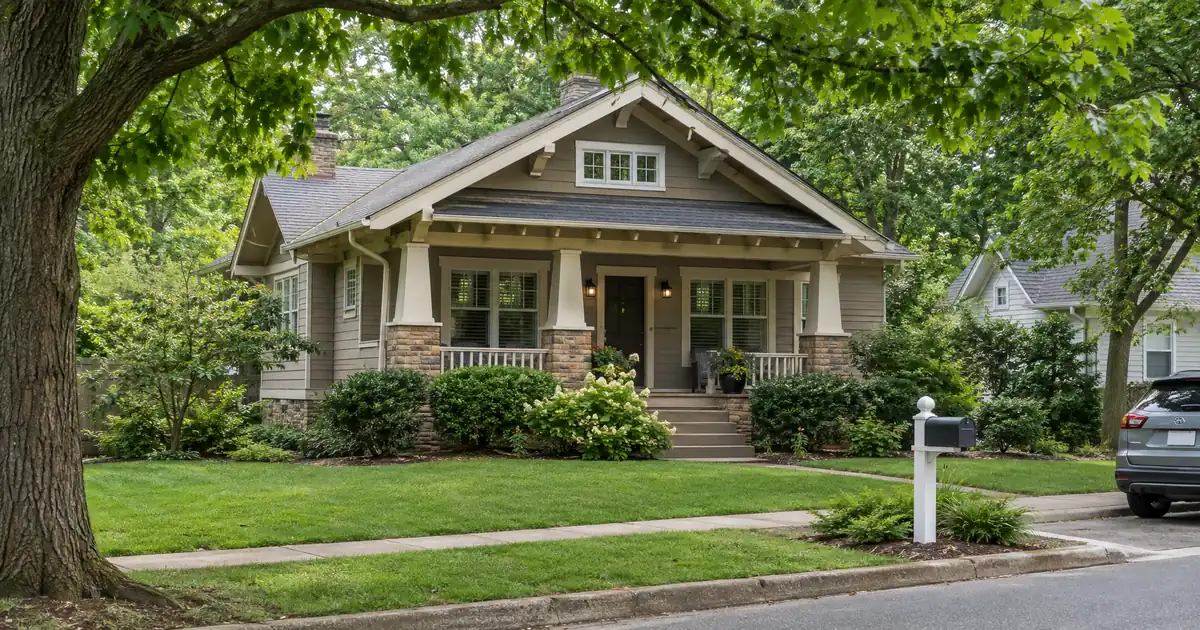
The Quick Read: A DSCR portfolio loan on newly built rentals puts two to twenty finished homes under one note. It is a take-out loan that follows the build, so every home needs proof it can legally be occupied. Each home gets an appraisal that sets its value and market rent. Coverage is then tested on the whole pool, subject to lender guidelines.
- Network portfolio loans run 2 to 20 properties, with loan sizes typically $300,000 to $5,000,000 on the 30-year portfolio DSCR loan.
- Leverage goes up to 80% on a purchase or rate-and-term refinance.
- Pooled coverage starts at 1.00, so stronger homes can offset weaker ones.
- Inside the first six months of ownership, the loan is also capped at 90% of total cost.
- Each home needs a certificate of occupancy and an appraiser-supported market rent.
A DSCR loan does not fund the build. Cash, a construction loan, or a bridge loan carries the project, and the portfolio loan replaces that debt once the homes are finished. Lendmire is a broker that arranges these loans through select lenders in its wholesale network, across 41 markets including Washington, D.C. The details below come from files placed across that network. Programs change, and every file is underwritten individually. This is not a commitment to lend.
Our complete DSCR loans guide covers the basics. This piece covers what changes when the collateral is new construction and there are several homes.
Key Terms Defined
DSCR (debt service coverage ratio): monthly rent divided by the full monthly housing payment.
PITIA: principal, interest, taxes, insurance, and association dues. It is the payment the rent has to cover.
Portfolio (blanket) DSCR loan: one note secured by several rentals. “Blanket” and “cross-collateralized” name the same thing. A big bank’s “portfolio loan,” one it keeps on its own books, is a different meaning of the word.
Pooled coverage: total rent across the homes divided by total PITIA across the homes.
Certificate of occupancy (CO): the document the local building authority issues to say a home can legally be lived in.
Market rent: the rent an appraiser estimates the home would command, documented on a rent schedule attached to the appraisal.
Cost basis: purchase price plus documented improvements.
What Is a Portfolio DSCR Loan, and Why Does a New Build Change It?
A portfolio DSCR loan is one mortgage secured by several rentals. You get one closing, one payment, and one coverage test. The tradeoff is shared risk, because every home secures the whole balance.
New builds change the picture in one way. There is no rental history. A seasoned rental brings leases and operating records. A finished new home brings a certificate of occupancy and an appraisal. So the file leans on documents about the building, not the tenant.
Two structures exist in the network, and they differ a lot:
| Feature | 30-year portfolio DSCR loan | Rental portfolio term loan |
|---|---|---|
| Properties | 2 to 20 | 5 or more properties or units |
| Loan size | Typically $300,000 to $5,000,000 | Typically $500,000 to $50,000,000 |
| Leverage | Up to 80% on purchase | Up to 75% |
| Term | 30 years | 3, 5, 7, or 10 years, balloon at maturity |
| Property types | SFR, 2-4 unit, condo, townhome | Adds small multifamily (five or more units) |
Larger balances go on review in both. Most newly built single-family homes fit the 30-year structure, so that is the focus here.
How Does Underwriting Treat a Newly Built Home, Step by Step?
Underwriting treats each new build as a finished property that must prove three things: it is legally occupiable, it is worth the price, and its market rent supports the debt. Here is the sequence.
1. Build financing comes first. Cash, a construction loan, or a bridge loan carries the project. That means two financing events, two approvals, and two sets of closing costs. Construction lenders look at your ability to repay during the build and at your exit. They do not look at property income.
2. The homes are completed. Each needs a CO or equivalent proof, utilities on, and the punch list closed. A missing CO is an eligibility problem, not a coverage problem. Coverage math cannot fix it.
3. Each home is appraised. The appraisal sets the value that leverage is measured against. It also sets the rent that drives coverage.
4. Coverage is tested on the pool. Add up the market rents, add up the PITIA, and divide.
5. Documents are assembled. The pool carries one note, a security instrument for each property, a schedule allocating debt to each home, a release clause, and a guaranty where the structure calls for one.
Seasoning is the waiting period a lender wants between events. A purchase of a finished new build does not trigger one. Refinance and cash-out seasoning varies by program.
Whose Rent Counts When There Is No Lease?
The appraiser’s market-rent opinion counts. Your own projection does not, and a signed lease above market adds nothing. Where both a lease and a market-rent opinion exist, programs typically use the lower of the two.
For a single-family home, the appraiser documents rent on a comparable rent schedule. Fannie Mae’s appraiser guidance describes that form as the way an appraiser documents estimated monthly market rent on a single-family investment property. Two-to-four-unit homes use a different operating income form. Agency rules do not govern DSCR files, but the appraisal tools are the same. For contrast, Fannie Mae’s selling guide also accepts an appraiser’s market-rent opinion when a property is not currently rented. DSCR lenders land in the same place for the same reason.
Many investors assume a pro forma rent will carry the file. It won’t. Nightly-rate math doesn’t either. A short-term-rental new build has no hosting history, so income comes from an appraisal or market-data analysis, and leverage is lower. Short-term rental rules can vary by city, county, HOA, and property type, so investors should confirm local rules before relying on projected rental income.
How Is Pooled Coverage Calculated?
Pooled coverage is total rent used for lender review divided by total PITIA for every home in the loan. Strong homes can offset weak ones, which is the main reason investors pool.
Run the logic on a three-home pool. Say two homes clear 1.25x on their own and one sits at 0.90x. Pooled together, the result lands comfortably above 1.00. The weak home rides along because the pool carries it. Underwriting tests the pooled coverage, the leverage, and the terms in one pass, subject to lender guidelines. These are illustrative ratios, not market data.
Two cautions:
- One weak home still counts. Every home still needs a lease or an appraiser-supported market rent. A weak home drags the pooled number down, and a pool of three weak homes has nobody to offset them.
- Clearing 1.00 is not positive cash flow. The ratio counts only PITIA. Repairs, vacancy, management, utilities, and capex sit outside it.
What Property and Borrower Requirements Apply?
Property. Eligible types are single-family, 2-4 unit, condo, and townhome. Owner-occupied, co-op, mixed-use, and commercial property are not eligible in the pool. Manufactured homes, log homes, and barndominiums are not offered on any of these programs.
Credit. The portfolio programs set a floor of 640, and some portfolio structures want 680 or 720.
Entity. Some structures require a special-purpose entity, typically an LLC, subject to program terms. Entity papers, title, and insurance are needed for each home. Recourse loans carry a personal guarantee. Non-recourse structures exist on the term loan, with carve-outs such as fraud and bankruptcy.
Reserves. They vary by lender, leverage, and loan size. Many files need around six months of PITIA, stepping up above $1,500,000. Loans of that size can also carry overlays on credit and eligibility.
Cost-basis cap. This one trips up new-build buyers. Inside the first six months of ownership, the loan is also capped at 90% of total cost (purchase price plus documented improvements). From six to twelve months it is 100% of total cost. The leverage ceiling still applies, so the loan is the lower of the two. After twelve months, appraised value alone is the basis. A rate-and-term refinance is not subject to the cost-basis cap.
A larger down payment lowers the payment and can lift coverage. It never erases leverage caps, credit floors, reserve rules, or property eligibility. The strongest files clear both tests: enough equity and enough rental coverage.
When Does the General Rule Break?
These are the edge cases that stall pooled new-build files.
- Mixed readiness. All homes must be CO-ready together, or they close on separate schedules. Three finished homes and one under construction usually means closing three, or waiting. Partial lease-up does not block a file, and a lease is not required on every home.
- Temporary certificates. A temporary CO can bridge a delay, but it can expire and stall things. Duration varies by jurisdiction.
- Thin rent comps. A subdivision built in one wave has few comparable rentals. Sales comps can be dominated by the builder. The appraiser may lean on cost, which can produce lower rent or a lower leverage tier than you expected.
- Cross-collateralization. Every home secures the whole balance, so one problem property can reach all of them. A release clause may let a home exit, following the loan documents and the lender’s release terms. The release price runs above the property’s allocated balance, and the remaining pool must still cover its debt service.
- Adding a home later. Usually not possible. It takes a modification, a refinance of the pool, or a separate loan.
- One first lien. A property cannot sit in both a standalone DSCR loan and a blanket loan.
- A home below 1.00. It can sit in the pool, and underwriting tests the pooled coverage, the leverage and the terms.
For a standalone version of this question, see Lendmire’s piece Can You Get a DSCR Loan on a Newly Built Rental?.
Pool or Separate Loans? The Investor Decision
Pooling suits investors finishing several homes in the same window who want one closing and the offset effect. Separate loans suit investors who expect to sell individual homes soon, or whose homes finish months apart.
Think through the exit first. A CO delay or a low appraisal can break a take-out, and you are carrying construction debt meanwhile. The supply side is real, too: the Census Bureau and HUD new residential construction series tracks single-family starts and completions, and its quarterly starts and completions table breaks out homes built for rent. More build-to-rent product means more investors sequencing these exits.
Coordinate leasing and stabilization across the homes so the pool looks consistent at appraisal. If you plan to sell a home, run the release math before you add it.
If you are buying or refinancing a rental property and want to see how the numbers work, Lendmire can help you compare DSCR loan options based on the property income, credit profile, leverage, and investor goals. Call 828-256-2183.
Frequently Asked Questions
Can a DSCR portfolio loan pay for construction?
No. It is a take-out loan for finished, occupancy-ready homes. Cash, a construction loan, or a bridge loan funds the build, and the portfolio loan replaces that debt afterward.
Do I need a signed lease on every new home?
No. A lease is not a DSCR requirement. Each home needs a lease or an appraiser-supported market rent. On a vacant new build, the appraiser’s rent schedule fills that role.
Does a certificate of occupancy make the home eligible?
It is necessary, not sufficient. Permanent financing generally cannot close without a CO, and the home also needs an appraisal, eligible property type, and pooled coverage that clears the floor.
What if one home is below 1.00 coverage?
It can sit in the pool, because coverage is measured on the whole pool. Underwriting tests the pooled coverage, the leverage and the terms. Each home still needs a lease or market rent behind it.
Can I add or sell a home after closing?
Adding is usually not possible without a modification, refinance, or separate loan. Selling one follows the loan documents and release terms. The remaining pool must still cover its debt service.
About Lendmire
A DSCR-focused mortgage broker, Lendmire (NMLS# 2371349) places investor financing across 41 markets — 40 states plus Washington, D.C. — with DSCR eligibility generally reviewed by the lender on property cash flow instead of traditional personal-income documentation, subject to lender guidelines. Scotsman Guide named Lendmire a Top Mortgage Workplace in 2025 and 2026.
Get Started
Ready to find the right loan for you?
In about 30 seconds you can review financing options available for your investment property. No commitment required.
Informational only. Not a Loan Estimate, approval, or commitment to lend. Program availability and eligibility are subject to lender guidelines, credit approval, property review, and underwriting.
References
1. Fannie Mae Appraiser Update
2. Fannie Mae Selling Guide, Rental Income
This article is part of Lendmire’s DSCR loan program — full qualification details, guidelines, and scenarios live on the program page.
Related reading: One DSCR Portfolio Loan vs. a Loan in Each Southeastern State · Blanket DSCR Loan Requirements for Two Investment Properties · DSCR Loan Requirements for Out-of-State Investors With No P&L
Brandon Miller
Founder & CEO, Mortgage Loan Originator, Lendmire LLC
- Mortgage Loan Originator · NMLS# 1129696 · Verify on NMLS Consumer Access
- North Carolina Real Estate Broker · License# 343312 · Verify on NCREC
- North Carolina Insurance Producer · License# 19053198 · Property, Casualty, Life, Health · Verify on NAIC SBS
- Lendmire LLC · Firm NMLS# 2371349 · Verify firm licensure
Disclosures. The information presented in this article is general market commentary, not financial, legal, or tax advice. Lendmire is a mortgage brokerage (NMLS# 2371349) — not a direct lender or depository institution — and loan placement is subject to lender underwriting. Nothing in this content represents a commitment to lend. Loan terms, pricing, and program availability vary based on borrower qualifications, property characteristics, and state of subject property, and are subject to change at any time. Lendmire complies with Equal Housing Opportunity requirements. Consumer access: nmlsconsumeraccess.org.