
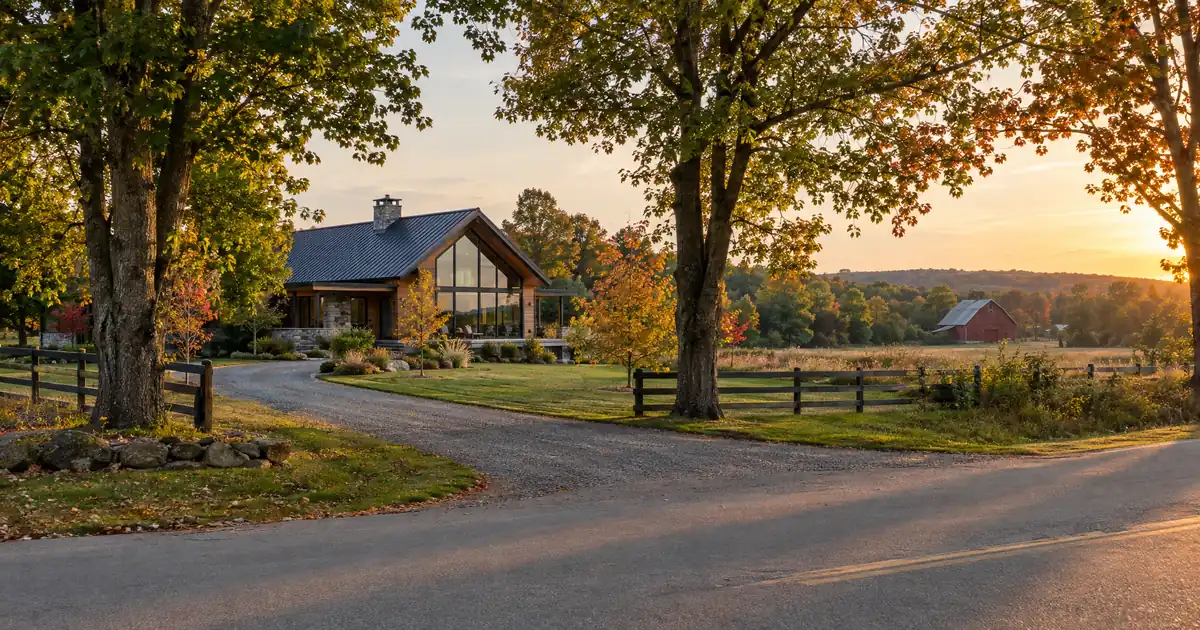
The Quick Read: On a rural DSCR file, a full appraisal is usually the safer fit for an out-of-state investor, because it produces both a value opinion and a market-rent opinion, while an automated value model produces only a value estimate. Rent drives the coverage ratio, so a tool that cannot speak to rent cannot carry the whole file.
- A full appraisal typically delivers collateral value and a rent schedule; an automated value delivers a value estimate only.
- Rural properties thin out the comparable sales and rentals that both methods depend on.
- An automated value, where a program accepts one, can replace the value step at most, never the rent step.
- Leverage, credit, and reserve rules apply either way, subject to lender guidelines.
- Confirm rural eligibility before you sign a contract, not after the appraisal is ordered.
Two products, two jobs. That’s the whole story, and the rest of this piece shows where it bends.
DSCR Calculator
Run the numbers in your market
Rate source: Freddie Mac 30-yr average via FRED® — Federal Reserve Bank of St. Louis · effective Oct 22, 2026
Prefilled with starting assumptions — enter your own rent or nightly figures, taxes, insurance, and HOA for a more accurate picture.
Program parameters update from Lendmire’s centralized guideline source. Taxes and insurance are editable estimates.
As of Oct 22, 2026 · General Freddie Mac market benchmark, not a Lendmire loan offer. Rent, nightly rate, occupancy, taxes, and insurance are editable estimates. Short-term rental figures are estimates only and vary significantly by season, property type, management approach, and local short-term-rental rules — confirm local regulations before relying on them. Qualifying income for short-term rentals varies by program — some use appraisal market rent, others use documented STR history or projections — and is confirmed in underwriting. Not a Loan Estimate, approval, or commitment to lend. Program availability and eligibility are subject to lender guidelines, credit approval, property review, and underwriting.
Side-by-Side
The table compares the two valuation routes as they typically work on DSCR files. The automated column reflects published industry norms, since acceptance varies by program and lender.
| Factor | Full Appraisal | Automated Value (AVM) |
|---|---|---|
| Review basis | Value plus market rent | Value estimate only |
| Documentation | Rent schedule form included | No rent opinion produced |
| Property inspection | On-site by a local appraiser | None; data-driven |
| Condition awareness | Observed in person | Assumes average condition |
| Property types | 1007 for single-family; 1025 for 2-4 units | Best on simple, comp-rich homes |
| Entity vesting | Unaffected; LLC docs still required | Unaffected; LLC docs still required |
| Timeline | Longer; scheduling and report | Shorter in concept |
| Reserve expectations | Same program rules apply | Same program rules apply |
Notice the bottom rows. Entity paperwork and reserves don’t change with the valuation method. The valuation choice moves the value and rent steps, nothing else.
What Each Product Actually Produces
A DSCR coverage ratio divides monthly rent by the full monthly obligation: principal, interest, taxes, insurance, and any association dues. A full appraisal feeds that equation twice. It sets the value that determines your loan amount through LTV, and its rent schedule supplies the numerator.
An automated value feeds only the first step. It is a statistical estimate built from public records and recent sales. It does not walk the property, and it does not produce a rent opinion. If a program accepts one, the rent evidence still has to come from somewhere else, typically a lease or a rent schedule.
Short-term rentals add a wrinkle. The standard rent schedule measures monthly lease rent, not nightly income, so those files lean on booking history or a third-party projection instead. Across the wholesale network, short-term rental files typically want about 12 months of hosting history and a 640+ score.
Why Rural Breaks the Model
Rural is where both methods get weaker, and the research says so plainly. An FHFA working paper on rural appraisal accuracy reports that more than 25 percent of rural appraisals exceed the contract price by more than five percent. The authors tie this to fewer comparable sales and more variation from one home to the next.
That finding cuts against the lazy assumption that a human appraisal is automatically right. Brookings notes that FHFA researchers found automated models can outperform appraisals in rural areas. One explanation: appraisers tend to land on the contract price when they know it, while models never see it. Brookings also cautions that automated models can carry historic disparities and reduce transparency.
Here’s the catch. Those studies concern purchase-money value on owner-occupied-style lending. Acreage, wells, septic, and deferred maintenance are classic blind spots for a model, and rental comps run thinner than sale comps once you leave town.
So the fair reading is mixed. Value accuracy is a toss-up in thin markets. Rent accuracy is the bigger exposure, and only one of the two products even attempts it.
What Rural Means to a DSCR Lender
Rural has no single definition. Lenders look at comp sufficiency and rent reliability more than a label. Can the appraiser find enough recent sales and rentals nearby? Does the area show steady rental demand? Is the property marketable if the loan goes bad?
Separate two questions that get blurred. Eligibility asks whether the property type fits the program at all. Valuation asks how it will be valued. Across the network, DSCR investor loans are not offered on manufactured homes (single- or double-wide), log homes, or barndominiums. No valuation method fixes that, rural or not.
If the appraisal labels a property rural, terms can shift. The practical move is to tell the lender up front that the property is rural, so it can confirm a program fits before anyone orders a report.
When a Full Appraisal Is the Better Fit
Choose the appraisal route when the file depends on rent that is hard to prove. That describes most rural rentals.
- The rent number is the weak link. A rent schedule is the only product here that gives an independent rent opinion. A thin one can cap qualifying income no matter how strong the lease looks, since many programs work from the lower of lease rent and market rent.
- Condition is uncertain. A person on site sees deferred maintenance, outbuildings, and access issues that a model assumes away.
- The property is multi-unit. A fourplex needs the operating-income form for 2-4 units, and a model has no equivalent.
- You’re buying at higher leverage. Purchases typically run 75%-80% LTV on an investment property, and a value opinion backed by inspection gives lenders more to work with when comps are scarce.
- The investor is remote. The appraiser is your on-site proxy. You don’t need to be there, though you still supply the lease or rent evidence, entity documents, and reserves.
The tradeoff is real. A local appraiser’s choice of comps can decide your outcome, and you have less control over that than you’d like.
When an Automated Value Is the Better Fit
An automated value earns its place on simpler files, and only where a program allows one.
- Comp-rich property types. A conventional single-family home in an area with plenty of recent sales gives a model something solid to work from.
- Lower leverage. A more conservative loan-to-value leaves more cushion if the estimate runs a little off.
- You already hold strong rent evidence. A signed lease and listing-based comps cover the rent step, so the model only needs to handle value.
- Refinances where you know the asset. Familiarity with the property’s condition reduces the model’s blind spot.
Still, an automated value never answers the rent question. It can simplify valuation; it can’t replace the rent schedule. And acceptance is the lender’s call. Some programs permit one in narrow cases, others don’t, and the property must still clear every eligibility test.
On regulation, since investors ask. The federal interagency rule on automated valuation quality control, published by the CFPB, is written around mortgages secured by a consumer’s principal dwelling. DSCR loans are business-purpose loans on investment property, so don’t assume that rule shapes your file. Treat it as context, not as a protection or a requirement.
A Worked Example
Picture an out-of-state investor eyeing a rural single-family rental at 75% LTV on a purchase. The investor holds a lease that looks strong. The figures below are modeled assumptions, not market data. These specifics are subject to lender guidelines and a full review of property, leverage, and credit.
Route one, full appraisal. The value comes in near contract, and the rent schedule lands slightly under the lease. Coverage computes against the lower figure and clears about 1.1x. The file works, with less room than the lease suggested.
Route two, automated value. The model returns a value estimate but no rent opinion. The lender asks for rent evidence anyway. If the lease and listing comps support it, coverage looks similar. If the property has acreage or a private well, the model may return low confidence, and the lender typically falls back to a full appraisal.
Same property, same investor. The difference is where the risk lands. The appraisal surfaces a rent haircut early. The automated route can hide it until later.
One caution on the math. Clearing 1.00x measures rent against the monthly obligation only. It is not the same as positive cash flow, because repairs, vacancy, management, utilities, and capex sit outside the calculation.
The Out-of-State Investor Playbook
Do these before you commit earnest money.
1. Ask about rural eligibility first. Tell the broker the property is rural and get a read on which programs fit.
2. Gather rent evidence. Pull listing-based comps and a lease if one exists, so the appraiser has data to work with.
3. Confirm the property type. Manufactured homes, log homes, and barndominiums are outside the network’s DSCR programs.
4. Know your leverage tier. Most purchases land at 75%-80% LTV, and select high-leverage programs reach 85% with a score around 700+, subject to lender guidelines.
5. Plan reserves. They commonly run around 6 months of PITIA, stepping up to about 9 months on loans above $1,500,000.
6. Review the report for facts. If the appraisal misses a better comp, a data-based review request is reasonable. Arguments built on opinion rarely move anything.
DSCR vs. conventional financing
There are two common ways to finance an investment property, and they qualify you differently — here’s how investors weigh them.
Why investors choose it
- Qualifies on the property’s rental income — no personal tax returns, W-2s, or pay stubs needed to document income.
- No personal debt-to-income ceiling to clear, so existing mortgages and obligations don’t cap your borrowing the same way.
- Can be closed in an LLC, keeping the property inside a business entity.
- Built for scaling — not held to the limit on number of financed properties that conventional financing applies.
- Underwriting centers on the deal: generally qualifies when the rent covers the payment, a 1.00x coverage ratio being a common baseline (confirmed in underwriting).
- Designed specifically for investment property, including long-term and, where the program allows, short-term rentals.
Where it’s strong
- Often the lowest ongoing financing cost for a buyer who fully qualifies on personal income — a fit for a first property or a cost-first purchase.
Trade-offs for investors
- Requires full personal income documentation and must fit within a debt-to-income limit — salary, existing debts, and other mortgages all count.
- Typically held in your personal name rather than a business entity.
- Caps how many financed properties you can carry, which can become a ceiling as a portfolio grows.
- Evaluates you as a borrower as much as the property, which usually means more paperwork.
How investors usually choose: a first or single property often optimizes for the lowest financing cost; portfolio builders often optimize for leverage, vesting in an LLC, and scaling past conventional caps. The right answer depends on your goals, the property, and current guidelines — both paths run through select lenders in Lendmire’s wholesale network, with eligibility and terms confirmed in underwriting.
If the Values Disagree
Sometimes a lender holds both an appraisal and an automated estimate. The lower supported value generally governs. Lenders don’t average them. If the gap is large, a desk review or a re-evaluation request may follow, and the lender decides which product controls.
A lower value reduces your loan amount at a given LTV, and a lower rent figure reduces coverage. Both can land at once. That’s why the pre-contract homework above matters more than any post-report appeal.
Key Terms Defined
Appraisal: A licensed appraiser’s on-site opinion of a property’s value.
Automated value (AVM): A statistical estimate of value built from public records and recent sales, with no inspection.
Rent schedule (Form 1007): The report estimating market rent for a single-family rental; Form 1025 covers 2-4 units.
PITIA: Principal, interest, taxes, insurance, and association dues, the monthly obligation in the coverage ratio.
DSCR: Debt service coverage ratio, rent divided by PITIA.
Frequently Asked Questions
Can I refuse an automated value on a rural file?
Usually the lender decides which valuation product a file gets, so refusing isn’t really an option. What you can do is raise rural status early, which tends to steer the file toward a full appraisal where one makes sense.
Does rural mean I can’t get a DSCR loan?
No, though the property type and comp availability matter. Standard rural single-family homes can be eligible, while manufactured homes, log homes, and barndominiums are not offered in the network. Leverage and terms can adjust, subject to lender guidelines.
Will an automated value support my rent?
No. It estimates value only. Rent has to come from a rent schedule, a lease, or other evidence, and many programs review the file on the lower of lease and market rent.
Does being out of state affect my application?
Not directly. The appraiser inspects on site, and you supply the lease or rent evidence, entity documents, and reserves. Hold the property in an LLC if you prefer, subject to program eligibility, and expect the usual entity paperwork.
What if the appraisal comes in low?
A low value cuts the loan amount at a given LTV, and a low rent figure cuts coverage. A data-based review request with better comps can help. Otherwise, adjust the structure or the price. Tax treatment varies; consult a qualified professional.
The Balanced Verdict
For most rural rentals bought from afar, the full appraisal is the stronger default, because rent is the fragile input and only that product addresses it. An automated value fits best on simple, comp-rich properties at conservative leverage, with strong rent evidence already in hand. And if neither route produces numbers that clear coverage, that’s a signal to revisit the property or the price, not the valuation method.
If you are buying or refinancing a rental property and want to see how the numbers work, Lendmire can help you compare DSCR loan options based on the property income, credit profile, leverage, and investor goals. The complete DSCR loans guide covers the program basics, and Lendmire, a broker working through select lenders across 41 markets including Washington, D.C., arranges the financing, subject to lender guidelines and not a commitment to lend.
About Lendmire
Lendmire (NMLS# 2371349) is a DSCR-focused mortgage broker that helps arrange investor financing across 41 markets, including Washington, D.C., through wholesale and investor-lending channels. DSCR eligibility is generally reviewed by the lender around the property’s rental income rather than personal income documentation, subject to lender guidelines — which works for self-employed investors, LLC operators, and portfolios above four financed properties. Scotsman Guide named Lendmire a Top Mortgage Workplace in both 2025 and 2026.
Get Started
Ready to find the right loan for you?
In about 30 seconds you can review financing options available for your investment property. No commitment required.
Informational only. Not a Loan Estimate, approval, or commitment to lend. Program availability and eligibility are subject to lender guidelines, credit approval, property review, and underwriting.
References
2. Brookings, Governing the Ascendancy of AVMs
3. CFPB AVM quality control final rule
This article is part of Lendmire’s DSCR loan program — full qualification details, guidelines, and scenarios live on the program page.
Related reading: DSCR Cash-Out Paperwork and Limits for a 2-4 Unit Building · Is Flood Insurance Required on an Out-of-State DSCR Rental? · Bridge Loan vs DSCR Loan for a Declined Rural Buyer: What Each Needs
Brandon Miller
Founder & CEO, Mortgage Loan Originator, Lendmire LLC
- Mortgage Loan Originator · NMLS# 1129696 · Verify on NMLS Consumer Access
- North Carolina Real Estate Broker · License# 343312 · Verify on NCREC
- North Carolina Insurance Producer · License# 19053198 · Property, Casualty, Life, Health · Verify on NAIC SBS
- Lendmire LLC · Firm NMLS# 2371349 · Verify firm licensure
Compliance and disclosures. Lendmire (NMLS# 2371349) is a licensed mortgage broker and is not a direct lender, depository institution, financial advisor, or tax professional. Content in this article is general market analysis and educational information — not financial, legal, or tax advice for any specific situation. Lendmire does not guarantee loan approval; every transaction is subject to underwriting by the funding lender. Mortgage pricing and loan program guidelines are subject to change at any time without notice and vary by borrower characteristics, property type, and state regulations. Lendmire complies with Equal Housing Opportunity. Licensure verification: NMLS Consumer Access.