
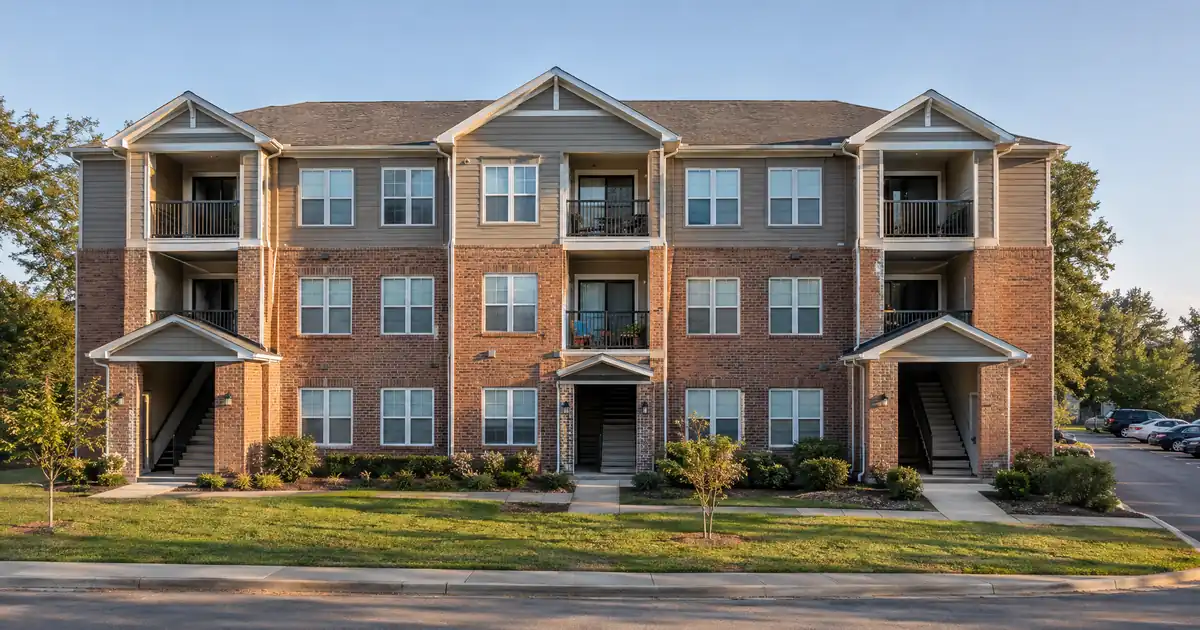
The Quick Read: On a multi-unit cash-out refinance, the lender counts rent per unit, usually the lower of the signed lease or the appraiser’s market rent, and compares that gross total to the full payment on the new loan, which is how most DSCR programs reach their coverage number. The paper trail has to match the appraisal’s unit-by-unit schedule, or proceeds shrink even when equity is plentiful.
- Cash-out on investment property tops out around 75% LTV across most of the network, with about 6 months of seasoning, subject to lender guidelines.
- Each occupied unit needs a signed lease, and the rent roll should reconcile to those leases.
- A lease above market rent usually does not lift coverage. A lease below market usually governs.
- Coverage is rent against PITIA on the new, larger loan, so rent can cap proceeds before equity does.
- Clearing the ratio is not the same as positive cash flow.
This article is about the landlord side of the table: what a lender needs to see to credit rent on a 2-4 unit building. It is not about the tenant-side proof-of-income letters that renters gather. And since no government body writes the rules for DSCR rent documentation, what follows is how files are structured across Lendmire’s wholesale network. Each program sets its own details, and every file is underwritten individually.
DSCR Cash-Out Calculator
Run the cash-out numbers in your market
Rate source: Freddie Mac 30-yr average via FRED® — Federal Reserve Bank of St. Louis · effective Oct 22, 2026
Prefilled with starting assumptions — enter your property’s value, balance, taxes, and insurance for a more accurate picture.
Program parameters update from Lendmire’s centralized guideline source. Taxes and insurance are editable estimates.
As of Oct 22, 2026 · General Freddie Mac market benchmark, not a Lendmire loan offer. Property value, balance, taxes, and insurance are editable estimates. Maximum loan-to-value varies by lender, program, property type, and seasoning. Not a Loan Estimate, approval, or commitment to lend. Program availability and eligibility are subject to lender guidelines, credit approval, property review, and underwriting.
How Does Underwriting Treat Rent on a Multi-Unit Cash-Out?
Underwriting treats rent as gross monthly income per unit, tested against the full monthly obligation on the new loan. Lendmire, a mortgage broker arranging DSCR investor loans through select lenders in its network, sees the same sequence on most files. Each step below builds on the one before it.
Step 1: Classify the building. A 2-4 unit property is appraised as a residential income property. Fannie Mae’s forms library lists Form 1025, the Small Residential Income Property Appraisal Report, as the report for these buildings. Five or more units is generally treated as commercial, underwritten on stabilized net operating income with a commercial appraisal. Confirm the exact threshold against program guidelines.
Step 2: Collect the rent evidence for each unit. Most programs want a signed lease for every occupied unit, a rent roll listing unit, tenant, rent and lease dates, and proof the rent is actually being paid, usually bank deposits. The rent roll and leases should tell the same story.
Step 3: The appraiser sets market rent. The appraisal carries unit-level rent opinions built from comparable rentals. The borrower does not supply that number. The same appraisal drives value, and value drives the LTV test.
Step 4: The lender picks the rent used for lender review for each unit. The common convention is the lower of the lease or market rent. Vacant units typically use market rent alone. Month-to-month or expired leases often fall back to market rent too. Programs differ, so treat this as typical, not guaranteed. It is gross rent: no vacancy or expense deduction sits inside the ratio.
Step 5: Build the denominator. The denominator is PITIA on the new cash-out loan: principal, interest, taxes, insurance, and association dues. Your old payment does not matter. A bigger cash-out balance means a bigger obligation, so rent may limit proceeds before equity does.
Step 6: Run the other gates. Appraised value sets LTV. Credit, reserves, seasoning and entity documents are tested separately. Clearing coverage does not waive any of them. A larger equity position helps, but it never erases credit floors, reserve rules or property eligibility.
Lendmire’s complete DSCR loans guide covers the basics of how the ratio works if you want the foundation first.
Key Terms Defined
Rent roll: A schedule of every unit showing tenant, monthly rent, and lease start and end dates.
Market rent: The appraiser’s opinion of what a unit would rent for today, based on comparable rentals.
PITIA: Principal, interest, taxes, insurance, and association dues on the new loan.
Seasoning: The length of time you have owned the property, measured from title recording, before cash-out is allowed.
Coverage ratio (DSCR): Qualifying monthly rent divided by PITIA.
Form 1025: The appraisal report for 2-4 unit income properties, with rent analysis built in.
What Is the Document Package, Piece by Piece?
Five items carry nearly every multi-unit file: leases, a rent roll, deposit records, the appraisal, and ownership papers. Each answers a different question for the reviewer.
- Signed leases. They prove the contractual rent and its term. Unsigned drafts and verbal agreements do not count. A planned increase that is not signed does not count either.
- Rent roll. It gives the reviewer a one-page view of the whole building. Errors here, like a unit listed at one rent while its lease says another, can prompt follow-up requests.
- Deposit records. Bank deposits show the rent is really collected. Cash rent that never touches an account is hard to credit.
- Appraisal with unit-level rents. This supplies the market-rent figure for each unit and for any vacant ones.
- Ownership and entity papers. If an LLC holds title, expect operating agreement and formation documents, subject to program terms.
Beyond those, expect insurance, a payoff statement, tax and association information, and a reserves check. Light on personal income documentation never means light on paperwork. The property’s income carries the qualification, subject to lender guidelines, but the property still has to be documented.
Where the Appraisal Fits (and Why Form 1007 Is the Wrong Form)
Form 1025 covers 2-4 unit buildings and weighs rental income alongside comparable sales. The Single-Family Comparable Rent Schedule, Form 1007, is a different animal. Fannie Mae’s Selling Guide requires it for one-unit investment properties where rent is used to qualify. A fourplex does not use it.
Appraisers often add an operating income statement, Form 216, which deducts expenses including a vacancy estimate to reach net income. That is useful context, but DSCR files typically do not use the net figure. The ratio runs on gross rent used for lender review. Fannie Mae’s own forms exist for agency loans, and DSCR programs borrow only their format.
What the Four Rent Scenarios Look Like on One Building
Picture a fourplex with three occupied units and one empty. Here is how the rent used for lender review is typically assembled:
| Unit status | Typical rent used for program review | What the file needs |
|---|---|---|
| Lease at market | Lease and market agree | Lease, deposits |
| Lease above market | Market rent (lower of) | Lease, deposits |
| Lease below market | Lease (lower of) | Lease, deposits |
| Vacant | Market rent from appraisal | Appraisal schedule |
Add the four figures, divide by the new loan’s PITIA, and you have the coverage number. Say the three occupied units come in at or near market and the vacant one carries a market figure from the appraisal. The total might clear 1.00 comfortably, or it might land at 1.0x on the new, larger payment. Some programs discount vacant-unit rent or trim leverage when a building is partly empty, so the vacant unit is where files get tight.
The same building at a smaller cash-out amount produces a smaller PITIA and a higher ratio. That trade, less cash out for stronger coverage, is the lever most investors actually pull.
Where the General Rule Breaks
The lower-of convention is a market practice, not a law, and edge cases bend it.
Lease below market. The lease usually governs. The cleanest fix is renewing at market rent before the appraisal is ordered, if the tenant agrees and local rules allow it. The renewal must be a signed document.
Lease above market. Expect no credit for the excess. Many investors are surprised by this one.
Partly vacant buildings. Leases cover occupied units, appraisal market rent covers the empty ones. Some programs adjust leverage when vacancy is meaningful.
Owner-occupied unit. DSCR loans are designed for non-owner-occupied investment properties. Living in one unit of a fourplex makes it a different kind of file, so confirm eligibility before you plan around it.
Short-term rental units. Fannie Mae’s appraiser guidance says Form 1007 documents monthly market rent and that an appraiser should not multiply a nightly rate by 30. HousingWire makes a related point: forcing STR income into that form can produce artificially low coverage numbers. On 2-4 unit buildings, Form 1025 already has per-unit rent lines, so the pressure is lower. STR documentation then runs on platform history and bank deposits. Typical STR terms: refinance and cash-out around 70% LTV, a 640+ score, about 12 months of hosting history, and a 1.00 coverage floor. Short-term rental rules can vary by city, county, HOA, and property type, so investors should confirm local rules before relying on projected rental income. Lendmire’s piece Short-Term Rental Cash-Out Refinance Income Documentation Requirements goes deeper. Exact terms depend on the lender’s guidelines, property type, leverage, and a full review of the borrower’s file.
Rent-by-room or co-living. Many programs restrict or exclude it. Where accepted, expect whole-property market rent rather than a stack of room rents.
Agency contrast. HUD’s FHA knowledge base shows a different philosophy for 2-4 unit rent: the lesser of fair market rent or lease, with only 75% of that figure credited. DSCR files do not work that way. They use gross rent over PITIA, with no agency haircut.
What Does the Investor Decision Look Like in Practice?
The practical decision comes down to how much cash you want out versus how much coverage you need, and whether you fix the paper before the appraisal is ordered.
Strengthening a file is cheap if done early. Renew below-market leases at market. Reconcile the rent roll to the leases. Pull together deposit records. Resolve any unit where the lease and the rent roll disagree. Do this before the appraisal, not after.
Then size the loan. Cash-out on standard rentals tops out around 75% LTV, and about 6 months of seasoning is the common expectation. Coverage of 1.00 is where select programs start, and stronger ratios open better pricing and leverage. Coverage below 1.00 is available through select lenders in the network, with leverage and terms adjusted. No-ratio structures exist only through select lenders, generally for borrowers who already own a primary residence. Credit floors start at 620 in parts of the network, most programs want around 660, and 700+ unlocks the strongest leverage tiers. Reserves commonly run around 6 months of PITIA, stepping up to about 9 months above $1,500,000. Standard loan sizes run up to $3,000,000. Manufactured homes, log homes, and barndominiums are not offered through these programs.
One caution every multi-unit investor should hold onto: the ratio compares rent to PITIA and nothing else. Repairs, vacancy, management, utilities, and capex sit outside it. A building can clear 1.00 and still cash-flow poorly. Stress-test at lower rent before pulling equity, particularly if the plan is to buy more units with the proceeds. Scotsman Guide notes that DSCR products often include a cash-out option and avoid the agencies’ financed-property cap, which is why they appeal to investors who have outgrown conventional lanes.
Common Misconceptions
A higher lease boosts my DSCR. Under the usual lower-of convention, it does not.
Light documentation means no paperwork. Rent evidence, entity papers, insurance, payoff, and reserves are all still required.
Form 1007 works for a fourplex. It is the one-unit form. Fourplexes use Form 1025.
DSCR follows agency rules. It does not. Programs set their own terms.
Above 1.00 means positive cash flow. The ratio ignores operating costs.
Frequently Asked Questions
Do I need a lease for every unit?
Most programs want a signed lease for each occupied unit. Vacant units are usually credited at the appraiser’s market rent instead. Month-to-month tenants are often treated at market rent as well, depending on program guidelines.
Does a rent increase I plan to make count?
Only if it is a signed renewal or new lease in place before the appraisal. A planned increase with nothing signed is not credited. Renewing early, with the tenant’s agreement, is the cleanest fix for below-market leases.
Why would my cash-out be smaller than my equity allows?
Because rent can limit the loan before equity does. The new payment must be covered by rent used for eligibility review. When a larger balance pushes coverage too low, the loan amount shrinks to fit, or terms adjust through select lenders.
Can I use an LLC to hold the building?
Often yes, subject to lender program eligibility. Expect entity documents alongside the lease package, and have the entity’s paperwork match the title and insurance.
Does Form 216 net income decide the rent used for the lender’s review?
Not on a typical DSCR file. The appraiser may attach it, but the ratio generally runs on gross rent used for financing review against PITIA.
If you are buying or refinancing a rental property and want to see how the numbers work, Lendmire can help you compare DSCR loan options based on the property income, credit profile, leverage, and investor goals. Reach the team at 828-256-2183 or request a quote. Tax treatment varies; consult a qualified professional.
Not a commitment to lend. Program terms are subject to lender guidelines and change.
For current guidelines and terms, see Lendmire’s DSCR loan programs page.
About Lendmire
Lendmire is a non-QM mortgage brokerage (NMLS# 2371349) arranging DSCR investor loans in 41 markets, including Washington, D.C., through wholesale and investor-lending channels. DSCR loans are evaluated by the lender on rental income rather than personal income, subject to lender guidelines — a fit for LLC-owned portfolios, self-employed investors, and operators scaling beyond conventional loan caps. Recognized as a Scotsman Guide Top Mortgage Workplace in 2025 and 2026.
A deeper walk-through of investment-property equity extraction lives in Lendmire’s guide to cash-out refinance on an investment property.
Get Started
Ready to find the right loan for you?
In about 30 seconds you can review financing options available for your investment property. No commitment required.
Informational only. Not a Loan Estimate, approval, or commitment to lend. Program availability and eligibility are subject to lender guidelines, credit approval, property review, and underwriting.
References
1. Fannie Mae Selling & Servicing Guide Forms
2. Fannie Mae Selling Guide B4-1.2-01
3. HousingWire
This article is part of Lendmire’s investment property cash-out refinance program — full qualification details, guidelines, and scenarios live on the program page.
Related reading: Co-Owner Buyout Cash-Out Refinance Requirements on a Rental · Rental Cash-Out Refinance Closing Cost Rules for an Investor · Rental Income Letter Requirements for a Cash-Out Refinance
Brandon Miller
Founder & CEO, Mortgage Loan Originator, Lendmire LLC
- Mortgage Loan Originator · NMLS# 1129696 · Verify on NMLS Consumer Access
- North Carolina Real Estate Broker · License# 343312 · Verify on NCREC
- North Carolina Insurance Producer · License# 19053198 · Property, Casualty, Life, Health · Verify on NAIC SBS
- Lendmire LLC · Firm NMLS# 2371349 · Verify firm licensure
Compliance and disclosures. Lendmire (NMLS# 2371349) is a licensed mortgage broker and is not a direct lender, depository institution, financial advisor, or tax professional. Content in this article is general market analysis and educational information — not financial, legal, or tax advice for any specific situation. Lendmire does not guarantee loan approval; every transaction is subject to underwriting by the funding lender. Mortgage pricing and loan program guidelines are subject to change at any time without notice and vary by borrower characteristics, property type, and state regulations. Lendmire complies with Equal Housing Opportunity. Licensure verification: NMLS Consumer Access.