
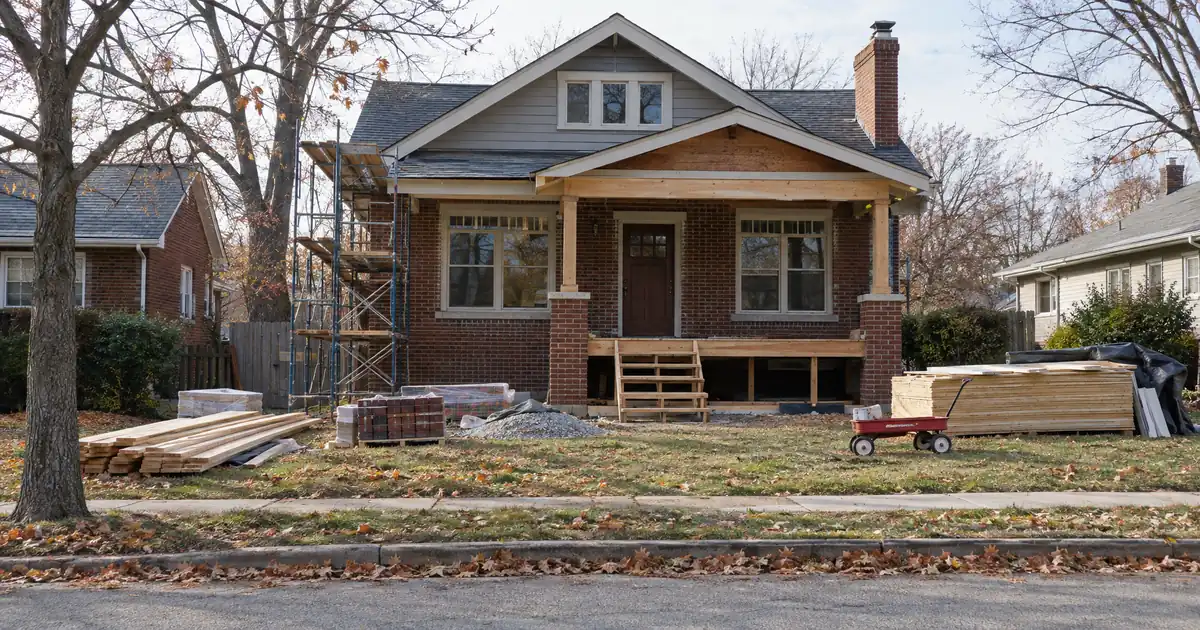
The Quick Read: Cash is the simpler down payment, and a HELOC draw is how you keep cash on hand. Either can work on a hard money bridge loan, because the bridge lender decides whether borrowed funds count. Choose cash when it is seasoned and you can spare it. Choose the draw when liquidity matters more than a clean file.
- Cash needs the least tracing: statements show it is yours and it has been in the account.
- A HELOC draw is borrowed money, so lenders document where it came from and where it went.
- The HELOC payment is yours personally. The bridge property’s rent does not service it.
- A failed exit hits both loans at once: the bridge and the HELOC.
- Policy on borrowed down payments varies by lender, property, and experience, so confirm it in writing before you draw.
Here is the honest answer on who each option is for. Cash fits the investor who has money sitting idle and enough left over for rehab, holding costs, and a surprise or two. A HELOC draw fits the investor with real equity in a home or rental they already own, a stable personal financial picture, and a clear exit that repays both loans. Neither is better in the abstract. The deal’s margin for error decides it.
What this loan actually costs to carry.
Hard money is sized against the project and priced by time. Enter the deal and see how much the program will lend, the cash required at closing, the carry while you hold it, and what is left at the exit.
Leverage tiers on the current program: 85% with fewer than 2, 90% with 2 or more, 93% with 5 or more completed projects — every tier capped at 75% of after-repair value. Loan amounts up to $5,000,000, larger by exception; terms of 6 to 18 months, interest-only, no prepayment penalty. The rehab portion funds in draws against completed work, not at closing.
Program parameters shown update from Lendmire’s centralized guideline source. Rate, points, and months are editable assumptions, not quoted terms.
Cost cap sets the loan · positive spread
Illustrative estimate only — not a quote, Loan Estimate, approval, or commitment to lend. Rate, points, and months are editable assumptions. Hard money is business-purpose financing for real estate investors, not a consumer mortgage. Leverage on the current program tops out at 93% of project cost for investors with a documented track record, capped at 75% of after-repair value, with rehab funding up to 100% of the documented budget released in draws; actual terms vary by lender, borrower experience, property, and exit. Lendmire is a mortgage broker, not a lender.
If you want the bigger picture on how these loans fit together, Lendmire’s complete DSCR loans guide covers the long-term financing that often replaces a bridge.
Side-by-Side
The table below compares the two funding sources, not the loans. The hard money side describes published industry norms for how lenders treat each source. Individual lenders differ.
| Factor | HELOC Draw | Cash |
|---|---|---|
| Source of the money | Borrowed against a home you own | Your savings or entity account |
| Review basis | Your equity, credit, and personal finances | None needed beyond statements |
| Documentation | Line statement, draw record, receiving account | Seasoned bank or brokerage statements |
| Entity vesting | Line is personal; funds move to the LLC | Entity can hold cash directly |
| Property types | Line sits on a different property than the deal | No link to any property |
| Reserve and liquidity effect | Preserves cash for rehab and carry | Cash drops on day one |
| Ongoing obligation | Personal payment on the drawn balance | None created |
| Collateral at risk | Home securing the line | Only the cash itself |
| Sequencing | Line must be open before you need it | Ready when statements are |
| Exit dependency | Bridge exit must repay both loans | Bridge exit repays one loan |
Notice the pattern. Cash wins on simplicity and risk. The draw wins on liquidity. Everything else follows from those two facts.
When a HELOC Draw Is the Better Fit
A HELOC draw is the better fit when your cash has a better job to do. That job is usually rehab overruns, holding costs, and reserves. The draw turns home equity into a down payment and leaves your savings untouched.
Start with what the line is. A HELOC is a revolving, general-purpose line. You borrow, repay, and borrow again during the draw period. The line itself places no restriction on what you buy. The gate is the bridge lender, who decides whether it accepts that source of funds.
Next, sizing. Lenders generally size a line from home value and the existing mortgage balance. Nasdaq’s worked example multiplies the home’s value by a set percentage, then subtracts the mortgage balance. The result is the equity you can actually reach. Your own lender sets the real percentage, and each lender’s underwriting box governs.
Picture an investor with a paid-down home and a bridge purchase without rehab. On the hard money side, a purchase like that typically funds up to 80% of purchase price, varying by lender, property, and experience. The investor owes the other 20% plus closing costs and reserves. Draw that 20% from the line and the savings account stays full for carry.
The draw also fits a few other situations:
- The rehab budget is tight. Hard money programs can fund a rehab budget in draws against completed work. You still front costs between draws. Liquidity covers the gap.
- The exit is strong. A clean sale or a refinance into long-term rental financing repays both loans.
- You already have the line open. That matters, as you will see below.
Many investors use this route and exit through a long-term DSCR refinance once the property is stabilized. Lendmire brokers that path.
When Cash Is the Better Fit
Cash is the better fit when the deal is thin, the exit is uncertain, or the lender is cautious about borrowed funds. It is the lowest-friction source because it needs no tracing beyond statements.
The practical advantages are real:
- No second obligation. Nothing outside the property needs servicing.
- No home at risk. Bankrate warns that when you borrow against your home, you carry the home equity debt on top of the mortgage on the new property. A drawn HELOC on your primary home puts the home you live in behind the deal.
- A cleaner file. Seasoned funds already sitting in your account answer the source-of-funds question on their own.
- A simpler exit. If the sale drags, only one loan is waiting for payoff.
The cost is opportunity. Cash spent on the down payment is cash you cannot spend on a roof, a permit delay, or three extra months of carry. This is the part investors underestimate. Hard money terms run 6 to 18 months and are interest-only, so the bridge itself is built to be short. A short loan still has long surprises.
Honestly, this one is a toss-up for investors with plenty of reserves. If you can fund the down payment in cash and still hold generous reserves, cash probably wins on risk. If the down payment would drain you, the draw is worth the added exposure.
How the Bridge Lender Sees Each Source
Bridge lenders underwrite the property, the plan, and the exit. They care about your equity in the deal, which is the down payment as skin in the game. They also want proof you can carry the project.
What changes between the two sources is the paper trail. With cash, you show statements. With a draw, expect to show the line statement, the draw confirmation, and the bank statement where the money landed. The lender wants to trace borrowed money from its source to the closing table.
A few points decide how it goes:
1. Policy on borrowed funds. Some lenders accept a HELOC draw for the down payment. Others restrict borrowed funds. Ask before you draw, and get the answer in writing.
2. Share of the down payment that is borrowed. A partly borrowed down payment can read very differently from a fully borrowed one.
3. Buckets. Down payment, closing costs, and reserves are often treated separately. Borrowed funds may be accepted for one bucket and excluded from another. Reserves are the usual sticking point.
4. Entity vesting. Hard money lenders often lend to an LLC, subject to lender program eligibility. A HELOC on your primary home is your personal debt, not the LLC’s. The money has to move from you to the LLC or the closing agent, and that movement should be documented too.
Note the sequencing problem. You cannot open a line against a property you have not bought yet. The line has to come from a home or rental you already own, and it should be open and available before you go under contract. A new line can need an appraisal and underwriting of its own. Treat it as a separate approval that has to be in place first.
Leverage on the hard money side matters here as well. On the programs Lendmire’s wholesale network places, bridge purchases without rehab run up to 80% of purchase price. Fix-and-flip files run up to 85% of project cost with fewer than two completed projects, always capped at 75% of after-repair value. Higher tiers are reserved for experienced investors with documented completed projects. Cash-out and rate-and-term refinances run up to 65% of value. Credit starts around 620, with added conditions below 660. All of it varies by lender, property, and experience, and none of it is a commitment to lend. A larger down payment never erases those caps, so the draw-versus-cash choice only fills the equity gap, not the credit or property rules.
Risk Stacking: What Happens When Things Slip
A draw layers a second obligation on top of the bridge. That is the cost of preserving cash. The risks stack in three places.
The personal payment. The HELOC balance is serviced from your pocket. The bridge property produces no rent while you rehab, and even afterward the rent does not service the line. Plan for that payment from the day you draw. Bankrate lists these stacked obligations among the main risks of borrowing against one home to buy another.
The line itself. A line is not a promise. Opendoor’s explainer notes that lenders retain the right to freeze the undrawn portion when values decline. Draw what you need early rather than counting on future access. Drawn money is yours. Undrawn money is only a maybe.
The exit. The bridge payoff, whether a sale or a refinance, is what retires the HELOC too. A delayed sale means two loans sit open together. A refinance that comes in smaller than planned means a shortfall on both. Run the exit before you commit, and run the bad version.
Think of it as one exit paying for two loans. With cash, the exit has to pay for one.
A rental-secured line changes the risk picture. Experian notes that a HELOC on an investment property is generally harder to qualify for because lenders see it as riskier. It also says your primary home usually is not tied to that loan. You trade a harder approval for less personal exposure.
A Scenario in Percentages and Ratios
Run the numbers on two investors buying the same bridge purchase without rehab. The lender funds up to 80% of purchase price, so each owes the remaining 20% plus closing costs and reserves. Both plan to refinance into long-term rental financing after stabilizing. This is a modeled setup, not market data.
Investor One pays cash. Savings drop by the full down payment. Reserves shrink. The bridge exit repays one loan. If the refinance lands late, the carrying cost is the interest-only bridge payment and nothing more.
Investor Two draws the HELOC. Savings stay intact. A personal payment starts on the drawn balance. If the refinance lands late, the bridge payment and the HELOC payment run together. If the refinance appraises low, the shortfall hits both loans.
Now the exit. DSCR compares a property’s rent to its principal, interest, taxes, insurance, and any HOA dues. It does not count your personal debts the way a debt-to-income test would. A personal HELOC payment is typically outside that ratio, though source-of-funds and reserve rules still apply at the refinance. Where DSCR is concerned, 1.00 is where many select programs start, and a separate select-lender path takes coverage below 1.00 with leverage and terms adjusted. Cash-out DSCR refinances top out around 75% LTV across most of the network, with about 6 months of seasoning as the common expectation.
Clearing 1.00 does not mean the property cash flows. Repairs, vacancy, management, and utilities sit outside the ratio. A draw that is still outstanding when the refinance closes can be repaid from proceeds, but only if the refinance leaves enough room under the leverage cap. Check that before you lean on it.
Lendmire’s piece Rental HELOC vs DSCR Cash-Out vs Bridge for a Hard Money Payoff walks through the exit side in more depth.
Key Terms Defined
HELOC: A home equity line of credit, which is a revolving credit line secured by a home you own.
Draw period: The stretch of time when you can borrow from the line, repay, and borrow again.
Hard money bridge loan: A short-term, asset-based loan secured by real property. It bridges the gap until a sale or longer-term financing.
Source of funds: The documented origin of your down payment, shown through statements and transfer records.
Seasoned funds: Money that has sat in your account long enough to look like yours rather than a recent transfer.
Cross-collateral: Pledging equity in another property in place of some cash down. Some lenders allow it, many do not.
Frequently Asked Questions
Will a hard money lender accept a HELOC draw as my down payment?
Some do and some restrict borrowed funds, so the answer depends on the lender. Ask directly before you draw, and get the policy in writing. Also ask whether borrowed funds count toward closing costs and reserves, since lenders often treat those buckets separately.
Does the HELOC need to be open before I go under contract?
Yes, as a practical matter. The line has to come from a home or rental you already own, because you cannot borrow against a property you have not bought. A new line may require an appraisal and its own approval. Open it before you need the money, not after.
Can my LLC take out the HELOC?
Generally not on a primary residence. A HELOC on your home is your personal debt, while the bridge loan often goes to an LLC, subject to lender program eligibility. The money moves from you to the entity or the closing agent. Keep a clean record of that transfer.
Will the HELOC payment hurt my DSCR refinance later?
A personal HELOC payment typically is not part of the DSCR ratio, which compares property rent to the property’s own payment. Lenders still review source of funds and reserves, and each file is underwritten individually. Programs vary by lender, leverage, and loan size.
What if my bridge exit is delayed?
Both loans stay open and both payments continue. The bridge terms run 6 to 18 months, interest-only, on the programs Lendmire places. Build a delayed-exit scenario into your numbers before you draw, and keep reserves aside for it.
The Balanced Verdict
Cash is the lower-risk source and the cleaner file. A HELOC draw is the liquidity play, and it pays only when the exit is strong and the lender accepts borrowed funds. The mistake is treating the draw as free money. It is a second loan with your home behind it.
A simple rule works for most investors. If the deal has thin margins or an uncertain exit, use cash. If the deal is strong and cash is needed for rehab and carry, a draw can make sense, provided the lender has approved it in advance.
If you are buying, rehabbing or refinancing an investment property on a short timeline and want to see how the numbers work, Lendmire can help you compare hard money options based on the project, the exit plan, leverage, and your goals. Lendmire is a broker arranging financing through select lenders in its wholesale network across 41 markets, including Washington, D.C.
About Lendmire
A DSCR-focused mortgage broker, Lendmire (NMLS# 2371349) places investor financing across 41 markets — 40 states plus Washington, D.C. — with DSCR eligibility generally reviewed by the lender on property cash flow instead of tax returns, subject to lender guidelines. Scotsman Guide named Lendmire a Top Mortgage Workplace in 2025 and 2026.
Get Started
Ready to find the right loan for you?
In about 30 seconds you can review financing options available for your investment property. No commitment required.
Informational only. Not a Loan Estimate, approval, or commitment to lend. Program availability and eligibility are subject to lender guidelines, credit approval, property review, and underwriting.
References
1. Nasdaq: How to Use a HELOC for a Down Payment
2. Bankrate: Use home equity to buy another house
3. Opendoor: Use a HELOC to buy another house
4. Experian: HELOC on investment property
This article is part of Lendmire’s hard money loan program — full qualification details, guidelines, and scenarios live on the program page.
Related reading: Can an Investor Get a Hard Money Loan Without Verifying Income? · Should You Pay Down Hard Money Principal Before a DSCR Refinance? · Can You Get a Hard Money Loan Without Owning a Business?
Brandon Miller
Founder & CEO, Mortgage Loan Originator, Lendmire LLC
- Mortgage Loan Originator · NMLS# 1129696 · Verify on NMLS Consumer Access
- North Carolina Real Estate Broker · License# 343312 · Verify on NCREC
- North Carolina Insurance Producer · License# 19053198 · Property, Casualty, Life, Health · Verify on NAIC SBS
- Lendmire LLC · Firm NMLS# 2371349 · Verify firm licensure
Important disclosures. Lendmire (NMLS# 2371349) is a licensed mortgage brokerage. Lendmire is not a direct lender, depository institution, or financial advisor. All loan inquiries are subject to lender underwriting; this article does not constitute a commitment to lend. Rates, terms, and program guidelines are subject to change without notice and vary by borrower profile, property type, and state. Information in this article is general in nature and is not financial, legal, or tax advice. Equal Housing Opportunity. NMLS Consumer Access: nmlsconsumeraccess.org.