
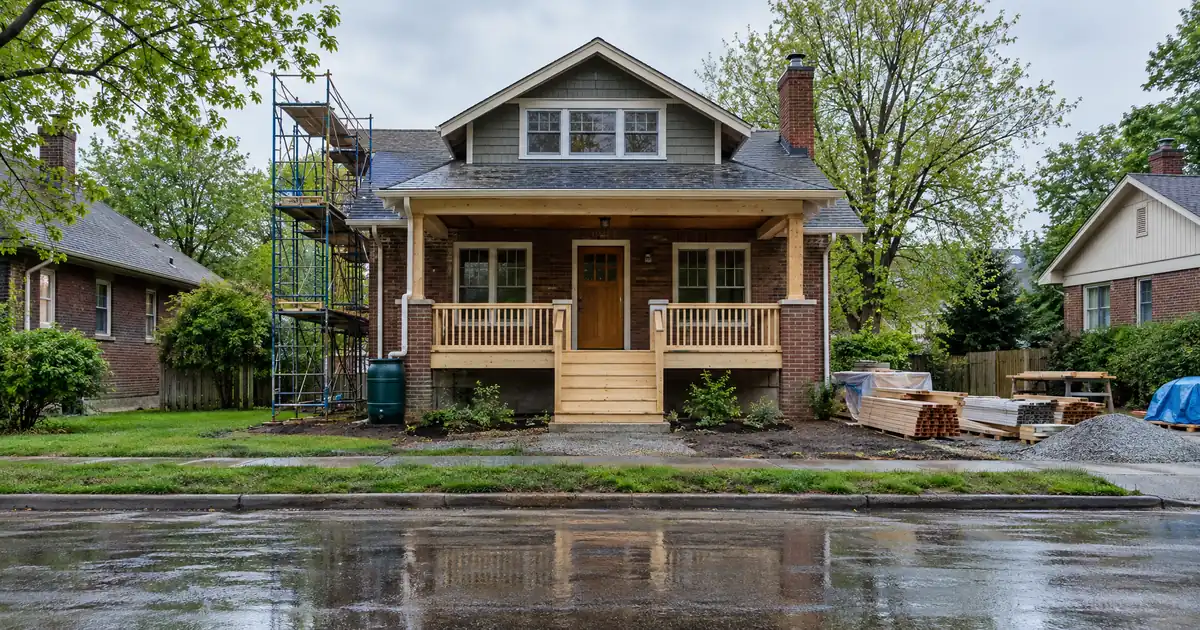
The Quick Read: Total cash on a hard money flip is the equity gap plus closing costs, reserves, carry, and the rehab money you front between draws. A hard money lender sizes the loan on project cost and caps it against after-repair value, so the down payment is only the first of several cash buckets. Build the budget from the conservative value backward, then add each bucket in order.
- Across the wholesale network, fix-and-flip leverage typically runs 85% of project cost with fewer than 2 completed projects, 90% at 2 or more, and 93% at 5 or more. Every tier is capped at 75% of after-repair value.
- Up to 100% of the rehab budget funds in draws against completed work, so you front each stage and get reimbursed.
- Closing costs, lender fees, title, reserves, and interest carry sit on top of the equity gap.
- When purchase plus rehab runs high against value, the 75% cap binds and your cash goes up.
- Program terms vary by lender, property, and experience, and nothing here is a commitment to lend.
Key Terms Defined
Project cost: the purchase price plus the approved rehab budget, which is the base the loan-to-cost percentage applies to.
After-repair value (ARV): the expected sale value once the work is finished, taken from sold comps of renovated homes.
Equity gap: the part of project cost the loan does not cover, which is your down payment.
Holdback and draws: the rehab budget is held by the lender and released in stages after completed work is inspected.
Rehab float: the cash you spend on each stage before a draw reimburses you.
Contingency: a cushion inside the rehab budget for surprises found after demolition.
Reserves: liquid cash set aside for carry, delays, and costs the budget missed.
What this loan actually costs to carry.
Hard money is sized against the project and priced by time. Enter the deal and see how much the program will lend, the cash required at closing, the carry while you hold it, and what is left at the exit.
Leverage tiers on the current program: 85% with fewer than 2, 90% with 2 or more, 93% with 5 or more completed projects — every tier capped at 75% of after-repair value. Loan amounts up to $5,000,000, larger by exception; terms of 6 to 18 months, interest-only, no prepayment penalty. The rehab portion funds in draws against completed work, not at closing.
Program parameters shown update from Lendmire’s centralized guideline source. Rate, points, and months are editable assumptions, not quoted terms.
Cost cap sets the loan · positive spread
Illustrative estimate only — not a quote, Loan Estimate, approval, or commitment to lend. Rate, points, and months are editable assumptions. Hard money is business-purpose financing for real estate investors, not a consumer mortgage. Leverage on the current program tops out at 93% of project cost for investors with a documented track record, capped at 75% of after-repair value, with rehab funding up to 100% of the documented budget released in draws; actual terms vary by lender, borrower experience, property, and exit. Lendmire is a mortgage broker, not a lender.
What Decides How Much Cash You Bring
Experience and the value cap decide your cash more than the purchase price does. The lender takes the lower of two tests: a percentage of project cost, and 75% of ARV. Whichever is smaller sets the loan, and you cover the rest.
Most programs in the network tier the cost percentage by documented completed projects. A first-time flipper usually lands at the 85% tier, which leaves a 15% gap on project cost. Two or more finished flips can reach 90%. Five or more can reach 93%. First-time investors can qualify at the lower tiers, subject to a 620 minimum score and additional conditions below 660. Underwriting stays asset-based: the property, the plan, and the exit.
The market gives you a reason to budget with room to spare. ATTOM’s quarterly flipping report puts the typical flip at a 21.5% gross return and $60,526 in gross profit, both down for about two years. CNBC’s coverage of ATTOM’s full-year data describes the lowest typical return since 2008. A budget with no cushion has little room when margins are that thin.
The Five Cash Buckets
Plan for five separate buckets, because each leaves your account at a different point. Treat them as separate lines in the budget, not one number.
| Bucket | What it covers | Financed? |
|---|---|---|
| Equity gap | Project cost minus the loan | No |
| Cash to close | Lender fees, title, insurance, closing costs | Usually no |
| Rehab float | Early work you pay before a draw | Reimbursed later |
| Carry and reserves | Interest-only payments, delays, taxes, utilities | No |
| Sale-side costs | Agent, transfer, staging | Paid from sale |
Closing costs and lender fees are the line first-timers most often leave out. They are not part of the down payment, and they are due at the table. Whether a lender allows any fees to be financed is negotiated per file, so do not count on it.
Why Rehab Money Isn’t Cash at Closing (and Why It’s Still Your Cash)
Rehab money is held back at closing and released in draws, so you pay for the work first and get repaid after it is verified. The loan can cover up to 100% of the rehab budget, but only as reimbursement for completed work. That is where the phrase “100% rehab financing” misleads people. It does not mean you bring no rehab cash.
Most draw processes follow the same path:
1. You complete a stage of work and pay the contractor.
2. You submit a draw request with invoices and photos.
3. The lender sends an inspector to confirm the work against your itemized budget.
4. The lender reimburses the finished line items.
The float is the cash you carry between steps 1 and 4. Sequence the work so reimbursed draws fund later phases. That way you do not need the full rehab budget in the bank at once. You do need enough for the first phase, plus a buffer for the stage that stalls.
Itemized budgets matter here. Inspectors check against line items, so a lump sum labeled miscellaneous creates friction at the first draw. One more point: the approved budget is the ceiling on lender funds. If the work runs over, the overrun comes from your own cash.
Budget It in Six Steps
This is the order that keeps the budget honest. Use modeled numbers until the lender issues a term sheet.
1. Back-solve from a conservative value. Set ARV from sold comps of renovated homes, not the listing price. The lender caps the loan against ARV, so an optimistic value overstates your loan and understates your cash.
2. Screen the offer with the 70% rule, then stop leaning on it. The rule says maximum offer equals ARV times 70%, minus repairs. Educators describe it as a starting filter that shifts in very high-priced and low-priced markets. It is not a lender requirement.
3. Build the rehab scope line by line. Get contractor bids and add contingency. One educator suggests 10% to 20% of repair costs. Treat that as a planning range, not a rule.
4. Compute the equity gap and test the cap. Take project cost times one minus the cost percentage for your tier. Then check whether 75% of ARV is lower than the tier’s loan. If it is, the cap wins and your gap grows.
5. Add the carry, float, and reserves. Term sheets show 6 to 18 months, interest-only, with no prepayment penalty on the network’s current program. Ask whether interest accrues on drawn funds only or on the full commitment. Then ask for a month-by-month carry schedule. Size the float to your first phase of work.
6. Total it and compare to liquid funds. Add the equity gap, cash to close, float, carry, reserves, and contingency. Compare that to cash you can document and still leave untouched. If the total uses every dollar, the budget is too tight.
Worked Example in Percentages
The example below uses modeled assumptions, not market data. Say project cost equals 80% of ARV, with purchase at 60% of ARV and rehab at 20% of ARV. The investor has fewer than 2 completed projects, so the 85% of project cost tier applies.
- Loan: 85% of project cost, which is 68% of ARV. That is below the 75% ARV cap, so the cost tier sets the loan.
- Equity gap: 15% of project cost, which is 12% of ARV.
- Contingency: if set at 15% of the rehab budget, that is 3% of ARV, held in cash and not financed.
- Rehab float: if the work runs in three equal phases, the first phase is about a third of the rehab budget, roughly 6.7% of ARV, until the first draw lands.
- Sale-side costs: one educator example uses roughly 7% of sale price, and they come out of sale proceeds.
- Still to add: lender fees, title, closing costs, and carry. These come from the term sheet, so get them before you commit.
Now tighten the deal. Say project cost is 90% of ARV, which is a thinner margin. At 85% of cost, the tier suggests a loan of 76.5% of ARV. That is above the 75% cap, so the cap binds and the loan is 75% of ARV. Your gap is now 15% of ARV, or about 16.7% of project cost. The same tier needed less cash on the cheaper deal. The difference comes from the cap, not the tier.
For comparison, a 70%-rule deal puts project cost at 70% of ARV. At the 85% tier the gap is 10.5% of ARV. At the 93% tier it falls to about 4.9% of ARV, and a high tier is reserved for experienced investors.
Stress Test the Cash, Not Just the Profit
Run the base case through three failures and watch how much more cash each one demands. Using the 80%-of-ARV example above:
| Scenario | What changes | Added cash from you |
|---|---|---|
| Rehab overrun | Work runs 15% over budget | About 3% of ARV, since the budget is the ceiling |
| Low value | ARV comes in 15% lower | About 4.25% of original ARV, because the cap binds |
| Longer hold | Sale slips past the planned term | Extra carry per lender schedule, plus any extension |
The low-value case is the one people miss. A drop in ARV can lower the loan even when your purchase price and rehab budget did not change. In the overrun case, contingency is the first line of defense. Reserves cover the other two.
Contingency, float, and reserves are three different things. Contingency pays for surprises inside the scope. Float bridges the gap before draws. Reserves cover carry and delay. Stack them in the budget instead of letting one cushion do three jobs.
When the General Rule Breaks
These are the edge cases that change the cash number.
- The value cap overrides the tier. A 93% tier does nothing for you when purchase plus rehab already exceeds 75% of ARV.
- Experience tiers. Leverage steps up with documented completed projects, so a first flip needs more cash than a fifth.
- Interest method. Interest on drawn funds only costs less per month than interest on the full commitment, and it changes the reserve you need.
- Light work and no rehab money. Bridge purchases without rehab fund up to 80% of purchase price. The borrower pays for repairs.
- Very cheap homes. ATTOM found homes bought under $50,000 posted a typical 14% gross loss, so low price does not mean low risk.
- Remote flippers. Managing the project between stages is harder without a local representative to check work and keep draws moving, and carrying costs keep running while you wait.
- Financing the gap with credit cards. Some flippers bridge the float that way. It adds a second debt service to a thin deal, so size the float in cash instead.
The same report says ATTOM’s gross profit excludes rehab and other costs, which flipping veterans estimate at 20% to 33% of ARV. A headline profit figure is not what you will net.
The Cash Timeline
Cash leaves your account in phases, not all at once. Mapping the phases shows where you are most exposed.
| Phase | Cash out | Cash back |
|---|---|---|
| Contract | Earnest money, inspections, appraisal | None |
| Closing | Equity gap, fees, title, insurance | None |
| Each rehab stage | Contractor payment | Draw after inspection |
| Between draws | Carry, utilities, taxes | None |
| Sale | Agent, transfer, staging | Sale proceeds |
Your lowest cash point usually comes in the middle of the first rehab stage. Right after closing you have spent the equity gap and fees, and the first draw has not landed. That is the stretch to size reserves for.
When the Numbers Don’t Fit
If the total exceeds your liquid funds, you have four options. They are listed in the order that usually costs the least.
1. Cut scope. Remove work that does not move the appraised value. An improvement may support a higher appraised value, depending on comps and underwriter review, but it is not automatic.
2. Renegotiate the price. A lower purchase price shrinks both the equity gap and the chance the cap binds.
3. Bring in a cash partner. A partner who contributes part of the down payment can close the equity gap without a lower price, though the split of profits, decision-making and exit terms should be agreed in writing before any money moves.
4. Walk away. A deal that needs every dollar and every assumption to hold is a poor first project.
Proof of Funds and Common Mistakes
Lenders ask for documented liquidity, so use accounts you can show. A short checklist helps:
- Statements showing the equity gap and fees, plus reserves.
- A line-item rehab budget with contractor bids.
- Sold comps for the ARV.
- Entity documents if the loan will be made to an LLC, subject to lender program eligibility.
- Experience documentation for the tier you are applying under.
The usual mistakes are predictable. Investors count the down payment as the only cash. They treat the 70% rule as a lender rule, when it is a screening tool, and the remaining 30% is not profit because buying, holding, financing, and selling costs come out of it. They assume interest runs on drawn funds only. They also spend the contingency early because the budget looked fine. Tax treatment varies; consult a qualified professional before relying on any deduction.
Planning the Exit Before You Close
Cash planning does not end at the sale. When a flip stalls, a short-term loan becomes a refinance problem. Many investors refinance out of hard money into long-term DSCR financing once the property is rentable and stabilized, and Lendmire brokers that path. DSCR underwriting compares rent to the full housing payment, and 1.00 is where many select programs start, subject to lender guidelines. It looks at the property’s rent, not the flip’s profit. Clearing 1.00 also does not mean positive cash flow, since repairs, vacancy, and management sit outside the calculation. The complete DSCR loans guide covers coverage, leverage, and reserves for that backup exit. Keep reserves for the seasoning gap, because the refinance will not fix a flip that is out of cash.
Frequently Asked Questions
Is 100% financing really no money down?
No. The 100% figure applies to the rehab budget, and it funds in draws after work is done. There is no true 100% purchase program, and the equity gap, fees, and reserves still come from you.
Is rehab part of cash to close?
Usually not. Rehab money is held back and released against completed work. The exception is when the 75% ARV cap binds, because purchase plus rehab then exceeds what the lender will fund, and the shortfall becomes your cash.
How much should I hold in reserve?
It depends on the hold, the interest method, and how much contingency sits in the rehab budget. Ask for a month-by-month carry schedule and size reserves against the longest hold the term allows. Terms run 6 to 18 months, interest-only, subject to lender guidelines.
What happens if the rehab runs over?
The approved budget is the ceiling on lender funds, so the overrun comes from your own cash. Contingency inside the budget is the first buffer, and reserves are the second. Some lenders will review a revised budget, but that is not something to plan on.
Do I need cash between draws?
Yes. Draws reimburse finished work, so you front each stage. Sequencing the phases lets reimbursed money fund the next stage, but you still need enough for the first phase and any delay.
Where This Leaves the Budget
If you are buying, rehabbing, or refinancing an investment property and want to see how the numbers work, Lendmire can help you compare hard money options based on the project, the exit plan, leverage, and your goals. As a broker arranging financing through select lenders in its wholesale network across 41 markets, including Washington, D.C., Lendmire can run the equity gap and cap test before you commit. Loan amounts run up to $5,000,000, and every file is reviewed on its own.
About Lendmire
Lendmire is a DSCR-focused mortgage brokerage, NMLS# 2371349, placing investor loans across 41 markets, including Washington, D.C. DSCR eligibility is generally reviewed by the lender around a property’s rental income rather than personal income documentation, which fits LLC-held rentals, self-employed investors, and portfolios scaling past conventional financed-property limits. Scotsman Guide named Lendmire a Top Mortgage Workplace in both 2025 and 2026.
The exit plan matters as much as the purchase price on short-term financing – see the hard money loan overview.
Get Started
Ready to find the right loan for you?
In about 30 seconds you can review financing options available for your investment property. No commitment required.
Informational only. Not a Loan Estimate, approval, or commitment to lend. Program availability and eligibility are subject to lender guidelines, credit approval, property review, and underwriting.
References
1. attomdata.com: Home Flipping Profits Continue Gradual Two Year Decline
2. CNBC on home flipper profits
4. Flipsquad on the 70% rule and contingency
5. attomdata.com: Q1 Home Flipping Report
This article is part of Lendmire’s hard money loan program — full qualification details, guidelines, and scenarios live on the program page.
Related reading: Does Every Hard Money Lender Ask the Same Minimum Down on a Flip? · Hard Money vs Cash Purchase Requirements for a Rental Property · Is There a Limit on a Hard Money Fix-and-Flip Loan?
Brandon Miller
Founder & CEO, Mortgage Loan Originator, Lendmire LLC
- Mortgage Loan Originator · NMLS# 1129696 · Verify on NMLS Consumer Access
- North Carolina Real Estate Broker · License# 343312 · Verify on NCREC
- North Carolina Insurance Producer · License# 19053198 · Property, Casualty, Life, Health · Verify on NAIC SBS
- Lendmire LLC · Firm NMLS# 2371349 · Verify firm licensure
Disclosure information. Lendmire is a state-licensed mortgage brokerage under NMLS# 2371349. Lendmire is not a depository institution, direct lender, or financial advisor — all loans referenced are placed through wholesale lender partners and are subject to each lender's underwriting standards. This article is provided for general informational purposes and is not a commitment to lend, nor does it constitute financial, legal, or tax advice. Loan programs, terms, rates, and qualification standards change without notice and depend on borrower profile, property type, and the state in which the subject property is located. Equal Housing Opportunity provider. NMLS Consumer Access: nmlsconsumeraccess.org.