
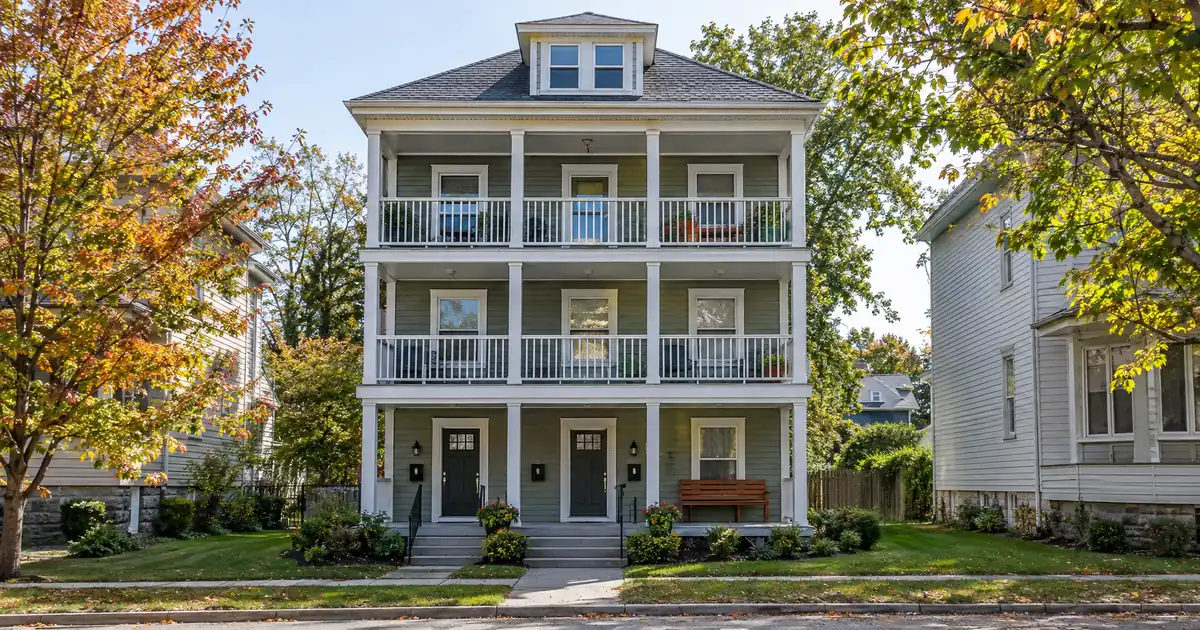
The Quick Read: Yes, but only part of it, and only if you live in one of the units. For a 2-4 unit purchase with no rental history, the lender counts 75 percent of the lesser of the appraiser’s market rent or the lease rent. That amount is added to your income. It does not reduce your payment. Three- and four-unit homes face an extra test: the property’s own rent has to cover the payment without your paycheck.
Who Can Count Rent on an FHA Loan?
Only an owner-occupant can count it. You must live in one unit as your principal residence. HUD’s Handbook 4000.1 glossary defines an owner-occupant borrower as one who resides in the property securing the FHA-insured mortgage as a principal residence. Buy a duplex to rent out both sides and this program is off the table.
FHA payment estimate
Starting assumptions reflect an example price and the FHA minimum investment. Replace them with your own figures.
Editable benchmark: 7.32% as of October 22, 2026 · Freddie Mac 30-year average via FRED®. A conventional market reference, not an FHA loan quote.
Illustrative starting assumptions: a $350,000 price, the FHA minimum investment as the down payment, a thirty-year term at the current Freddie Mac benchmark, and property taxes and insurance estimated at typical national rates. Every field is editable.
Illustrative estimate only — not a Loan Estimate, approval, quote, or commitment to lend. The rate field carries the weekly Freddie Mac thirty-year conventional benchmark, a market reference and not an FHA loan quote; your rate is set by the lender at lock. FHA mortgage insurance follows HUD’s published schedule for the term, leverage and loan size entered; taxes, insurance and dues are editable estimates; closing costs are not included; county loan limits are not checked here. Licensed in sixteen states for consumer mortgages. Lendmire is not affiliated with or acting on behalf of FHA, HUD, or the federal government.
HUD Mortgagee Letter 2023-17 allows rental income from the subject property to count as effective income when the home is a two- to four-unit dwelling, or a one-unit home with an accessory dwelling unit. Rent from commercial space does not count. A storefront under the apartments adds nothing to the income calculation.
On the program side, the wholesale lenders that Lendmire places FHA files with start at a 580 decision score. At that score, maximum financing is 96.5 percent with a 3.5 percent minimum investment. One to four units are allowed, and the home must be your principal residence. These figures are subject to lender guidelines and full file review. Nothing here is a commitment to lend. Anyone exploring FHA loan programs for a multi-unit purchase should start with this occupancy rule, because it decides everything else.
How Do Lenders Calculate the Rental Income?
For a purchase with limited or no rental history on the property, the lender takes 75 percent of the lesser of two numbers. One is the fair market rent from the appraiser. The other is the rent in the signed lease. The lower figure wins. A seller’s claim, or an asking rent on a listing, changes nothing.
The 25 percent haircut is a rule, not a negotiation. The usual reason given is that it allows for vacancy and upkeep.
The result is added to your gross income. It does not come off the mortgage payment. Many buyers assume the rent offsets the payment, and it does not. If the net rental figure comes out negative, the lender counts it as a monthly debt.
Ratios still apply. The base pair on FHA is 31/43 (housing to total) with no compensating factors. Documented compensating factors can reach 40/50 at the top tier, and the automated finding governs most files. Rent that raises qualifying income can move you from one side of those lines to the other, which is the main reason house hackers look at 2-4 unit homes.
Key Terms Defined
Fair market rent: The rent an appraiser estimates each unit would bring on the open market.
Lease rent: The monthly rent written in a signed lease for a unit.
Effective income: The income a lender counts for qualifying after its own rules and adjustments.
Owner-occupant: A borrower who lives in the property as a principal residence.
Reserves: Cash you still hold after closing, measured in months of the full housing payment.
Self-sufficiency test: The extra rule for three- and four-unit homes, where the property’s rent alone must cover the payment.
What Changes Between a 2-Unit and a 3-4 Unit Home?
A two-unit home uses the 75 percent rule and a lighter reserve requirement. A three- or four-unit home adds the self-sufficiency test and a higher reserve requirement. Per HUD’s letter, reserves are one month of the full housing payment for one- to two-unit properties and three months for three- to four-unit properties. Exact terms depend on the lender’s guidelines, property type, leverage, and a full review of the borrower’s file.
| Factor | 2 units | 3-4 units |
|---|---|---|
| Rent counted as income | 75% of lesser of market rent or lease | Same rule |
| Self-sufficiency test | Does not apply | Applies |
| Reserves after closing | 1 month of housing payment | 3 months of housing payment |
| Owner’s own unit | Not counted as income | Counted in the test only |
Here is the test as it is generally described. The lender takes the appraiser’s market rent for all units, including yours. It subtracts the greater of the appraiser’s vacancy and maintenance estimate or 25 percent. The full housing payment divided by that net rent cannot exceed 100 percent. HUD requires this for three- and four-unit homes. The exact handbook wording should be confirmed against the current Handbook 4000.1 before anyone relies on it for a specific file.
Notice what that means. Your own unit’s rent never counts toward your income. It only shows up in the self-sufficiency test. A good-looking fourplex can still fail if the rents are thin against the price.
A Walkthrough Without Dollar Amounts
Picture a buyer purchasing a duplex at 96.5 percent financing. They live in one side. The other side has a lease. The appraiser says market rent for that unit is higher than the lease. The lender uses the lease number, because it is lower, and counts 75 percent of it. That figure joins the buyer’s paycheck in the income line. If the buyer’s ratios sit near the edge of 31/43, that added income may be what keeps the file inside the line.
Now picture a fourplex with the same financing. The buyer’s income might be strong. It doesn’t matter for the self-sufficiency test. The appraiser’s rents for all four units go in, the larger of the vacancy estimate or 25 percent comes off, and what’s left has to cover the full payment. If it falls short, the buyer’s options are limited and mechanical: a lower price, a larger down payment, or a different property. The loan structure doesn’t bend around a failed test.
What Documentation Does the Lender Want?
The paper depends on the property’s history.
- Units already leased: bring the leases. They set the lease side of the “lesser of” comparison.
- Mixed building, some leased and some vacant: expect the lease figure for leased units and the appraiser’s number for the rest.
- Rented since your last tax filing: the lender wants your most recent two years of traditional personal-income documentation, including Schedule E. Tax treatment can depend on your situation; borrowers should speak with a qualified tax professional before relying on any deduction or credit.
Reserves need their own paper. Bank statements showing the required months of housing payment after closing keep the file from stalling late.
What If the Appraiser’s Rent Comes in Low?
The appraiser’s number drives the outcome. A low market rent shrinks the counted income and, on a three- or four-unit home, can sink the self-sufficiency test. Before the appraisal, ask the agent for recent leases and local comparables on similar units. A buyer can hand those to the lender and ask whether the appraiser can consider them. If the number still lands low, the choices are the same ones above. Don’t count on the figure moving.
Roommates, Accessory Units and Other Rent
A one-unit home with an accessory dwelling unit is not a 2-4 unit home, though people mix them up. Reserves there are two months of the housing payment, and the accessory unit rules carry limits that are best checked on your specific file. Rent from a home you are moving out of follows a separate HUD rule. Don’t apply the 2-4 unit subject-property rule to it. Homes with five or more units fall outside this one-to-four unit program.
Common Myths
- “All the rent counts.” It’s 75 percent of the lesser figure.
- “My unit’s rent counts toward income.” It doesn’t. It only enters the 3-4 unit test.
- “I need signed leases.” Not with no history. The appraisal’s market rent is the required evidence.
- “The test applies to duplexes.” It’s a three- and four-unit rule.
- “Rent lowers my payment.” It adds to income. The payment stays whole.
- “An investor can use this.” The borrower must occupy a unit.
- “The rules are fixed.” The handbook is updated regularly, so any figure should be checked against its current text.
Rental Income After Closing
Counted rent is a coverage figure, not a cash-flow forecast. Vacancy and turnover still hit your account even though the lender only counted 75 percent. Keep the reserve months intact. Three months of the housing payment on a fourplex is a minimum, not a comfort level.
Frequently Asked Questions
Can I use projected rent if I have never been a landlord?
Yes. With no rental history on the property, the appraiser’s fair market rent on the small residential income property form is the required evidence. Leases are used if you have them. No landlord experience is required for the income to count.
Does the rent from the unit I live in count?
Not toward your qualifying income. Only the units you rent out count there. Your unit’s market rent does enter the self-sufficiency test on three- and four-unit homes.
Does the self-sufficiency test apply to a duplex?
No. It applies to three- and four-unit homes. Duplexes use the 75 percent rule and a one-month reserve requirement. Every figure here varies by lender and program — guidelines, property type, leverage, and credit profile all apply.
Can rental income replace a job?
No. Rent is added to the income you already have, and your ratios still apply. On three- and four-unit homes the property must also pass its own test. Counted rent supplements income. It doesn’t substitute for it.
What if the property I’m buying already has rental history?
If the units have been rented since the seller’s last tax filing, the lender wants the most recent two years of personal-income documentation with Schedule E. The 75 percent rule and the owner-occupancy requirement still apply to the purchase.
Next Step
If you are buying a home and want to see whether an FHA loan fits your file, Lendmire can help you compare the options and what each one asks of the file. For the next step in the comparison, Lendmire’s piece Does Rental Income on a 2-4 Unit Primary Home Help a VA Cash-Out? shows how a different program treats the same rent.
For your own numbers, request a scenario review with Lendmire.
About Lendmire
Lendmire (NMLS# 2371349) is a mortgage broker licensed for consumer lending in 16 states. Lendmire arranges FHA, VA, conventional and jumbo purchase and refinance loans through wholesale lenders; every file is underwritten by the lender under the applicable program guidelines. Scotsman Guide named Lendmire a Top Mortgage Workplace in both 2025 and 2026.
Get Started
Ready to find the right loan for you?
In about 30 seconds you can review financing options available for your home or investment property. No commitment required.
Informational only. Not a Loan Estimate, approval, or commitment to lend. Program availability and eligibility are subject to lender guidelines, credit approval, property review, and underwriting.
References
1. HUD Handbook 4000.1 Glossary
2. HUD Mortgagee Letter 2023-17
This article is part of Lendmire’s FHA loan program — full qualification details, guidelines, and scenarios live on the program page.
Related reading: Conventional Loan vs FHA With a Co-Borrower on a 2-4 Unit Purchase · Conventional vs FHA Loan on a 2-4 Unit: The Self-Sufficiency Test · How Much a Conventional Loan Saves Over FHA Insurance on a 2-4 Unit
Brandon Miller
Founder & CEO, Mortgage Loan Originator, Lendmire LLC
- Mortgage Loan Originator · NMLS# 1129696 · Verify on NMLS Consumer Access
- North Carolina Real Estate Broker · License# 343312 · Verify on NCREC
- North Carolina Insurance Producer · License# 19053198 · Property, Casualty, Life, Health · Verify on NAIC SBS
- Lendmire LLC · Firm NMLS# 2371349 · Verify firm licensure
Required disclosures. Lendmire (NMLS# 2371349) operates as a licensed mortgage broker, not a direct lender or depository. The discussion in this article is general in nature and should not be relied upon as financial, legal, or tax advice — every investment scenario is unique and should be reviewed by a qualified professional. Any loan inquiry is subject to lender underwriting, and this article is not a commitment to lend or a guarantee of approval. Mortgage rates, loan terms, and program guidelines vary by borrower, property, and state, and may change without notice. Equal Housing Opportunity. Verify licensure at NMLS Consumer Access.