
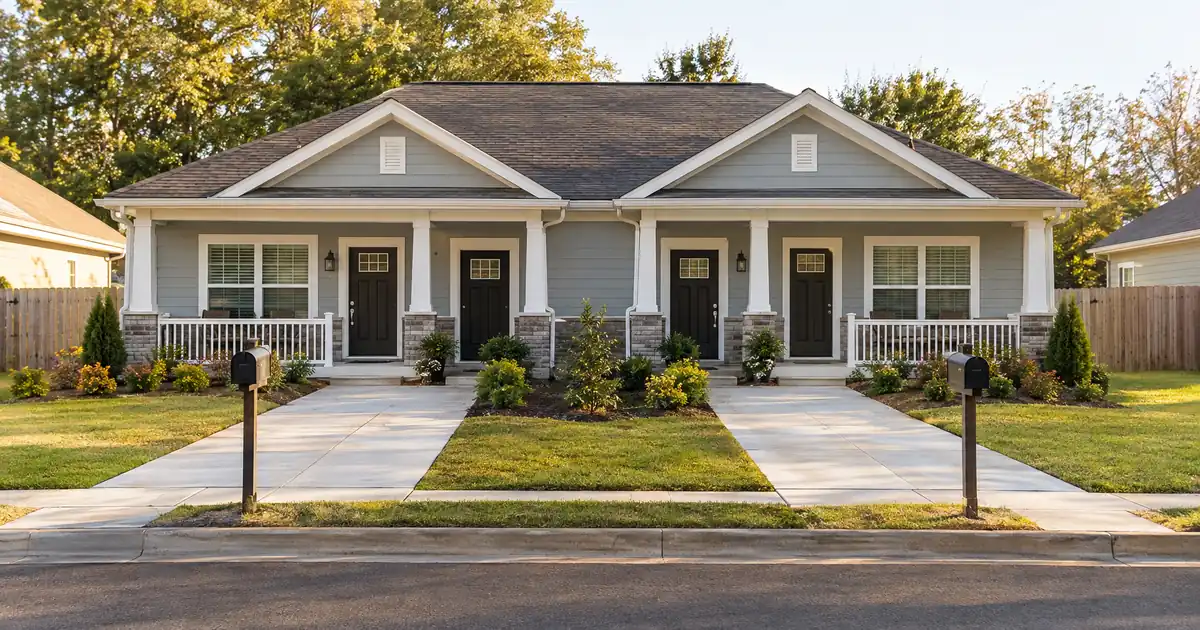
The Quick Read: An expired lease does not disqualify a duplex from a DSCR cash-out refinance, but it changes which rent number the underwriter trusts, and the loan is sized by whichever test binds first: the leverage cap or the rent-coverage test. On most files in the network, the appraiser’s market rent per unit carries the income side.
- Cash-out on a standard rental tops out around 75% LTV, with about 6 months of ownership seasoning.
- Rent coverage can cap the loan before equity does, even with plenty of equity.
- Taking less cash is the most reliable way to lift coverage once rent is fixed.
- A renewal signed at market rent before the appraisal can raise the rent that counts.
- Credit, reserves, and property type still apply, subject to lender guidelines.
Picture a duplex owner whose tenants stayed after the paper lease ended. The rent keeps arriving, the building is full, and yet the file feels shaky. That worry is common, and it is usually smaller than it looks. This piece walks through how the loan is sized, how rent is counted unit by unit, and what to fix before ordering an appraisal. For the broader picture, Lendmire’s complete DSCR loans guide covers the program basics.
DSCR Cash-Out Calculator
Run the cash-out numbers in your market
Rate source: Freddie Mac 30-yr average via FRED® — Federal Reserve Bank of St. Louis · effective Oct 29, 2026
Prefilled with starting assumptions — enter your property’s value, balance, taxes, and insurance for a more accurate picture.
Program parameters update from Lendmire’s centralized guideline source. Taxes and insurance are editable estimates.
As of Oct 29, 2026 · General Freddie Mac market benchmark, not a Lendmire loan offer. Property value, balance, taxes, and insurance are editable estimates. Maximum loan-to-value varies by lender, program, property type, and seasoning. Not a Loan Estimate, approval, or commitment to lend. Program availability and eligibility are subject to lender guidelines, credit approval, property review, and underwriting.
The Two Tests That Size a Duplex Cash-Out
The loan amount is the smaller of two numbers: what the value allows and what the rent can carry. Think of two gates in a row. The loan can only be as large as the tighter gate permits.
The first gate is leverage. Across most of the network, a cash-out refinance on a standard rental tops out around 75% LTV. That cap applies to the appraised value, not to what you paid or what you hope the building is worth. Short-term rental collateral is a separate case with a lower ceiling of 70%, and it is outside this article. Leverage, reserves, and pricing vary by lender and program; the final terms follow the full file review.
The second gate is coverage. DSCR compares monthly rent to the full housing payment: principal, interest, taxes, insurance, and any HOA dues (PITIA). Operating costs like repairs, vacancy, management, and utilities sit outside the ratio. That is why clearing 1.00 does not mean the property produces positive cash flow after real-world costs.
Here is the catch with cash-out. The ratio is tested on the new, larger loan, not the old one. More cash back means a bigger payment and a lower ratio. A duplex with strong equity can still hit the coverage wall first, because rent never grew just because the loan did.
Coverage of 1.00 is where many select programs start. A separate select-lender path takes coverage below 1.00, with leverage and terms adjusted. Stronger ratios generally open better pricing and leverage.
How Rent Gets Counted Unit by Unit
A duplex is underwritten as two rent streams, not one blended number. Each unit gets its own rent figure, and a strong unit does not make up for a weak one.
Two-to-four-unit properties are appraised on the Small Residential Income Property Appraisal Report, Form 1025, which Fannie Mae’s Selling Guide describes as the traditional appraisal for that property type. The one-unit counterpart for rent is Form 1007, the Single-Family Comparable Rent Schedule, listed with Form 1025 on the Fannie Mae forms page. These are agency form names only. DSCR loans are not agency products, but programs commonly borrow the appraisal format and then apply their own rent rules.
The usual pattern runs like this:
1. The file shows each unit’s lease, rent roll, and proof the rent is being paid.
2. The appraiser reports value and a market rent for each unit.
3. The underwriter picks a rent per unit, often the lower of the lease rent and the market rent.
4. The unit rents are added together to form the numerator.
5. That total is divided by PITIA on the new loan.
Lenders in the network set their own treatment, so this is a convention rather than a universal rule. Some lean harder on actual rent and others lean on the appraisal. The practical lesson: a lease rent above market adds nothing, because the excess is capped. A lease rent below market can pull coverage down.
What “Expired” Means to an Underwriter
An expired lease with a tenant still paying is usually a workable tenancy, not a dead one. In most states, when a landlord keeps accepting rent after the term ends, courts generally treat that as creating a periodic tenancy, often month-to-month. Rules vary by state, so the safest read is “depending on local law.”
For underwriting, the point is simple. The lender sees rent being paid, but nothing contractual locks it in. That gap is why market rent tends to take over the file.
| Lease status | Rent usually used | Proof to provide | Possible fix |
|---|---|---|---|
| Expired, tenant paying | Market rent, or lower written rent | Payment history, old lease | Renew at market |
| Month-to-month | Lower of written and market | Ledger, deposits | Sign a fresh term |
| No written lease | Market rent, closer review | Deposits, written agreement | Sign a lease |
| Tenant behind on rent | May not be relied on | Cure and payment record | Cure, then re-lease |
| Vacant unit | Market rent, per program rules | Condition and rent-ready status | Lease it or refinance later |
Related-party or family tenants usually get market rent and closer review as well.
One Duplex, Four Tenancy Scenarios
Run the numbers on a single hypothetical duplex across four situations. These are modeled assumptions expressed as relative outcomes, not market data. Assume the loan request and the payment are identical in each case. The first scenario starts with leases at market rent; the third shows what happens when written rents sit below market.
| Scenario | Rent counted | Relative coverage | Effect on loan size |
|---|---|---|---|
| Both leases current at market | Both at lease | Baseline, say near 1.25x | Equity usually binds first |
| One expired, paying, at market | One at lease, one at market | About the same | Little change |
| Both expired, written rents below market | Lower written rents | Drops toward 1.05x | Coverage may bind first |
| One unit vacant | One at lease, one at market | Depends on market rent | Closer review |
When an expired lease’s rent matches appraiser market rent, expiration barely moves the number. The damage comes from the gap. If tenants have paid below-market rent for years and the lease lapsed, the lower figure can pull the ratio down, sometimes enough that the lender trims the loan.
Now consider the sizing logic with a price anchor. Say a duplex appraises at $400,000. At the 75% cash-out ceiling, value alone supports a loan up to 75% of that figure, minus the payoff on the existing mortgage. If the rent only carries a smaller loan, the smaller loan wins, and the unused equity stays where it is. Terms vary by lender guidelines, property type, leverage, credit profile, and full file review.
Practitioners across the network see this pattern often with older duplexes held by long-term landlords. Rents drift below market because the owner never raised them, the leases quietly roll to month-to-month, and the equity looks large on paper. The coverage test, not the appraisal, ends up setting the loan. Lenders tend to ask for fresh documentation of what is actually being collected, and the strongest files show consistent deposits rather than a stack of expired paper.
How to Document Expired Leases Before the Appraisal
Order of operations matters here. The appraisal locks in the market rent opinion, and it is hard to undo afterward, so tidy the file first.
- Gather payment evidence. Bank deposits, a payment ledger, or both, for each unit. This proves the tenancy is real.
- Build a clean rent roll. List each unit, tenant, rent, and lease end date.
- Keep the expired leases. They support the story even though they no longer set the rent.
- Consider renewing at market. A renewal at market rent before the appraisal can raise the rent that counts.
- Avoid discount renewals. A below-market lease signed only to paper the file can lower counted rent.
Does renewing at a higher rent help? It can, but only up to the appraiser’s market figure. Anything above that gets capped. A renewal also needs a tenant who will agree to it, so treat it as an option, not a plan.
Tenants who are behind on rent are a different problem. A lease whose cash is not arriving will not be relied on. Cure it, re-lease it, or refinance after the unit is vacant and rent-ready.
Mixed and Vacant-Unit Cases
Mixed duplexes are handled unit by unit. One unit on a live lease and one holdover simply means the first counts at the lower of lease and market, and the second at market or its written rent, whichever is lower.
A vacant unit usually stands on market rent alone, subject to condition and program rules. A unit that needs work to rent may be treated more cautiously. Some other products require a signed lease and limit vacancy, so the answer here depends on the specific program, which is worth asking before paying for an appraisal.
From Loan Amount to Cash in Hand
The headline loan is not the check you receive. Cash to you equals the new loan minus the existing mortgage payoff, any junior liens, closing costs, and prepayment terms on the old loan. Reserves matter as well. Across the network, reserves commonly run around 6 months of PITIA, stepping up to about 9 months on loans above $1,500,000. They vary by lender, leverage, loan size, and transaction type.
Equity available is never a guaranteed figure. It depends on rent used for lender review, PITIA, reserves, and the 75% LTV ceiling together. A larger down payment on a purchase can lower the payment and lift coverage, but on a cash-out the same idea shows up as taking less cash. Exact terms depend on the lender’s guidelines, property type, leverage, and a full review of the borrower’s file.
Eligibility Guardrails
A few gates sit alongside rent and equity.
- Seasoning. About 6 months of ownership is the common expectation, measured from title recording.
- Credit. A 620 floor exists in parts of the network. Most programs want around 660, and 700 or higher unlocks the strongest leverage tiers.
- Loan size. Standard programs run up to $3,000,000, with smaller balances routed through select lenders.
- Property type. Manufactured homes, log homes, and barndominiums are not offered through these programs. A standard duplex is fine.
- Term options. The spine is the 30-year fixed. Extended terms and interest-only periods are available through select lenders in the network.
Everything here is subject to lender guidelines, credit approval, and property review, and none of it is a commitment to lend.
DSCR vs. conventional financing
There are two common ways to finance an investment property, and they qualify you differently — here’s how investors weigh them.
Why investors choose it
- Qualifies on the property’s rental income — no personal tax returns, W-2s, or pay stubs needed to document income.
- No personal debt-to-income ceiling to clear, so existing mortgages and obligations don’t cap your borrowing the same way.
- Can be closed in an LLC, keeping the property inside a business entity.
- Built for scaling — not held to the limit on number of financed properties that conventional financing applies.
- Underwriting centers on the deal: generally qualifies when the rent covers the payment, a 1.00x coverage ratio being a common baseline (confirmed in underwriting).
- Designed specifically for investment property, including long-term and, where the program allows, short-term rentals.
Where it’s strong
- Often the lowest ongoing financing cost for a buyer who fully qualifies on personal income — a fit for a first property or a cost-first purchase.
Trade-offs for investors
- Requires full personal income documentation and must fit within a debt-to-income limit — salary, existing debts, and other mortgages all count.
- Typically held in your personal name rather than a business entity.
- Caps how many financed properties you can carry, which can become a ceiling as a portfolio grows.
- Evaluates you as a borrower as much as the property, which usually means more paperwork.
How investors usually choose: a first or single property often optimizes for the lowest financing cost; portfolio builders often optimize for leverage, vesting in an LLC, and scaling past conventional caps. The right answer depends on your goals, the property, and current guidelines — both paths run through select lenders in Lendmire’s wholesale network, with eligibility and terms confirmed in underwriting.
When to Wait, Renew, or Choose Another Path
This is a genuine judgment call, and the flip points are fairly clear.
Renew first if the tenants are paying below market, are willing to sign, and the gap is what’s holding coverage down. The cost is some effort, and the gain can be a larger loan.
Document first if rents are already near market and the only problem is missing paper. A clean ledger and rent roll may be all the file needs.
Wait or reduce the ask if a tenant is behind or a unit is not rent-ready. Taking less cash is the most reliable way to improve coverage once rent is fixed. A lower request can clear where a larger one stalls.
Look at a different structure if coverage still falls short. A sub-1.00 path is available through select lenders in the network, with leverage and terms adjusted. It is a defensible choice when the property has a real story behind it, and a warning sign if it is the only way the deal works. That second case usually points to a pricing or rent problem, not a loan-type problem.
DSCR typically beats a conventional refinance for the investor with several rentals or complicated tax returns, because the file qualifies primarily on property-level rental income covering the payment, subject to lender guidelines. For a salaried owner with one duplex and clean income, a conventional path may carry a lower cost. If you are buying or refinancing a rental property and want to see how the numbers work, Lendmire can help you compare DSCR loan options based on the property income, credit profile, leverage, and investor goals. Reach the team at 828-256-2183 or request a quote.
Key Terms Defined
DSCR (debt service coverage ratio): The property’s monthly rent divided by its full monthly housing payment.
PITIA: Principal, interest, taxes, insurance, and any HOA dues, the full monthly payment in the denominator.
Market rent: The appraiser’s opinion of what each unit would rent for today, reported unit by unit on Form 1025.
Rent roll: A list of each unit, its tenant, its rent, and its lease end date.
Holdover tenancy: A tenant who stays and keeps paying after the lease term ends, often treated as month-to-month depending on local law.
Seasoning: How long you have owned the property before a cash-out refinance, about 6 months in most of the network.
Frequently Asked Questions
Can I get a DSCR cash-out if both of my duplex leases have expired?
Usually yes, provided the tenants are still paying and the rest of the file fits. Expect the appraiser’s market rent for each unit to carry more weight, and expect to show payment history. A renewal at market rent can make the packet cleaner, though it is not always required. Eligibility depends on the lender, credit profile, and property review.
Does a lease rent above market raise my coverage ratio?
No. Under the common lower-of convention, the counted rent is capped at the appraiser’s market figure. Paying more than market gives the lender no extra credit, while a lease below market can pull the ratio down.
How much can I borrow if rent is the limiting factor?
Less than the equity alone would suggest. The loan is the smaller of the value-based amount, up to about 75% LTV on a standard rental cash-out, and the amount the rent can carry at the program’s coverage floor. Taking less cash is the most dependable way to raise the ratio. Every figure here varies by lender and program, with guidelines, property type, leverage, and credit profile all applying.
Does clearing 1.00 mean my duplex cash flows?
Not necessarily. The ratio compares rent to PITIA only. Repairs, vacancy, management, utilities, and capital expenses sit outside it, so a duplex can clear 1.00 and still run thin after real costs.
Should I renew a lease before the appraisal?
Often, if tenants are below market and willing to sign at market rent. Skip a discounted renewal signed just to fill paper, because it can lower the counted rent. Local landlord-tenant rules vary, so confirm what applies to your property.
Tax treatment varies; consult a qualified professional before relying on any deduction.
Duplex cash-out math rewards the owner who sorts out rent before equity, because the number the appraiser puts on each unit decides how much of that equity ever becomes cash.
For how equity extraction works on an investment property, see Lendmire’s guide to cash-out refinance on an investment property.
For current guidelines and terms, see Lendmire’s DSCR loan programs page.
About Lendmire
Lendmire (NMLS# 2371349) is a mortgage brokerage built around DSCR investor lending, with programs available in 41 markets, including Washington, D.C. DSCR lenders commonly evaluate rental-income coverage instead of personal income paperwork — a practical fit for LLC-owned and multi-property investors. Terms vary by lender, property, leverage, and program. Scotsman Guide named Lendmire a Top Mortgage Workplace in both 2025 and 2026.
Get Started
Ready to find the right loan for you?
See your offer in seconds. No credit pull, no obligation.
Informational only. Not a Loan Estimate, approval, or commitment to lend. Program availability and eligibility are subject to lender guidelines, credit approval, property review, and underwriting.
References
2. Fannie Mae Selling & Servicing Guide Forms
3. RentPrep holdover tenant guide
This article is part of Lendmire’s investment property cash-out refinance program — full qualification details, guidelines, and scenarios live on the program page.
Related reading: How Much a DSCR Lender Lends on a Transferred Appraisal · Spousal Consent vs Spouse as Guarantor on a DSCR Cash-Out · How Much a DSCR Loan Lends on a Duplex Based on Rent
Brandon Miller
Founder & CEO, Mortgage Loan Originator, Lendmire LLC
- Mortgage Loan Originator · NMLS# 1129696 · Verify on NMLS Consumer Access
- North Carolina Real Estate Broker · License# 343312 · Verify on NCREC
- North Carolina Insurance Producer · License# 19053198 · Property, Casualty, Life, Health · Verify on NAIC SBS
- Lendmire LLC · Firm NMLS# 2371349 · Verify firm licensure
Important disclosures. Lendmire (NMLS# 2371349) is a licensed mortgage brokerage. Lendmire is not a direct lender, depository institution, or financial advisor. All loan inquiries are subject to lender underwriting; this article does not constitute a commitment to lend. Rates, terms, and program guidelines are subject to change without notice and vary by borrower profile, property type, and state. Information in this article is general in nature and is not financial, legal, or tax advice. Equal Housing Opportunity. NMLS Consumer Access: nmlsconsumeraccess.org.