
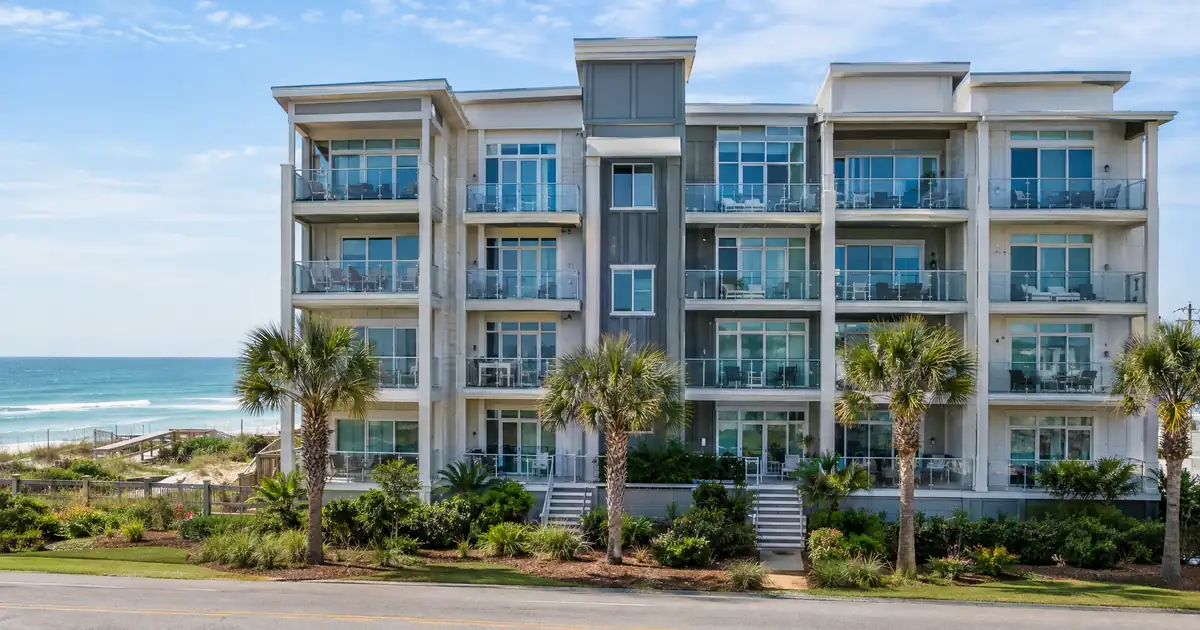
The Quick Read: A DSCR loan can finance a Perdido Key condo as an investment property, and it qualifies primarily on property-level rental income covering the payment, subject to lender guidelines, but only after the building’s rental rules, the condo project’s financial health, and the unit’s income all pass review. Perdido Key is the worked example here. The same steps apply to any resort-style condo with rental restrictions.
- Purchase leverage typically lands at 75%-80% LTV (20%-25% down). Select high-leverage programs reach 85% LTV on a purchase with roughly a 700+ score.
- Short-term-rental purchases top out at 75% LTV and want about 12 months of hosting history on most programs.
- Credit starts at a 620 floor in parts of the network. Most programs want around 660, and 700+ opens the strongest leverage.
- Reserves commonly run about 6 months of PITIA, with higher requirements on larger loans.
- Association dues and insurance sit inside the payment, so a condo’s building costs can decide the coverage ratio.
What a DSCR Loan Does for a Condo Rental
DSCR stands for debt service coverage ratio. The lender divides the monthly rent by the monthly PITIA, which is principal, interest, taxes, insurance, and any association dues. A result of 1.00 means rent covers the payment exactly. For a condo, the dues and the building’s insurance are part of that bottom number.
DSCR Calculator
Run the numbers in your market
Rate source: Freddie Mac 30-yr average via FRED® — Federal Reserve Bank of St. Louis · effective Oct 29, 2026
Prefilled with starting assumptions — enter your own rent or nightly figures, taxes, insurance, and HOA for a more accurate picture.
Program parameters update from Lendmire’s centralized guideline source. Taxes and insurance are editable estimates.
As of Oct 29, 2026 · General Freddie Mac market benchmark, not a Lendmire loan offer. Rent, nightly rate, occupancy, taxes, and insurance are editable estimates. Short-term rental figures are estimates only and vary significantly by season, property type, management approach, and local short-term-rental rules — confirm local regulations before relying on them. Qualifying income for short-term rentals varies by program — some use appraisal market rent, others use documented STR history or projections — and is confirmed in underwriting. Not a Loan Estimate, approval, or commitment to lend. Program availability and eligibility are subject to lender guidelines, credit approval, property review, and underwriting.
DSCR loans are designed for non-owner-occupied investment properties. Because they are business-purpose investor loans, they are reviewed differently from a standard owner-occupied mortgage. Your personal income documents are not the center of the file. Credit, assets, and experience still matter. Scotsman Guide calls the belief that only the property gets qualified the biggest misconception about this product.
Condos are where this loan type earns its place. Scotsman Guide reports that investors adding rental condos often turn to DSCR loans for units that conventional lenders label non-warrantable. It also notes that the cap of 10 financed properties on agency loans does not apply to DSCR loans. If you want the full mechanics, Lendmire’s complete DSCR loans guide walks through the product from the ground up.
How to Buy a Perdido Key Condo Rental, Step by Step
Order matters. The most expensive mistakes happen when buyers sign a contract before checking whether the building lets them rent the way their numbers assume.
1. Pick your rental strategy first. Long-term lease or nightly stays? The answer drives how income is counted and which buildings work. A building with a 30-day minimum cannot support a nightly-rate pro forma.
2. Confirm the building’s rental rules before you fall in love with a unit. Minimum stays, rental caps, and owner-only rules live in the association documents. A listing agent’s summary is not the rule.
3. Collect the HOA documents. Ask for the declaration, rules, budget, insurance summary, and the most recent reserve study and inspection reports. Florida buyers can request these records because they are part of the association’s official file.
4. Start the condo project review. The lender sends the association a questionnaire. Answers about investor concentration, litigation, reserves, and commercial space decide whether the project fits a program.
5. Establish the income. For a long-term rental, that is an in-place lease or the appraiser’s market-rent schedule. For a short-term rental, it is hosting history, an appraiser’s analysis, third-party data, or a mix. More on this below.
6. Run the coverage ratio twice. Calculate it once on short-term income and once on long-term rent. If the building or the lender rejects nightly income, you still know where you stand.
7. Order the appraisal, then settle title and entity. The appraisal sets the value for LTV and the rent for coverage. Many business-purpose loans allow title in an LLC, subject to lender program eligibility, but confirm that before you sign.
8. Close with the documents reviewed. Florida gives condo buyers a review window for association documents. Use all of it.
Can Every Perdido Key Building Be Rented?
No. Rental rights differ building by building, and this is the biggest local variable in the whole deal. A local broker directory of rent-restricted Perdido Key condos lists buildings with 30-day minimums, 6-month, 7-month, and 12-month minimums, a rental cap at one small complex, and one owners-only building. It is a broker listing rather than an official source. It still shows how much the rules vary from one tower to the next.
Short-term rental rules can vary by city, county, HOA, and property type, so investors should confirm local rules before relying on projected rental income. The table shows how each common policy type changes your income and your loan.
| Building policy | Effect on income | Effect on the loan |
|---|---|---|
| Nightly stays allowed | Short-term income may be usable | STR program rules apply |
| 7-day minimum | Weekly pricing, fewer bookings | Often treated as STR |
| 30-day minimum | Monthly pricing only | Usually run as long-term rent |
| 6- to 12-month minimum | Standard lease income | Long-term rent path |
| Owners-only or no new rentals | No rental income | Does not fit a rental loan |
| Grandfathered owners only | Rights may not transfer | Verify before you contract |
The last two rows deserve a second look. One local brokerage page says a community stopped letting new owners rent, with only a limited group of earlier owners keeping the right. If a seller’s rental history comes from grandfathered rights, those rights may not follow the unit to you. Lendmire’s piece How to Buy a Short-Term Rental When the Permit Does Not Transfer covers that trap in detail.
How Does the Lender Read the Condo Project?
The lender checks the building as well as the unit. This is where many Perdido Key deals stall.
A warrantable condo is one that meets the standard tests conventional lenders use. A non-warrantable condo misses at least one, and the common triggers are heavy investor concentration, pending litigation, thin reserves, commercial space in the building, and short-term rental activity. Non-warrantable does not mean unfinanceable. DSCR lenders apply their own project overlays rather than the conventional tests, and programs differ on how far they will stretch.
Published guidance reflects that variation. One Scotsman Guide piece says some DSCR lenders limit themselves to warrantable condos. The other Scotsman piece cited above says DSCR is increasingly used for non-warrantable ones. Across the network, the honest answer is that it depends on the program. Settle warrantable status early.
Some features are harder than others. A building with mandatory rental pooling or deed restrictions can fail under every rental strategy. Investor concentration alone is often more workable, especially on short-term-rental programs. Resale is also worth a thought. The next buyer of a non-warrantable unit may need cash or a similar non-conventional loan, which narrows your exit.
Florida’s Reserve Study Rule
Florida adds one more layer. Under Florida Statutes section 718.112, a residential condo association must complete a structural integrity reserve study at least every 10 years for each building of three or more habitable stories. A licensed engineer, a licensed architect, or a certified reserve specialist or analyst must perform or verify it.
For you, the practical points are simple. Tall Gulf-front towers fall under that rule, and low-rise buildings may not. Read the study. It shows whether the association has funded major repairs or is heading toward a special assessment. Pending inspection issues can also mean extra underwriting documents or fewer loan options. A lender will not ignore an underfunded building just because the unit’s rent looks strong.
How Is Rental Income Counted?
Long-term rent is the simpler path. The lender uses an in-place lease, the appraiser’s market-rent schedule (Form 1007 for a one-unit condo), or a program-specific blend. Programs in the network differ here. Some lean on the appraisal figure, and others allow a variance for a signed lease.
Short-term rental income is harder to prove. Most programs we place files with want about 12 months of hosting history, and they set tighter leverage for that collateral. Purchase leverage tops out at 75% LTV on short-term-rental collateral. A refinance runs around 70%, and cash-out is capped at 70% on short-term-rental collateral. Expect a score of 640 or higher. The coverage floor on a short-term-rental purchase is 1.00, and the floor on a refinance is also 1.00.
A first-time buyer has no history on the unit. Many such files are run on long-term market rent instead, or on an appraiser’s short-term analysis plus third-party market data, depending on the lender. Lenders may also discount projected nightly income. Treat gross bookings as a sales number rather than a coverage figure.
What Does a Worked Example Look Like?
Here are modeled assumptions, not sourced market data. Run the numbers this way on a mid-rise Gulf-front unit with no rental history.
Base case. Long-term market rent on the appraisal covers the full PITIA at about 1.15x. That clears the 1.00 level where many select programs start.
Stress case. The association runs a reserve catch-up, dues climb, and the insurance renewal also moves up. Coverage drops to roughly 1.05x. The unit still clears 1.00, but the cushion is thin.
Building-rule case. You priced the deal on nightly stays, and the building turns out to require a 30-day minimum. The short-term pro forma disappears, and the file reverts to long-term rent. If that rent only covers the payment at around 0.95x, the deal works into sub-1.00 territory.
It is a separate path from the programs that start at 1.00, and it usually means more cash down. Scotsman Guide also reports that some non-QM lenders will go below 1.0 with compensating assets, with terms varying by lender. Qualification stays subject to lender guidelines, credit approval, and property review.
A larger down payment lowers the monthly payment and can lift the ratio. It does not erase leverage caps, credit floors, reserve rules, or property eligibility. The strongest files clear both tests: enough equity and enough rental coverage.
What Sits Inside the Ratio and What Doesn’t?
Clearing 1.00 does not mean the unit makes money. DSCR compares rent to PITIA only.
| Cost | Inside the DSCR? |
|---|---|
| Principal and interest | Yes |
| Property taxes | Yes |
| Condo (HO-6) and required flood coverage | Yes |
| HOA dues | Yes |
| Management and cleaning fees | No |
| Utilities, repairs, and capital costs | No |
| Vacancy and seasonal slow periods | No |
On a barrier island, insurance and dues are the swing items that sit inside the ratio. Obtain the insurance quotes before you waive your contingencies, and ask whether short-term rental use affects eligibility for the policy. A short-term rental also carries local lodging taxes and licensing duties that cut into cash flow without changing the ratio. Tax treatment varies; consult a qualified professional before relying on any deduction.
DSCR vs. conventional financing
There are two common ways to finance an investment property, and they qualify you differently — here’s how investors weigh them.
Why investors choose it
- Qualifies on the property’s rental income — no personal tax returns, W-2s, or pay stubs needed to document income.
- No personal debt-to-income ceiling to clear, so existing mortgages and obligations don’t cap your borrowing the same way.
- Can be closed in an LLC, keeping the property inside a business entity.
- Built for scaling — not held to the limit on number of financed properties that conventional financing applies.
- Underwriting centers on the deal: generally qualifies when the rent covers the payment, a 1.00x coverage ratio being a common baseline (confirmed in underwriting).
- Designed specifically for investment property, including long-term and, where the program allows, short-term rentals.
Where it’s strong
- Often the lowest ongoing financing cost for a buyer who fully qualifies on personal income — a fit for a first property or a cost-first purchase.
Trade-offs for investors
- Requires full personal income documentation and must fit within a debt-to-income limit — salary, existing debts, and other mortgages all count.
- Typically held in your personal name rather than a business entity.
- Caps how many financed properties you can carry, which can become a ceiling as a portfolio grows.
- Evaluates you as a borrower as much as the property, which usually means more paperwork.
How investors usually choose: a first or single property often optimizes for the lowest financing cost; portfolio builders often optimize for leverage, vesting in an LLC, and scaling past conventional caps. The right answer depends on your goals, the property, and current guidelines — both paths run through select lenders in Lendmire’s wholesale network, with eligibility and terms confirmed in underwriting.
What Leverage, Credit, and Reserves Should You Expect?
These are typical network ranges, not promises. Every file is underwritten individually.
- Leverage: 75%-80% LTV on a purchase, with select programs reaching 85% LTV on a purchase around a 700+ score. If you later pull equity, cash-out tops out around 75% LTV on a standard rental and 70% on short-term-rental collateral, with about six months of seasoning as the common expectation.
- Credit: a 620 floor in parts of the network, around 660 on most programs, and 700+ for the strongest leverage tiers.
- Loan size: up to $3,000,000 on standard programs (smaller balances available through select lenders). Above $2,500,000 the network generally holds to 30-year fixed structures.
- Reserves: commonly around 6 months of PITIA. Conservative rate-and-term files at modest leverage under $1,500,000 can see reserves waived, and loans above that size typically step up to about 9 months.
- Structure: the 30-year fixed is the spine. Extended terms and interest-only periods are available through select lenders, and ARM structures exist for investors who want them.
Where Does the General Rule Break?
The basic path above breaks in a few named places.
- Grandfathered rental rights. The seller’s income may not transfer to you. Get the association’s written answer before you rely on it.
- Rental pools and condotel structures. If the unit must join a mandatory pool, many programs will not fit it. Do not assume a different rental strategy rescues the file.
- Tall, older, underfunded buildings. A weak reserve study can add underwriting steps, narrow the lender list, or raise your dues after closing.
- Mixed-use buildings. Meaningful commercial space can trigger the non-warrantable label.
- No hosting history. Programs that want 12 months of history may not fit a first purchase, so the file often runs on long-term rent instead.
- Thin coverage on strong rent. A unit can show healthy bookings and still fail if dues and insurance weigh down the denominator.
What About Buying From Out of State?
Many Perdido Key buyers live elsewhere, and the loan works the same way. Remote closing and holding title in an LLC are common requests, and both depend on lender program requirements and on the title company. Arrange local management before you close rather than after. A remote owner relies on that manager for the nightly numbers the file may later need to prove.
What Should the Pre-Offer Timeline Look Like?
Sequence your checks against the contract. Before you make an offer, confirm the building’s rental policy in writing and ask whether a lender-friendly project questionnaire is already on file. Right after you sign, request the full document package, the reserve study, the insurance summary, and the budget. During your review period, get insurance quotes, run coverage on both income paths, and have your broker confirm the project fits a program. Do not let the review window lapse while you wait on a missing report.
Proceed, Pause, or Walk Away?
Proceed when the building allows your rental plan in writing, the reserve study shows funded repairs, and coverage clears 1.00 on the strategy the building actually permits.
Pause when coverage only clears on nightly income you cannot yet document, when the building has open litigation or inspection items, or when the dues have just changed.
Walk away when the building bars new rentals, requires a rental pool, or only works at coverage below 1.00 with leverage you cannot fund.
Key Terms Defined
DSCR: the monthly rent divided by the monthly PITIA, used to judge whether a rental covers its own payment.
PITIA: principal, interest, taxes, insurance, and association dues.
Non-warrantable condo: a condo project that misses conventional lending tests, often because of investor concentration, litigation, thin reserves, commercial space, or short-term rental use.
Structural integrity reserve study: a Florida engineering-style review that tells an association which major building components need funding and when.
HO-6 policy: the insurance policy a condo owner carries on the interior of the unit.
LTV: the loan amount as a share of the property value.
Frequently Asked Questions
Can I use a DSCR loan on a Perdido Key condo that I want to rent nightly?
Yes, if the building allows nightly stays and a program accepts the project. Short-term-rental purchases top out at 75% LTV, typically want a 640+ score and about 12 months of hosting history, and carry a 1.00 coverage floor. Qualification stays subject to lender guidelines.
Does a non-warrantable condo rule out a DSCR loan?
No. Non-warrantable is a conventional-lending label, and DSCR lenders run their own project review. Some programs will take investor concentration, while others will not take a mandatory rental pool. Check status before you go under contract.
Does clearing 1.00 mean the condo will cash flow?
No. The ratio counts rent against principal, interest, taxes, insurance, and dues. Management, cleaning, utilities, repairs, vacancy, and capital costs sit outside it, so a unit can clear the ratio and still lose money.
What if the numbers only work below 1.00 coverage?
Coverage below 1.00 is available through select lenders in the network, with leverage and terms adjusted. Expect more cash down and different terms than on a file that starts at 1.00. A separate group of programs starts at 1.00 and offers stronger leverage.
How much down payment should I plan for?
Plan on 20%-25% down on most purchases, which matches 75%-80% LTV. Select high-leverage programs reach 85% LTV on a purchase with a 700+ score, which means 15% down. Short-term-rental collateral tops out at 75% LTV on a purchase.
Next Steps
If you are buying or refinancing a rental property and want to see how the numbers work, Lendmire can help you compare DSCR loan options based on the property income, credit profile, leverage, and investor goals. As a broker, Lendmire arranges financing through select lenders in its wholesale network across 41 markets, including Washington, D.C. Not a commitment to lend.
Perdido Key’s mix of towers, bay-side buildings, and low-rise inland communities means the building’s rules will decide more deals than the loan itself.
About Lendmire
A non-QM mortgage broker (NMLS# 2371349), Lendmire arranges DSCR financing for real estate investors in 41 markets — 40 states plus Washington, D.C. Because deals are underwritten primarily on property cash flow rather than personal income documentation, the structure suits self-employed buyers and entity-owned portfolios. Lendmire places loans through wholesale investor lenders; it is not a direct lender. Scotsman Guide named Lendmire a Top Mortgage Workplace in both 2025 and 2026.
Get Started
Ready to find the right loan for you?
See your offer in seconds. No credit pull, no obligation.
Informational only. Not a Loan Estimate, approval, or commitment to lend. Program availability and eligibility are subject to lender guidelines, credit approval, property review, and underwriting.
References
1. Scotsman Guide, “An Ace in the Hole”
2. Scotsman Guide, “Invest in Your Future”
3. CondoInvestment.com, rent-restricted Perdido Key condos
4. Scotsman Guide, “Get in the Game”
5. Florida Senate, Florida Statutes section 718.112
This article is part of Lendmire’s DSCR loan program — full qualification details, guidelines, and scenarios live on the program page.
Related reading: Can You Reapply for a DSCR Loan After a Rental Income Denial? · Can You Get a DSCR Loan on a Vacant Rental With No Lease? · Is a DSCR Loan Worth It Over a Conventional Loan on a Rental?
Brandon Miller
Founder & CEO, Mortgage Loan Originator, Lendmire LLC
- Mortgage Loan Originator · NMLS# 1129696 · Verify on NMLS Consumer Access
- North Carolina Real Estate Broker · License# 343312 · Verify on NCREC
- North Carolina Insurance Producer · License# 19053198 · Property, Casualty, Life, Health · Verify on NAIC SBS
- Lendmire LLC · Firm NMLS# 2371349 · Verify firm licensure
Legal disclosures. Lendmire (NMLS# 2371349) is a state-licensed mortgage brokerage that arranges financing through wholesale lender relationships. Lendmire is not a direct lender, depository institution, or registered financial advisor. The discussion above is general informational content about real estate financing — it is not financial, legal, or tax advice, and readers should consult licensed professionals for guidance on their individual circumstances. Loan inquiries are subject to lender underwriting; this article does not represent a commitment to lend. Loan terms, rates, and qualification standards vary by borrower, property, and state, and are subject to change at any time. Equal Housing Opportunity. NMLS Consumer Access: nmlsconsumeraccess.org.