
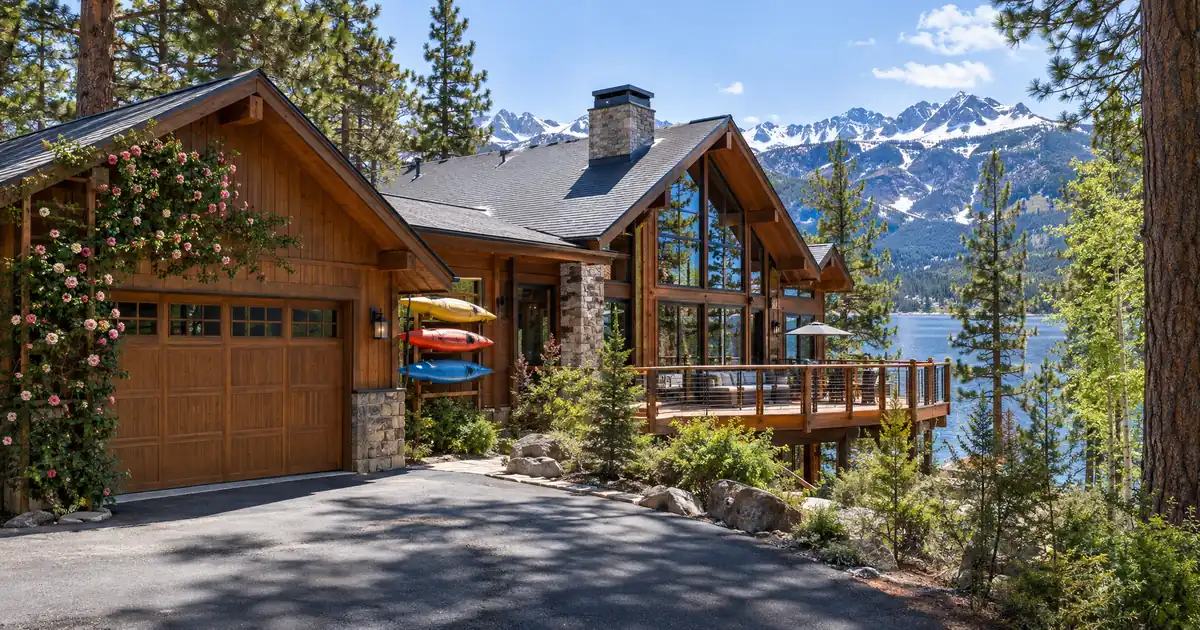
The Quick Read: A DSCR lender counts a documented or projected twelve-month income figure for a Big Bear Lake cabin, trims it with an expense factor, and divides the result by the full monthly payment (principal, interest, taxes, insurance, and any HOA dues). Peak-season months never carry the file on their own. Qualification runs primarily on property-level rental income covering the payment, subject to lender guidelines.
- Lenders look at a full year, so a strong ski winter gets averaged against quiet spring and fall months.
- Three paths exist: actual 12-month history, a third-party projection, or the appraiser’s long-term rent figure.
- Many lenders trim short-term rental income before the division. The size of that trim varies by lender.
- Clearing 1.00 on coverage is not the same as positive cash flow.
- Whether the income counts can depend on a rental license, and in Big Bear Lake the license does not transfer on a sale.
Big Bear Lake is a useful example because the income swings so hard. A cabin can book solid through a ski holiday, fill again around a summer holiday, and sit quiet in between. A lender cannot underwrite a swing. It underwrites one number. This piece walks through how that number gets built.
DSCR Calculator
Run the numbers in your market
Rate source: Freddie Mac 30-yr average via FRED® — Federal Reserve Bank of St. Louis · effective Oct 29, 2026
Prefilled with starting assumptions — enter your own rent or nightly figures, taxes, insurance, and HOA for a more accurate picture.
Program parameters update from Lendmire’s centralized guideline source. Taxes and insurance are editable estimates.
As of Oct 29, 2026 · General Freddie Mac market benchmark, not a Lendmire loan offer. Rent, nightly rate, occupancy, taxes, and insurance are editable estimates. Short-term rental figures are estimates only and vary significantly by season, property type, management approach, and local short-term-rental rules — confirm local regulations before relying on them. Qualifying income for short-term rentals varies by program — some use appraisal market rent, others use documented STR history or projections — and is confirmed in underwriting. Not a Loan Estimate, approval, or commitment to lend. Program availability and eligibility are subject to lender guidelines, credit approval, property review, and underwriting.
The mechanics apply to any seasonal rental. Big Bear Lake is the example market only. For the full program picture, see the complete DSCR loans guide.
What Is a DSCR Lender Actually Measuring?
A DSCR lender measures whether the property’s credited rent covers its full monthly obligation. The ratio is credited monthly income divided by monthly PITIA. Personal income is not the focus. The property’s rent is.
Across the wholesale network Lendmire works with, 1.00 is where select programs start. It is a floor for specific programs, not a universal standard. Stronger ratios open better pricing and leverage. A separate select-lender path takes coverage below 1.00, with leverage and terms adjusted.
The hard part on a seasonal cabin is the numerator. “Rent” is not one lease payment. It is a year of uneven bookings that someone has to turn into a single monthly figure.
Key Terms Defined
DSCR: The ratio of credited rental income to the monthly payment on the loan.
PITIA: Principal, interest, taxes, insurance, and association dues, the full monthly obligation the income must cover.
Trailing twelve months (TTM): The most recent twelve months of actual rental income, used when a property has operating history.
Projection: A modeled income estimate, usually from third-party market data, used when there is no history.
Expense factor (haircut): A percentage the lender subtracts from gross short-term rental income before dividing by the payment.
1007 rent schedule: The appraiser’s market-rent opinion for a single-family rental, which assumes a long-term lease.
From Seasonal Bookings to One Number: How Underwriting Treats It
Underwriting builds the number in steps. The order below is how most files in the network move.
1. Pick the income path by deal type. A refinance or an already-operating rental is documented with actual history. A purchase with no history uses a projection or an appraiser’s analysis.
2. Document twelve months. For an operating cabin, that means platform or property-manager statements covering the full year. Underwriters commonly match statements to bank deposits. Months the owner blocked for personal use show up as gaps, so they need an explanation.
3. Apply the expense factor. The lender trims gross short-term rental revenue as a stand-in for operating costs. The factor is lender-specific, so the same cabin can produce different credited income at different lenders.
4. Divide by PITIA. The credited monthly figure goes over the full payment. That gives the coverage ratio.
5. Run the long-term rent fallback. The appraiser’s rent schedule is often a floor. Many underwriters check it alongside the short-term figure.
Why twelve months? A full year captures both the peaks and the troughs. Annualizing a peak-season snapshot is the classic overstatement, and lenders know it. A property that earns most of its income in a few months looks very different from one with steady bookings, even when the annual total matches.
How Does a Projection Get Built for a Purchase With No History?
A projection estimates a year of revenue from comparable listings. AirDNA’s help center explains that its Rentalizer revenue estimate uses a weighted average of similar nearby active listings, factors in seasonality, and includes the cleaning fee but not the host fee, other fees, or taxes. It also shows a month-by-month chart with a range for each month. That chart is the seasonality curve an underwriter can inspect.
The comp radius matters. AirDNA’s Airbnb calculator page says its estimate draws on comps within a 10-mile radius. In Big Bear Lake, that radius can mix lake-view homes, ski-area cabins, and village properties that earn very differently. A projection is only as good as the comp set behind it.
Two cautions from the broker’s side:
- Many lenders do not accept a projection at face value. They apply a further haircut, and that factor varies across the network.
- The projection is a modeled number, not a guarantee. Investors who underwrite their own deal first, with conservative assumptions, tend to hit fewer surprises when the lender’s figure comes back lower.
Big Bear Lake’s Two-Peak Curve
Big Bear Lake runs on two demand peaks. A local property manager describes winter ski demand around Presidents’ Week and summer lake demand around the Fourth of July, with quieter spring and fall and holiday climbs at Thanksgiving and Christmas. Data aggregator AirROI reports December as the strongest month and May as the softest.
Here is how that plays inside a file. Picture a cabin with a strong ski winter, a decent summer, and weak shoulder months. A refinance after a big ski season can look far better on a short window than on a full year. The lender looks at the full year anyway. The peak months lift the annual total, but the quiet months pull the monthly average back down, and the average is what gets divided by PITIA.
Occupancy figures also vary widely by data vendor. Public aggregators and local operators report different occupancy for the same market, spread across roughly the high 20s to high 30s in percent. That spread is the point. Two projections for the same cabin can differ simply because they use different vendors and different comp sets. Do not treat any single occupancy figure as the market answer.
Seasoned Rental Versus New Purchase
| Factor | Seasoned short-term rental | New purchase, no history |
|---|---|---|
| Income basis | Actual 12 months of statements | Projection or appraiser analysis |
| Proof | Platform payouts matched to deposits | Comp-based model |
| Main risk | Owner-blocked months, peak-heavy year | Optimistic projection, extra haircut |
| Fallback | Appraiser’s long-term rent | Appraiser’s long-term rent |
For short-term rentals, the network’s programs run lower leverage than standard long-term rentals. Typical guidance on short-term rental collateral is up to 75% LTV on a purchase and around 70% on a refinance and on a cash-out. Expect a score around 640 or better and roughly 12 months of hosting history on programs that want it. Coverage is 1.00 on purchases and refinances, though programs differ and every file is underwritten individually. These specifics are subject to lender guidelines and a full review of property, leverage, and credit.
Standard long-term rental purchases, by comparison, usually land at 75%-80% LTV, with a cash-out ceiling around 75% on a standard rental. Reserves are commonly around 6 months of PITIA, stepping up to about 9 months above $1,500,000. Those are typical ranges, not promises.
A larger down payment lowers the payment and can lift the ratio. It does not erase credit floors, reserve rules, leverage caps, or property eligibility. The strongest files clear both tests: enough equity and enough rental coverage.
When the Long-Term Rent Basis Wins
Sometimes the appraiser’s rent figure becomes the safer path. The appraiser’s rent schedule often comes in well below short-term income, so a cabin that clears on bookings can miss on the long-term number.
The reverse also happens. A lender that distrusts a thin history may want the long-term figure to carry the ratio. In second-home-heavy markets, long-term rental comps are thin. Lendmire’s own Big Bear Lake short-term rental page cites Census data showing roughly 73% of local housing units held for seasonal or occasional use. Few year-round leases means few comps, and that can weaken the fallback.
The practical read: the income method decides the ratio. The same house can clear on actual history, clear thinner on a haircut projection, and fall short on long-term rent.
The Legal Gate: Does the Income Count at All?
Income only counts if the rental is allowed.
Why this matters for underwriting. The city’s vacation rental program requires a license with annual renewal for homes inside city limits, while homes outside the ZIP 92315 boundary register with the county. The city’s FAQ states that the license is not transferable and expires on sale, so a new owner must obtain one before renting.
For a purchase, that is the edge case. Seller history does not carry over. A purchase underwritten on short-term income may depend on the buyer getting a new license. Confirm the path before the file goes in.
Some lenders also decline short-term rental income entirely or require the property to qualify on long-term rent. Not every program takes it, so lender selection matters. A broker with a wide network can route around a program that does not fit.
DSCR vs. conventional financing
There are two common ways to finance an investment property, and they qualify you differently — here’s how investors weigh them.
Why investors choose it
- Qualifies on the property’s rental income — no personal tax returns, W-2s, or pay stubs needed to document income.
- No personal debt-to-income ceiling to clear, so existing mortgages and obligations don’t cap your borrowing the same way.
- Can be closed in an LLC, keeping the property inside a business entity.
- Built for scaling — not held to the limit on number of financed properties that conventional financing applies.
- Underwriting centers on the deal: generally qualifies when the rent covers the payment, a 1.00x coverage ratio being a common baseline (confirmed in underwriting).
- Designed specifically for investment property, including long-term and, where the program allows, short-term rentals.
Where it’s strong
- Often the lowest ongoing financing cost for a buyer who fully qualifies on personal income — a fit for a first property or a cost-first purchase.
Trade-offs for investors
- Requires full personal income documentation and must fit within a debt-to-income limit — salary, existing debts, and other mortgages all count.
- Typically held in your personal name rather than a business entity.
- Caps how many financed properties you can carry, which can become a ceiling as a portfolio grows.
- Evaluates you as a borrower as much as the property, which usually means more paperwork.
How investors usually choose: a first or single property often optimizes for the lowest financing cost; portfolio builders often optimize for leverage, vesting in an LLC, and scaling past conventional caps. The right answer depends on your goals, the property, and current guidelines — both paths run through select lenders in Lendmire’s wholesale network, with eligibility and terms confirmed in underwriting.
Owner Use and the Personal-Cabin Question
DSCR loans are designed for non-owner-occupied investment properties. Because they are business-purpose investor loans, they are reviewed differently from a standard owner-occupied mortgage. A cabin you plan to live in or use as a personal second home generally does not fit this product.
Occasional owner stays in a true rental are a documentation question, not a disqualifier by themselves. Blocked weeks show up in booking history. A clean calendar and a clear explanation help the file.
Documentation Checklist
- Twelve months of platform statements or property-manager reports.
- Bank statements showing the matching deposits.
- A clear explanation for any blocked or zero-income months.
- Proof of rental license status where required.
- An insurance quote reflecting the rental use.
- The HOA questionnaire if the cabin sits in an association.
- Entity documents if the property is titled in an LLC, subject to lender program eligibility.
Gaps in this list are the quiet friction. Most delays-in-review come from missing statements, mismatched deposits, or an insurance quote that does not match the use.
What If the Counted Income Falls Short?
Credited income that lands under the target ratio has options. A borrower can bring more down payment, which lowers the payment. A smaller loan amount does the same. Some files switch to the long-term rent basis if it works better. A select-lender path takes coverage below 1.00, with leverage and terms adjusted. Interest-only and extended-term structures exist through select lenders in the network, which can change the payment the ratio is measured against. Every option is subject to lender guidelines, credit approval, and property review.
Common Mistakes That Lower the Counted Figure
1. Using the best month as the run rate. Lenders use full-year data.
2. Treating the projection as the number that gets counted. It is usually adjusted first.
3. Assuming the appraiser’s rent will reflect short-term income. It often will not.
4. Assuming all lenders take short-term income. They do not.
5. Assuming the license transfers. In Big Bear Lake it does not.
6. Reading 1.00 as profit. DSCR compares rent to PITIA only. Repairs, vacancy, management, utilities, cleaning, and lodging taxes sit outside the calculation. A cabin can clear 1.00 and still run thin after a quiet winter.
Seasonal gaps may call for cash reserves. That is a general planning point, not a program figure.
Frequently Asked Questions
Does short-term rental income count toward DSCR on a Big Bear Lake cabin?
Often yes, through select programs in the network. The lender uses documented twelve-month history or a projection, trims it with an expense factor, and divides by PITIA. Some lenders do not accept short-term income at all, so program fit matters.
Will a great ski season carry the loan?
No. The lender averages the full year. A peak winter lifts the annual total, but quiet spring and fall months pull the monthly figure back down. A refinance right after a strong season still gets underwritten on the full cycle.
What if I have no rental history on a new purchase?
The lender typically uses a market projection or an appraiser’s analysis. Projections get adjusted, and the long-term rent figure often works as a floor. Some programs want about 12 months of hosting history, which can steer a new-purchase file toward a different structure.
Does a property manager change the ratio?
Indirectly. Manager reports can document the twelve months, which helps. Management fees reduce real profit but sit outside the DSCR calculation, so a strong ratio does not mean strong take-home.
Can I use the cabin myself?
Not if it is a personal second home. DSCR loans are for non-owner-occupied investment property. Occasional personal blocks in a real rental need documentation and an explanation.
Does ADU income help?
Not in Big Bear Lake’s licensing example. The city’s 2021 vacation rental ordinance says no property with an ADU is eligible for a license, so a lender may not be able to count short-term income on such a property. The ordinance may have been superseded, so check the current version.
If you are buying or refinancing a rental property and want to see how the numbers work, Lendmire can help you compare DSCR loan options based on the property income, credit profile, leverage, and investor goals. Reach the team at 828-256-2183 or request a quote. Programs change, every file is underwritten individually, and nothing here is a commitment to lend.
For a related look at how a lender counts a different kind of non-standard rent, see Lendmire’s piece How Much Rent a DSCR Lender Counts From a Permitted ADU.
Tax treatment varies; consult a qualified professional.
About Lendmire
Lendmire, NMLS# 2371349, is a mortgage brokerage focused on investor financing, arranging DSCR loans in 40 states plus Washington, D.C. — 41 markets total. Qualification is based on the property’s income rather than personal income documentation, subject to lender guidelines, making it a fit for LLC-held rentals and scaling portfolios. Scotsman Guide named Lendmire a Top Mortgage Workplace in both 2025 and 2026.
Get Started
Ready to find the right loan for you?
See your offer in seconds. No credit pull, no obligation.
Informational only. Not a Loan Estimate, approval, or commitment to lend. Program availability and eligibility are subject to lender guidelines, credit approval, property review, and underwriting.
References
1. AirDNA Help – Rentalizer Revenue Calculator
3. Big Bear Vacations – How Big Bear Vacations Prices Your Cabin
This article is part of Lendmire’s DSCR loan program — full qualification details, guidelines, and scenarios live on the program page.
Related reading: How a DSCR Lender Applies Market Rent to a Family-Member Lease · How Much Rent a DSCR Lender Counts From a Relative Tenant · How Much a DSCR Lender Funds as You Scale a Rental Portfolio
Guides: DSCR Loans in Big Bear Lake, CA · DSCR Loans in California
Brandon Miller
Founder & CEO, Mortgage Loan Originator, Lendmire LLC
- Mortgage Loan Originator · NMLS# 1129696 · Verify on NMLS Consumer Access
- North Carolina Real Estate Broker · License# 343312 · Verify on NCREC
- North Carolina Insurance Producer · License# 19053198 · Property, Casualty, Life, Health · Verify on NAIC SBS
- Lendmire LLC · Firm NMLS# 2371349 · Verify firm licensure
Required disclosures. Lendmire (NMLS# 2371349) operates as a licensed mortgage broker, not a direct lender or depository. The discussion in this article is general in nature and should not be relied upon as financial, legal, or tax advice — every investment scenario is unique and should be reviewed by a qualified professional. Any loan inquiry is subject to lender underwriting, and this article is not a commitment to lend or a guarantee of approval. Mortgage rates, loan terms, and program guidelines vary by borrower, property, and state, and may change without notice. Equal Housing Opportunity. Verify licensure at NMLS Consumer Access.