
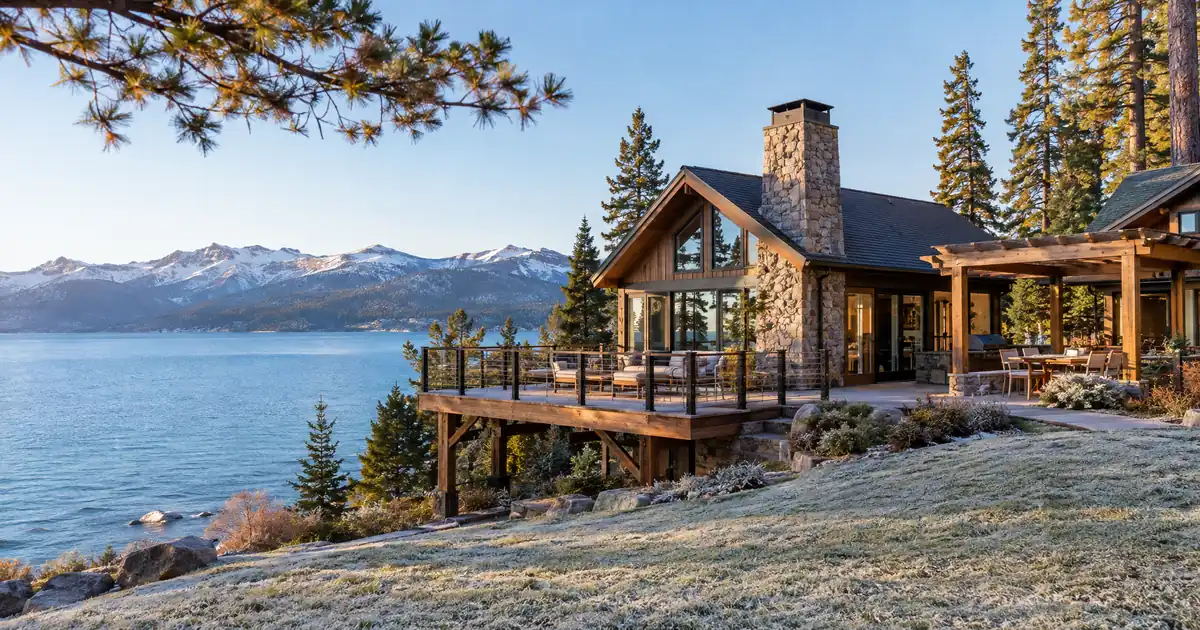
The Quick Read: A Lake Tahoe purchase works with a DSCR loan when the property’s rental income covers its full monthly obligation, the short-term rental permit is secure, and insurance and HOA costs still fit inside the ratio. The lender tests rent against principal, interest, taxes, insurance, and dues, not your personal income. Permit status and the income basis the lender accepts decide most files.
- DSCR (debt service coverage ratio) compares the property’s rent used for lender review to its monthly housing payment.
- On a short-term rental purchase, leverage tops out at 75% LTV, and most programs want a 640+ credit score.
- Confirm the permit and HOA rental rules before you write an offer, not after.
- Clearing 1.00 is not the same as positive cash flow.
What Is a DSCR Loan, and Why Does It Fit Tahoe?
DSCR loans are designed for non-owner-occupied investment properties. Because they are business-purpose investor loans, they are reviewed differently from a standard owner-occupied mortgage. The file qualifies primarily on property-level rental income covering the payment, subject to lender guidelines.
DSCR Calculator
Run the numbers in your market
Rate source: Freddie Mac 30-yr average via FRED® — Federal Reserve Bank of St. Louis · effective Oct 29, 2026
Prefilled with starting assumptions — enter your own rent or nightly figures, taxes, insurance, and HOA for a more accurate picture.
Program parameters update from Lendmire’s centralized guideline source. Taxes and insurance are editable estimates.
As of Oct 29, 2026 · General Freddie Mac market benchmark, not a Lendmire loan offer. Rent, nightly rate, occupancy, taxes, and insurance are editable estimates. Short-term rental figures are estimates only and vary significantly by season, property type, management approach, and local short-term-rental rules — confirm local regulations before relying on them. Qualifying income for short-term rentals varies by program — some use appraisal market rent, others use documented STR history or projections — and is confirmed in underwriting. Not a Loan Estimate, approval, or commitment to lend. Program availability and eligibility are subject to lender guidelines, credit approval, property review, and underwriting.
That suits the typical Tahoe buyer. Many are self-employed, hold several financed properties, or live out of the area. A loan that looks at the cabin’s income instead of a tax-return stack removes a lot of friction.
Tahoe is also one of the harder places to run the math. Prices are high, insurance is a moving target, and occupancy swings by season. The complete DSCR loans guide covers the basics. This article covers what changes at the lake.
How Does Underwriting Treat a Tahoe Short-Term Rental?
The lender picks an income figure, divides it by PITIA, and sizes the loan around the result. PITIA is principal, interest, taxes, insurance, and association dues. Across the wholesale network Lendmire works with, 1.00 is where many select programs start. A separate select-lender path takes coverage below 1.00, with leverage and terms adjusted.
The harder question is which income figure counts. Long-term rentals use a market rent schedule from the appraiser. Short-term rentals do not fit that form. An appraisal firm, Class Valuation, explains that the standard long-term rent form (Form 1007) cannot support nightly-rental income. Appraisers instead add a short-term rental income analysis as a narrative addendum.
Lenders in the network generally accept one of a few evidence types:
- A market-data projection for the property and its bedroom count.
- About 12 months of hosting history, shown through platform or bank-statement records.
- A property manager’s statement.
- An appraiser’s short-term rental analysis.
Which of these a program accepts, and how much it discounts them, varies by lender. A property with no hosting history is handled differently from one with a full year of records. A conservative buyer should assume the lender will use the lower of any two figures.
What Are the Steps, in Order?
Start with the permit, not the loan. Here is the sequence that tends to work.
1. Pick the jurisdiction. The lake spans several permitting authorities. Short-term rental rules can vary by city, county, HOA, and property type, so investors should confirm local rules before relying on projected rental income.
2. Confirm the permit status. Ask whether a permit exists, whether it transfers to a buyer, and whether a new one is available.
3. Read the HOA rules. Condos and townhomes often restrict rentals, whatever the listing says.
4. Get a pre-qualification. The broker reviews credit, reserves, entity structure, and the property type.
5. Estimate the income and the full payment. Load in taxes, insurance, and dues before you fall for a gross-revenue figure.
6. Make the offer with contingencies. Tie it to the permit, the appraisal, and the insurance quote.
7. Complete the appraisal and underwriting. The appraisal sets the value, and the value sets the leverage ceiling.
8. Close and keep the file clean. Records you keep after closing become the hosting history for your next refinance.
Buying in an LLC is common, subject to lender program eligibility.
Why Does the Permit Decide the File?
A rental income estimate only matters if the rental is legal for the next owner. Real Estate Tahoe’s permit availability tracker reports that in at least one county a permit does not stay with the house when it sells. The new owner has to reapply, and new permits may sit on a waitlist.
An income projection built on a permit you cannot obtain describes a different asset from the one you are buying. Lenders know this. HVS, a hospitality advisory, documents how caps and spacing rules differ across the basin’s jurisdictions. The practical takeaway is simple. Check with the issuing jurisdiction, not the listing agent.
For a deeper look at this scenario, see Lendmire’s piece How to Buy a Short-Term Rental When the Permit Does Not Transfer.
What Does a Tahoe Deal Look Like in Practice?
Here are two modeled scenarios. They are illustrations, not market data.
Scenario one: the cabin that clears. Picture a buyer purchasing a mid-priced cabin at 75% LTV on a short-term rental purchase, with a credit score above 700. The lender’s accepted income basis covers PITIA at roughly 1.25x. That is comfortable. The file then turns on reserves, which commonly run about six months of PITIA, stepping up to about nine months on loans above $1,500,000.
Scenario two: the cabin that looks good and does not. A second buyer sees strong gross revenue on a listing. Once insurance, taxes, and HOA dues sit in the payment, the ratio lands near 0.90x. That is below the 1.00 floor many programs start with.
Several fixes exist for the second buyer:
- Put more down. A larger down payment lowers the payment and can lift the ratio, but it never erases leverage caps, credit floors, or reserve rules.
- Choose a lower-priced property with a better rent-to-price relationship.
- Ask about an interest-only period or a 40-year term. Both are available through select lenders in the network.
- Ask about the sub-1.00 path, which is available through select lenders in the network, with leverage and terms adjusted.
Qualification is always subject to lender guidelines, credit approval, and property review.
One more point matters. DSCR compares rent to PITIA only. A file that clears 1.00 can still lose money after repairs, vacancy, management, utilities, and capital expenses. Those sit outside the calculation, so run them yourself.
How Does Seasonality Change the Math?
Tahoe has two peaks, ski season and summer, and weak shoulder months between them. The payment does not flex with the calendar, so it arrives every month at the same size. Lenders look at annualized income for this reason, and they tend to be conservative on seasonal resort markets.
Investors who pencil in peak-month nightly rates all year will overstate income. Use a full-year figure, and remember that occupancy estimates from different data providers often disagree. Underwrite to the lower one.
DSCR vs. conventional financing
There are two common ways to finance an investment property, and they qualify you differently — here’s how investors weigh them.
Why investors choose it
- Qualifies on the property’s rental income — no personal tax returns, W-2s, or pay stubs needed to document income.
- No personal debt-to-income ceiling to clear, so existing mortgages and obligations don’t cap your borrowing the same way.
- Can be closed in an LLC, keeping the property inside a business entity.
- Built for scaling — not held to the limit on number of financed properties that conventional financing applies.
- Underwriting centers on the deal: generally qualifies when the rent covers the payment, a 1.00x coverage ratio being a common baseline (confirmed in underwriting).
- Designed specifically for investment property, including long-term and, where the program allows, short-term rentals.
Where it’s strong
- Often the lowest ongoing financing cost for a buyer who fully qualifies on personal income — a fit for a first property or a cost-first purchase.
Trade-offs for investors
- Requires full personal income documentation and must fit within a debt-to-income limit — salary, existing debts, and other mortgages all count.
- Typically held in your personal name rather than a business entity.
- Caps how many financed properties you can carry, which can become a ceiling as a portfolio grows.
- Evaluates you as a borrower as much as the property, which usually means more paperwork.
How investors usually choose: a first or single property often optimizes for the lowest financing cost; portfolio builders often optimize for leverage, vesting in an LLC, and scaling past conventional caps. The right answer depends on your goals, the property, and current guidelines — both paths run through select lenders in Lendmire’s wholesale network, with eligibility and terms confirmed in underwriting.
What About Insurance and Condo Rules?
Insurance is the line item that most often breaks a Tahoe ratio. The lake sits across a state line, and the backstop options differ on each side. Nevada has no state FAIR Plan. Wildfire exposure has also pushed up non-renewals in higher-risk areas, which the California Department of Insurance documented in its wildfire fact sheet. That data is older, so treat it as direction, not a forecast.
Get a real insurance quote before you sign, and confirm it covers rental use. A basic dwelling policy may not. Lenders can require specific coverage, which varies by program.
Condo and townhome buyers face a second gate. Check the CC&Rs for rental restrictions before you rely on nightly income. Hotel-style rental pools can complicate the file as well.
Which Properties Does the Network Not Offer?
Manufactured homes (single- and double-wide), log homes, and barndominiums are not offered through the network’s DSCR programs. Tahoe has plenty of log-style cabins, so this matters. A cabin that reads as log construction on the appraisal can take the file off the table, so ask early.
Price range also matters. Real Estate Tahoe’s market data page shows medians running from about $729,000 in South Lake Tahoe to roughly $16 million in some luxury enclaves. Standard programs go up to $3,000,000, and above $2,500,000 the network generally holds to 30-year fixed structures. For high-end homes, read Lendmire’s piece How a Lake Tahoe Luxury Rental DSCR Loan Works.
What Documents Do You Need?
| Document | Why it matters |
|---|---|
| Entity papers | Show who holds title |
| Permit or registration | Proves the rental is legal |
| HOA rental rules | Confirms rentals are allowed |
| Insurance quote | Confirms rental coverage |
| Income evidence | Supports the lender’s income basis |
| Reserve statements | Prove post-closing cash |
Key Terms Defined
PITIA: Principal, interest, taxes, insurance, and association dues, the full monthly housing obligation.
LTV (loan-to-value): The loan amount as a percentage of the property’s appraised value or price.
Reserves: Liquid cash you hold after closing, measured in months of PITIA.
Hosting history: The record of past nightly bookings and income for a property.
Form 1007: The appraiser’s long-term market rent schedule, which does not capture nightly-rental income.
Permit transferability: Whether a short-term rental permit stays with the property when it sells.
Frequently Asked Questions
Can I buy a Tahoe rental with no hosting history?
It depends on the program and the lender. Most want about 12 months of hosting history. For a property with none, some lenders weigh a market-based income analysis instead, usually with tighter terms. Expect a 640+ credit score on short-term rental files.
How much do I need to put down on a short-term rental?
Short-term rental purchases typically top out at 75% LTV, so plan on at least 25% down. Refinances run lower, around 70% on both a rate/term refinance and a cash-out for short-term rental collateral. Standard long-term rentals reach 75% to 80% on a purchase, and select high-leverage programs reach 85% LTV with roughly a 700+ score.
Do lenders use my actual Airbnb income?
Sometimes. History from platform or bank records is one accepted evidence type, alongside market projections and appraiser analysis. Programs discount these figures differently, and the lender picks the basis that applies to your file.
Can I buy in an LLC?
Yes, in many cases, subject to lender program eligibility. A personal guarantee is common. Title and insurance must match the entity.
Can I cash-out refinance later?
Usually, once you have about six months of seasoning. Cash-out on standard rentals tops out around 75% LTV, and on short-term rental collateral around 70%.
Where to Go Next
If you are buying or refinancing a rental property and want to see how the numbers work, Lendmire can help you compare DSCR loan options based on the property income, credit profile, leverage, and investor goals. As a broker, it arranges financing through select lenders in its wholesale network, which covers 41 markets, including Washington, D.C. Lake Tahoe will keep rewarding the buyers who verify the permit first and trust the ratio second.
About Lendmire
Lendmire, NMLS# 2371349, is a non-QM mortgage broker serving real estate investors in 41 markets, including Washington, D.C., through DSCR investor loan programs. Qualification is generally reviewed around the subject property’s rental income, not the borrower’s W-2 history — a practical fit for LLC-titled portfolios and self-employed investors. All scenarios remain subject to lender review and program guidelines. Two consecutive Scotsman Guide Top Mortgage Workplace recognitions (2025, 2026).
Get Started
Ready to find the right loan for you?
See your offer in seconds. No credit pull, no obligation.
Informational only. Not a Loan Estimate, approval, or commitment to lend. Program availability and eligibility are subject to lender guidelines, credit approval, property review, and underwriting.
References
1. Class Valuation: Appraisal Form 1007 and short-term rentals
2. Real Estate Tahoe: STR permit availability
3. HVS: Short-term rentals and lodging news in Lake Tahoe
4. California Department of Insurance: wildfire fact sheet
5. Real Estate Tahoe: Tahoe real estate market data
This article is part of Lendmire’s DSCR loan program — full qualification details, guidelines, and scenarios live on the program page.
Related reading: How to Pull Equity From a Paid-Off Rental With a DSCR Loan · How to Close a DSCR Loan on a Carolina Beach Rental · Can You Vest a Rental in an LLC Before a DSCR Loan Closes?
Brandon Miller
Founder & CEO, Mortgage Loan Originator, Lendmire LLC
- Mortgage Loan Originator · NMLS# 1129696 · Verify on NMLS Consumer Access
- North Carolina Real Estate Broker · License# 343312 · Verify on NCREC
- North Carolina Insurance Producer · License# 19053198 · Property, Casualty, Life, Health · Verify on NAIC SBS
- Lendmire LLC · Firm NMLS# 2371349 · Verify firm licensure
Legal disclosures. Lendmire (NMLS# 2371349) is a state-licensed mortgage brokerage that arranges financing through wholesale lender relationships. Lendmire is not a direct lender, depository institution, or registered financial advisor. The discussion above is general informational content about real estate financing — it is not financial, legal, or tax advice, and readers should consult licensed professionals for guidance on their individual circumstances. Loan inquiries are subject to lender underwriting; this article does not represent a commitment to lend. Loan terms, rates, and qualification standards vary by borrower, property, and state, and are subject to change at any time. Equal Housing Opportunity. NMLS Consumer Access: nmlsconsumeraccess.org.