
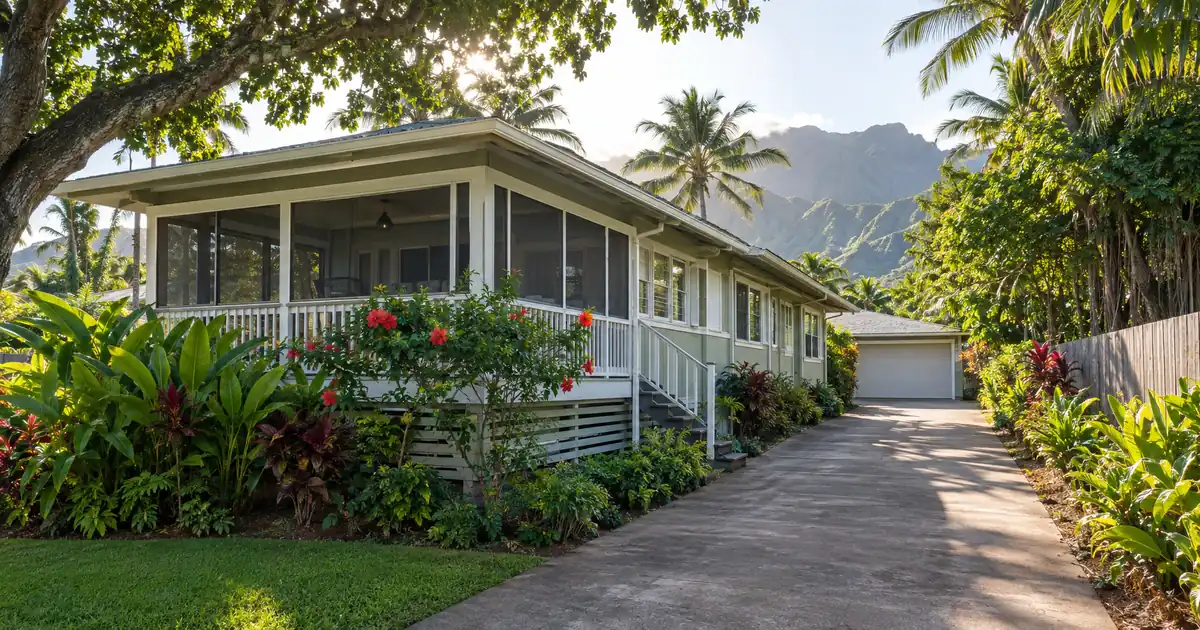
The Quick Read: A mainland investor can finance a Kauai rental on a DSCR loan, which qualifies primarily on property-level rental income covering the payment, subject to lender guidelines. On Kauai, the parcel’s legal rental status comes before the ratio. The county decides whether short-term income can count, and the lender decides whether the file clears the numbers.
- Check the parcel’s short-term rental status with the county before you make an offer.
- Treat long-term rent as the safe base case. Count short-term income only when the use is legal.
- On most files, purchases land at 75%–80% LTV on an investment property, with credit around 660 or better.
- Condo dues, insurance and ground rent (if leasehold) all sit inside the payment the rent must cover.
- Clearing 1.00 on coverage is not the same as positive cash flow.
What Is a DSCR Loan, and Does It Suit a Mainland Buyer?
It suits you well. A DSCR loan, short for debt service coverage ratio, compares the property’s rent to its monthly housing payment. Your W-2s and tax returns are not the center of the file. That helps when you live in another state and your income is complicated.
DSCR Calculator
Run the numbers in your market
Rate source: Freddie Mac 30-yr average via FRED® — Federal Reserve Bank of St. Louis · effective Oct 29, 2026
Prefilled with starting assumptions — enter your own rent or nightly figures, taxes, insurance, and HOA for a more accurate picture.
Program parameters update from Lendmire’s centralized guideline source. Taxes and insurance are editable estimates.
As of Oct 29, 2026 · General Freddie Mac market benchmark, not a Lendmire loan offer. Rent, nightly rate, occupancy, taxes, and insurance are editable estimates. Short-term rental figures are estimates only and vary significantly by season, property type, management approach, and local short-term-rental rules — confirm local regulations before relying on them. Qualifying income for short-term rentals varies by program — some use appraisal market rent, others use documented STR history or projections — and is confirmed in underwriting. Not a Loan Estimate, approval, or commitment to lend. Program availability and eligibility are subject to lender guidelines, credit approval, property review, and underwriting.
DSCR loans are designed for non-owner-occupied investment properties. Because they are business-purpose investor loans, they are reviewed differently from a standard owner-occupied mortgage.
The lender still reviews you. Credit score, reserves and the property itself all matter. Across our wholesale network, a 620 score exists as a floor in parts of the network. Most programs want around 660, and 700 or better unlocks the strongest leverage tiers. For the full mechanics, see the complete DSCR loans guide.
Distance is not the obstacle. Property type, tenure and rental legality are. Many investors buy outside their home state, and Lendmire’s piece How to Buy Rentals in Three Markets as an Out-of-State DSCR Investor covers that side of the process.
How Does Underwriting Treat a Kauai Deal, Step by Step?
Underwriting runs in a fixed order: property, income, payment, then you. On Kauai, the first step carries more weight than on the mainland. Here is the sequence.
1. Pin down the property type. Single-family, condo, small multifamily and townhome are the usual candidates. Manufactured homes, log homes and barndominiums are not offered in the network’s DSCR programs.
2. Confirm the tenure. Fee simple means you own the land. Leasehold means you rent the land. Some lenders decline leasehold. Others review it with conditions.
3. Choose the income basis. Long-term rent comes from a lease or the appraiser’s market rent schedule. Short-term rent comes from booking history or a projection, if the lender accepts one.
4. Build the full payment. Principal, interest, taxes, insurance and HOA dues make up PITIA, the payment the rent must cover. Flood insurance and ground rent join the stack where they apply.
5. Order the appraisal and rent analysis. The appraiser values the home and supports the rent figure.
6. Review the borrower. Credit, reserves and ownership entity come next. LLC purchases are possible, subject to program terms.
7. Close. Then the property starts earning.
Reserves vary by lender, leverage, loan size and transaction type. About 6 months of PITIA is common. Loans above $1,500,000 typically step up to about 9 months. Standard programs run up to $3,000,000.
Can You Count Short-Term Rental Income on Kauai?
Only where the use is legal for that specific parcel. Short-term rental rules can vary by city, county, HOA, and property type, so investors should confirm local rules before relying on projected rental income. On Kauai, that check is not optional.
The County of Kauai Planning Department says that outside the Visitor Destination Area, transient vacation rentals are generally not permitted and cannot be applied for. Homes with a grandfathered nonconforming certificate are the exception. Inside the visitor area, the county does not apply that same restriction.
So the town name tells you little. Poipu, Princeville and Kapaa are names buyers hear often, but status is parcel by parcel. A listing that says “vacation rental” proves nothing. Ask the county, and ask the seller for the certificate file.
| Factor | Long-term rental | Short-term rental |
|---|---|---|
| Income proof | Lease or market rent schedule | Booking history or projection |
| Legal check | Lease of 180 days or more | Parcel status and certificate |
| Leverage on a purchase | 75%–80% LTV typical | Up to 75% LTV |
| Credit | About 660 typical | 640+ expected |
| Fallback | Not applicable | Underwrite as long-term |
For short-term files, expect about 12 months of hosting history to matter, and a 1.00 coverage floor on purchases. Whether a brand-new purchase can lean on a projection depends on the lender. Ask before you write the offer.
Where Does the General Rule Break?
Several Kauai situations break the clean DSCR picture. Know them before you fall for a listing.
No certificate, outside the visitor area. You cannot count short-term income. Model the home as a long-term rental. If the numbers only work on nightly rates, walk away.
Inside the visitor area, but the building bans rentals. Zoning may allow the use while the condo declaration blocks it. Read the HOA documents first. Zoning does not override them.
Leasehold land. Hawaii has many leasehold properties. A Hawaii brokerage explainer notes that when a lease expires, the landowner can set the price of the fee on a take-it-or-leave-it basis. Ground rent resets raise your payment and lower your ratio. Some lenders in the network decline leasehold. Others look at remaining lease term and conditions.
Condotels and hotel-condo projects. These often count as non-warrantable condos. That narrows the lender list and can tighten leverage.
Buying a grandfathered home. The county’s FAQ says the seller should hand you the original determination file, the latest renewal application and the renewal letter. Make that delivery a condition of your contract.
Coverage below 1.00. Here is the split. A 1.00 floor is where many select programs start. A separate select-lender path takes coverage below 1.00, with leverage and terms adjusted. Do not assume you can use it. Price it as the exception.
What Do the Numbers Look Like in Practice?
Run a modeled example with ratios, not dollars. These are assumptions, not market data.
Say a Kauai condo rents long-term at coverage of about 1.15x on its full payment. That looks fine. Now suppose the association raises dues. Dues are part of PITIA, so the ratio drops to roughly 0.98x. The same rent now misses the common floor. Rent did not change. The denominator did.
Now picture a short-term home in a legal parcel, where a lender haircuts gross bookings before computing coverage. The headline coverage can look strong, yet the owner still pays cleaning, management, utilities and transient accommodations tax. Hawaii’s Department of Taxation has announced an increase in the transient accommodations tax. Counties can add surcharges, and general excise tax sits on top. None of that enters the DSCR formula, but all of it hits your margin. Tax treatment can depend on how the funds are used and how the property is held; investors should keep clear records and speak with a qualified tax professional before relying on any deduction.
Two lessons follow. First, clearing 1.00 is not positive cash flow. Repairs, vacancy, management, utilities and capex sit outside the calculation. Second, stronger ratios open better pricing and leverage, so a thin pass is a weaker file.
Why Is Insurance a Kauai-Specific Problem?
Because wind and hurricane coverage can cost real money and may not come standard. ValuePenguin’s Hawaii homeowners insurance guide says policies often won’t cover hurricane-force wind damage unless a special endorsement is added. Hurricane deductibles are often a percentage of insured value rather than a flat amount. That affects your reserves, not the ratio.
Coastal and flood-zone parcels add more. A higher insurance line lowers coverage. Get a real quote before you make an offer, not after the appraisal.
DSCR vs. conventional financing
There are two common ways to finance an investment property, and they qualify you differently — here’s how investors weigh them.
Why investors choose it
- Qualifies on the property’s rental income — no personal tax returns, W-2s, or pay stubs needed to document income.
- No personal debt-to-income ceiling to clear, so existing mortgages and obligations don’t cap your borrowing the same way.
- Can be closed in an LLC, keeping the property inside a business entity.
- Built for scaling — not held to the limit on number of financed properties that conventional financing applies.
- Underwriting centers on the deal: generally qualifies when the rent covers the payment, a 1.00x coverage ratio being a common baseline (confirmed in underwriting).
- Designed specifically for investment property, including long-term and, where the program allows, short-term rentals.
Where it’s strong
- Often the lowest ongoing financing cost for a buyer who fully qualifies on personal income — a fit for a first property or a cost-first purchase.
Trade-offs for investors
- Requires full personal income documentation and must fit within a debt-to-income limit — salary, existing debts, and other mortgages all count.
- Typically held in your personal name rather than a business entity.
- Caps how many financed properties you can carry, which can become a ceiling as a portfolio grows.
- Evaluates you as a borrower as much as the property, which usually means more paperwork.
How investors usually choose: a first or single property often optimizes for the lowest financing cost; portfolio builders often optimize for leverage, vesting in an LLC, and scaling past conventional caps. The right answer depends on your goals, the property, and current guidelines — both paths run through select lenders in Lendmire’s wholesale network, with eligibility and terms confirmed in underwriting.
What Loan Terms Should You Expect?
Purchases most often land at 75%–80% LTV on an investment property, meaning 20%–25% down. A few select high-leverage programs reach 85% LTV on a purchase with about a 700+ score. A bigger down payment lowers the payment and can lift the ratio. It never erases credit floors, reserve rules or property eligibility. The strongest files clear both tests: enough equity and enough rental coverage.
On structure, the 30-year fixed is the spine. Select lenders in the network also offer 40-year terms and interest-only periods, and ARMs exist for investors who want them. Above $2,500,000, the network generally holds to 30-year fixed.
If you later pull equity from a Kauai rental, a cash-out refinance tops out around 75% LTV on standard rentals and 70% on short-term-rental collateral. About 6 months of seasoning is the common expectation. Every file is underwritten individually, and programs change. Leverage, reserves, and pricing vary by lender and program; the final terms follow the full file review.
What Should You Check Before You Offer?
Work this list from the mainland before you go under contract.
- Confirm the parcel’s rental status with the county, not the listing.
- If grandfathered, make the certificate file a contract condition.
- Read the condo declaration and budget for rental limits and dues.
- Confirm fee simple or leasehold, and get the lease terms if leasehold.
- Get a hazard and hurricane insurance quote on the actual address.
- Ask whether the project is a condotel or hotel-condo.
- Line up a local property manager and include the fee in your own math.
- Decide your entity early, and ask whether program terms allow it.
What If the Coverage Is Too Low?
You have options, and they are about the same on any island. Put more down. Pick a property with lower dues. Underwrite on long-term rent instead of a projection. Or ask about a select-lender path that accepts coverage below 1.00 with leverage and terms adjusted.
One more note on distance. A seller’s pro forma that counts rentals the permit does not allow is a red flag. Ignore it and run your own numbers.
Key Terms Defined
DSCR: the property’s rent divided by its monthly housing payment.
PITIA: principal, interest, taxes, insurance and HOA dues, the payment the rent has to cover.
LTV: loan-to-value, the loan amount as a share of the property’s value.
VDA: the Visitor Destination Area, the county-designated zone where short-term rentals can be allowed.
TVR-NCU: a transient vacation rental with a Nonconforming Use Certificate, meaning a grandfathered short-term rental.
Leasehold: you own the building but rent the land. Fee simple means you own both.
Non-warrantable condo: a condo project that falls outside normal lender project rules, often a hotel-condo.
Frequently Asked Questions
Do I need a Hawaii bank account or local income to qualify?
No. A DSCR loan looks at the property’s rent, plus your credit and reserves. It does not require local income. Your reserves are reviewed as documented assets, subject to lender guidelines.
Will HARPTA withholding affect my loan?
Not directly. HARPTA is a Hawaii withholding that applies to a nonresident seller’s proceeds. It is not a tax on your financing. Ask escrow how it will be handled, and see Hawaii’s Department of Taxation guidance for details.
Can I buy in an LLC?
Often yes, subject to program terms. Raise it early, because entity documents, insurance and vesting all change the file.
Is long-term rent the safer way to underwrite a Kauai home?
Yes. A 12-month lease or market rent schedule needs no special permit. It gives you a ratio you can defend if short-term rules or bookings shift.
Does a stronger coverage ratio matter beyond qualifying?
Yes. Stronger ratios can open better pricing and leverage. A file that barely clears 1.00 has less room if insurance or dues rise.
Ready to Run Your Kauai Numbers?
If you are buying or refinancing a rental property and want to see how the numbers work, Lendmire can help you compare DSCR loan options based on the property income, credit profile, leverage, and investor goals. As a broker, it arranges DSCR investor loans through select lenders in its wholesale network, spanning 41 markets, including Washington, D.C. Any estimate from the site’s calculator is illustrative only, and no loan is a commitment to lend.
Kauai rewards the buyer who checks the parcel first and the pro forma second.
About Lendmire
Lendmire (NMLS# 2371349) is a mortgage brokerage focused on DSCR investor financing, helping arrange programs through wholesale and investor-lending channels in 41 markets, including Washington, D.C. DSCR loans are evaluated by the lender on property cash flow rather than personal income, subject to lender guidelines, supporting LLC closings and accommodating investors with four or more financed properties. Scotsman Guide Top Mortgage Workplace in both 2025 and 2026.
Get Started
Ready to find the right loan for you?
See your offer in seconds. No credit pull, no obligation.
Informational only. Not a Loan Estimate, approval, or commitment to lend. Program availability and eligibility are subject to lender guidelines, credit approval, property review, and underwriting.
References
1. County of Kauai Planning Department, Transient Vacation Rentals
2. Hawaii Living, leasehold property risks
3. Hawaii Department of Taxation, Announcement 2026-01
4. ValuePenguin, Hawaii homeowners insurance
This article is part of Lendmire’s DSCR loan program — full qualification details, guidelines, and scenarios live on the program page.
Related reading: DSCR Refinance vs Loan Modification for a Rental Nearing Maturity · Can You Get a DSCR Loan on a Wrightsville Beach Rental? · How to Buy a Wears Valley Cabin With a DSCR Loan
Brandon Miller
Founder & CEO, Mortgage Loan Originator, Lendmire LLC
- Mortgage Loan Originator · NMLS# 1129696 · Verify on NMLS Consumer Access
- North Carolina Real Estate Broker · License# 343312 · Verify on NCREC
- North Carolina Insurance Producer · License# 19053198 · Property, Casualty, Life, Health · Verify on NAIC SBS
- Lendmire LLC · Firm NMLS# 2371349 · Verify firm licensure
Legal disclosures. Lendmire (NMLS# 2371349) is a state-licensed mortgage brokerage that arranges financing through wholesale lender relationships. Lendmire is not a direct lender, depository institution, or registered financial advisor. The discussion above is general informational content about real estate financing — it is not financial, legal, or tax advice, and readers should consult licensed professionals for guidance on their individual circumstances. Loan inquiries are subject to lender underwriting; this article does not represent a commitment to lend. Loan terms, rates, and qualification standards vary by borrower, property, and state, and are subject to change at any time. Equal Housing Opportunity. NMLS Consumer Access: nmlsconsumeraccess.org.