
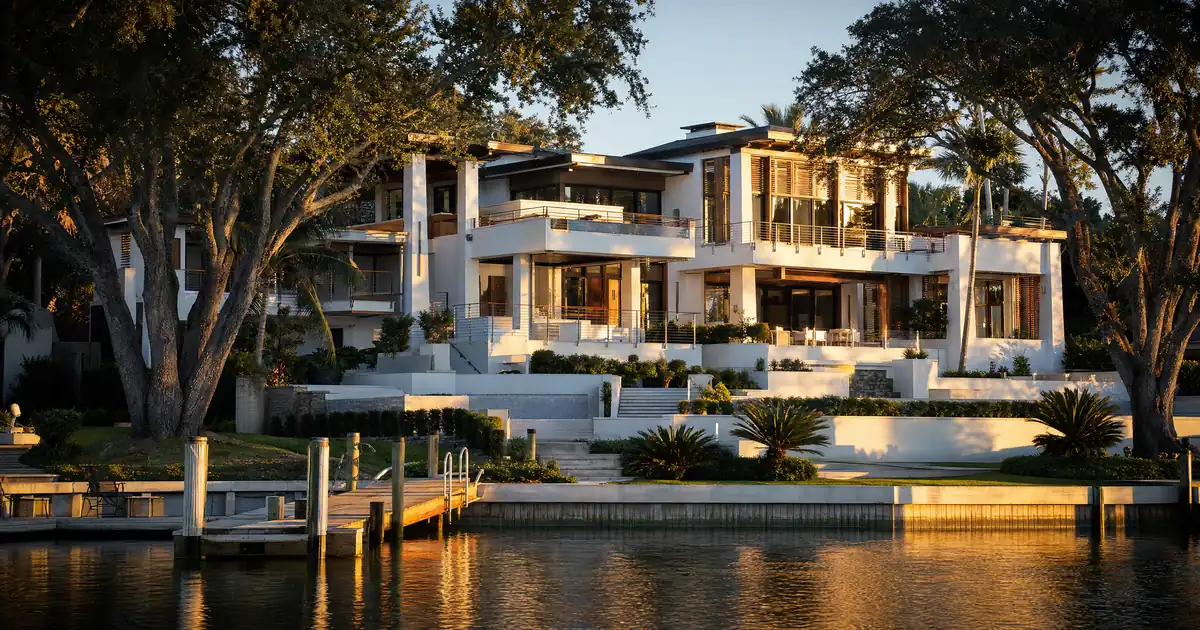
DSCR Loan For A Beachfront Rental — The Quick Read: A DSCR loan for a beachfront rental works the same way it does for any investment property — the lender drives lender review on rental income covering the payment rather than traditional personal-income documentation — but three variables move the math harder on the coast: flood insurance is mandatory in most beachfront flood zones, short-term rental income gets discounted and documented differently than a long-term lease, and condo-building insurance health can affect a unit’s financeability independent of the unit’s own rent roll. Investors who price all three before making an offer avoid the surprises that kill beachfront files late.
What Changes When the Property Sits on the Water
The DSCR formula itself doesn’t change at the beach. Rental income divided by the monthly obligation — principal, interest, taxes, insurance, and any association dues — still produces the ratio a lender reviews. What changes is what feeds that denominator, and how the numerator gets documented.
DSCR Calculator
Run the numbers in your market
Rate source: Freddie Mac 30-yr average via FRED® — Federal Reserve Bank of St. Louis · effective Sep 3, 2026
Prefilled with local estimates — enter your own rent or nightly figures, taxes, insurance, and HOA for a more accurate picture.
Program parameters update from Lendmire’s centralized guideline source. Taxes and insurance are editable estimates.
As of Sep 3, 2026 · General Freddie Mac market benchmark, not a Lendmire loan offer. Rent, nightly rate, occupancy, taxes, and insurance are editable estimates. Short-term rental figures are estimates only and vary significantly by season, property type, management approach, and local short-term-rental rules — confirm local regulations before relying on them. Qualifying income for short-term rentals varies by program — some use appraisal market rent, others use documented STR history or projections — and is confirmed in underwriting. Not a Loan Estimate, approval, or commitment to lend. Program availability and eligibility are subject to lender guidelines, credit approval, property review, and underwriting.
Three variables move harder on a beachfront file than on an inland rental:
- Insurance cost. Flood coverage, and often a separate wind/hurricane policy, sit on top of standard hazard insurance and can be the single largest swing factor in the whole ratio.
- Income-verification method. A long-term lease gets appraised the conventional-adjacent way. A short-term or vacation rental gets underwritten off booking history or a specialized rent analysis, and the two methods rarely produce the same number.
- Building-level risk. For a condo or association-governed property, the building’s master insurance policy and reserve health can matter as much as the unit’s rent.
None of these disqualify a beachfront purchase on their own. They just mean the file needs more documentation gathered up front, not discovered mid-underwriting.
Key Terms Defined
DSCR (Debt Service Coverage Ratio): the property’s monthly rental income divided by its full monthly obligation (principal, interest, taxes, insurance, association dues); 1.00 means the rent exactly covers the payment.
SFHA (Special Flood Hazard Area): the high-risk flood zone designation — any zone starting with the letter A or V — where flood insurance becomes a mandatory condition of a federally backed or federally regulated loan.
V/VE Zone: the coastal flood-zone designation reserved for areas with wave-action and storm-surge risk, distinct from inland A zones where floodwater risk exists without breaking waves.
NFIP (National Flood Insurance Program): the federal flood-insurance program with statutory coverage caps that frequently fall well below a beachfront home’s replacement value, pushing investors toward private or excess flood coverage.
Form 1007 / Form 1025: the appraisal-industry rent-schedule forms used to document market rent — Form 1007 for single-family, Form 1025 for 2-4 unit income property — adopted across the non-QM space as a shared documentation format even on loans that aren’t sold to the agencies.
Does Being in a Flood Zone Kill the Deal?
No — flood-zone location changes what has to be documented and priced, but it is not a disqualifier on its own. What it does is force the flood-insurance line item into the DSCR math before the deal can be finalized, not after.
Federal law is the governing authority here, not lender preference. Congress requires flood insurance on any federally regulated or federally backed loan secured by a building in a Special Flood Hazard Area, full stop. Beachfront parcels overwhelmingly land in the highest-risk designations. FEMA’s zone system reserves V and VE specifically for coastal land exposed to wave action and storm surge, distinct from the inland A and AE zones. Any zone beginning with A or V triggers the mandatory-purchase requirement for a federally backed mortgage.
Practically, that means the flood determination has to happen before an investor gets attached to a purchase price. Once the zone is known, a live flood-insurance quote — not a guess, not last year’s number on a comparable listing — needs to go into the PITIA side of the ratio.
The NFIP itself caps out well below what most beachfront homes are worth. Coverage tops out at $250,000 for building coverage and $100,000 for contents on a single-family home, and $500,000 building / $100,000 contents on a 5-plus unit residential building (Congressional Research Service). Multi-family beachfront buildings got a bump to that ceiling — the NFIP raised the 5-plus-unit building cap from $250,000 to $500,000 effective June 2014 under the Biggert-Waters Flood Insurance Reform Act (Cullen and Dykman LLP) — but that still frequently falls short of full replacement value on true oceanfront structures. When the cap binds, private flood or excess flood coverage becomes the practical requirement, and that premium is what actually lands in the debt-service calculation. And if a borrower doesn’t secure required coverage within the notice period after a lender identifies the SFHA exposure, the lender is required to force-place a policy — usually at a materially higher cost than a borrower-obtained policy (FludZone).
Long-Term Lease vs. Short-Term Rental: How Income Gets Verified
The income-verification method is the single biggest lever an investor controls on a beachfront file, and it depends entirely on how the property is being rented. Get the wrong method into the file and the qualifying income can come in materially lower than what the property actually earns.
| Verification Method | How It Works | Best Fit |
|---|---|---|
| Appraisal rent schedule (Form 1007/1025) | Appraiser surveys comparable monthly leases in the area | Long-term or annual-lease beachfront rentals |
| 12-month operating history | Actual documented rental income from the subject property over the trailing year | Refinance on an established short-term rental |
| Purchase-transaction STR rent analysis | Appraisal-based short-term-rent projection for a property with no owner operating history | Purchase of a vacation-rental beachfront property |
For a beachfront home rented on a standard lease, documentation looks conventional-adjacent: an appraiser pulls comparable monthly rents using Form 1007 for single-family or Form 1025 for 2-4 unit property (McKissock Learning).
For a short-term or vacation rental — which is how most true beachfront property gets used — the mechanics diverge. Standard non-QM practice takes the lower of two measurements: the trailing 12-month average of actual short-term rental income, or the comparable market rent pulled from the appraisal form (Scotsman Guide). Across the wholesale network Lendmire works with, the programs that finance beachfront short-term rentals typically apply this at 80% of gross rental income on a purchase, using the appraisal’s short-term-rent analysis, or the trailing twelve months of actual booking history on a refinance — and most of those programs want to see the investor has owned an income property in the last three years before extending that structure. It’s not a rule every lender in the market applies the same way, but it’s the shape investors should plan around.
Here’s the mistake investors make most often on this exact point: pulling a peak-season screenshot from a booking platform and assuming that’s the number the lender will use. It isn’t. Underwriters review seasonal patterns and apply vacancy discounting to raw platform revenue precisely because a beach property that earns heavily in July and August and much less in the off-season has to be evaluated on its annualized picture, not its best month.
Appraisers face a parallel restriction. Fannie Mae’s own guidance to appraisers — used across the non-QM space as shared vocabulary even on loans that aren’t agency products — explicitly warns against the naive shortcut of taking a nightly rate and multiplying it by 30 to manufacture a monthly figure. The form calls for an “Indicated Monthly Market Rent” derived from actual monthly-lease comparables, and using STR comps and multiplying them out is called out directly as the wrong approach (Fannie Mae Appraiser Update). That means a beachfront home commanding a premium nightly rate can’t lean on the appraisal alone to reflect that premium — the operating-history or STR-analysis pathway typically has to carry the file instead.
The Condo Problem: When the Building’s Balance Sheet Becomes Your Problem
A beachfront condo or co-op unit that pencils fine on its own numbers can still get flagged for reasons that have nothing to do with the unit. This is the edge case that surprises the most experienced beachfront investors, because it sits outside anything the borrower directly controls.
Coastal towers carry concentrated catastrophe exposure that shows up as per-unit loss-assessment risk. In high-value oceanfront and beachfront mid-rise buildings, per-unit exposure to a special assessment following a loss can run $50,000 to $100,000 or more (CondoSignal). That exposure exists because coastal associations increasingly carry percentage-based hurricane and windstorm deductibles instead of flat-dollar deductibles — a response to loss frequency in coastal markets — which shifts a meaningful share of catastrophe risk back onto the association and, ultimately, individual owners. A worked example from condo-insurance trade coverage shows the mechanics: on a Florida coastal tower carrying a $500,000 master hurricane deductible spread across 200 units, owners can face a real per-unit assessment for repairs the master policy doesn’t cover, on top of loss-assessment exposure tied to the deductible itself (TrueCondoCost).
This is why underwriters on a beachfront condo file look past the individual unit’s rent roll at the association’s master policy, its reserve funding, and its open special-assessment history. A well-rented unit inside a poorly reserved building is a different risk profile than the same unit inside a well-capitalized one, and lenders treat it that way.
For a condo-titled beachfront file specifically, condotel and non-warrantable condo structures also come into play — across the network Lendmire places files with, non-warrantable condo financing typically tops out around 75% LTV and a $1,500,000 loan size, and condotel purchases typically run to 75% LTV (65% on a refinance), also capped near $1,500,000 with a documented cash-in-hand requirement. These aren’t universal figures — every lender’s overlay differs — but they’re the shape an investor should expect when a beachfront purchase is condo-titled rather than a standalone single-family home.
HOA and Rental-Restriction Screening Before Making an Offer
Before an offer goes in on any beachfront condo or association-governed property, an investor should confirm the association actually permits the rental strategy the loan is being built around:
1. Pull the HOA rental rider or bylaws and confirm whether short-term rentals, minimum-stay restrictions, or owner-occupancy quotas apply.
2. Request the association’s master insurance declarations page and confirm flood and windstorm coverage limits relative to total insured value.
3. Ask for the most recent reserve study and any open or pending special-assessment notices.
4. Confirm municipal short-term-rental permission separately from HOA rules. Local rules can allow what the association forbids, or vice versa, and short-term rental rules can vary by city, county, HOA, and property type — investors should confirm local rules before relying on projected rental income.
5. Get a flood-zone determination and a live flood-insurance quote before finalizing the offer price, not after the appraisal comes back.
Skipping any one of these is the most common reason a beachfront file that looked clean at the letter-of-intent stage gets stuck in underwriting.
DSCR vs. conventional financing
Two common ways to finance an investment property in this market. They qualify you differently — here’s how investors weigh them.
Why investors choose it
- Qualifies on the property’s rental income — no personal tax returns, W-2s, or pay stubs needed to document income.
- No personal debt-to-income ceiling to clear, so existing mortgages and obligations don’t cap your borrowing the same way.
- Can be closed in an LLC, keeping the property inside a business entity.
- Built for scaling — not held to the limit on number of financed properties that conventional financing applies.
- Underwriting centers on the deal: generally qualifies when the rent covers the payment, a 1.00x coverage ratio being a common baseline (confirmed in underwriting).
- Designed specifically for investment property, including long-term and, where the program allows, short-term rentals.
Where it’s strong
- Often the lowest ongoing financing cost for a buyer who fully qualifies on personal income — a fit for a first property or a cost-first purchase.
Trade-offs for investors
- Requires full personal income documentation and must fit within a debt-to-income limit — salary, existing debts, and other mortgages all count.
- Typically held in your personal name rather than a business entity.
- Caps how many financed properties you can carry, which can become a ceiling as a portfolio grows.
- Evaluates you as a borrower as much as the property, which usually means more paperwork.
How investors usually choose: a first or single property often optimizes for the lowest financing cost; portfolio builders often optimize for leverage, vesting in an LLC, and scaling past conventional caps. The right answer depends on your goals, the property, and current guidelines — both paths run through select lenders in Lendmire’s wholesale network, with eligibility and terms confirmed in underwriting.
A Worked Example: Insurance Cost Moves the Ratio More Than Anything Else
Consider a beachfront single-family property priced at $850,000, purchased with a rental strategy already documented through 12 months of operating history at a comparable nearby property. Under the wholesale-network structure described above, that loan size sits in the $150,000-$1,000,000 tier, where purchase leverage typically runs to 80% for a borrower with a 660-plus credit profile (subject to underwriting and program eligibility).
Run the coverage two ways. With a standard flood and wind package quoted at a manageable premium, the property’s rental income comfortably clears a ratio in the 1.15-1.20x range. Swap in a private excess-flood policy priced for full V-zone exposure and the same rental income might barely clear 1.00x, or slip just under it. Nothing about the rent changed. The insurance line moved the ratio on its own.
That’s the mechanic every beachfront investor needs internalized: insurance is the least predictable input in the DSCR formula, and it’s the one variable most likely to move between the offer and the closing table if it isn’t quoted early. Broader commercial-property commentary confirms this isn’t a beachfront-specific anomaly — the insurance market overall has been softening, but coastal and catastrophe-exposed property remains a structurally harder market regardless of the general trend (Captives Insure). In Florida specifically, the statewide average homeowner premium including wind coverage was reported at $3,815, even as 21 new carriers have entered the market since 2022-2023 legislative reforms expanded placement options (Insurance Business Magazine). That figure is one state’s average, not a national one — every beachfront file needs its own live quote regardless of region.
What If the Ratio Comes in Under 1.00?
A beachfront property that doesn’t clear 1.00x on rent alone isn’t automatically unfinanceable. Some lenders in the wholesale network extend financing to investors whose ratio falls below 1.00 when other assets or compensating factors offset the shortfall — a structure that matters disproportionately at the beach, where purchase prices routinely outpace achievable rent. Across the programs Lendmire places files with, sub-1.00 coverage is a real path to loan sizes up to $2,000,000, though leverage and terms adjust downward to compensate, subject to underwriting. This is a documented lane, not an exception squeezed in as a favor — beachfront and other premium coastal markets are close to the textbook case for why the structure exists. Every figure here varies by lender and program — guidelines, property type, leverage, and credit profile all apply.
Interest-only structuring is the other lever worth knowing. Programs across the network commonly offer a 120-month interest-only period on 30- and 40-year terms, up to 75% LTV, for files clearing roughly 0.75x coverage or better, qualified on the interest-taxes-insurance-association portion of the payment rather than full principal and interest. That interest-only period can be the difference between a beachfront property clearing coverage and falling just short, particularly in the early years of a short-term rental’s operating history before it has a full trailing-twelve-month track record.
None of this replaces reserves. Standard reserve requirements across these programs run six months of the full monthly obligation held on the subject property, stepping up to twelve months for a borrower purchasing an investment property for the first time. Cash-out proceeds don’t count toward satisfying that reserve requirement on programs that use this structure. Final terms depend on lender guidelines, property type, leverage, and the borrower’s complete credit picture.
Entity Ownership and Portfolio Scaling
Vesting a beachfront rental in an LLC or corporation is common practice across DSCR financing generally, and beachfront property is no exception — subject to program eligibility and without layering multiple entities into the same file. The appeal for beachfront investors specifically is portfolio scaling: because qualification runs on the property’s income rather than the borrower’s personal debt-to-income ratio, an investor can hold a beachfront rental alongside other financed properties without each new acquisition eating into a fixed debt-to-income ceiling the way conventional financing does. Programs across the network Lendmire places files with typically support up to 20 financed properties per borrower.
DSCR loans are designed for non-owner-occupied investment properties. Because they’re business-purpose loans rather than consumer mortgages, they’re reviewed differently than a standard owner-occupied purchase — qualification runs primarily on the property’s rental income covering the payment, subject to lender guidelines, rather than traditional personal-income documentation.
For investors weighing this against a cash-out approach on an existing rental to fund the beachfront purchase, the mechanics work differently depending on timing — Lendmire’s guide on when it makes sense to refinance a rental property walks through that decision separately. And for the broader mechanics of how the ratio is built and what “good” looks like across property types generally, Lendmire’s complete DSCR loans guide covers the foundation this article builds on.
Tax treatment can depend on how loan proceeds are used and how the property is titled; investors should keep clear records and speak with a qualified tax professional before relying on any deduction.
Frequently Asked Questions
Does a beachfront property automatically need flood insurance? Not automatically, but nearly always in practice. Flood insurance becomes mandatory on a federally backed or federally regulated loan when the property sits in a Special Flood Hazard Area, and true oceanfront parcels overwhelmingly fall into the highest-risk V or VE zone designations. The determination happens through an official flood-zone lookup tied to the specific parcel, not a general assumption about the area.
Can I use my Airbnb screenshots as proof of income? Not on their own. Underwriters typically want either a full trailing twelve months of documented operating history or an appraisal-based short-term-rent analysis, applied at a discount to gross income — and the lower of that figure versus comparable market rent often governs. A single peak-season screenshot doesn’t reflect the seasonal averaging most programs require.
Will my condo’s HOA rules affect my loan even if my unit is fine? Yes, potentially. Coastal association buildings carry building-level insurance and reserve risk that sits outside any individual unit’s numbers — underwriters review the master policy, reserve funding, and open special-assessment history as part of evaluating the file, separate from the unit’s own rent roll.
What’s the largest loan size available for a beachfront short-term rental? Programs across the wholesale network Lendmire works with typically cap short-term-rental-qualified loans at $2,000,000, with income calculated on operating history or an appraisal-based STR analysis at a discount to gross rent. Larger beachfront purchases generally need to qualify on long-term-lease income or a stronger coverage ratio to reach higher loan tiers.
Does a low DSCR ratio disqualify a beachfront property? Not automatically. A handful of lenders in the network extend financing on coverage below 1.00 when compensating factors — like additional liquid assets — offset the shortfall, with reduced leverage and adjusted terms, subject to underwriting. Interest-only structuring can also help a file clear coverage that wouldn’t work on a fully amortizing payment.
If you’re evaluating a beachfront rental purchase or thinking through a refinance to pull equity for one, Lendmire can help compare DSCR loan options based on the property’s income, the credit profile involved, available leverage, and where the investor is trying to go with the portfolio. Reach Lendmire at 828-256-2183 or request a quote directly to walk through how a specific beachfront property’s numbers line up against current program guidelines.
For investors weighing a beachfront purchase against pulling equity from an existing single-family rental, Lendmire’s single-family rental home equity guide and its companion piece on short-term rental home equity strategy cover that comparison in more depth, including how a short-term rental investment property HELOC structure differs from a full DSCR refinance.
Beachfront rental math will keep coming down to the same three variables for as long as coastal insurance markets stay volatile: what the flood and wind premium actually costs this year, which income-verification method the property’s rental strategy supports, and whether the building underneath the unit is financially sound enough not to become the borrower’s problem.
About Lendmire
Lendmire (NMLS# 2371349), a non-QM mortgage broker serving investors in 40 markets including Washington, D.C., helps structure DSCR scenarios commonly evaluated around a property’s rental income rather than personal income paperwork, subject to lender guidelines. A Scotsman Guide Top Mortgage Workplace in 2025 and 2026, Lendmire places loans through wholesale investor lenders and is not a direct lender.
Lendmire’s Top Mortgage Workplace recognition is documented by Scotsman Guide 2025 Top Mortgage Workplace and Scotsman Guide 2026 Top Mortgage Workplace.
Get Started
Ready to find the right loan for you?
In about 30 seconds you can review financing options available for your home or investment property. No commitment required.
Informational only. Not a Loan Estimate, approval, or commitment to lend. Program availability and eligibility are subject to lender guidelines, credit approval, property review, and underwriting.
References
1. Congressional Research Service – NFIP Coverage Limits Brief
2. Cullen and Dykman LLP – Maximum Flood Insurance for Multi-Family Buildings
4. McKissock Learning – Form 1007 and STR Appraisals
5. Scotsman Guide – Invest in Your Future
6. Fannie Mae – Appraiser Update, June 2024
7. CondoSignal – Condo Insurance Master Policy Guide
8. TrueCondoCost – Condo Master Policy Deductible Explained
9. Captives Insure – Property Market Softens Broadly
10. Insurance Business Magazine – Citizens Cuts Policy Count
Brandon Miller
Founder & CEO, Mortgage Loan Originator, Lendmire LLC
- Mortgage Loan Originator · NMLS# 1129696 · Verify on NMLS Consumer Access
- North Carolina Real Estate Broker · License# 343312 · Verify on NCREC
- North Carolina Insurance Producer · License# 19053198 · Property, Casualty, Life, Health · Verify on NAIC SBS
- Lendmire LLC · Firm NMLS# 2371349 · Verify firm licensure
Disclosure information. Lendmire is a state-licensed mortgage brokerage under NMLS# 2371349. Lendmire is not a depository institution, direct lender, or financial advisor — all loans referenced are placed through wholesale lender partners and are subject to each lender's underwriting standards. This article is provided for general informational purposes and is not a commitment to lend, nor does it constitute financial, legal, or tax advice. Loan programs, terms, rates, and qualification standards change without notice and depend on borrower profile, property type, and the state in which the subject property is located. Equal Housing Opportunity provider. NMLS Consumer Access: nmlsconsumeraccess.org.


