
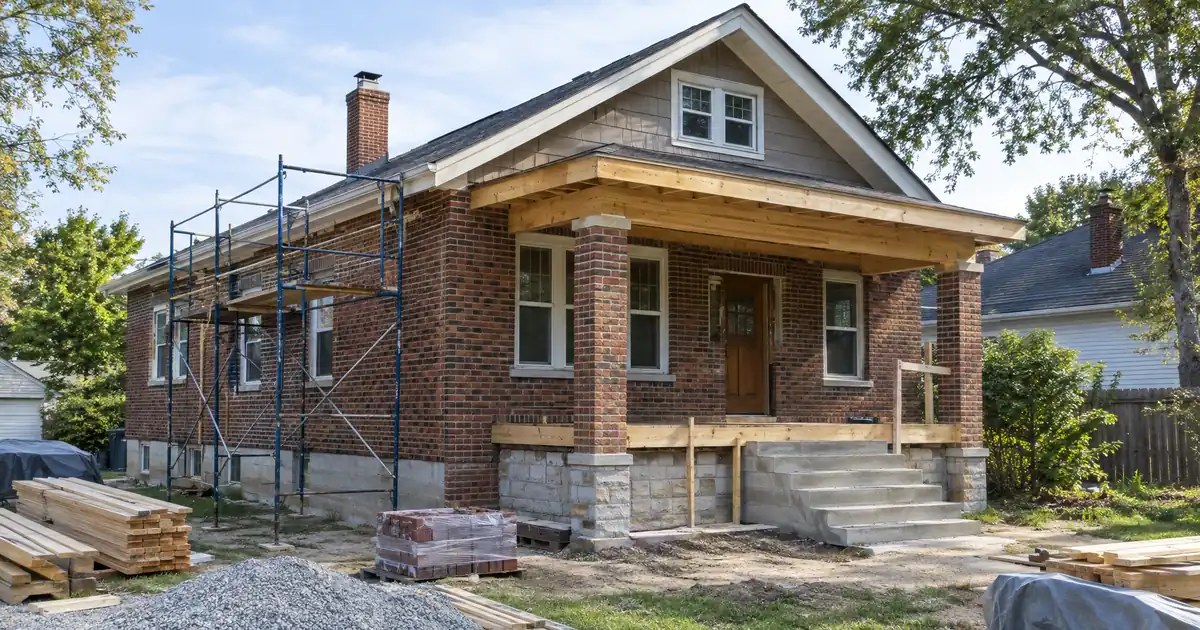
BRRRR Strategy Hard Money To DSCR Refinance With No Cash Out Of Pocket — The Quick Read: The hard-money-to-DSCR refinance is what makes BRRRR work. You buy and rehab with a short-term loan. Then you pay it off with a long-term investment loan. That loan gets reviewed on the property’s rent, not your personal income. “No cash out of pocket” is not a guaranteed feature of the strategy. It happens when the after-repair value creates enough new equity to cover both the original loan payoff and the cash you put into the deal. Get the spread wrong, or misjudge the seasoning clock, and part of your capital stays stuck in the property. The rest of this piece walks through how that math and timing play out.
Key Takeaways
- The DSCR refinance leg typically caps around 75% loan-to-value on a cash-out — not the higher ceiling that applies to a straight purchase.
- “No cash out of pocket” depends on the spread between the after-repair value and your total cost basis, not on any single lender being generous.
- Seasoning is usually the real bottleneck. Recovering your original cash back to your cost basis can happen fast. But capturing extra equity from forced appreciation usually means waiting out a lender’s seasoning window.
- Neither the hard money loan nor the DSCR refinance funds 100% of anything on its own. The zero-cash outcome comes from stacking two partial-leverage loans against a value gap.
- Coverage below 1.00 and no-ratio underwriting are both real paths through select lenders. But they come with adjusted leverage and terms, not a free pass.
Key Terms Defined
BRRRR — Buy, Rehab, Rent, Refinance, Repeat. This is a five-step cycle. You buy a distressed property, add value, rent it out, refinance to pull equity out, then use that cash for the next deal.
What this loan actually costs to carry in your market.
Hard money is sized against the project and priced by time. Enter the deal and see how much the program will lend, the cash required at closing, the carry while you hold it, and what is left at the exit.
Leverage tiers on the current program: 85% with fewer than 2, 90% with 2 or more, 93% with 5 or more completed projects — every tier capped at 75% of after-repair value. Loan amounts up to $5,000,000, larger by exception; terms of 6 to 18 months, interest-only, no prepayment penalty. The rehab portion funds in draws against completed work, not at closing.
Program parameters shown update from Lendmire’s centralized guideline source. Rate, points, and months are editable assumptions, not quoted terms.
Cost cap sets the loan · positive spread
Illustrative estimate only — not a quote, Loan Estimate, approval, or commitment to lend. Rate, points, and months are editable assumptions. Hard money is business-purpose financing for real estate investors, not a consumer mortgage. Leverage on the current program tops out at 93% of project cost for investors with a documented track record, capped at 75% of after-repair value, with rehab funding up to 100% of the documented budget released in draws; actual terms vary by lender, borrower experience, property, and exit. Lendmire is a mortgage broker, not a lender.
Hard money loan — a short-term, asset-based loan. Some call it a bridge loan or private money. It funds the purchase and rehab. Lenders price it on the deal and the plan, not the borrower’s income.
ARV (after-repair value) — what the property should appraise for once renovations are done. This is different from the as-is purchase price.
Cost basis — the total cash you put into a deal. Add up the purchase price, the rehab spend, and carrying costs during the hold.
DSCR (debt-service coverage ratio) — monthly rent divided by the monthly debt obligation. That obligation includes principal, interest, taxes, insurance, and any HOA dues. This ratio shows whether the property’s income covers its own payment.
LTV (loan-to-value) — the loan amount shown as a percentage of the property’s value or appraised value.
Seasoning — the minimum time a lender wants to pass between a prior event, usually the purchase date, and a new refinance. Wait long enough, and the lender will fund based on current value instead of cost.
Prepayment penalty — a fee charged if you pay off a loan earlier than its stated schedule. This is common on DSCR and other business-purpose loans. It’s often structured as a step-down over several years.
What “No Cash Out of Pocket” Actually Means
No single loan in the BRRRR stack funds all of a deal’s cost. Hard money leverage in Lendmire’s network commonly runs 85% to 93% of total project cost. The exact number depends on the investor’s track record. But it’s always capped at 75% of the after-repair value, no matter the tier. A straight bridge purchase without a rehab scope can reach up to 80% of purchase price. On the back end, a DSCR cash-out refinance typically tops out around 75% LTV of the appraised value. Neither number is 100%. The “zero cash left in the deal” outcome comes from the gap between those two partial-leverage loans. It doesn’t come from either loan covering everything.
That gap comes from forced appreciation. You buy below market, add value through rehab, and the appraisal comes back well above your total cost basis. When 75% of the new ARV is large enough to pay off the hard money balance and return the cash you put in, the deal nets to zero or better. When it isn’t, part of that original cash stays parked in the property until the next refinance or a sale. This is why practitioner commentary treats the BRRRR exit into a DSCR loan as one of the more reliably profitable refinances available — as long as the underlying spread is real, not just hoped for.
The Five-Step Cycle, and Where the Financing Handoff Happens
Buy
Acquisition runs on hard money. Lenders price and underwrite it on the deal itself: purchase price, planned scope of work, rehab budget, exit strategy, and your experience level. First-time investors typically qualify at the lower leverage tier. A track record of two or more completed projects opens higher leverage. Five or more projects unlocks the top tier. All of this stays inside that 75%-of-ARV ceiling.
Rehab
Rehab dollars don’t arrive as a lump sum. They release in draws as contractor work gets completed and inspected. This commonly funds up to 100% of the rehab budget itself — a separate figure from the purchase LTV. This draw structure protects the lender’s collateral position while the ARV actually gets built.
Rent
Before a DSCR lender will touch the refinance, the property generally needs to be leased, or at least showing market rent. Appraisers document that rent using Fannie Mae’s Single-Family Comparable Rent Schedule — commonly called Form 1007 — for one-unit investment properties. For 2-4 unit buildings, they use the parallel Form 1025. These forms started on the agency side. But non-agency DSCR lenders use the same documentation convention, because it’s the industry-standard way to prove rent.
Refinance
This is the handoff. The new loan gets underwritten primarily on the property’s cash flow. It qualifies primarily on property-level rental income covering the payment, subject to lender guidelines, rather than traditional personal-income documentation or W-2s. Lendmire’s DSCR cash-out refinance programs generally land near a 75% LTV ceiling on this step. Reserve expectations vary by loan size and leverage. Expect commonly around six months of PITIA. Some lenders waive this on conservative rate-term files under roughly $1.5 million. It steps up toward nine months on larger loans. For a fuller breakdown of how the ratio itself is built, Lendmire’s complete DSCR loans guide covers the calculation and rent used for lender review in more depth.
Repeat
Whatever cash comes back after paying off the hard money balance, closing costs, and any prepayment charge on the exiting loan becomes your recycled capital for the next acquisition. These are loan proceeds, not sale proceeds. That means they aren’t treated as taxable income the way a sale would be. But tax treatment can still depend on how you use the funds and how you hold the property. Keep clean records, and talk to a qualified tax professional before assuming any particular outcome.
Three Ways the Same Deal Can End: Best Case, Breakeven, Shortfall
Here’s a modeled illustration using assumed inputs, not sourced market data. Say total project cost lands at $220,000 — a $175,000 purchase plus a $45,000 rehab budget. The hard money loan funds $185,000 of that against completed work. That leaves roughly $35,000 of your own cash in the deal by the time the property is rent-ready. Assume rent comfortably clears a modeled 1.15x coverage ratio in every scenario below. Coverage isn’t what’s moving here. The appraisal is.
| Scenario | Appraised Value (ARV) | DSCR Refinance Loan (75% LTV) | Hard Money Payoff | Cash Returned | Original Cash In |
|---|---|---|---|---|---|
| Best case | $300,000 | $225,000 | $185,000 | ~$40,000 | $35,000 |
| Breakeven | $293,000 | $219,750 | $185,000 | ~$34,750 | $35,000 |
| Shortfall | $260,000 | $195,000 | $185,000 | ~$10,000 | $35,000 |
Notice how narrow the swing is. A $40,000 difference in appraised value — roughly 13% of the ARV — is the difference between pocketing extra capital and leaving $25,000 stuck in the property. That’s the entire game. The DSCR refinance loan amount moves in lockstep with the appraisal. The hard money payoff stays fixed. Closing costs on the refinance trim every one of these numbers further. So read the best-case figure above as a ceiling, not a promise.
Hard Money and DSCR Aren’t Underwritten the Same Way
It’s easy to assume the acquisition loan and the exit loan are cousins. They’re not. Lenders evaluate them on almost opposite bases.
| Feature | Hard Money | DSCR Refinance |
|---|---|---|
| Reviewed on | Deal plan, ARV, cost, experience | Property’s rent vs. the payment |
| Term structure | 6-18 months, interest-only | 30-year fixed is the spine; extended terms and interest-only periods exist through select lenders |
| Leverage basis | Loan-to-cost, capped at 75% of ARV | Loan-to-value, up to roughly 75% on a cash-out |
| Documentation | Scope of work, budget, title, reserves | Lease or market rent; minimal personal income paperwork |
| Prepayment | Typically none | Step-down prepayment schedules are common |
DSCR loans are business-purpose investor loans. That means lenders review them differently from a standard owner-occupied mortgage. The file lives or dies on the property, not the borrower’s pay stubs. That’s exactly why the refinance step can move an investor through underwriting without the DTI math that would slow down a conventional loan for the same person. This helps investors who are self-employed, who already hold several mortgages, or who show heavy depreciation on traditional personal-income documentation.
Investors comparing the two loan types side by side on an actual property can find more detail in Lendmire’s coverage of whether a hard money lender will do a cash-out refinance. It walks through why most investors ultimately move to a different lender for the permanent loan.
Seasoning: The Clock That Decides How Much Equity You Can Pull
Seasoning isn’t one fixed number. It’s a range, and it depends on how much value you’re trying to pull out relative to what you originally spent. If the refinance amount stays within the purchase price plus documented rehab cost, several lenders in the network will waive seasoning entirely. You can then recover your basis without waiting. Pull out more than that — capturing the extra equity created by forced appreciation — and a roughly six-month minimum from the original purchase date becomes the common expectation across most standard DSCR programs. Some lenders ask for three months. A few hold out for closer to twelve.
There are really two clocks running at once. One is title seasoning — how long you’ve actually owned the property. The other is a documentation clock. Has the rehab been completed and inspected? Has the rental income stabilized with a signed lease or demonstrated market rent? Both clocks need to clear before a lender will use the current appraised value instead of the original cost basis. Refinance too early, before that documentation is airtight, and the lender may fall back to the purchase price for its valuation. That leaves real, earned equity temporarily un-recoverable, even on a property that has genuinely appreciated.
For scale, consider this: agency guidelines don’t govern DSCR loans, but they illustrate the contrast. Those guidelines require an existing first mortgage to be at least twelve months old before a conventional cash-out refinance can pay it off. DSCR seasoning windows for a genuine BRRRR exit tend to run considerably shorter than that agency benchmark. This is a big part of why investors gravitate toward this refinance path in the first place. Investors weighing whether to stay in a hard money position longer, or push for an early exit, may find Lendmire’s piece on refinancing a hard money loan after a BRRRR project useful for thinking through that timing decision on a specific file.
DSCR vs. conventional financing
Two common ways to finance an investment property in this market. They qualify you differently — here’s how investors weigh them.
Why investors choose it
- Qualifies on the property’s rental income — no personal tax returns, W-2s, or pay stubs needed to document income.
- No personal debt-to-income ceiling to clear, so existing mortgages and obligations don’t cap your borrowing the same way.
- Can be closed in an LLC, keeping the property inside a business entity.
- Built for scaling — not held to the limit on number of financed properties that conventional financing applies.
- Underwriting centers on the deal: generally qualifies when the rent covers the payment, a 1.00x coverage ratio being a common baseline (confirmed in underwriting).
- Designed specifically for investment property, including long-term and, where the program allows, short-term rentals.
Where it’s strong
- Often the lowest ongoing financing cost for a buyer who fully qualifies on personal income — a fit for a first property or a cost-first purchase.
Trade-offs for investors
- Requires full personal income documentation and must fit within a debt-to-income limit — salary, existing debts, and other mortgages all count.
- Typically held in your personal name rather than a business entity.
- Caps how many financed properties you can carry, which can become a ceiling as a portfolio grows.
- Evaluates you as a borrower as much as the property, which usually means more paperwork.
How investors usually choose: a first or single property often optimizes for the lowest financing cost; portfolio builders often optimize for leverage, vesting in an LLC, and scaling past conventional caps. The right answer depends on your goals, the property, and current guidelines — both paths run through select lenders in Lendmire’s wholesale network, with eligibility and terms confirmed in underwriting.
Where the General Rule Breaks
Short-term rental collateral changes both the leverage and the paperwork. On STR properties, purchase leverage tops out around 75% LTV. Refinance leverage runs closer to 70% LTV. Cash-out sits at that same 70% ceiling for STR collateral, against the roughly 75% ceiling on standard long-term rental collateral. Expect a 640+ credit score, about twelve months of hosting history, and a 1.00x coverage floor on both the purchase and the refinance. These are separate requirements documented differently, not one blended number. Property type also changes the appraisal form. Form 1007 is scoped narrowly to monthly rent on single-family homes. It isn’t built to capture nightly rate or business-style income. So it doesn’t work for a property being operated as a short-term rental. That’s a documented limitation, and lenders lean on different income substantiation for STR files as a result, per McKissock Learning’s coverage of Form 1007’s STR limitations. Terms vary by lender guidelines, property type, leverage, credit profile, and full file review.
Coverage below 1.00 isn’t a dead end, but it isn’t free either. Select lenders in Lendmire’s network will review deals that don’t clear a full 1.00x. But leverage and terms adjust to compensate. A smaller group offers no-ratio structures with no rent-to-payment test at all. These are generally reserved for borrowers who already own a primary residence. That pathway typically isn’t available above roughly the $2,000,000-plus loan tier, where overlay-state caps and larger-file underwriting already tighten things up.
Loan size shifts the term structure. Standard DSCR loan sizes run roughly up to $3,000,000 on standard programs, with smaller balances available through select lenders. Above about $2,500,000, the network generally holds to 30-year fixed structures rather than the shorter or adjustable options available on smaller files. Four overlay states — Connecticut, Florida, Illinois, and New Jersey — generally cap purchase leverage near 75% LTV. They also cap overlay-state deal size around $2,000,000, tighter than the national norm.
Prepayment penalties can quietly erase the win. A common step-down prepayment structure on DSCR and other business-purpose loans can cost several percent of the balance in the early years. Refinancing a DSCR loan again too soon after the original BRRRR exit can end up doubling the true cost of the move. This happens when investors chase a rate change or additional cash-out without pricing in that penalty first.
Some property types just aren’t on the menu. Manufactured homes, log homes, and barndominiums aren’t offered under DSCR programs in Lendmire’s network. This holds true no matter how strong the rent-to-payment math looks on paper.
Is Your Deal a Real Zero-Cash Candidate?
Run through this before assuming a BRRRR deal will return 100% of your cash:
- Does the ARV spread clear your total cost basis by enough margin? After a modeled cushion for closing costs, does 75% of it still cover the hard money payoff and your original cash in?
- Is the rehab fully documented and inspected? Do you have a signed lease or clear market rent in place, so the DSCR lender can use current value instead of falling back to cost?
- Does your timeline fit inside the hard money loan’s term, commonly 6-18 months, with room to spare for lease-up and seasoning?
- Have you priced in the prepayment penalty on the loan you’re exiting, and the closing costs on the one you’re entering?
- Are you titling the refinance in your own name or an LLC? Either can work, but eligibility runs through lender program guidelines either way.
If you’re working through this math on an actual property, Lendmire can help you compare DSCR loan options. This is based on the property’s income, your credit profile, target leverage, and what you’re trying to accomplish with the next deal. Investors weighing a similar exit strategy in Pennsylvania markets may also want to look at Lendmire’s coverage of a Philadelphia hard money cash-out refinance on non-owner-occupied property. It shows how the same mechanics play out on a specific file type.
Frequently Asked Questions
Can I refinance a BRRRR deal that’s titled in an LLC?
Yes, this is common and generally workable. But it’s subject to lender program eligibility, not a blanket yes across every program in the network. Some lenders want to see the LLC’s formation documents and a personal guaranty. Others have additional conditions depending on the borrower’s experience and the loan size. Check this early rather than assuming it at closing.
What happens if the appraisal comes in lower than my rehab budget suggested?
The refinance loan amount shrinks with it. That’s because it’s based on roughly 75% of appraised value, not on what you spent on rehab or what you hoped the property would be worth. This is why a conservative, well-supported ARV estimate matters more before committing capital than almost any other number in the deal. A soft appraisal can turn a planned zero-cash exit into a shortfall scenario overnight.
How do you qualify for a DSCR refinance after a BRRRR project?
Qualification centers on the property’s rent covering the payment, rather than the borrower’s personal income. Lenders generally want a signed lease or documented market rent, a fully completed and inspected rehab, and reserves that vary by loan size and leverage. Expect commonly around six months of PITIA. Some lenders waive this on smaller, conservative rate-term files. It steps up on larger loans, per lender guidelines.
What are the requirements to avoid a full seasoning wait on a BRRRR refinance?
Staying within the original purchase price plus documented rehab cost is generally what allows several lenders in the network to waive seasoning entirely. Pulling equity beyond that basis, by capturing the extra value created by forced appreciation, typically triggers the standard seasoning window described earlier. That’s commonly around six months from the purchase date, though it can run shorter or longer by lender.
Does a prepayment penalty apply if I refinance the DSCR loan again soon after the BRRRR exit?
Most DSCR and other business-purpose loans carry a step-down prepayment structure in the early years. So exiting that loan again shortly after the original BRRRR refinance can carry a real cost. Price that penalty in before deciding to refinance again. It can offset much of the benefit of an early second move.
Short-term financing tends to work best when the long-term plan is decided early – see refinancing out of a hard money loan with a DSCR loan.
About Lendmire
Lendmire is a non-QM DSCR mortgage broker, not a direct lender. It works with a network of lenders across 40 markets. This helps real estate investors evaluate financing on the property’s cash flow rather than personal income documentation. Because Lendmire operates as a broker, the program availability, leverage, reserve requirements, and pricing described here vary by lender guidelines, property type, credit profile, loan size, and full underwriting review. They are not offered directly by Lendmire, and they are not guaranteed outcomes for any particular borrower or property. Lendmire NMLS# 2371349. Scotsman Guide named Lendmire a Top Mortgage Workplace in both 2025 and 2026.
This article is for general informational purposes only. It does not offer tax, legal, or financial advice. The loan programs, leverage limits, seasoning requirements, and prepayment structures referenced here illustrate common industry practice, and they are subject to change. Investors should confirm current terms with a licensed loan originator, and consult a qualified tax or legal professional, before making financing decisions.
Many investors treat hard money as the acquisition tool and plan the exit up front – see refinancing out of a hard money loan with a DSCR loan.
Get Started
Ready to find the right loan for you?
In about 30 seconds you can review financing options available for your home or investment property. No commitment required.
Informational only. Not a Loan Estimate, approval, or commitment to lend. Program availability and eligibility are subject to lender guidelines, credit approval, property review, and underwriting.
References
1. Fannie Mae’s Single-Family Comparable Rent Schedule
3. McKissock Learning’s coverage of Form 1007’s STR limitations
Brandon Miller
Founder & CEO, Mortgage Loan Originator, Lendmire LLC
- Mortgage Loan Originator · NMLS# 1129696 · Verify on NMLS Consumer Access
- North Carolina Real Estate Broker · License# 343312 · Verify on NCREC
- North Carolina Insurance Producer · License# 19053198 · Property, Casualty, Life, Health · Verify on NAIC SBS
- Lendmire LLC · Firm NMLS# 2371349 · Verify firm licensure
Important disclosures. Lendmire (NMLS# 2371349) is a licensed mortgage brokerage. Lendmire is not a direct lender, depository institution, or financial advisor. All loan inquiries are subject to lender underwriting; this article does not constitute a commitment to lend. Rates, terms, and program guidelines are subject to change without notice and vary by borrower profile, property type, and state. Information in this article is general in nature and is not financial, legal, or tax advice. Equal Housing Opportunity. NMLS Consumer Access: nmlsconsumeraccess.org.


