
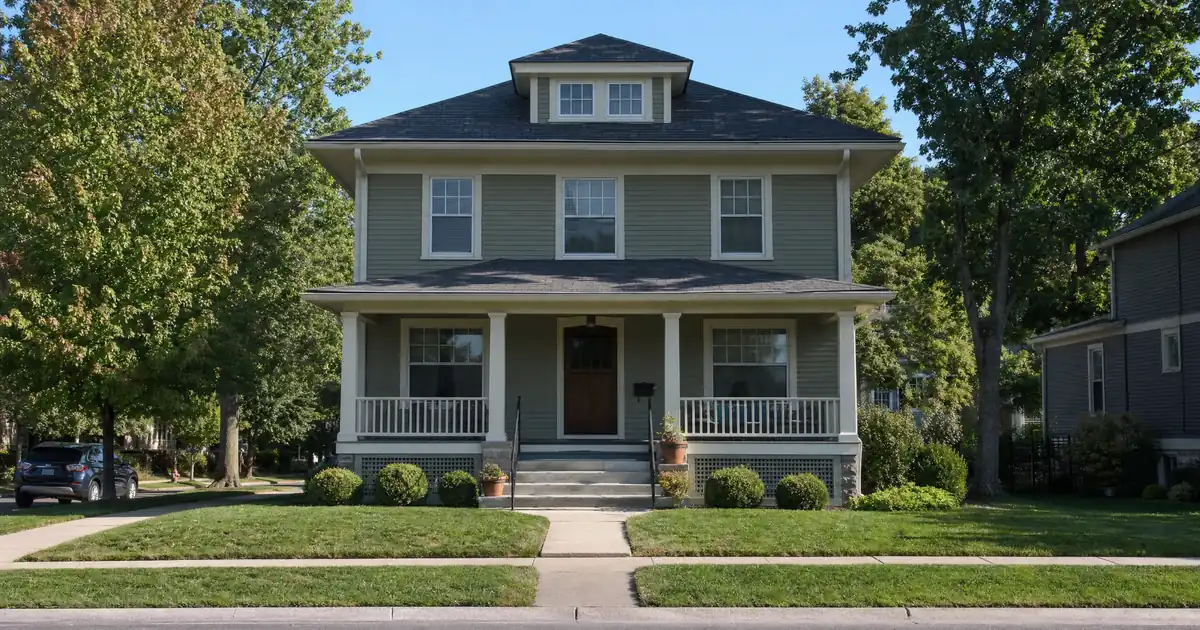
Banks that offer cash out refinance on rental properties typically follow one of two underwriting paths. Big banks and large retail lenders do offer fixed-rate cash-out refinances on rental properties. But most cap leverage lower than they would on a primary home. They also want the borrower’s traditional personal-income documentation to support the file. There’s a separate lane: DSCR (debt-service coverage ratio) financing through non-QM lenders. This lane bases lender review on the property’s rental income instead. It typically goes up to 75% loan-to-value with roughly six months of ownership seasoning. Which lane fits depends on how the borrower’s income documents look and how many financed properties they already carry.
How Rental Property Cash-Out Refinancing Actually Works
A cash-out refinance on a rental property replaces the existing loan with a new, bigger one. The lender sends the difference to the borrower in cash. The property still has to appraise for enough value. That value must support both the new loan amount and the equity the lender wants left in the deal. That’s the whole transaction in one sentence.
DSCR Cash-Out Calculator
Run the cash-out numbers in your market
Rate source: Freddie Mac 30-yr average via FRED® — Federal Reserve Bank of St. Louis · effective Jul 30, 2026
Prefilled with starting assumptions — enter your property’s value, balance, taxes, and insurance for a more accurate picture.
Program parameters update from Lendmire’s centralized guideline source. Taxes and insurance are editable estimates.
As of Jul 30, 2026 · General Freddie Mac market benchmark, not a Lendmire loan offer. Property value, balance, taxes, and insurance are editable estimates. Maximum loan-to-value varies by lender, program, property type, and seasoning. Not a Loan Estimate, approval, or commitment to lend. Program availability and eligibility are subject to lender guidelines, credit approval, property review, and underwriting.
Two paths get an investor there. The first is a conventional-style loan through a depository institution. This loan is underwritten against the borrower’s personal income, debt-to-income ratio, and credit history. It uses the same basic framework as a primary-residence refinance. But it comes with tighter leverage and reserve requirements, since the property is non-owner-occupied. The second path is a DSCR loan. This is a type of non-QM, business-purpose loan. It qualifies primarily on property-level rental income covering the payment, subject to lender guidelines. It does not rely on the borrower’s traditional personal-income documentation or W-2s.
Both paths produce a fixed-rate note. The difference is what the underwriter looks at to decide the loan is safe to make. Big banks and large retail lenders generally want to see the borrower’s full financial picture. That means pay stubs, traditional personal-income documentation, and debt-to-income math across every property owned. DSCR lenders in Lendmire’s wholesale network work differently. They run the numbers on the subject property itself. They check whether the rent, measured against the full monthly obligation, clears a workable ratio. That full monthly obligation includes principal, interest, taxes, insurance, and any HOA dues — commonly abbreviated PITIA.
Key Terms Defined
DSCR (Debt-Service Coverage Ratio): the rental income divided by the property’s full monthly payment obligation. A ratio at or above 1.00 means the rent covers the payment on paper. This is before accounting for vacancy, repairs, or management costs.
LTV (Loan-to-Value): the new loan amount expressed as a percentage of the appraised value. A lower LTV means more equity has to stay in the property after the refinance closes.
Seasoning: the length of time a borrower must have owned the property (or held the prior loan) before a cash-out refinance is eligible. This is typically measured from the closing date of the current ownership or loan.
PITIA: principal, interest, taxes, insurance, and association dues combined. This is the figure lenders compare against rent to calculate DSCR.
Do Big Banks Actually Offer This on Rental Properties?
Yes — most large retail lenders and depository institutions will do a fixed-rate cash-out refinance on a non-owner-occupied rental. But they underwrite it more conservatively than a primary-home refinance. And they lean heavily on the borrower’s personal income file. This makes this lane strongest for W-2 or self-employed borrowers. It works best for those with clean traditional personal-income documentation and only a handful of financed properties.
The mechanics on the bank side generally follow the agency-style playbook, even when the loan isn’t sold to an agency. Fannie Mae’s Selling Guide requires at least one borrower to have been on title for six months before the disbursement date on a standard cash-out refinance. Per commentary from industry counsel, a 2023 rule change added another requirement. The mortgage being paid off must be at least 12 months old, measured note-date to note-date (Black, Mann & Graham). Investors on forums like BiggerPockets noticed that change right away. It stretched the wait on a common BRRRR-style refinance from six months to a full year.
That seasoning shift is a big reason why non-QM cash-out volume has grown the way it has. Say a borrower’s income documents don’t cleanly support the rental add-backs. Or say the borrower already carries several financed properties. In both cases, the bank lane gets harder before it gets easier. DTI math compounds across every mortgaged property, not just the one being refinanced.
What DSCR Lenders Look At Instead
DSCR lenders skip the personal income file and underwrite the property instead. Across the wholesale network Lendmire places files through, cash-out refinances on rental property typically cap around 75% loan-to-value. Lenders typically expect roughly six months of ownership seasoning before a cash-out request goes to underwriting. Coverage of 1.00 — where rent equals the full monthly obligation — is where select programs start. It’s a floor on specific programs, not a universal minimum. Stronger ratios generally open better leverage and pricing tiers.
Credit requirements vary across the network. Some programs have a 620 floor. Most want something closer to 660. A credit profile at 700 or above tends to unlock the strongest leverage available. Reserve requirements move around too. They commonly land near six months of PITIA. Loans above roughly $1,500,000 often step up to about nine months. Some conservative rate-and-term files at modest leverage can see reserves waived entirely. None of these are fixed rules. They shift by lender, loan size, and transaction type. That’s exactly why working with a broker who sees multiple programs matters more on a cash-out file than on a purchase.
One distinction worth sitting with: DSCR loans are business-purpose loans made to LLCs or to individuals for non-owner-occupied property. This puts them outside Regulation Z’s ordinary consumer-mortgage disclosure framework. They’re generally exempt from TRID’s Loan Estimate and Closing Disclosure timing rules that apply to owner-occupied refinances. That’s a structural fact about how the loan is classified. It is not a shortcut in underwriting rigor.
Fixed-Rate vs. Other Structures on These Loans
Key takeaways:
- The dominant structure across DSCR/non-QM cash-out lending is a 30-year fully amortizing fixed-rate note.
- Extended 40-year terms and interest-only periods are available through select lenders in the network for investors who want a different payment shape.
- Adjustable-rate structures (5/6, 7/6, 10/6 ARMs) exist for borrowers who want them, though they trade payment certainty for potential rate movement.
- On a standard 30-year fixed DSCR loan, the loan term and amortization period are identical; that stops being true the moment a 40-year term or interest-only period enters the picture.
- Fixed-rate DSCR cash-out loans commonly carry a step-down prepayment penalty (such as 5-4-3-2-1, shrinking each year the loan is held) — a structure conventional consumer mortgages generally can’t use past a shorter cap under Dodd-Frank protections, precisely because DSCR loans sit outside that framework as business-purpose credit.
For a rental held long-term, a fixed rate removes payment-shock risk entirely. The monthly obligation doesn’t move, no matter where the broader financing environment goes. The tradeoff for that certainty is usually the prepayment structure. An investor planning to sell or refinance again within a few years should ask specifically about the penalty schedule before locking into a fixed note. Selling into a step-down period can eat into proceeds.
| Structure | Term & Amortization | Payment Behavior | Best Fit |
|---|---|---|---|
| 30-year fixed | Identical | Never changes | Long-term buy-and-hold |
| 40-year fixed (select lenders) | Extended amortization | Lower payment, slower equity build | Cash-flow-first investors |
| Interest-only period (select lenders) | Term exceeds IO period | Lowest payment during IO window | Short hold or rehab-to-sell plan |
| ARM (5/6, 7/6, 10/6) | Fixed initial period, then adjusts | Can rise or fall after initial period | Investors expecting to refinance or sell before adjustment |
How Value and Rent Get Established
An appraiser sets market value through comparable sales. That figure becomes the denominator for the LTV calculation. Rent gets documented separately, and the paperwork differs by property type. For a one-unit rental, Fannie Mae’s own guidance calls for a Single-Family Comparable Rent Schedule (Form 1007). Two-to-four-unit properties use the Small Residential Income Property Appraisal Report (Form 1025). These agency-designed forms have become the industry-standard template even on non-agency DSCR files. They give underwriters a consistent way to verify a rent figure against comparable rentals, rather than taking a lease or a landlord’s estimate at face value.
It’s worth being clear about who decides what, though. The appraiser only estimates the rent. The lender makes the final call on how that rent gets used in the DSCR calculation. A rent estimate that looks generous on the 1007 doesn’t automatically become the number underwriting relies on.
Short-term rentals break this model. Appraisal-industry guidance is explicit that the 1007 form wasn’t built for nightly-rate properties. Appraisers shouldn’t take a nightly rate, multiply it by 30, and call that monthly rent. That approach ignores vacancy, business expenses, and the personal-property component that comes with furnished short-term units (Marketwise Valuation). Cash-out refinances on short-term rentals in Lendmire’s network typically route through a separate underwriting track. This track generally caps around 70% LTV, with a credit profile around 640 or better, roughly 12 months of documented hosting history, and coverage still expected to clear 1.00.
Where the Standard Rule Breaks: Edge Cases
Not every file follows the six-month seasoning clock. Delayed financing applies when an investor paid cash for the property outright. No waiting period is required in this case. But the new loan is capped at the lower of appraised value or the borrower’s documented purchase cost. So an investor hoping for a refinance based on current market value the day the six-month mark hits often finds the exception waives time, not value.
Inherited or legally awarded property — through inheritance or a divorce settlement, for example — generally sees the ownership-seasoning clock waived. This applies both on the agency side and across most non-QM programs, since the borrower didn’t choose the timing of acquisition.
Occupancy and unit count matter for the business-purpose classification. A non-owner-occupied rental is automatically treated as business-purpose credit. No test is required for this. But where the borrower plans to occupy part of the property, a more granular test applies. Regulation Z’s commentary ties this test to unit count and a 14-day occupancy threshold (Hunton Andrews Kurth). That’s a compliance classification question more than a lending-guideline question. It rarely changes the practical DSCR math. It mostly determines which disclosure framework the loan falls under.
Refinances document rental income differently than purchases. A purchase file can often lean on Form 1007 alone, or pair it with a lease. A refinance typically wants more support, such as existing lease agreements or traditional personal-income documentation. An appraisal or rent schedule dated 12 months or more before the transaction generally can’t be relied on for qualifying purposes.
Ineligible property types stay ineligible regardless of leverage or credit. Manufactured homes — single- or double-wide — along with log homes and barndominiums fall outside DSCR programs in Lendmire’s network. That’s a property-eligibility rule, not a “harder to finance” situation. These structures simply aren’t offered on this program type.
Here’s a pattern worth mentioning: files on properties with heavy renovation or non-standard construction backgrounds often come in with a certain look. The rent estimate looks strong relative to the prior loan balance but weak relative to the new, larger loan amount after cash-out. The lesson isn’t to avoid cash-out on those properties. It’s to run the DSCR math against the proposed new loan amount, not the old one, before assuming the numbers work.
What the Decision Actually Looks Like for an Investor
Picture an investor holding a rental purchased with cash eighteen months ago. That investor is now sitting on meaningful equity after local appreciation. Two lanes are open. A big bank might offer a fixed-rate cash-out refinance, but the file will lean on that investor’s traditional personal-income documentation. It will also lean on existing DTI across any other mortgaged properties, and typically a lower LTV ceiling than a primary-home refinance would carry. Say that investor is self-employed, holds the property in an LLC, or already carries several financed rentals. In any of these cases, the DTI math compounds fast. The bank lane can get tight before the equity conversation even starts.
The DSCR lane sidesteps that. The file gets built around one question: does the rent — verified through a lease, appraisal rent schedule, or comparable rent data — cover the new loan’s monthly obligation at the requested LTV? A property with rent comfortably clearing its full monthly payment supports a cleaner cash-out request. A property where rent barely covers the payment leans into tighter leverage or a stronger credit tier to compensate. Neither structure is automatically “better.” The right one is whichever documentation lane the borrower’s file actually supports, and how many mortgaged properties they’re already carrying elsewhere.
One nuance worth stating plainly: DSCR only measures rent against PITIA. Clearing a 1.00 ratio isn’t the same as positive cash flow. Vacancy, repairs, management fees, utilities, and capital expenses all sit outside that calculation. A property that clears 1.05 on paper can still run tight or negative once those real-world costs get factored in. So investors should run their own operating budget alongside the DSCR number, not instead of it.
Lendmire’s complete DSCR loans guide walks through qualification mechanics in more depth. Investors weighing whether to pull equity out versus sell the asset outright may find it useful to compare that decision against tax consequences. Lendmire’s guide to selling a rental property versus doing a cash-out refinance covers that comparison, along with the tax implications of a cash-out refinance on a rental property. Investors specifically looking to avoid a personal-income-heavy underwriting process may also want to review Lendmire’s guide to cash-out refinancing a rental property without showing income.
Tax treatment on cash-out proceeds can depend on how the funds are used and how the property is held. Investors should keep clear records and speak with a qualified tax professional before relying on any deduction.
The Bigger Picture: Why This Lane Has Grown
Non-QM lending has moved from a niche product to a mainstream financing channel. Separately, S&P Global has projected that non-QM loans will make up nearly 30% of non-agency mortgage-backed securities.
That growth tracks a real shift in who’s buying housing. Scotsman Guide reporting notes first-time homebuyers claimed just 1 in every 5 home sales. More than 85% of home investors own fewer than five properties. This points to a distributed, small-scale investor base, not institutional buyers dominating the space. The same reporting flags a risk worth tracking: serious delinquencies (90+ days past due) in the non-QM space have climbed noticeably since mid-2022. This trend ties to vintage sensitivity in loans originated during that period. It’s a reminder that rate certainty on a DSCR loan doesn’t eliminate underwriting discipline on the front end. Reserves and coverage still matter.
Frequently Asked Questions
Do big banks require personal income documentation for a rental property cash-out refinance?
Yes, on most conventional-style bank refinances. Big banks and large retail lenders generally underwrite against the borrower’s traditional personal-income documentation, pay stubs, and debt-to-income ratio across every mortgaged property they own. This is different from a DSCR loan, where qualification runs primarily on the property’s own rental income.
How much equity does an investor need to leave in the property for a cash-out refinance?
Cash-out refinances on rental property typically cap around 75% loan-to-value across most DSCR programs. That means at least 25% equity generally has to remain after the new loan closes. Exact leverage depends on the borrower’s credit profile, the property’s DSCR, and the specific program guidelines.
Can an investor do a cash-out refinance on a rental bought with cash a few months ago?
Possibly, through a delayed-financing structure that waives the standard seasoning period for all-cash purchasers. The tradeoff is that the new loan amount is generally capped at the lower of the appraised value or the documented purchase price, not full current market value. So the exception waives time, not the value ceiling.
Does a short-term rental qualify differently for a cash-out refinance than a long-term rental?
Yes. Short-term rentals typically route through a separate underwriting track. This track generally caps around 70% loan-to-value on a cash-out refinance, with a stronger credit profile expected (often 640 or above) and roughly 12 months of documented hosting history. Standard rent-schedule appraisal forms weren’t built to estimate nightly-rate income.
What property types are not eligible for a DSCR cash-out refinance?
Manufactured homes (single- and double-wide), log homes, and barndominiums fall outside DSCR programs in Lendmire’s wholesale network. These aren’t simply harder to finance — they’re not offered on this program type, regardless of the equity or credit profile involved.
For how equity extraction works on an investment property, see cash-out refinance on an investment property.
About Lendmire
Lendmire is a mortgage broker, not a bank or direct lender. It arranges DSCR investor financing through select lenders in its wholesale network across 41 markets, including Washington, D.C. (NMLS# 2371349). Loan approval is never guaranteed, and nothing here is a commitment to lend. Every scenario described here is general information, not financial, legal, or tax advice. Actual terms remain subject to lender approval and borrower, property, and program guidelines. Investors weighing a fixed-rate cash-out refinance on a rental can reach Lendmire at 828-256-2183. They can also request a pricing quote to compare how leverage, coverage, and credit profile shape the options available on a specific property. Scotsman Guide named Lendmire a Top Mortgage Workplace in both 2025 and 2026.
Get Started
Ready to find the right loan for you?
In about 30 seconds you can review financing options available for your investment property. No commitment required.
Informational only. Not a Loan Estimate, approval, or commitment to lend. Program availability and eligibility are subject to lender guidelines, credit approval, property review, and underwriting.
References
1. Fannie Mae Selling Guide — Cash-Out Refinance Transactions
2. Black, Mann & Graham — Fannie Mae 12-Month Seasoning Requirement
3. Fannie Mae Selling Guide — Rental Income
4. Marketwise Valuation — Short-Term Rentals and Form 1007
5. Compliance Alliance — Regulation Z and Investment Properties
6. Hunton Andrews Kurth — Business Purpose Regulatory Implications
8. Scotsman Guide — Investors Anchor Housing Market as Non-QM Loans Surge
This article is part of Lendmire’s investment property cash-out refinance program — full qualification details, guidelines, and scenarios live on the program page.
Related reading: Banks That Will Refinance Investment Properties · Do Big Banks Offer DSCR Loans? Why These Live in the Non-QM · Which Lenders Offer Equity Loans On Rental Property?
Brandon Miller
Founder & CEO, Mortgage Loan Originator, Lendmire LLC
- Mortgage Loan Originator · NMLS# 1129696 · Verify on NMLS Consumer Access
- North Carolina Real Estate Broker · License# 343312 · Verify on NCREC
- North Carolina Insurance Producer · License# 19053198 · Property, Casualty, Life, Health · Verify on NAIC SBS
- Lendmire LLC · Firm NMLS# 2371349 · Verify firm licensure
Legal disclosures. Lendmire (NMLS# 2371349) is a state-licensed mortgage brokerage that arranges financing through wholesale lender relationships. Lendmire is not a direct lender, depository institution, or registered financial advisor. The discussion above is general informational content about real estate financing — it is not financial, legal, or tax advice, and readers should consult licensed professionals for guidance on their individual circumstances. Loan inquiries are subject to lender underwriting; this article does not represent a commitment to lend. Loan terms, rates, and qualification standards vary by borrower, property, and state, and are subject to change at any time. Equal Housing Opportunity. NMLS Consumer Access: nmlsconsumeraccess.org.