
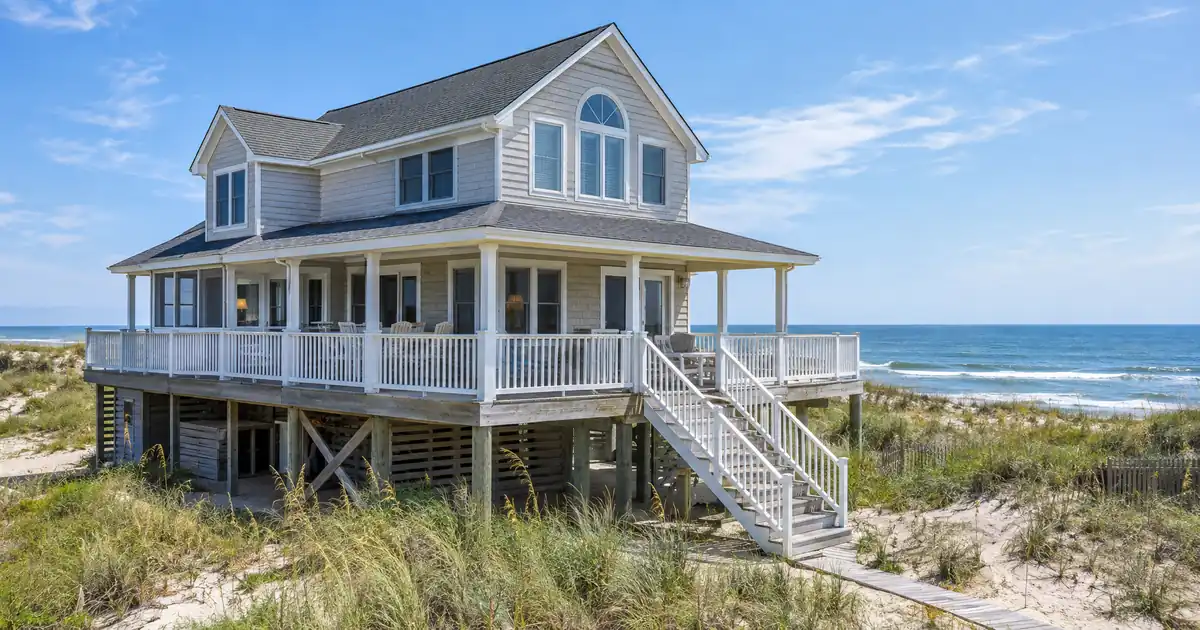
The Quick Read: A beach house you plan to rent out qualifies for financing the same way any other investment property does — on the rent, not your paycheck. The catch is that beach houses come with three complications most rentals don’t: seasonal income swings, mandatory flood insurance in flood-mapped zones, and a personal-use question that can change how the loan gets classified. This guide walks through how underwriting actually treats a coastal rental, where the standard rule breaks down, and what the financing options look like once you get past the beach-town marketing pages.
Key Takeaways
- Beach rentals typically qualify on a DSCR loan, which compares the property’s rent to its full monthly obligation rather than your personal income.
- Purchase leverage on most programs runs 75%-80% loan-to-value, with select high-leverage programs reaching 85% for borrowers with strong credit.
- Seasonal income gets averaged across the full year, not judged on peak-summer numbers alone.
- Flood insurance is a separate underwriting requirement from the mortgage itself, and it can move the debt-coverage math even when rent hasn’t changed.
- Short-term rental beach houses, condotels, and personal-use properties each carry their own wrinkles worth understanding before you make an offer.
Key Terms Defined
DSCR (debt-service coverage ratio) compares a property’s monthly rent to its full monthly housing obligation. A ratio of 1.00 means rent exactly covers that obligation; higher numbers mean more cushion.
DSCR Calculator
Run the numbers in your market
Rate source: Freddie Mac 30-yr average via FRED® — Federal Reserve Bank of St. Louis · effective Aug 20, 2026
Prefilled with starting assumptions — enter your own rent or nightly figures, taxes, insurance, and HOA for a more accurate picture.
Program parameters update from Lendmire’s centralized guideline source. Taxes and insurance are editable estimates.
As of Aug 20, 2026 · General Freddie Mac market benchmark, not a Lendmire loan offer. Rent, nightly rate, occupancy, taxes, and insurance are editable estimates. Short-term rental figures are estimates only and vary significantly by season, property type, management approach, and local short-term-rental rules — confirm local regulations before relying on them. Qualifying income for short-term rentals varies by program — some use appraisal market rent, others use documented STR history or projections — and is confirmed in underwriting. Not a Loan Estimate, approval, or commitment to lend. Program availability and eligibility are subject to lender guidelines, credit approval, property review, and underwriting.
PITIA stands for principal, interest, taxes, insurance, and association dues — the complete monthly cost of owning the property, and the number DSCR measures rent against.
LTV (loan-to-value) is the loan amount expressed as a percentage of the property’s value or purchase price. An 80% LTV purchase means a 20% down payment. Final terms depend on lender guidelines, property type, leverage, and the borrower’s complete credit picture.
Business-purpose loan is a loan made for an investment or income-producing purpose rather than to finance a home you’ll live in. DSCR loans are structured this way, which is why they’re reviewed differently than a standard owner-occupied mortgage.
Non-warrantable condo is a condo project that doesn’t meet conventional lending standards — often because of hotel-style rental pools, heavy investor concentration, or HOA issues. Many beachfront condo-hotel projects fall into this category.
No-ratio loan is a DSCR structure that skips the rent-to-payment calculation entirely, in exchange for stronger credit, lower leverage, and larger reserves.
What Makes a Beach House Different From a Standard Rental
A beach house isn’t underwritten like a duplex in a landlocked suburb, and the differences aren’t cosmetic. Three things separate it from a typical rental file: the income is seasonal, the insurance stack is heavier, and the personal-use question actually matters.
DSCR loans are designed for non-owner-occupied investment properties. Because they are business-purpose investor loans, they are reviewed differently from a standard owner-occupied mortgage — which is exactly the framework a coastal rental purchase runs through. Across Lendmire’s wholesale network of DSCR lenders, that framework holds for beach properties, too, with a few program-level adjustments layered on top to account for the seasonal and coastal risk profile.
Coastal and seasonal listings are a meaningful piece of the short-term rental market, and demand there tends to run in waves — summer strong, winter thin. That pattern is precisely why underwriting doesn’t take a June rent number at face value. It’s also why lenders build in more room for insurance volatility than they would on an inland single-family rental, since named-storm coverage in coastal states behaves differently from a standard homeowners policy.
How Underwriting Actually Treats a Beach Rental, Step by Step
Step 1: The rent gets weighed against PITIA, not your income. DSCR programs qualify the loan on the property’s income rather than pay stubs or traditional personal-income documentation. The lender divides projected monthly rent by the property’s full monthly obligation — principal, interest, taxes, insurance, and HOA dues where applicable — to arrive at the coverage ratio.
Step 2: Rent gets established through appraisal forms first. Most lenders in the DSCR space lean on the same forms used in agency lending to set market rent — the Single-Family Comparable Rent Schedule (Form 1007) for one-unit properties, or the equivalent small-income-property form for two-to-four unit deals. These forms were built for monthly, long-term leases, which creates a real gap for a beach house that rents nightly. McKissock Learning notes that the biggest limitation of Form 1007 is that it documents monthly rent for single-family homes, not nightly rate or hospitality-style income — meaning an appraiser working a beach cottage generally can’t just plug in your Airbnb calendar and call it done.
Step 3: Short-term rental income gets documented a different way. This is where the non-QM channel earns its keep. Across the network, lenders typically document short-term rental income through some combination of an appraiser’s income analysis, a trailing twelve-month statement from the booking platform or property manager, twelve months of bank statements showing the deposits, or market data pulled for the property. Gross platform revenue is the starting point, and vacancy factors — usually somewhere in the 15%-25% range — get applied before the number is treated as sustainable income. For a deeper walk through how these income paths get evaluated, Lendmire’s short-term rental financing guide covers the documentation options in more depth.
Step 4: Seasonality gets averaged, not peaked. A beach house that generates strong summer income and a fraction of that in January gets evaluated on annualized average income, not the best month of the year. Lenders also look at local market data — demand consistency, comparable availability, seasonal swings — rather than taking a borrower’s own summer projection in isolation. Seasonal and vacation markets typically land at tighter coverage thresholds or lower leverage than a year-round rental, to offset that income volatility.
Step 5: Reserves scale with the risk. Reserves are the liquid funds you need to show remaining after closing, separate from your down payment and closing costs. On most files in the network, that’s around six months of PITIA, stepping up toward nine months on loans above roughly $1.5 million. Because seasonal income carries more volatility than a standard long-term lease, beach and short-term rental files tend to land at the higher end of whatever reserve range the specific program allows.
Step 6: Flood determination and insurance get sorted before funding. If the property sits in a mapped Special Flood Hazard Area, flood coverage — through the National Flood Insurance Program or a qualifying private carrier — has to be bound before closing. In high-risk zones, an elevation certificate documenting the lowest floor’s elevation is often required for accurate pricing, and a standard NFIP policy carries a 30-day waiting period before coverage takes effect (LegalClarity). That waiting period is a scheduling detail investors routinely underestimate — order the flood determination early, not the week before closing.
DSCR loans are also business-purpose products, which means they sit outside the standard consumer mortgage disclosure timeline that applies to an owner-occupied purchase — no Loan Estimate, no three-day waiting period tied to a Closing Disclosure. That’s a function of the loan’s classification, not a shortcut around underwriting.
The Financing Paths for a Beach Rental
Not every beach house financing scenario looks the same, and the right structure depends on how you plan to use and rent the property. Here’s how the main paths compare within Lendmire’s wholesale network:
| Path | Typical Leverage | Coverage Basis | Best Fit |
|---|---|---|---|
| Standard DSCR purchase | 75%-80% LTV | 1.00x floor on select programs | Long-term or off-season stable rental |
| High-leverage purchase | Up to 85% LTV | Stronger credit compensates | 700+ score, strong equity position |
| Cash-out refinance | Up to 75% LTV | Rent must still clear program floor | Pulling equity after value gains or a seasoning period |
| Short-term rental purchase | Up to 75% LTV | 1.00x floor, separate from refi | Established or projected nightly income |
| STR refinance / cash-out | Around 70% LTV | 1.00x floor on refinance | Refinancing an operating STR |
A few structural notes worth knowing before you assume any one path fits: select high-leverage purchase programs generally want a credit score in the 700-plus range to reach that 85% ceiling, while the network’s baseline credit floor sits around 620, with most programs preferring something closer to 660. Loan sizes on these programs typically run from the low six figures into the low seven figures, and above roughly $2.5 million, the network generally holds to 30-year fixed structures rather than adjustable terms. Below that threshold, extended terms — including 40-year amortization and interest-only periods — are available through select lenders, and adjustable-rate structures exist for investors who prefer them.
Cash-out is worth a separate note for beach owners specifically, since coastal appreciation has pushed a lot of home equity into these properties. Most files in the network expect around six months of seasoning — meaning six months of ownership — before a cash-out refinance is considered, and leverage tops out at 75% regardless of how much the property has appreciated. If you’re weighing whether to pull equity now or wait, Lendmire’s piece on when refinancing a rental property actually makes sense is a useful gut-check before running the numbers.
A larger down payment lowers the monthly obligation and can lift the coverage ratio — but it doesn’t erase a leverage cap, a credit floor, or a reserve requirement. The strongest beach house files clear both tests: enough equity in the deal and enough rental coverage to satisfy the program. For the full mechanics of how DSCR review works end to end, Lendmire’s complete DSCR loans guide is the deeper reference. These specifics are subject to lender guidelines and a full review of property, leverage, and credit.
Where the General Rule Breaks: Edge Cases
The personal-use question. This is the one beach-house-specific wrinkle that has real legal teeth. Regulation Z’s own commentary uses a beach house as its textbook example: a property the owner occupies for a month each summer and rents out the rest of the year is treated as owner-occupied, not as a pure rental, for purposes of business-purpose classification (CFPB). If you’re planning to use the property personally for more than roughly two weeks a year, that plan needs to be part of the conversation with your lender before you assume a straight DSCR investment structure applies. This isn’t a Lendmire program quirk — it’s a foundational classification question every business-purpose lender in the space has to account for.
Coastal Barrier Resources System (CBRS) properties. Some of the most desirable stretches of coastline sit inside federally designated CBRS units, where flood insurance through the federal program is barred by law for newer construction. A property built after roughly 1982, or after its unit’s specific designation date, generally can’t get NFIP coverage at all — only private flood carriers, if any are willing to write the risk. Lender appetite tends to shrink in these zones because coverage availability isn’t guaranteed at any price, not because of anything unique to DSCR underwriting itself.
Condotels and non-warrantable coastal condos. Beach markets are full of condo-hotel projects with front-desk check-in, mandatory rental pools, or heavy investor concentration — features that push a project outside conventional lending eligibility entirely. This is exactly the scenario the non-QM/DSCR channel exists to solve, since these files are evaluated on the property’s cash flow rather than agency project standards. Down payment, leverage, and coverage requirements vary meaningfully by project and lender here, so confirming project-level eligibility before writing an offer matters more than it does on a standalone single-family rental. Lendmire’s property eligibility guide for short-term rental financing walks through what tends to get flagged.
Coverage below 1.00 and no-ratio structures. A beach house with strong appreciation potential but a weak off-season number is a common candidate for these paths. Coverage below 1.00 is available through select lenders in the network, with leverage and terms adjusted to offset the thinner cushion. No-ratio structures — which skip the rent-to-payment calculation entirely — are available only through select lenders, generally for borrowers who already own a primary residence and can lean on stronger credit and reserves instead.
Unseasoned short-term rental properties. A property with no operating history is a genuine gray area. Some programs will accept market-based projections; others want an appraiser’s income analysis or executed booking agreements before they’ll count the income at all. This is one of the widest points of variation across the wholesale network and should be confirmed loan-by-loan rather than assumed.
Ineligible property types. A handful of construction types are excluded outright, regardless of rental income or location: manufactured homes (both single- and double-wide), log homes, and barndominiums are not offered under these DSCR programs. Worth checking early if the “beach cottage” you’re eyeing is a manufactured structure — it happens more often in older coastal communities than buyers expect.
Running the Numbers: What Qualification Looks Like
Picture a beach house where peak-summer rent comfortably clears the monthly obligation — call it roughly 1.35x coverage in July and August — but drops to somewhere around 0.85x in the slow winter months. Judged on a single peak month, this file looks strong. Judged on a single trough month, it looks like it doesn’t qualify at all. Underwriting splits the difference by averaging annualized rent across the full year, which is why the year-round number, not either extreme, is what actually determines eligibility on most programs.
Across files like this, one pattern shows up consistently: the deals that come in tight on long-term rent assumptions often clear comfortably once trailing twelve-month short-term rental income is documented properly — which is exactly why the appraiser’s monthly rent schedule and the platform-income analysis can produce two very different coverage numbers on the same property. Getting both figures pulled before an offer, rather than after, saves a lot of surprises at underwriting.
Many buyers also hold a beach rental under an LLC or similar entity for liability reasons, which DSCR programs generally accommodate, subject to lender program eligibility. And on the insurance side, the math deserves real attention: the National Flood Insurance Program caps its own payout well below what full rebuild costs typically run for a beachfront structure (Congress.gov, Congressional Research Service), which is why excess or private coverage frequently sits on top of the base NFIP policy. Nineteen states and Washington, D.C., carry some form of named-storm or hurricane deductible on residential policies, applied as a percentage of insured value rather than a flat dollar amount (NAIC; Insurance Information Institute). None of that changes what DSCR measures, but it does change PITIA — and PITIA is half of the ratio.
If you’re comparing a beach house against an inland lake property, the underwriting logic runs closer than you’d think; Lendmire’s lake house short-term rental financing guide covers a lot of the same seasonal-income terrain from a freshwater angle.
There’s no state overlay on purchase leverage. Given how much beach inventory sits in Florida and New Jersey specifically, it’s worth knowing that the 80% baseline applies there just as it does everywhere else. Investors leaning on equity from an existing rental rather than a fresh purchase should also know that investment-property HELOC lines cap at $500,000 total across the network — there’s no higher tier above that for this product type.
Lendmire (NMLS# 2371349) arranges these files through select lenders across a non-QM investor platform covering 40 states and Washington, D.C. As a broker, Lendmire doesn’t fund or approve loans directly — it structures the file and places it with lenders whose guidelines fit the property and the borrower. Every program detail above reflects typical ranges across that network, not a guaranteed outcome on any specific file, and terms can shift by lender, credit profile, and property type.
Tax treatment can depend on how the funds are used and how the property is held; investors should keep clear records and speak with a qualified tax professional before relying on any deduction.
Loan approval is never guaranteed, and nothing in this guide is a commitment to lend. Every scenario described here is subject to lender approval and to borrower, property, and program guidelines that vary by file. This article is general information, not financial, legal, or tax advice.
If you’re buying or refinancing a coastal rental and want to see how the coverage math actually shakes out, Lendmire can help compare DSCR options based on the property’s income, your credit profile, target leverage, and what you’re trying to accomplish. Reach the team at 828-256-2183 or request a quote directly.
Frequently Asked Questions
Can I get a DSCR loan on a beach house I also plan to use personally?
It depends on how much personal use you’re planning. Regulation Z’s own guidance flags roughly two weeks a year as the line where a property tips from “non-owner-occupied rental” toward owner-occupied classification, which changes how the loan needs to be structured. Flag your intended personal use with your lender upfront rather than assuming a straight investment loan applies.
Does flood insurance affect my DSCR coverage ratio?
Yes, because flood premiums fold into PITIA, and PITIA is the denominator in the coverage calculation. A property in a mapped flood zone with rising insurance costs can see its coverage ratio compress even if rent hasn’t moved at all — which is why getting an accurate insurance quote before underwriting matters more on a coastal file than an inland one.
How do lenders calculate rent for a seasonal beach rental?
They typically average income across the full year rather than judging the property on peak-summer performance. Documentation usually comes from a blend of appraiser income analysis, platform booking history, or bank statement deposits, since the standard monthly-rent appraisal form wasn’t built for nightly-rate properties.
Can I finance a condotel or non-warrantable beach condo?
Often, yes, through the DSCR channel specifically — these projects are typically excluded from conventional lending because of hotel-style operations or investor concentration, which is precisely the gap non-QM programs fill. Down payment, leverage, and coverage requirements vary by project, so confirming eligibility at the project level before making an offer is worth the extra step.
What happens if my beach house’s DSCR falls below 1.00 in the off-season?
Sub-1.00 coverage is a real path available through select lenders in the network, with leverage and terms adjusted to account for the thinner ratio. No-ratio structures, which skip the calculation altogether, are also available through select lenders — generally for borrowers who already own a primary residence and bring stronger credit and reserves to the file.
About Lendmire
Lendmire (NMLS# 2371349), a non-QM mortgage broker serving investors in 41 markets including Washington, D.C., helps structure DSCR scenarios commonly evaluated around a property’s rental income rather than personal income paperwork, subject to lender guidelines. A Scotsman Guide Top Mortgage Workplace in 2025 and 2026, Lendmire places loans through wholesale investor lenders and is not a direct lender.
Get Started
Ready to find the right loan for you?
In about 30 seconds you can review financing options available for your investment property. No commitment required.
Informational only. Not a Loan Estimate, approval, or commitment to lend. Program availability and eligibility are subject to lender guidelines, credit approval, property review, and underwriting.
References
1. McKissock Learning — Form 1007 & Its Impact on Short-Term Rental Appraisals
2. LegalClarity — FEMA NFIP: Requirements, Coverage, and Claims
3. Consumer Financial Protection Bureau — Regulation Z, Comment for §1026.3
5. NAIC — Hurricane Deductibles
6. Insurance Information Institute — Background on Hurricane and Windstorm Deductibles
This article is part of Lendmire’s DSCR loan program — full qualification details, guidelines, and scenarios live on the program page.
Related reading: Why Rent Analysis Drives A Beach House DSCR Loan’s Leverage? · What Experienced Operators Check Before A Beach House DSCR Loan? · Luxury Beach House DSCR Loans: Financing High-season Rentals
Brandon Miller
Founder & CEO, Mortgage Loan Originator, Lendmire LLC
- Mortgage Loan Originator · NMLS# 1129696 · Verify on NMLS Consumer Access
- North Carolina Real Estate Broker · License# 343312 · Verify on NCREC
- North Carolina Insurance Producer · License# 19053198 · Property, Casualty, Life, Health · Verify on NAIC SBS
- Lendmire LLC · Firm NMLS# 2371349 · Verify firm licensure
Legal disclosures. Lendmire (NMLS# 2371349) is a state-licensed mortgage brokerage that arranges financing through wholesale lender relationships. Lendmire is not a direct lender, depository institution, or registered financial advisor. The discussion above is general informational content about real estate financing — it is not financial, legal, or tax advice, and readers should consult licensed professionals for guidance on their individual circumstances. Loan inquiries are subject to lender underwriting; this article does not represent a commitment to lend. Loan terms, rates, and qualification standards vary by borrower, property, and state, and are subject to change at any time. Equal Housing Opportunity. NMLS Consumer Access: nmlsconsumeraccess.org.