
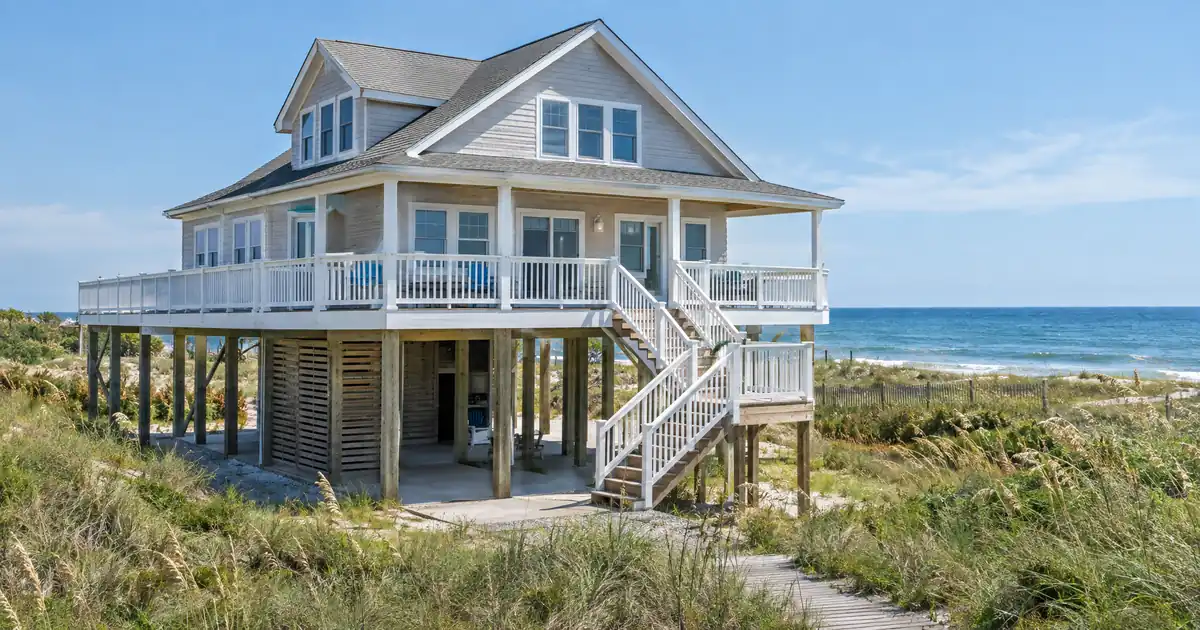
Beach House You Rent Is A Business-Purpose DSCR Loan — The Quick Read: A beach house you plan to rent out is treated as an investment property, not a second home, once you’re not living in it as your residence. Because the loan is being used to acquire a rental, it’s classified as business-purpose credit rather than consumer credit. That single classification is why a DSCR loan is reviewed around the property’s rental income instead of your traditional personal-income documentation.
Here’s the short version. Lenders don’t care what you call the property. A “beach house” is marketing language. What a lender cares about is whether you’re going to live there or rent it out. If the answer is rent it out, the loan gets underwritten as business-purpose from day one — and that opens the door to debt-service coverage ratio, or DSCR, financing, where the property’s rent has to cover its own payment instead of your paycheck covering it.
DSCR Calculator
Run the numbers in your market
Rate source: Freddie Mac 30-yr average via FRED® — Federal Reserve Bank of St. Louis · effective Sep 17, 2026
Prefilled with local estimates — enter your own rent or nightly figures, taxes, insurance, and HOA for a more accurate picture.
Program parameters update from Lendmire’s centralized guideline source. Taxes and insurance are editable estimates.
As of Sep 17, 2026 · General Freddie Mac market benchmark, not a Lendmire loan offer. Rent, nightly rate, occupancy, taxes, and insurance are editable estimates. Short-term rental figures are estimates only and vary significantly by season, property type, management approach, and local short-term-rental rules — confirm local regulations before relying on them. Qualifying income for short-term rentals varies by program — some use appraisal market rent, others use documented STR history or projections — and is confirmed in underwriting. Not a Loan Estimate, approval, or commitment to lend. Program availability and eligibility are subject to lender guidelines, credit approval, property review, and underwriting.
What Makes a Rental Beach House “Business-Purpose”?
A loan is business-purpose when the money is used to buy, improve, or hold a property you don’t occupy as your home. DSCR loans are designed for non-owner-occupied investment properties. Because they are business-purpose investor loans, they are reviewed differently from a standard owner-occupied mortgage.
That’s it. There’s no separate beach-house rule. A rental condo in a mountain town, a duplex in the suburbs, and a rental beach house all get classified the same way once the owner isn’t living there. The location doesn’t change the classification — the use does.
Where this gets interesting for coastal property specifically is seasonality and personal-use temptation. Beach houses get used by their owners more than almost any other rental property type. A week here, a long weekend there, maybe the whole month of July. That personal-use pattern is exactly what can push a property out of pure rental territory and complicate both the tax picture and the loan file.
The Occupancy Line: Rental vs. Second Home vs. Primary Residence
The line that actually matters is occupancy, not the word “beach.” If you live in the property, it’s your primary residence. If you own it and rent it out without living there, it’s an investment property. If you use it occasionally for yourself and don’t rent it enough to make it a real rental, it starts looking like a second home instead.
That last category is where a lot of investors get tripped up. A property with heavy personal use — even one advertised as a vacation rental — reads more like a second home to an underwriter than a business. The IRS applies a related but separate concept for tax purposes: rent a place fewer than 15 days a year, and you don’t even report the rental income. Cross into heavier personal use relative to rental days, and the IRS starts treating the property more like a residence than a rental business. That’s a tax rule, not a lending rule, but the two concepts rhyme — heavy personal use undercuts the “this is a rental business” story in both worlds.
For DSCR qualification specifically, most programs in Lendmire’s wholesale network want the property to actually operate as a rental. It shouldn’t be occupied by the owner on a regular basis. That’s the whole point of business-purpose underwriting. The lender is betting on the property’s income — not on you living somewhere else and paying with your salary.
How a Beach House Rental Actually Qualifies
DSCR lender review comes down to one ratio: the property’s monthly rental income divided by its full housing payment, including principal, interest, taxes, insurance, and any HOA dues. That ratio is the whole story — no W-2s, no personal debt-to-income math, no tax return analysis of your other income sources.
For a beach house that rents nightly instead of on a standard annual lease, income gets documented a bit differently than a typical single-family rental. Across the programs Lendmire places files with, three paths show up regularly:
- A full trailing twelve months of documented platform income (Airbnb, Vrbo, or similar) if you’ve owned and operated the property.
- A market-rent projection from a short-term-rental data service if you’re buying the property new and have no operating history yet.
- The appraiser’s long-term market rent, used as a conservative fallback when nightly data isn’t available or the file calls for a simpler comparison.
Short-term rental programs in Lendmire’s network typically qualify at 80% of gross projected or trailing income. This built-in cushion protects against a real problem: beach rental income swings hard between peak season and the off-season. This haircut is standard across most short-term-rental DSCR files — it’s not unique to coastal property. But it matters more here, because seasonality at the beach is more extreme than almost anywhere else.
Here’s something worth knowing from working these files regularly: appraisers sometimes default to the standard long-term rent schedule, even when a property clearly operates as a nightly rental. That form wasn’t built for vacation-rental math. It tends to understate what a beach property earns during season. Getting a short-term-rental-specific income analysis into the file upfront — instead of relying on the default appraisal form — usually gives a more accurate, and often higher, coverage figure.
Loan Sizing and Leverage for Beach House Investors
Loan amounts on business-purpose investment financing arranged through Lendmire’s network run from $150,000 up to $10,000,000, with a ladder that steps down in leverage as the loan gets larger. On the smaller end, up to $1,000,000, purchase and rate-and-term leverage typically reaches 80% for borrowers with credit around 660 or better. From $1,000,000 to $1,500,000, that generally steps down to 75% purchase leverage with a 700+ credit profile. Above $1,500,000, purchase leverage typically holds near 75% up to the $3,000,000 mark before stepping down again to roughly 65% between $3,000,000 and $4,000,000, and around 60% from $4,000,000 up through $10,000,000 — with anything above $4,000,000 reviewed case by case before submission, purchase or rate-and-term only, no cash-out available at that size.
Cash-out works on a separate, tighter scale. Proceeds are unlimited at or below 60% loan-to-value, with a $1,500,000 cash-out cap above that threshold on standard rental collateral, and a 70% cash-out ceiling for short-term-rental collateral versus the 75% ceiling typical for standard long-term rentals. Cash-out isn’t available at all above $3,000,000 in loan size. Every figure here varies by lender and program — guidelines, property type, leverage, and credit profile all apply.
Short-term-rental-specific files — the more common structure for a genuine vacation beach house — top out around $2,000,000 in loan amount, with coverage at 1.00 or better typically required, and qualification limited to investors who’ve owned income-producing property for at least twelve of the last thirty-six months. That experience requirement exists because seasonal rental income is harder to project reliably than a signed annual lease, and lenders want to see that the borrower has actually managed a rental cash flow before.
Coverage below 1.00 isn’t a dead end. Select programs in Lendmire’s network do accept DSCR ratios in the 0.75-to-0.99 range up to $2,000,000, though leverage and terms adjust downward to offset the weaker coverage, subject to underwriting. No-ratio qualification also exists on a select basis through Lendmire’s network, generally requiring a seven-year clean housing payment history and no late payments in the past two years — but it’s scoped to specific programs and always subject to underwriting, never a universal option.
Why Short-Term Rental Legality Matters More Than the Math
A strong DSCR ratio means nothing if the rental itself isn’t legal. Underwriters check whether short-term rental use is allowed at the property before they’ll count that income at all — a file with excellent cash flow on paper can still get rejected on this single point.
Short-term rental rules can vary by city, county, HOA, and property type, so investors should confirm local rules before relying on projected rental income. This isn’t a formality. If a jurisdiction restricts or bans nightly rentals in a given zone, or an HOA prohibits short-term leasing outright, the lender may fall back to long-term market rent instead — which is usually a lower number and can change whether the deal clears at all. Municipal permission has to be documented for the specific property in question; it’s never assumed just because nearby properties operate as short-term rentals.
This is the underrated risk in beach-house investing. Buyers get excited about nightly rate potential and skip the zoning check. The lender won’t skip it, and neither should the buyer.
Condos, Condotels, and Non-Warrantable Buildings
Plenty of “beach house” purchases are actually condo units, and some of those are condotels — buildings operated more like a hotel than a residential condo association. That structure typically disqualifies a property from conventional financing outright.
DSCR vs. conventional financing
Two common ways to finance an investment property in this market. They qualify you differently — here’s how investors weigh them.
Why investors choose it
- Qualifies on the property’s rental income — no personal tax returns, W-2s, or pay stubs needed to document income.
- No personal debt-to-income ceiling to clear, so existing mortgages and obligations don’t cap your borrowing the same way.
- Can be closed in an LLC, keeping the property inside a business entity.
- Built for scaling — not held to the limit on number of financed properties that conventional financing applies.
- Underwriting centers on the deal: generally qualifies when the rent covers the payment, a 1.00x coverage ratio being a common baseline (confirmed in underwriting).
- Designed specifically for investment property, including long-term and, where the program allows, short-term rentals.
Where it’s strong
- Often the lowest ongoing financing cost for a buyer who fully qualifies on personal income — a fit for a first property or a cost-first purchase.
Trade-offs for investors
- Requires full personal income documentation and must fit within a debt-to-income limit — salary, existing debts, and other mortgages all count.
- Typically held in your personal name rather than a business entity.
- Caps how many financed properties you can carry, which can become a ceiling as a portfolio grows.
- Evaluates you as a borrower as much as the property, which usually means more paperwork.
How investors usually choose: a first or single property often optimizes for the lowest financing cost; portfolio builders often optimize for leverage, vesting in an LLC, and scaling past conventional caps. The right answer depends on your goals, the property, and current guidelines — both paths run through select lenders in Lendmire’s wholesale network, with eligibility and terms confirmed in underwriting.
DSCR programs handle this differently. They don’t sell loans into the conventional secondary market, so agency rules on warrantability simply don’t apply the same way. Non-warrantable condos can be reviewed up to 75% leverage and $1,500,000 in Lendmire’s network. Condotels specifically go up to 75% on a purchase or 65% on a refinance, capped at $1,500,000, with $250,000 in required cash-in-hand. Non-warrantable status caps leverage — it doesn’t kill the deal, the way it typically would with a conventional lender.
Insurance and Coastal Risk Documentation
Coastal beach property routinely sits in a FEMA-mapped high-risk flood zone. That triggers a mandatory flood insurance requirement, layered on top of everything else in the file. Homeowners with federally regulated mortgages in high-risk zones are generally required to carry flood coverage under the National Flood Insurance Program. This isn’t a DSCR-specific rule — it applies broadly to properties in those zones. But it’s a real cost that beach investors need to budget for, no matter how the loan itself is classified. Tax treatment can depend on how the funds are used and how the property is held. Investors should keep clear records and talk to a qualified tax professional before relying on any deduction.
Key Terms Defined
DSCR (debt-service coverage ratio): the property’s monthly rental income divided by its full monthly housing payment — the core number lenders use to qualify a rental property loan.
Business-purpose loan: financing used to acquire, improve, or hold a property for investment rather than as the borrower’s home; this is the classification that makes DSCR loans possible under Regulation Z’s business-purpose exemption.
Non-owner-occupied: a property the borrower does not live in as a primary or occasional residence — the occupancy status a lender needs to confirm before treating a file as business-purpose.
Cash-out refinance: refinancing an existing property for more than what’s owed, with the difference paid out to the borrower — leverage limits on cash-out run tighter than on a straight purchase.
Non-warrantable condo: a condo building that doesn’t meet conventional secondary-market rules (often due to rental concentration, commercial use, or litigation) — ineligible for agency financing but reviewable through DSCR programs at reduced leverage.
Frequently Asked Questions
Can I use my beach house myself and still get a DSCR loan? Occasional personal use complicates the file, since DSCR loans are built around genuine non-owner-occupied rental use. Heavy personal use pushes a property toward second-home territory in a lender’s eyes, which is a different loan category entirely — a second-home loan on a beach house may fit better if personal use is a priority.
Does my beach house need an LLC to qualify for DSCR financing? Not always — Lendmire’s network allows entity vesting, but individual ownership is common too. Whether an LLC makes sense usually comes down to liability protection and tax planning rather than a lending requirement, subject to lender guidelines.
How is short-term rental income documented if I haven’t owned the property yet? Lenders typically use a market projection from a rental data service, or the appraiser’s rent analysis, when there’s no operating history. Once you’ve owned and rented the property for twelve months, trailing income becomes the primary documentation source, generally at 80% of gross.
What if my beach house is in an HOA that restricts short-term rentals? The lender will likely qualify the property on long-term market rent instead of nightly income, which usually produces a lower number. Confirming HOA and municipal rules before making an offer avoids a surprise at underwriting.
Is a condotel-style beach unit reviewable through a DSCR loan? Condotels are reviewable in Lendmire’s network up to 75% purchase leverage and $1,500,000 in loan amount, with $250,000 in required cash-in-hand — a structure conventional lenders typically won’t touch given the building’s commercial-style operation.
If you’re buying or refinancing a rental property and want to see how the numbers work, Lendmire can help. We’ll help you compare DSCR loan options based on the property’s income, your credit profile, available leverage, and your investor goals. For a deeper walkthrough of how these loans work, check out Lendmire’s complete DSCR loans guide — it covers the full picture. If you’re weighing short-term rental income specifically, you can also review how a beach house rented short-term gets treated under these programs.
A beach house is only ever as “business-purpose” as its actual use. Rent it out, keep the paper trail clean, and the classification takes care of itself — chase personal use days and the file gets harder, not easier.
For current guidelines and terms, see Lendmire’s super jumbo DSCR loan programs page.
Self-employed borrowers can compare both super jumbo programs on Lendmire’s self-employed mortgages page.
About Lendmire
Lendmire is a non-QM mortgage brokerage (NMLS# 2371349) arranging DSCR investor loans in 40 markets, including Washington, D.C. DSCR eligibility is generally reviewed around property-level rental income rather than personal income, subject to lender and program guidelines, a fit for self-employed investors and LLC-owned portfolios. Lendmire was recognized as a Scotsman Guide Top Mortgage Workplace in 2025 and 2026.
Lendmire’s Top Mortgage Workplace recognition is documented by Scotsman Guide 2025 Top Mortgage Workplace and Scotsman Guide 2026 Top Mortgage Workplace.
Get Started
Ready to find the right loan for you?
In about 30 seconds you can review financing options available for your home or investment property. No commitment required.
Informational only. Not a Loan Estimate, approval, or commitment to lend. Program availability and eligibility are subject to lender guidelines, credit approval, property review, and underwriting.
References
1. IRS Topic No. 415, Renting Residential and Vacation Property
2. FEMA Flood Insurance overview page
Brandon Miller
Founder & CEO, Mortgage Loan Originator, Lendmire LLC
- Mortgage Loan Originator · NMLS# 1129696 · Verify on NMLS Consumer Access
- North Carolina Real Estate Broker · License# 343312 · Verify on NCREC
- North Carolina Insurance Producer · License# 19053198 · Property, Casualty, Life, Health · Verify on NAIC SBS
- Lendmire LLC · Firm NMLS# 2371349 · Verify firm licensure
Disclosure information. Lendmire is a state-licensed mortgage brokerage under NMLS# 2371349. Lendmire is not a depository institution, direct lender, or financial advisor — all loans referenced are placed through wholesale lender partners and are subject to each lender's underwriting standards. This article is provided for general informational purposes and is not a commitment to lend, nor does it constitute financial, legal, or tax advice. Loan programs, terms, rates, and qualification standards change without notice and depend on borrower profile, property type, and the state in which the subject property is located. Equal Housing Opportunity provider. NMLS Consumer Access: nmlsconsumeraccess.org.


