
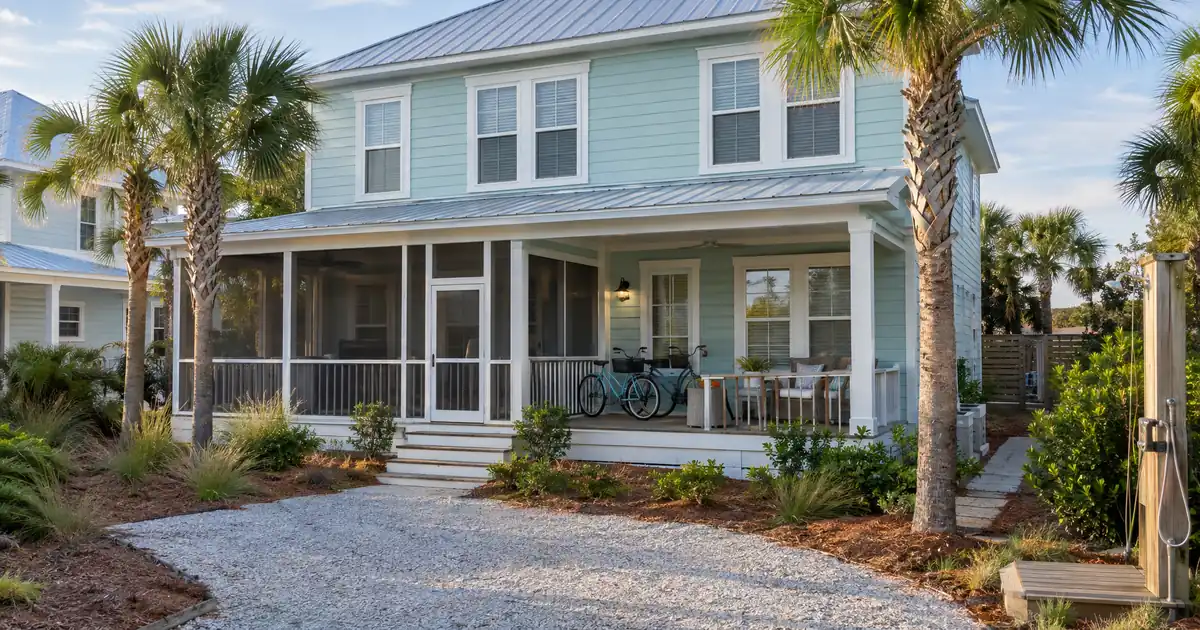
Does A Beach House You Rent Out Qualify As A Second-Home Loan — The Quick Read: No, not usually. A beach house you plan to rent out — whether long-term or short-term — is generally underwritten as a non-owner-occupied investment property, not a second home. Second-home financing is built around personal occupancy, not rental income. The moment rental reliance and third-party control (a manager, a rental pool) enter the picture, the file typically moves into investment-property or DSCR territory.
Second-home loans and DSCR loans solve two different problems. One assumes you’ll live in the house part of the year and doesn’t let rent count toward qualifying. The other assumes you won’t live there at all and is built entirely around the rent covering the payment. Investors who buy a beach house expecting to rent it out heavily and still get “second home” terms are usually disappointed — and worse, they can end up with a classification mismatch that follows the loan for its whole life.
DSCR Calculator
Run the numbers in your market
Rate source: Freddie Mac 30-yr average via FRED® — Federal Reserve Bank of St. Louis · effective Sep 17, 2026
Prefilled with local estimates — enter your own rent or nightly figures, taxes, insurance, and HOA for a more accurate picture.
Program parameters update from Lendmire’s centralized guideline source. Taxes and insurance are editable estimates.
As of Sep 17, 2026 · General Freddie Mac market benchmark, not a Lendmire loan offer. Rent, nightly rate, occupancy, taxes, and insurance are editable estimates. Short-term rental figures are estimates only and vary significantly by season, property type, management approach, and local short-term-rental rules — confirm local regulations before relying on them. Qualifying income for short-term rentals varies by program — some use appraisal market rent, others use documented STR history or projections — and is confirmed in underwriting. Not a Loan Estimate, approval, or commitment to lend. Program availability and eligibility are subject to lender guidelines, credit approval, property review, and underwriting.
The Core Rule: Occupancy, Not Location, Decides
Property type and location don’t determine the loan category. Personal use versus rental reliance does.
Under conventional rules, a second home must work for year-round living. The borrower must be able to use it themselves. No rental pool, timeshare structure, or management company can control when it’s available. Fannie Mae’s Selling Guide says a lender can still document rental income on the property and deliver the loan as a second home. The rental income just can’t be used to qualify the borrower. Every other second-home rule still has to be met.
That last clause is the whole ballgame. Rental income can technically exist on a second-home file. It just can’t be the reason the loan gets approved. If a beach house is being bought because the numbers only work with rent covering most of the payment, it isn’t really a second-home purchase — it’s an investment purchase wearing a second-home label.
On the tax side, the IRS applies a totally separate day-count test. Under IRS Topic 415, a dwelling counts as a personal residence for the year if the owner uses it for more than 14 days, or more than 10% of the days it’s rented at fair value, whichever is greater. That’s a tax-reporting threshold under the tax code — it doesn’t automatically decide how a lender classifies the loan. A house can pass the IRS residence test and still get underwritten as a straight investment property, and vice versa. Mixing the two up is one of the most common mistakes investors make when they’re shopping loan options.
Why DSCR Loans Don’t Do Second Homes
Here’s the plain version: DSCR loans are business-purpose loans for non-owner-occupied rental property. They’re not built to house a borrower part-time — they’re built to let rent qualify the file instead of a paycheck.
DSCR loans are designed for non-owner-occupied investment properties. Because they are business-purpose investor loans, they are reviewed differently from a standard owner-occupied mortgage.
This is why a rented beach house usually fits DSCR loans better than second-home loans. The lender only cares about one thing: does the rent cover the payment? Personal occupancy doesn’t factor in at all. Across the wholesale network Lendmire works with, DSCR files qualify mainly on property-level rental income covering the payment, subject to lender guidelines. They never qualify on the borrower’s traditional personal-income documents. They also never qualify on a promise of future occupancy.
If an investor wants real personal use of the property along with rental income, DSCR usually isn’t the right fit. A different non-QM product may work better — something occupancy-agnostic, like a bank-statement loan. These loans can finance a primary residence, a second home, or an investment property, all using the same documentation style. This is a program choice, not a property choice. Lendmire’s complete DSCR loans guide explains how the rental-coverage math works across property types.
What Actually Disqualifies Second-Home Status
Three things reliably push a beach house out of second-home eligibility and into investment-property or DSCR treatment.
Rental pools and revenue-sharing arrangements. If a management company controls the booking calendar or the owner is locked into a pooled-revenue structure, occupancy isn’t really the owner’s choice anymore. That control loss is a documented disqualifier under agency-adjacent underwriting guidance.
Heavy rental reliance relative to personal use. Occasional rental with plenty of personal use can still sit inside second-home guidelines. Full-time or near-full-time rental marketing, where the property is booked out almost every available week, tips the balance toward investment classification — even without a formal management contract.
Exceeding roughly 14 days of personal occupancy loses relevance in the other direction. For a file underwritten as strictly business-purpose from day one — meaning DSCR — occupying the property more than about two weeks a year can conflict with the business-purpose certification the loan was built on. Investors weighing a house-hack-style arrangement (living in the property part of the year while renting it the rest) should raise that plan with the lender before closing, not after.
The Appraisal Doesn’t Use Your Airbnb Calendar
A common assumption trips up beach-house buyers here: they think the appraiser will multiply the nightly Airbnb rate by 30 and call it market rent. That’s not how the form works.
When a lender is relying on rental income to qualify a file — which is the entire premise of DSCR underwriting — the appraisal typically uses Fannie Mae’s Form 1007, the Single-Family Comparable Rent Schedule, for one-unit properties, or Form 1025 for 2-4 unit income properties. Both forms estimate rent using comparable long-term lease data, not gross short-term booking revenue. Personal property like furniture and fixtures gets excluded from the value, and business income is explicitly out of scope — the form values the real estate, not the operation running inside it.
That distinction matters for a beach house pulling strong seasonal nightly rates. The DSCR ratio a lender calculates usually isn’t built off the gross Airbnb numbers the owner sees on a booking dashboard. On the short-term-rental path in Lendmire’s network, income typically comes from twelve months of documented operating history on a refinance, or the appraisal’s short-term-rent analysis on a purchase — generally applied at a discount to gross rent, not the full nightly-rate math. Investors who plug their raw Airbnb revenue into a DSCR calculator and expect the lender to match it are usually in for a surprise.
How the Numbers Actually Work on a Rented Beach House
Since a rented beach house is realistically a DSCR file rather than a second-home file, the leverage and coverage rules that matter are the investment-property ones.
Across Lendmire’s wholesale network, DSCR loans on rental property typically run from $150,000 up to $10 million on the portfolio side of the program, with the standard DSCR product topping out at $3 million and a jumbo ladder built for qualified investors past that point. Short-term-rental files and no-ratio files generally cap at $2 million.
Leverage steps down as loan size climbs. On most files in the $150,000-$1,000,000 range, purchase and rate-and-term leverage can reach 80%, with credit typically starting around 660. Move into the $1 million to $2 million band and purchase leverage typically runs closer to 75%, with credit expectations rising toward 700-720 depending on size. Cash-out is scoped tighter across the board: on standard rental collateral, cash-out generally tops out around 75% at smaller loan sizes; on short-term-rental collateral specifically, cash-out proceeds are generally capped closer to 70%, and cash-out disappears entirely above $3 million on either collateral type.
Coverage of 1.00 or better typically earns full leverage on most files. Coverage between roughly 0.75 and 0.99 still has a real path through select lenders in the network. This path is generally capped near $2 million. LTV and terms adjust to make up for the lower coverage — it’s not the same leverage a 1.00-plus file gets. No-ratio qualification is also available through a handful of programs in the network, up to about $2 million. It generally requires a clean multi-year housing-payment history. But it comes with its own credit and reserve requirements, and lenders review it case-by-case, subject to underwriting.
Most programs in the network want 6 months of reserves held against the subject property (interest-only equivalent for interest-only loans), sometimes 12 months for a first-time rental investor. Two appraisals typically come into play above $2 million. Interest-only structuring — often running a 120-month interest-only period on a 30- or 40-year term — is common on stronger files at leverage up to about 75%.
Picture an investor looking at a $1.4 million beach rental with a coverage ratio around 1.1x. This is a fairly typical file. Leverage sits in the mid-70s. Credit scores are in the low-700s. Reserves run six to twelve months. The rental-income analysis uses appraiser-supported market rent, not a peak-season nightly rate. Now picture a borderline file with coverage closer to 0.85x. This file isn’t dead on arrival. But it moves to a different part of the leverage ladder. It usually comes with lower LTV and tighter reserve requirements, to make up for the thinner coverage.
Investors evaluating whether DSCR or a conventional second-home path fits better can compare structural differences through Lendmire’s DSCR vs. conventional investment loan breakdown.
Post-Closing: Occupancy Misstatement Isn’t a Paperwork Technicality
This is the part beach-house buyers underestimate the most. Second-home files carry a closing document — the Multistate Second Home Rider — that amends the security instrument specifically to address how the borrower will occupy the property and what was represented during underwriting. Renting the property out heavily instead of occupying it, after signing that rider, isn’t a gray area. It’s a documented breach of the terms the loan was made under.
Federal fraud data shows a common problem: occupancy misrepresentation. This happens when a borrower calls a property a primary or second home on the application, but really plans to use it as an investment. A beach-house buyer can fall into this trap by mistake. They may not lie on purpose. They just assume occasional rental income won’t matter — but it does.
DSCR loans sidestep this problem structurally. There’s no occupancy rider because there’s no occupancy promise — the file is business-purpose from day one, and the borrower signs a business-purpose certification instead. Getting the classification right at application isn’t just about pricing. It’s about which legal document governs the loan for its entire life.
Key Terms Defined
Second-home loan: Financing for a property the borrower intends to occupy personally for part of the year, where rental income (if any exists) can’t be used to qualify and the property must remain available for the borrower’s own use.
DSCR loan: A business-purpose loan for non-owner-occupied rental property, where the debt service coverage ratio — rent divided by the total monthly payment — determines qualification instead of personal income documentation.
DSCR (debt service coverage ratio): A ratio comparing the property’s rental income to its full monthly housing payment; a ratio of 1.00 means rent exactly covers the payment, above 1.00 means rent exceeds it.
No-ratio loan: A qualification path, available through select lenders in the network on files up to roughly $2 million, that doesn’t rely on a calculated coverage ratio at all, instead leaning on a clean multi-year housing-payment history — subject to underwriting.
Occupancy certification: The written statement a borrower makes at closing about how they intend to use the property, which determines whether the loan is treated as owner-occupied, second-home, or investment financing.
Frequently Asked Questions
Can I rent my beach house occasionally and still keep second-home financing?
Possibly, if personal use stays meaningful and nobody else controls the booking calendar. The deciding factor isn’t whether a single dollar of rent ever touched the property — it’s the balance between personal use and rental reliance, and whether a management company or rental pool has taken over control of when the property is available.
Does the IRS 14-day rule and the lender’s occupancy rule mean the same thing?
No. The IRS 14-day/10% test is a tax-reporting threshold that determines how rental income and expenses get reported. A lender’s occupancy classification is a separate underwriting decision. A property can pass one test and fail the other.
Will the appraiser use my Airbnb nightly rate to calculate rental income?
Generally no. Appraisers working from Fannie Mae’s Form 1007 or Form 1025 base rental income on comparable long-term lease rates, not gross short-term booking totals, and they’re barred from folding furnishings or business income into the property’s value.
What if I already bought the beach house as a second home and now want to rent it out full-time? That typically means refinancing into investment-property or DSCR financing rather than continuing under the second-home terms. Renting a property financed as a second home well beyond occasional use, without addressing the classification, risks breaching the terms tied to the second-home rider.
Can rental income ever help me qualify for a second-home loan?
No — rental income generally isn’t allowed to count toward qualifying on a second-home file, even when the lender is aware the property will be rented occasionally. If the plan depends on rent covering a meaningful share of the payment, a DSCR structure is usually the more honest fit from the start.
If you’re buying or refinancing a beach rental and want to see how the numbers work, Lendmire can help you compare DSCR loan options based on the property’s income, credit profile, leverage, and investor goals. Reach the team at 828-256-2183 or request a quote directly through Lendmire’s mortgage quote page.
Tax treatment can depend on how the funds are used and how the property is held; investors should keep clear records and speak with a qualified tax professional before relying on any deduction.
For current guidelines and terms, see Lendmire’s super jumbo DSCR loan programs page.
Self-employed borrowers can compare both super jumbo programs on Lendmire’s self-employed mortgages page.
About Lendmire
As a DSCR and non-QM mortgage broker, Lendmire — NMLS# 2371349 — connects investors with wholesale lending channels across 40 markets, including Washington, D.C. The property’s rental income, not the borrower’s tax returns, is central to lender review, which works for self-employed operators and portfolios beyond four financed properties. Scotsman Guide named Lendmire a Top Mortgage Workplace in both 2025 and 2026.
Get Started
Ready to find the right loan for you?
In about 30 seconds you can review financing options available for your home or investment property. No commitment required.
Informational only. Not a Loan Estimate, approval, or commitment to lend. Program availability and eligibility are subject to lender guidelines, credit approval, property review, and underwriting.
References
1. Fannie Mae Selling Guide — Occupancy Types B2-1.1-01
2. IRS Topic No. 415, Renting Residential and Vacation Property
Brandon Miller
Founder & CEO, Mortgage Loan Originator, Lendmire LLC
- Mortgage Loan Originator · NMLS# 1129696 · Verify on NMLS Consumer Access
- North Carolina Real Estate Broker · License# 343312 · Verify on NCREC
- North Carolina Insurance Producer · License# 19053198 · Property, Casualty, Life, Health · Verify on NAIC SBS
- Lendmire LLC · Firm NMLS# 2371349 · Verify firm licensure
Compliance and disclosures. Lendmire (NMLS# 2371349) is a licensed mortgage broker and is not a direct lender, depository institution, financial advisor, or tax professional. Content in this article is general market analysis and educational information — not financial, legal, or tax advice for any specific situation. Lendmire does not guarantee loan approval; every transaction is subject to underwriting by the funding lender. Mortgage pricing and loan program guidelines are subject to change at any time without notice and vary by borrower characteristics, property type, and state regulations. Lendmire complies with Equal Housing Opportunity. Licensure verification: NMLS Consumer Access.


